Support independent arts journalism by joining our Patreon! Currently $5/month.

About Superconductor

Our motto: "Critical thinking in the cheap seats." Unbiased, honest classical music and opera opinions, occasional obituaries and classical news reporting, since 2007. All written content © 2019 by Paul J. Pelkonen. For more about Superconductor, visit this link. For advertising rates, click this link. Follow us on Facebook.
Showing posts with label Richard Wagner. Show all posts

Wednesday, April 10, 2019

Recordings Review: Shiver Me Timbers

A Guide to The Flying Dutchman on disc.
The Flying Dutchman prepares to battle the Silver Surfer.
Art by Jack Kirby from Silver Surfer Vol. 1 No. 8, © 1969 Marvel Comics

Wagner's first "hit" opera, Der Fliegende Höllander captures the imagination from its salt-soaked opening bars. A lot of conductors have committed the Dutchman to disc. Some of them opt for the harp-drenched "happy ending" version. Some break the score into three acts instead of playing it straight through with no intermission. Here's a quick buyer's guide for getting your own coal-black ship with ghostly, blood-red sails....

Monday, April 1, 2019

A Treasure Hidden in the Earth

A fifth chapter of Wagner's Ring has been found...and authenticated.
by Paul J. Pelkonen
Siegfried battles Fafner in Arthur Rackham's classic drawings based on Wagner's Ring.
Researchers digging through a hidden sub-basement in Schloss Neuschwanstein in south-western Bavaria have discovered a hidden archive belonging to the castle's owner, King Ludwig II. In that archive was found a leather folio of sheet music: the complete score of a previously unheard chapter of Richard Wagner's opera cycle Der Ring des Nibelungen. The discovery sent shock waves through the halls of Wagner scholarship.

Wednesday, August 22, 2018

Stairwell to Heaven

A case for the Siegfried Idyll as Wagner's best work.
by Paul J. Pelkonen
The house in Tribschen (Lucerne) Switzerland where Richard and Cosima Wagner lived in 1870.
It is now the Richard Wagner Museum and you can visit its official site here.
You won't hear it in an opera house. In fact you very rarely hear it performed in a concert hall. The Siegfried Idyll, Wagner's 1869 work for chamber orchestra written as a birthday/Christmas present for his second wife is neither fish nor flesh. It is an orchestral poem that built from the same leitmotivs as the score of Der Ring des Nibelungen, and it very well might be the best thing that Wagner ever wrote.

Sunday, April 30, 2017

Opera Review: When Her Ship Comes In

The Met revives Der fliegende Holländer.
by Paul J. Pelkonen
I will leave you, loudly: Amber Wagner and Michael Volle in a scene from
Der fliegender Holländer. Photo by Richard Termine © 2017 The Metropolitan Opera.

There's been a lot of excitement about the Metropolitan Opera's late-season revival of Der fliegende Holländer ("The Flying Dutchman") which opened last week and was seen by this writer at Saturday's matinée performance. This revival marks the first Wagner excursions at the Met for both Yannick Nézet-Séguin, the company's newly anointed incoming music director, and baritone Michael Volle, who has been tabbed by general manager Peter Gelb as both Wotan and Hans Sachs in seasons to come.

Monday, July 25, 2016

The Wagner Project: Götterdämmerung

The Ring comes full circle.
by Paul J. Pelkonen
Act II Scene II of Götterdämmerung as staged by the Mariinsky Theater.
That's Hagen standing on top of the Gibichung Hall. Photo by V. Baranovsky.
Twenty-two years after starting work on  his mammoth four-opera cycle Der Ring des Nibelungen, Richard Wagner wound up right back where he started with Götterdämmerung. The last opera of the cycle tells the story he wanted to tell in the first place: the death of the hero Siegfried and the redemption of the world by the heroine Brunnhilde. Except now the ending was different.

Wednesday, July 13, 2016

Superconductor Audio Guide: Tristan und Isolde

Love, death and infidelity, both on stage and in real life.
Promotional image for the 2015 production of Tristan und Isolde at
The Bayreuth Festapielhaus. Direction and concept by Katherina Wagner
Copyright 2015 Bayreuther Festapiele.
There is nothing in the opera repertory quite like Tristan und Isolde. Wagner’s meditation on love, death and longing baffled performers and audiences, taking almost a decade to finally reach the stage. When it was finally premiered in 1865 the tenor sang just four performances before dying. Since that inauspiciously start, Tristan has claimed the lives of two conductors since: both Felix Mottl and Joseph Keilberth died after conducting its second act.

Saturday, July 9, 2016

The Wagner Project: Das Rheingold

Wagner's first Ring opera has no pauses...and no humans!
by Paul J. Pelkonen
Underwater love: Alberich (Gunther von Kannen, center) pursues the three Rhinemaidens
in the opening scene of Das Rheingold.,
Image from the Bayreuth Festival, © 1991 Teldec/WBC/Unitel
Believe it or not, Wagner's enormous 15-hour Der Ring des Nibelungen (hereafter referred to as "the Ring Cycle) was originally supposed to be just one opera. In 1848, Richard Wagner sketched an opera called Siegfrieds Tod, which would retell the most famous incident from German myth and epic: the death of the hero Siegfried and the later fate of his beloved, the valkyrie (warrior maiden) Brunnhilde. And then, much like the ambitious god Wotan he realized that one opera wouldn't be enough.

Saturday, September 5, 2015

DVD Review: Schwann vs. Schwann

Two Bayreuth Lohengrins offer very different takes on Wagner's mythic opera.
by Paul J. Pelkonen
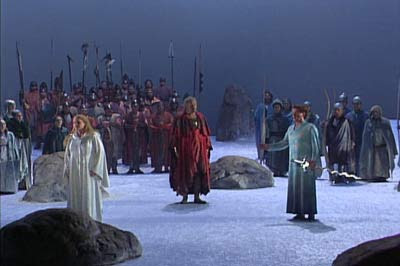
Cheryl Studer, Manfred Schenk and Paul Frey in Lohengrin.
Back in the misty era known as the 1990s, a humble young journalism student would go to the Tower Records in Boston and rent VHS opera performances, mostly released on the Philips label. Among those videos: two vastly different stagings of the Wagner opera Lohengrin from the Bayreuth Festspielhaus, filmed eight years apart. Universal Classics has acquired the rights to the Philips catalogue, and has re-released both performances on DVD under the DG imprint.

Saturday, August 29, 2015

Film Review: Just Don't Lend Him Money

Sir Richard Burton as Richard Wagner.
by Paul J. Pelkonen
Obsessive genius: Sir Richard Burton as Richard Wagner in Wagner.
Image © 1983 Hungarofilm/Kultur.
The turbulent life of composer Richard Wagner (1813-1883) is a fascinating and at times repellent subject. Tony Palmer's film is now available on Amazon Prime, allowing the curious and the dedicated to take a leisurely tour through this  expansive retelling of the convoluted life of the German composer. Divided here into three manageable episodes of three hours each, it is an experience that all serious Wagner lovers should try at least once. Then again, the same may be said of a trip to Bayreuth.

Friday, August 28, 2015

Recording Recommendation: The Shoe-String Ring

Valhalla on just $1.50 a day.
by Paul J. Pelkonen
The original cover of Die Walküre. Clearly not marketing the music.
All Photos by Christopher Whorf © 1968, the artist.

Hans Swarowsky's recording of the complete Ring Cycle was made in 1968 in Nuremberg. The sessions were a by-product of the Soviet invasion of Prague, which forced most of the Czech Philharmonic to flee to southern Germany. Under Mr. Swarowsky, the so-called "South German Philharmonic" dashed off these recordings quickly, releasing the entire cycle on the budget Westminster Gold label as a bargain-basement alternative to the Decca Ring with Georg Solti and the Vienna Philharmonic.

Thursday, May 22, 2014

How My Collection Started

A Reflection, on Wagner's Birthday.
by Paul J. Pelkonen
The Parsifal that started it all.
Inset photograph © 1985 Bayreuth Festspiele.
It all started with what I wanted for Christmas in 1993.

"Mom, I want the Richard Wagner Edition of Parsifal with James Levine conducting."

"OK." Mom was happy that my classes at Fordham (including The Age of Beethoven and Wagner and Wagnerism the year before had led to such a fruitful musical interest in her only son."

Tuesday, July 30, 2013

Recordings Review: The Best of Both Worlds

Marek Janowski's new Tannhäuser splits the difference. 
by Paul J. Pelkonen
Venus (center) and Tannhäuser in Lawrence Koe's 1896 painting Venus and Tännhäuser.
Image © 1896 Lawrence Koe.
Like its protagonist, Tannhäuser, the fifth opera by Richard Wagner (and the second to be considered "mature") is cursed with a double existence. Conductors can choose between the composer's original intentions ("Dresden") or the luscious orchestrations and rich "mature" Wagner of the "Paris" version created for a disastrous "second premiere" at the Paris Opéra in 1861. It is a difficult choice, as the later revisions give the story a very different tone and inflection.

Wednesday, May 22, 2013

Who Wants to Be a Wagnerite?

or...Happy Birthday, Richard Wagner!
by Paul J. Pelkonen
Ernestine Schumann-Heink as Waltraute in Götterdämmerung.
Original photograph © Bettmann/Corbis. 
Festive birthday cupcake added by the author.
Today is Richard Wagner's 200th birthday, and rather than give you a listicle full of dubious recommendations for the best Ring Cycle or another review of a new recording of Die Walküre, I thought I'd talk about something important.

Wagner takes patience. Endurance. Commitment. And yes, it takes a certain degree of physical (and possibly emotional) masochism to sit through the Waltraute scene from Götterdämmerung or the marathon first act of Parsifal. Don't get me started on Die Meistersinger, a six-hour comedy that ends with the public humiliation of the local bureaucrat and a speech on the importance of "holy German art."

That's another column.

Sunday, April 21, 2013

Metropolitan Opera Preview: Götterdämmerung

The last chapter of Wagner's Ring returns for another burn.
by Paul J. Pelkonen
The Gibichung Hall in Act II of the Met's new Götterdämnerung.
Photo by Ken Howard © 2012 The Metropolitan Opera.
The six-hour final chapter of Wagner's Ring is in some ways the most conventional opera of the four. That's because Götterdämmerung (the title translates as Twilight of the Gods, though the opera was originally called Siegfried's Death) was the first libretto written. Twenty-four years later, this was also the last opera of the Ring to be completed, so it has the most complex music.

Friday, July 27, 2012

A Milestone Reached

Half a Million Readers Can't be Wrong!
by Paul J. Pelkonen
Richard Wagner, grown taller and rocking the gold lamé suit. 
Sometime last night, the page-view counter on Superconductor ticked over the 500,000 mark. I want to thank all of the artists I've written about, the press agents who have made it possible for me to see so many performances and the record labels for providing me with stuff to write about.

I'd like to thank my colleagues: newspaper critics, book authors and fellow bloggers for camaraderie and encouragement through yet another serving of the Tchaikovsky Fifth.

I'd like to thank the advertisers too, with a polite reminder that advertising rates are available. (Hey, it's a business!)

Above all, though, I'd like to thank you readers for coming to Superconductor and staying with the blog for so many articles--especially when I went off my head and decided to make this a daily (or as I like to call it, an almost-daily publication.

I hope you continue to enjoy reading Superconductor. Here's some nice music:


Sir Georg Solti conducts Die Walküre. Unreleased recording from 1983.

Thursday, May 31, 2012

DVD Review: Queen Takes Knight

Nina Stemme in the Glyndebourne Tristan und Isolde.
by Paul Pelkonen
First-date jitters: Isolde (Nina Stemme) confronts Tristan (Robert Gambill) at Glyndebourne.
Photo © 2007 Glydebourne Festival/Opus Arte.
In the last decade, soprano Nina Stemme has transited from singing Mozart to heavier German repertory. This three-DVD set, released in 2008 by OpusArte captures Ms. Stemme as Isolde in the Glyndebourne Festival's first-ever staging of a Wagner opera. Jiří Bělohlávek conducts the London Philharmonic in a sweeping, slow reading of the score that draws out much of Wagner's musical detail.

The Irish princess is one of the most complicated roles in opera, traveling from rage to redemption and stopping along the way to fall in love with Tristan, the Cornish knight assigned to bring her to his feudal lord, King Marke. Ms. Stemme sings the two Act I narratives with power and detail, injecting vivid meaning into each word as she tells Brangäne of Tristan's betrayal.

In this Spartan setting by Nikolaus Lehnoff, those details are necessary for the viewer to understand what's going on. Set designer Roland Aeschlimann creates an abstract space, a large torus that looks like the "Guardian of Forever" on the original Star Trek. All the characters move through this torus which is carefully lit to reflect contrasting moods. The only ill effect of this "mystic donut" is that it muffles the chorus and offstage horns.

Wednesday, May 23, 2012

DVD Review: Minstrel in the Gallery

A Tannhäuser from Barcelona embraces the art world.
by Paul Pelkonen
Once upon a mattress: Tannhäuser (Peter Seiffert. left) confronts Venus
 (Bèatrice Uria-Monzon, standing) in Act I of Wagner's drama.
Photo by Anoni Bofill © 2008 Teatro Liceu de Barcelona.
In Robert Carsen's production of Tannhäuser (filmed in 2008 at the Teatro de Liceu in Barcelona), Wagner's medieval minstrel is reimagined as a contemporary artist, walking a tightrope between willing, naked figure models and the glitzy world of gallery openings.

Tannhäuser is about pilgrimage, whether the title character's own transition from the sensual world of Venus to our own, harsher reality or the treks to Rome and back in quest of redemption. In this staging, "reality" is the plastic world of a gallery opening, and a controversial new painting (presumably of Venus) is his "harp," the representation of artistic expression for the troubled knight.

Mr. Carsen keeps the curtain up for the famous overture, showing Tannhäuser (Peter Seiffert) hard at work painting a naked, reclining Venus. (This is the "Paris" version of the score so the music flows right into the Venusberg ballet. Here, Venus' sex club under a mountain becomes a sort of art school, with frenzied dancers imitating Tannhäuser's movements and creating their own canvases.

Friday, April 27, 2012

DVD Review: The Vault of Heaven

The Barenboim Parsifal finally arrives on DVD.
by Paul Pelkonen
Femme fatale: Waltraud Meier casts a spell as Kundry in Act II of Parsifal.
Image © Euro Arts/Berlin Staatsoper.
This video of Wagner's Parsifal, shot for Teldec in 1992 at the Berlin Staatsoper is notable for its strong, youthful cast of major Wagner singers and its stark production values. These come from director, Harry Kupfer, a proponent of the "older" school of regietheater, in that his ideas actually work. Mr. Kupfer transport the valued mystic objects (the Grail, the Spear) in a vast subterranean bank vault, a shifting puzzle box with moving walls and a huge vault door predominating the action. 

Twenty years ago, this was one of the first "concept" Parsifals released on home video to break away from the standard image of knights in robes and helmets and flowery tarts frolicking around the opera's clueless hero. Happily, Mr. Kupfer's ideas hold up well. His claustrophobic setting is populated by weak, tottering Grail Knights that treat their daily worship as a narcotic fix. Amfortas (Falk Struckmann) is a haggard mess, with a very visible wound in his side. At the opera's end, he dies, and Kundry lives.

If you're acquainted with this opera, you know that nothing happens for the first half of Act I. Then Parsifal (Poul Elming) blunders into the vault. He is taken to a strange Grail ritual where Amfortas is placed on a sort of metaphorical spear point, and lifted high above the Knights to "trigger" the Grail's magic. Klingsor's realm (on the other side of the vault door) is a mirror image. His "magic garden" is a matrix of CRT screens, populated by vapid models in various stages of undress. At the end of Act II, Parsifal sets off a massive system crash.

Thursday, April 19, 2012

Concert Review: Choose Your Mountain

The Juilliard Orchestra tackles the Alpine Symphony.

"Spock, you didn't tell me there were two Alpine Symphonies last night!"
Image from Star Trek V: The Final Frontier © 1989 Paramount Pictures.
As a concert-goer, I was faced with an unusual dilemma on Wednesday night. Two competing performances of Richard Strauss' Alpine Symphony were being offered at the same time: one at Avery Fisher Hall by the Juilliard Orchestra; the other at Carnegie Hall by the European Youth Orchestra conducted by Vladimir Ashkenazy. 

Monday, April 9, 2012

Recordings Review: I Pity the Fool

Marek Janowski's 2011 Berlin Parsifal.
by Paul J. Pelkonen
Parsifal and Kundry as painted by Rogellio de Egusquiza.
This is a live recording of Wagner's Parsifal made on April 8, 2011 before an audience at a single Berlin concert. in a single Berlin concert. It is the third entry in Marek Janowski's ambitious plan to record and release all ten Wagner operas on PentaTone, an independent German label (distributed by Naxos) that specializes in multi-channel hybrid Super Audio CDs. It falls among recordings like Pierre Boulez' and Herbert Kegel's that favor a lean and mean approach to presenting Wagner's final opera.

Trending on Superconductor

Translate

Share My Blog!

Share |

Critical Thinking in the Cheap Seats