Support independent arts journalism by joining our Patreon! Currently $5/month.

About Superconductor

Our motto: "Critical thinking in the cheap seats." Unbiased, honest classical music and opera opinions, occasional obituaries and classical news reporting, since 2007. All written content © 2019 by Paul J. Pelkonen. For more about Superconductor, visit this link. For advertising rates, click this link. Follow us on Facebook.
Showing posts with label DVD review. Show all posts

Saturday, January 6, 2018

Recordings Review: The Blood is the Life

The Met broadcast of Parsifal on DVD
by Paul J. Pelkonen
The kiss of life-and death. Katherine Dalayman is atop Jonas Kaufmann in the Met's Parsifal.
Photo by Ken Howard © 2013 The Metropolitan Opera.
The Metropolitan Opera's 2013 François Girard production of Wagner's Parsifal is back on the stage next month. So it's time to revisit the Sony DVDs of the Live in HD broadcast of the opera, filmed over two performances in March of that year. Watched here on two DVDs, this Parsifal remains gripping, a look back at this forward-thinking production which owes something to post-apocalyptic environmental disaster and something to an involved medical procedure show from late-night broadcast television.

Sunday, September 6, 2015

Opera Review: Pride. Prejudice and a Zombie

Gerald Finley is Don Giovanni from Glyndebourne.
by Paul J. Pelkonen
Gerald Finley and Luca Pisaroni in Don Giovanni.
Photo by Bill Cooper © 2011 EMI Classics/Glyndebourne Festival.
Mozart's Don Giovanni has long been burdened with the title of the "greatest" of all operas. And yet, it remains an elusive subject for directors who seek to bring something new to the tale of a rakish nobleman and a dinner date gone horribly wrong. This performance from the Glyndebourne Festival (originally released by EMI, broadcast by Medici.TV and viewed on Amazon Prime Video on Demand) preserves the production by the team of director Jonathan Kent and Paul Brown that graced the Glyndebourne Festival in 2010.

Saturday, September 5, 2015

DVD Review: Schwann vs. Schwann

Two Bayreuth Lohengrins offer very different takes on Wagner's mythic opera.
by Paul J. Pelkonen
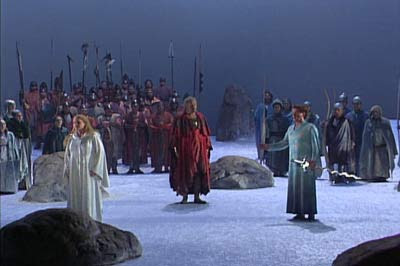
Cheryl Studer, Manfred Schenk and Paul Frey in Lohengrin.
Back in the misty era known as the 1990s, a humble young journalism student would go to the Tower Records in Boston and rent VHS opera performances, mostly released on the Philips label. Among those videos: two vastly different stagings of the Wagner opera Lohengrin from the Bayreuth Festspielhaus, filmed eight years apart. Universal Classics has acquired the rights to the Philips catalogue, and has re-released both performances on DVD under the DG imprint.

Thursday, June 25, 2015

DVD Review: Miracles Out of Nowhere

The Royal Opera of Covent Garden mounts Parsifal.
by Paul J. Pelkonen
The wounded and the penitent: Gerald Finely as Amfortas and Angela Denoke as
Kundry in a scene from Act II of Parsifal at Covent Garden.
Photo by Clive Barda © 2013 Royal Opera House of Covent Garden
Parsifal is the final completed stage work of Richard Wagner. For better or for worse, it is also the work that  lends itself most easily to radical interpretation. This latest DVD issue of the opera (released earlier this year on OpusArte) comes from the Royal Opera House of Covent Garden, and shows director Stephen Langridge's vision of the opera. He puts a secular spin on this story, re-imagining the Grail legend as a story of innocence lost and miracles achieved, although not always in a way that one would expect.

Monday, June 15, 2015

DVD Review: Call in the Swiss Navy

Opernhaus Zürich presents Der Fliegende Holländer.
by Paul J. Pelkonen
Heart of darkness: Bryn Terfel (center) is the Dutchman in Opernhaus Zürich's
Der Fliegende Holländer. Photo © 2013 Opernhaus Zürich/DG/UMG.
With the 1843 premiere of Der Fliegende Holländer (The Flying Dutchman) Richard Wagner created the first of ten operas that constitute the canon of his work. He also created a serious problem for stage directors, as the romance between a ghostly ship's captain and an obsessive young woman ends with the latter hurling herself off a nearby cliff and the reunited couple "ascending to Heaven" as the opera's final bars crash home.

Wednesday, May 20, 2015

DVD Review: The Wild One

The Guy Cassiers production of Siegfried storms La Scala.
by Paul J. Pelkonen
"D'you want to know how I got these scars?" Peter Bronder's Mime (right) prepares to tell
Lance Ryan's Siegfried (left) in Act I of Siegfried.> Photo © 2013 Brescia/Amisano/Teatro alla Scala.
Siegfried is the third and most problematic opera in Wagner's epic Ring Cycle. It's a three-act fairy tale about a lunk-headed hero who slays the monster, gets the treasure and (fumblingly) wins his woman over a five-hour stretch. But in the hands of conductor Daniel Barenboim in this 2014 Blu-Ray from La Scala (filmed in 2012 and released last year on the ArtHaus Musik label) , the languors of this opera seem to just fly by. It's not that Mr. Barenboim is fast, it's that he keeps the action moving forward producing the most exciting Siegfried on DVD since the one he made at Bayreuth in the 1990s.

Tuesday, May 19, 2015

DVD Review: Back to the Valkyrie Rock

Daniel Barenboim conducts the La Scala Die Walküre.
by Paul J. Pelkonen
Nina Stemme sleeps under sun-lamps--er Magic Fire in Act III of Die Walküre. 
Photo by Brescia e Amisano © 2014 Teatro alla Scala.
In the early 1990s, conductor Daniel Barenboim shot to the forefront of Wagner interpreters with a gutty, anachronistic and thoroughly entertaining audio and visual recording of Wagner's Der Ring des Nibelungen from the Bayreuth Festival. That staging, by German director Harry Kupfer, channeled the Mad Max films of George Miller to create a high-octane cycle set along a post-apocalyptic road. In this new cycle, Mr. Barenboim is paired with director Guy Cassiers, who combines the latest technical wizardry with detail-heavy acting to create a bold and entertaining  show.

Wednesday, April 23, 2014

DVD Review: The Guerillas and the Mist

Dmitri Tcherniakov takes on The Legend of the Invisible City of Kitezh and the Maiden Fevroniya at De Nederlandse Opera.
 by Paul J. Pelkonen
Boy meets girl: Vladimir Vaneev and Svetlana Ignatovich in The Legend of the Invisible
City of Kitezh and the Maiden Fevroniya.
Sometimes a bold director can breathe fresh life into a forgotten masterpiece. That is the case with this 2013 Blu-Ray of The Legend of the Invisible City of Kitezh and the Maiden Fevroniya, staged in 2012 by De Nederlandse Opera (in cooperation with the Teatro de Liceu in Barcelona) and filtered through the artistic sensibilities and political message of Dmitri Tcherniakov. This Russian director whose recent Prince Igor at the Met thrilled New York this season, has mounted  Rimsky-Korsakov's penultimate opera in a bleak, pessimistic production. Mounted at the Amsterdam Music Center and released on home video by OpusArte, this disc should do much to increase the reputation and frequency of performance of this challenging but thoroughly rewarding work.

Tuesday, May 28, 2013

DVD Review: The Killer Wore Furs

Verdi's Attila from the Mariinsky Theater.
by Paul J. Pelkonen
Barbarian beefcake: Ildar Abdrazakov in the title role of Verdi's Attila.
Photo © 2010 The Mariinsky Theater.
For more than a century, Verdi's eighth opera Attila was sneered at, considered to be one the weakest products of his "galley years". But in the 20th century,  the opera gained new life as a vehicle for a star bass who looks smashing with his shirt off. The latest to take up that tradition is Ildar Abdrazakov. This DVD from the Mariinsky Theater (filmed in December of 2010) preserves Mr. Abdrazakov's barbarian leader for posterity. It is also the first DVD release on the Russian opera house's own label.

Tuesday, February 5, 2013

DVD Review: It's Not Delivery

It's Un Giorno di Regno, Verdi's second opera.
by Paul J. Pelkonen
The wife of bath: Anna Caterina Antonacci as the Marchesa in Un Giorno di Regno.
Image © 2012 C Major Entertainment
(Ed. Note: This is the second step in a planned Superconductor celebration of Verdi's 200th birthday. The idea is to write about different recordings or DVDs of all of the Verdi operas plus the Requiem, ideally ending with Falstaff in October. The series started in January with a review of Oberto.)

Un Giorno di Regno ("King for a Day") was Verdi's second opera and his first attempt at comedy. It was also the first catastrophic failure of his career, premiering to hisses and boos at La Scala in 1840. Faced with a choice of libretti, the young composer selected a text originally titled La Finta Stanislao. This was an attempt at madcap, Da Ponte style comedy, the story of a a young nobleman who has to pretend to be a Polish king at a French court so the real King can slip off to Warsaw and legitimize his reign. And yes, it's based on historical incident.

This DVD was shot at the Teatro Regio di Parma in January of 2010. It is the first release of Un Giorno for home video, and the second of Tutto Verdi: a series of DVDs of all the Verdi operas on the C Major label. With a young cast of singers and an energetic conductor in Donato Renzetti, one had hopes that this lost Verdi comedy might be the latest of his many operas to be rehabilitated for the world stage.

Tuesday, January 8, 2013

DVD Review: The Shoe Must Go On

Die Meistersinger von Nürnberg from Glyndebourne.
by Paul J. Pelkonen
Cobbler Hans Sachs (Gerald Finley (r.) tries to get some work done as
Beckmesser (Johann Martin Kränzle) warbles in Act II of
Die Meistersinger. Image from the Glyndebourne Festival © 2011 OpusArte.
This DVD performance (released on two discs or a single Blu-Ray by OpusArte) was shot in June 2011 at the Glyndebourne Festival. It is just the second Wagner opera to be performed at Glyndebourne following a 2003 Tristan und Isolde. (It marks a collaboration between this house, San Francisco Opera and the Lyric Opera of Chicago, who will mount this staging in February 2012.)The show features a youthful, energetic cast who exhibit a thorough dramatic involvement in this vast comedy, anchored by the Sachs of Canadian baritone Gerald Finley.

Tuesday, October 30, 2012

DVD Review: The Shadow Resounds

Die Frau ohne Schatten  (Salzburg, 2011, OpusArte)
Vienna Philharmonic cond. Christian Thielemann
by Paul J. Pelkonen
Consider that a divorce? The Dyer's Wife (Evelyn Herlitzius) confronts Barak (Wolfgang Koch)
in Act II of Die Frau ohne Schatten from the 2011 Salzburg Festival.
Photo from the Salzburg Festival ©2011 OpusArte.
The historic early days of the recording era are at the center of Christof Loy's stripped-down Salzburg production of Die Frau ohne Schatten, the longest and most challenging of Richard Strauss' fifteen operas. Mr. Loy moves the action of this fairy-tale opera to a Vienna recording studio, a replica of the Sofiensaal ballroom which served as a crucible for the modern industry of recording classical music and opera.

Wednesday, July 11, 2012

DVD Review: The Plunder Down Under

Teddy Tahu Rhodes in an Australian Don Giovanni.
by Paul J. Pelkonen
"Does this mask make me look fat?"
Teddy Tahu Rhodes as Don Giovanni.
Photo by Branco Gaica © 2011 Opera Australia.

This DVD of Mozart's Don Giovanni, shot at the Sydney Opera House in October of 2011, preserves a 20-year old production by Opera Australia that is most noteworthy for the leading character's fashion sense--or lack thereof.

That's baritone Teddy Tahu Rhodes camping it up in a black domino mask, hot leather boots, Chelsea boy-shorts, and little else in the opening scene, as the Don goes prowling the rooftops of Seville dressed like Zorro on his way to a fetish night. All this beefcake hides the fact that Göran Järvefelt's well-worn production is, at its heart a thoroughly conventional re-telling of the Mozart-DaPonte collaboration, which captures the brilliance of Mozart's writing without breaking any major new ground.

Watching this performance, I noticed a "tunnel" effect on all the voices, most clearly heard in "Dalla su pace," Don Ottavio's aria in the first act. This is probably caused by Carl Friedrich Oberle's dull set, a series of wood-and-faux-plaster chambers that look left over from an old Jean-Pierre Ponelle seem to swallow up the voices instead of allowing them to project out into the house. Some of the singers (notably Rachelle Durkin, the Donna Anna) have the vocal fortitude to get their voices out into the house, but many suffer from this effect.

Wednesday, May 23, 2012

DVD Review: Minstrel in the Gallery

A Tannhäuser from Barcelona embraces the art world.
by Paul Pelkonen
Once upon a mattress: Tannhäuser (Peter Seiffert. left) confronts Venus
 (Bèatrice Uria-Monzon, standing) in Act I of Wagner's drama.
Photo by Anoni Bofill © 2008 Teatro Liceu de Barcelona.
In Robert Carsen's production of Tannhäuser (filmed in 2008 at the Teatro de Liceu in Barcelona), Wagner's medieval minstrel is reimagined as a contemporary artist, walking a tightrope between willing, naked figure models and the glitzy world of gallery openings.

Tannhäuser is about pilgrimage, whether the title character's own transition from the sensual world of Venus to our own, harsher reality or the treks to Rome and back in quest of redemption. In this staging, "reality" is the plastic world of a gallery opening, and a controversial new painting (presumably of Venus) is his "harp," the representation of artistic expression for the troubled knight.

Mr. Carsen keeps the curtain up for the famous overture, showing Tannhäuser (Peter Seiffert) hard at work painting a naked, reclining Venus. (This is the "Paris" version of the score so the music flows right into the Venusberg ballet. Here, Venus' sex club under a mountain becomes a sort of art school, with frenzied dancers imitating Tannhäuser's movements and creating their own canvases.

Friday, April 27, 2012

DVD Review: The Vault of Heaven

The Barenboim Parsifal finally arrives on DVD.
by Paul Pelkonen
Femme fatale: Waltraud Meier casts a spell as Kundry in Act II of Parsifal.
Image © Euro Arts/Berlin Staatsoper.
This video of Wagner's Parsifal, shot for Teldec in 1992 at the Berlin Staatsoper is notable for its strong, youthful cast of major Wagner singers and its stark production values. These come from director, Harry Kupfer, a proponent of the "older" school of regietheater, in that his ideas actually work. Mr. Kupfer transport the valued mystic objects (the Grail, the Spear) in a vast subterranean bank vault, a shifting puzzle box with moving walls and a huge vault door predominating the action. 

Twenty years ago, this was one of the first "concept" Parsifals released on home video to break away from the standard image of knights in robes and helmets and flowery tarts frolicking around the opera's clueless hero. Happily, Mr. Kupfer's ideas hold up well. His claustrophobic setting is populated by weak, tottering Grail Knights that treat their daily worship as a narcotic fix. Amfortas (Falk Struckmann) is a haggard mess, with a very visible wound in his side. At the opera's end, he dies, and Kundry lives.

If you're acquainted with this opera, you know that nothing happens for the first half of Act I. Then Parsifal (Poul Elming) blunders into the vault. He is taken to a strange Grail ritual where Amfortas is placed on a sort of metaphorical spear point, and lifted high above the Knights to "trigger" the Grail's magic. Klingsor's realm (on the other side of the vault door) is a mirror image. His "magic garden" is a matrix of CRT screens, populated by vapid models in various stages of undress. At the end of Act II, Parsifal sets off a massive system crash.

Tuesday, March 13, 2012

DVD Review: The Red Sword of Courage

La Forza del Destino from Vienna.
by Paul Pelkonen
Pistol packin' Presiozilla (Nadia Kristeva) confronts Don Carlo (Carlos Álvarez)
in Act II of La Forza del Destino. Image © 2008 Vienna State Opera
Giuseppe Verdi's La Forza del Destino remains the most challenging of the composer's operas to produce successfully. With a huge story that sprawls across two countries and many different locations, this attempt to completely destroy the dramatic concept of Aristotelian unity can be a director's nightmare. On this DVD from the Vienna State Opera, (filmed on March 1, 2008) British director David Pountey offers some innovative solutions, drawing inspiration from the spare writing of Cormac McCarthy. and the opera's wartime setting.


The production, designed by Richard Hudson, places most of the action on a unit set, a white rotating plinth with a door at one end. This unit does heavy duty as bed-chamber, tavern, monastery and battlefield as needed. In the last scene, it rotates one last time to become the area before Leonora's cave, with a door at one end the gateway to sanctuary and redemption.  A high scaffolding surrounds the action, providing different acting surfaces for the tavern scene and the battlefields of Act III.

Blood-red swords (indications of the coming fight between Don Alvaro and Don Carlo) are a recurring motif), doubling as crosses. Bodies hang from the scaffold as a grisly chandelier. Images of war and blood are projected on the action, which might have looked better in the theater than on video. The costumes move between Westerns and 20th century military dress, with the old fascist colors of red, white and black predominating.

Thursday, March 8, 2012

DVD Review: Catch a Falling Tsar

A new edit of Boris Godunov from Turin.
by Paul Pelkonen
Throne for a loop: Orlin Anastassov in Andre Koncalovsky
Photo by Ramanella & Giannese @ 2010 Fondazione Teatro Regio di Torino.
In 1869, Modest Mussorgsky first submitted his opera Boris Godunov to the Imperial Theater. It was rejected for its lack of female characters and novel dramatic structure that placed equal emphasis on the plight of the titular Tsar and the suffering of the Russian people. His later revision (with some tweaking by Rimsky-Korsakov) was a success in 1874.

Today, opera directors and conductors usually choose one of these two versions. This DVD from OpusArte, shot in 2010 at the Teatro Regio del Turin, offers a compromise. Director Andre Konchalovsky chooses the 1869 version of Boris for its dramatic momentum, but inserts the finale of the revised version (the march of the false tsar Dmitry through the Kromy Forest) between the St. Basil's scene and the death of Boris.

Orlin Anastassov is a youthful, convincing Boris, giving the impression from the get-go of being in over his political head. His Mad Scene is something to behold, acted with wide, staring eyes, the camera unforgiving and in his face. Heldentenor Ian Storey sings with loud, raw tone as Grigory, the monk who becomes the false Dmitri. Unaccountably, he is alone in the Kromy Forest scene--his paramour Marina (star of the missing "Polish Act") does not appear in this production.

Saturday, December 31, 2011

DVD Review: Uploading the Trojan Horse

Les Troyens from Valencia, with La Fura dels Baus.
by Paul Pelkonen.

The hockey-loving Trojans upload the Horse.
Picture by Tato Baeza.
© 2010 Palau de les Arts Reina Sofía/Unitel
The new DVD recording of Les Troyens, (conducted by Valery Gergiev and filmed at the gorgeous Calatrava-designed Palau des Artes Reina Sofia in Valencia, Spain) is a performance that, like Berlioz' bipartite opera, splits squarely down the middle. Part of that is the return of Catalan theater troupe La Fura dels Baus, who apply some strange (but curiously literal) ideas to Berlioz's operatic version of the Aeneid.

Despite the onstage weirdness (which we'll get to in a minute) this is a compelling performance of the score, robustly conducted. Lance Ryan is a strong vocal presence as Énée, keeping his stamina up over five taxing acts. He looks remarkably like he did in Siegfried (staged at the same theater)  recycling his bad-boy dreadlocks and keeping up the bluff charm.

Daniele Barcellona is a compelling, if motherly Didon, appearing from the depths of a particle accelerator like a sweet-singing God particle. Elisabete Matos is a compelling Cassandre, undercut by being forced to produce soprano chest tones while her character is confined to a wheelchair. Gabriele Viviani is good as the second tenor Chorèbe. Danish bass Stephen Milling is a welcome presence as Didon's minister Narbal.

Tuesday, December 20, 2011

DVD Review: Blonde Ambition

Anna Nicole at the Royal Opera of Covent Garden.
by Paul J. Pelkonen
Busting out: Eva-Marie Westbroek as Anna Nicole Smith.
Photo by Catherine Cooper © 2011 
Royal Opera at Covent Garden/ Opus Arte
Mark Anthony Turnage's ambitious opera Anna Nicole is a scathing indictment of American celebrity culture, materialism and media hype. It's an opera about the things in society that have replaced opera in the popular culture. Its focus, the rise and fall of a girl from Texas named Vicki Lynn Hogan, who became an international celebrity as Anna Nicole Smith.

Monday, December 19, 2011

DVD Review: Hell is for Minimalists

Robert Wilson vs. Monteverdi's L'Orfeo.
Doomed, I tell you: Orfeo (Georg Nigl) and Euridice (Roberta Invernizzi) prepare to get hitched.
Image by Mario Brescia © 2011 Teatro della Scala Archives/Opus Arte.
Theatrical styles clash across a 400-year gulf in this Opus Arte DVD of Monteverdi's L'Orfeo, shot at La Scala. American director/designer Robert Wilson applies his trademark minimalist style to this opera, the oldest work from the Italian renaissance to remain in the repertory today. But fear not. If you can't stand the visuals, turn off the TV and run your player through the stereo. This is a beautiful performance.

Monteverdi's setting of the Orpheus myth is the oldest work in the repertory--a stark retelling of the story that combined dance, solo singing and skilled choral writing in a way that would prove enduring for the next four centuries. First performed in Mantua at the court of the Duke of Gonzaga in 1607, L'Orfeo proved instantly popular. Conceived as an entertainment for the nobility, it was soon discovered to resonate with the common man, sowing the seed for the entire operatic genre.

L'Orfeo takes place on the fields of Thrace and in the underworld below. Mr. Wilson chose a painting by Titian (well actually, a small bit of the background from Venus and Music) to create a Greek grove that, by his standards, qualifies as an actual set. the second act takes place mostly in the dark.There is not much action, but by the standards set by this director's Wagner productions or his work with Philip Glass, this staging is positively hyperactive.

Trending on Superconductor

Translate

Share My Blog!

Share |

Critical Thinking in the Cheap Seats