A couple of swells. Eric Owens (left) and Alan Gilbert at the Japan Society in 2008. Photo by George Hirose for AlanGilbert.com
The New York Philharmonic tested its reputation as an opera orchestra on Thursday night, with the first concert of an ambitious program featuring most of the third act of Richard Wagner's Die Walküre, the most performed and best-loved episode in his mythological magnum opusDer Ring des Nibelungen. This concert was the first new program of 2016 under the baton of Alan Gilbert and marked Eric Owens' first New York appearance singing the role of Wotan.
Hans Swarowsky's recording of the complete Ring Cycle was made in 1968 in Nuremberg. The sessions were a by-product of the Soviet invasion of Prague, which forced most of the Czech Philharmonic to flee to southern Germany. Under Mr. Swarowsky, the so-called "South German Philharmonic" dashed off these recordings quickly, releasing the entire cycle on the budget Westminster Gold label as a bargain-basement alternative to the Decca Ring with Georg Solti and the Vienna Philharmonic.
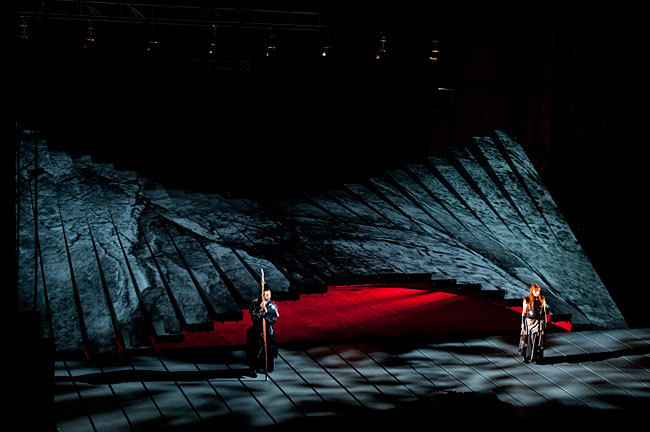
Like every opera in Robert Lepage's version of The Ring, Die Walküre takes place on a massive unit set with 24 rotating planks above the Met stage. Over the course of four hours, the "Machine" (as stage-hands call it) transforms into mountain-tops, buildings, trees, and even a gigantic flying wing for the Ride of the Valkyries.
Deborah Voigt Sings Broadway at Carnegie Hall. by Paul Pelkonen
"It's good to be back among the mortals, and on a stage that isn't moving." So said soprano Deborah Voigt as she opened "Something Wonderful," a benefit for the Collegiate Chorale at Carnegie Hall on Thursday night.
Ms. Voigt's relief was audible at this concert, which also featured baritone Paulo Szot. The two Metropolitan Opera veterans led the audience on a 90-minute excursion through Broadway songbooks, backed by the American Symphony Orchestra and the 180 voices of the Chorale.
Although Ms. Voigt regularly powers her way over the giant orchestras of Wagner and Strauss without electronic help, she sang much of this concert with help of a microphone. The opera star seemed uncomfortable with the amplification for much of the evening. A voice of her power and magnitude does not need improvement, and she seemed to have difficulty adjusting to the lower volume levels required.
From the opener ("It's a Grand Night for Singing") Ms. Voigt chose not to announce the program, surprising the audience with numbers from Meredith Wilson's The Music Man, Jerome Kern's Sweet Adeline and the little-heard Rodgers and Hammerstein collaboration Allegro.
A number from Mame (accompanied by an anecdote of the diva's first high school stage appearance in the role of the secretary Ms. Gooch) was an early highlight. "Something Wonderful" floated beautifully, and Ms. Voigt seemed about to abandon the mic. "Can't Stop Loving That Man of Mine" (arranged for jazz quartet) was more problematic. A brief halt came in the middle, and Ms. Voigt was heard to gather herself with a murmured "hojotoho" before continuing.
Mr Szot made hearty contributions throughout the evening, and his obvious comfort level with the Broadway songs seemed to cheer and inspire Ms. Voigt. They were at their best in the excerpts from Annie Get Yor Gun, the Irving Berlin show that Ms. Voigt is scheduled to sing this summer at Glimmerglass. A rip-roaring performance of the title song from Oklahoma! brought out the best in all the singers--including the choristers.
The finest part of the 90-minute set was its conclusion, with soaring performances from "a show they'll never do onstage", Porgy & Bess. her best in the excerpts from Porgy & Bess.. It was fascinating to hear Ms. Voigt soar through "My Man's Gone Now", using her experience in the operas of Richard Strauss to bring out the long melodic lines in Gershwin's music.
The encores featured two tributes to Herbert von Karajan's 1960 recording of Die Fledermaus, with Ms. Voigt emulating another Brunnhilde, Birgit Nilsson, in "I Could Have Danced All Night." Mr. Szot then returned, and the two Met stars did the opera version of "Anything You Can Do, I Can Do Better," complete with a full-out, effortless Valkyrie battle cry at the peak of "I can sing higher."
The Sony Met Broadcasts of Die Walküre and Die Meistersinger von Nürnberg
Birgit Nilsson as Brünnhilde.
From the singer's archives.
These bargain-priced recordings are live broadcasts from 1968 (Die Walküre) and 1972 (Die Meistersinger.) They date from the fertile period right before James Levine rose to power at the opera house, and feature first-class casts of Wagner singers, generally in peak form. These are CD issues of live broadcasts, and are an invaluable purchase for any Wagnerian who wants to hear how great these operas sound in front of an audience.
The first of these is Die Walküre, with a dream cast of Birgit Nilsson, Leonie Rysanek and Jon Vickers as Siegmund. Nilsson is in exceptional form here, ringing off clarion tones with seemingly impossible ease. She is matched by the late, great Thomas Stewart, an underrated bass-baritone who sang the role of Wotan on the Karajan recording of this opera.
The Wälsung twins Siegmund and Sieglinde feature the near-ideal pairing of Jon Vickers and Leonie Rysanek. The two singers share great onstage chemistry from the first lines, and the first act crackles with repressed Wagnerian sexual energy. The onion in their ointment is the Hunding of Karl Ridderbusch, another underrated singer. He brings black, resonant tone to the most unsympathetic role in the opera. Croatian conductor Berislav Klobučar leads a brisk, invigorating performance in the model of his teacher, Clemens Krauss.
Die Meistersinger was recorded four years later, with a strong cast anchored by Theo Adam's performance as Hans Sachs and James King's turn as Walther von Stolzing. Mr. Adam sounds completely at home in the live setting, indulging his sadomasochistic side at the expense of his apprentice David (Loren Driscoll) and singing with firm, dark tone. James King's clarion tenor is an ideal fit for Walther, and the Prize Song is sung with power and grace.
It also features the appearance of soprano Pilar Lorengar in a rare Wagnerian turn as Eva, Walther's love interest. Benno Kusche is a brusque, funny Beckmesser who involves the audience in his comic acts of artistic self-destruction, drawing them to laugh out loud in the second act.
This set was made two decades before the Met installed its titles system, so the presence of audience laughter testifies to the comic brilliance of Mr. Adam and Mr. Kusche. James Morris, who would take on the role of Sachs at the Met in the 1990s, appears here as Hans Schwarz, the stocking-weaver.
A recording like this one features the choristers tramping around Ye Olde Nuremberg in the third act, and there are problems balancing the onstage brass and percussion in the final scene. But the stage noises actually add to the feel of listening to a live performance, with the benefit of audience laughter in the second act. Thomas Schippers conducts a sprightly reading of the score and the Met orchestra and chorus are generally excellent.
Monday night's performance of Die Walküre at the Metropolitan Opera showed considerable improvement from the opening night. The cast continued to settle into their roles, and the performance went off without any technical glitches from "the Machine", the multi-million dollar mechanical set that is repeatedly reconfigured into appropriate backgrounds for the action of the opera.
This performance also afforded a chance to hear Eva-Maria Westbroek as Sieglinde. Ms. Westbroek was ill at the premiere, and did not sing in Act II and III. Restored to health, she displayed a powerful, rounded soprano that turns round and full in her lower register and rises to an impressive height at the top.
She is also a good physical onstage match for Jonas Kaufmann as Siegmund, and their love scene, conducted with fervor by James Levine, brought the first act to a thrilling close. However, she sounded pinched in the third, and "O heiliges wunder" did not bloom fully as it should. Mr. Kaufmann repeated his excellent portrayal from the opener. With singing like this, one regrets that his character dies at the end of Act II.
Deborah Voigt plays Brunnhilde as a spunky, enthusiastic teenager in her opening scene. The character underwent a harsh schooling in the long monologue by her father Wotan (Bryn Terfel.) Ms. Voigt displayed flawless "Hojotohos", maintaining lyric line through those difficult leaps. The Annunciation of Death was beautifully sung, though taken at a glacial pace by Mr. Levine. She also seemed to find more depth in her interpretation in the third act, displaying a deep emotional connection with Mr. Terfel.
Bryn Terfel sounded more comfortable as Wotan, singing with greater power and warmth. His first scene with Stephanie Blythe's searing Fricka went superbly well, with both singers more comfortable with the precarious set. Mr. Terfel used his strength as a lieder singer to maintain narrative drive through Wotan's monologue, aided by a bulbous, ocular movie screen that rises from the depths– like the god's missing, glaring eye.
He was even better in the third act, raging at the Valkyries and then singing a moving, proper Farewell to Brunnhilde. The annoying mannerisms (like the strangled cry of "Geh!" at the end of Act II) were gone, replaced by a greater warmth of tone and fluidity of line throughout the opera. As Hunding, Hans Peter König remains a scary Santa Claus, singing with a rich, impressive bass that menaces even when his bearing does not terrify.
This production has been plagued by onstage problems, particularly with actors mounting and dismounting the moving planks of the machine set. No slips happened on Monday, although the planks did thud distractingly as they flapped up and down to depict Brunnhilde's flying horse. In the combat scene at the end of Act II, Siegmund's sword, Nothung, failed to break. Ms. Voigt scooped it up and hid the unbroken weapon (behind her leg) as she escorted Sieglinde offstage.
Another onstage accident has been reported in connection with the Metropolitan Opera's new Ring Cycle: this time at Thursday night's performance of the Met's new production of Die Walküre.
In the third act, the famous Ride of the Valkyries features Brunnhilde's eight singing sisters mounting the planks of Robert Lepage's giant "machine" set, taking hold of "reins", and riding the see-sawing planks like bobbing horses' heads, across a digitally projected stormy sky. The singers let out their war cries in turn, as the computer-controlled planks move up and down. As the Valkyries arrive at the rock, the planks stop moving and the warrior maidens simply slide down the planks to the stage. It's simple and elegant, the best visual moment of this production.
According to several reports on Twitter, Eve Gigliotti, singing the role of Siegrune, fell off the machine, landing in the space between the stage apron underneath the still-moving planks. The audience gasped, and the scene continued with seven Valkyries until Ms. Gigliotti returned to the stage, to a wave of audience applause.
Ms. Gigliotti did not take her curtain call at the end of the opera. However, soprano Deborah Voigt, singing the role of Brunnhilde in the production, reported on her Twitter (@debvoigt) that the singer was OK. On her own Twitter account (@evegigliotti) Ms. Gigliotti said that she was "home and resting."
We here at the blog hope that Ms. Gigliotti was not seriously hurt, and that she stages a speedy recovery.
This is the second accident in this production involving the set. On opening night, Ms. Voigt was supposed to clamber up the set and hug her father, Wotan (Bryn Terfel) atop the contraption. But she slipped on the set before her opening "Hojotohos" and slid about two feet down to the apron. She picked herself up and sang an admirable set of battle-cries, continuing the performance without missing a beat.
In one of those weird operatic coincidences, this is also the second time that an accident has happened on April 28 during a performance of a Ring opera at the Met. The last such incident was in 1990, at a performance of Götterdämmerung, part of the Met's old Ring produced by the German team of Otto Schenk and Gunther Schneider-Siemssen.
The late, great Hildegard Behrens was singing Brünnhilde in the last scene of the opera, beneath a towering set depicting the Gibichung fortress on the banks of the Rhine River. She was supposed to sing her last notes and exit as the Hall collapsed onto the stage. Ms. Behrens was hit on the head by a piece of canvas-wrapped styrofoam scenery during the final conflagration. The singer recovered, but had back and shoulder injuries that may have affected her later career.
This DVD of Die Walküre shot live in front of an audience at the Bayreuth Festspielhaus on August 12, 2010, is a fascinating visual record of the august Wagner Festival's most recent production of Wagner's Ring, directed by German theatrical auteur Tankred Dost.
The debut of part II of the Robert Lepage production of Wagner's Ring Cycle features Deborah Voigt in the title role and Bryn Terfel as Wotan. Jonas Kaufmann is Siegmund, singing his first Wagner role at the Met. James Levine is scheduled to conduct the run of performances.
My old music teacher James Kurtz pointed out that Walküre was the first opera in the Ring to involve actual human beings with real emotions after the abtruse world of Rheingold with its gods, dwarves and giants. It also has some of Wagner's "greatest hits", including the "Winterstürme" aria, the Ride of the Valkyries, and the Magic Fire scene. Put those two facts together, and you have one of the most popular operas Wagner ever wrote.
The plot of Walküre concerns an act of incest and adultery between the twins Siegmund (Jonas Kaufmann) and Sieglinde, (Eva Maria Westbroek) the half-human Wälsung children of Wotan the king of the Gods. The rest of the opera is a chase, with the twins' half-sister Brunnhilde attempting to save them from the wrath of their father Wotan. Siegmund is killed. Sieglinde goes into exile. But the ultimate result of their union: the hero Siegfried, is the title character of the next opera in the Ring.
Recording Recommendations:
For recommendations for a complete Ring, click here.
For a recommendation of a recording of Das Rheingold, click here.
There are probably more recordings of Walküre out there than any other Wagner opera, for the simple fact that it's the one opera from the Ring that stands alone without being part of a complete cycle. But when it comes to this opera, there are basically two contenders.
Bayreuth Festival, 1966, cond. Karl Böhm (Philips, (currently Decca) 1970)
This is a really special performance, recorded live at the Festspielhaus. What sells it is James King and Leonie Rysanek as an ardent, nearly unbeatable pair of lovers. This is the recording with the famous Rysanek scream: it comes at the end of Act I when Siggy pulls the sword out of the tree.
The later acts feature the solid Wotan of Theo Adam and the great Birgit Nilsson, the one soprano of the golden age of recordings who could sing Brunnhilde, Isolde, Turandot and Elektra and not seem fatigued. Karl Böhm keeps things moving at a lively clip, and the orchestra plays superbly.
To hear what the Ring sounded like in the silver age of Bayreuth, this is the recording to own. The fact that it comes as part of an excellent complete Ring on 14 discs for about $56 bucks should sweeten the deal.
Berlin Philharmonic cond. Herbert von Karajan (DG, 1968)
Karajan's Berlin recording of the Ring is not without its admirers--and I'm one of them. The Austrian maestro has a special touch with Wagner, creating chamber-music dynamics out Wagner's huge set pieces, and making his crack Berlin troops respond with tender, languid playing that makes the first act feel, well, erotic.
This recording boasts a great pair of Walsüngs: Jon Vickers and Gundula Janowitz. For the casting of La Janowitz as Sieglinde, we can thank the confines of the recording studio: the role was far too heavy for this middle-weight soprano to tackle onstage.
The same applies to Regine Crespin, a controversial Brunnhilde (she recorded Sieglinde on the Solti Ring four years before) in a different mold from Nilsson. In the studio she brings a youthful freshness to the young warrior maiden. Thomas Stewart's performance as Wotan is under-rated.
One of the reasons for the enduring popularity of Die Walküre is the Magic Fire scene which ends the opera. The warrior maiden Brunnhilde is sentenced to punishment by her father Wotan. She is laid to sleep atop a rocky height, and surrounded with fire, a barrier which can only be crossed by the hero Siegfried.
"I want to know why they (meaning the Metropolitan Opera) re-staged the Ring. The Met was the only opera house in the world that had a staging that was as Wagner wrote it. People from all over the world came to see it and it was always sold out!! So, Why? I would really like your opinion."
And that sounds like a great excuse for a post about Wagner.
So here are some reasons why the Metropolitan Opera has decided to mount a new production of Der Ring des Nibelungen.
Ten reasons, in fact.
1) The Question of "Authenticity": To start with, the production in question, designed by Gunther Schneider-Siemssen and directed by Otto Schenk, was in no way "as Wagner wrote it." It was pretty close, but certain visual elements (and livestock) were eliminated. Herr Schenk created an innovative staging that used available 1980s technology to approximate what Wagner put in his librettos. But it was in no way the same as the first staging of the full Ring in 1876.
Following Wagner's death in 1883, Cosima Wagner maintained her husband's productions of the Ring and Parsifal until the sets practically fell apart. It wasn't until the 1900s, when her son Siegfried Wagner took over the management of Bayreuth, that new productions were allowed. And those were all based on the old ones. Authentic theatrical innovation did not come to Bayreuth until 1951, following the fall of the Nazis and the re-opening of the Festspielhaus under Wieland Wagner and his brother Wolfgang. And even their ideas ossified and were replaced, leading to the Bayreuth policy of new productions of the Ring every eight years.
2) Shelf Life: The Bayreuth Festival stages a new Ring every eight seasons, running a production for seven years and then taking a year off from the Ring before mounting a new one. Since the Met Ring's lifetime (counting the point from when the staging was first planned in the early '80s), Bayreuth has seen new Rings from Patrice Chereau, Sir Peter Hall, Harry Kupfer, Alfred Kirchner, and others while the Met has been duct-taping their show back together every few years or so.
By way of comparison, the Schenk Ring was on the boards of the Metropolitan Opera house for 22 years. (Die Walküre premiered in 1986, and the final performance of Götterdämmerung was in 2008.)
3) Boredom: Audiences, believe it or not, who live in New York, get tired of seeing the same show over and over. I saw the Schenk Ring in 1993 (in part), 1997, 2000, 2004 and 2008. Every time, the lighting was different. The cast was different. And the show got either better, or worse. The best I saw was that last cycle in May of 2008. While the last Ring I went to in 2008 had great singing, the show itself was getting tired.
4) Administration: The Met has a new general manager in Peter Gelb. He's still the new guy, and putting a new Ring on is part of him doing his job and making sure the Met remains a living, breathing, theatrical institution and not some dusty museum that caters to the tourist trade. And by the way, the Met's biggest money-maker is the Zeffirelli La bohéme, which has been running for 30 years as of this season.
5) Media: The old production has already been recorded and filmed with a cast of singers that are now either retired from the stage (Siegfried Jerusalem) or on the verge of calling it a career (James Morris, Jessye Norman.) It's exciting to have a fresh-voiced cast of new talent on the Met stage. They deserve a new production. And when Ben Heppner sings in Siegfried and Götterdämmerung (planned for 2011 and 2012) opposite Deborah Voigt, I think that the results will be worth the wait.
The "Magic Fire" scene from Bayreuth, in the 1988 Harry Kupfer production of Die Walküre.
6) Storage and Wear: Sets have to be repaired. Props and costumes break, get lost, or decay. They have to be stored. Lights and visual effects (gels, gobos, magic fire machines) wear out and have to be replaced. Costume restoration and storage of the massive sets (all those mountains and valleys and castles and stuff, not to mention the two dragons) required expenditure on the Met's already tight budget. A new Ring, with the unit set, makes financial sense even if the Met had to pay to reinforce the left side stage in order to store the heavy set.
7) Money: Opera houses in America are not funded with government handouts, unlike in Europe. They rely on private and corporate donors in order to stay solvent. That is, open. It's more attractive to ask those donors to donate to a new staging (one that they can make their "own") then to ask donors and corporate sponsors to spend on the upkeep of the old one.
8) The Director: Robert LePage has fresh, innovative ideas about the Ring, that are actually conventional at heart and close to Wagner's own. And he's making a new Ring using modern technology to tell the same story Wagner did. He's doing the same thing as Otto Schenk. But using lights and projections instead of papier-mâché and fake rocks.
9) The Composer: Wagner himself would have been excited about the new production. After all, the old Meister once said: "Children! Go do something new!" Not that they listened.
10) Time: It's a new century, a new millennium and New York deserves a new Ring. I can't wait for Walküre.
Hagen's Watch, from the Otto Schenk production of Götterdämmerung.
According to an article by Daniel J. Wakin in the New York Times, the Metropolitan Opera has had to resort to more than just member support in staging its new production of Wagner's Der Ring des Nibelungen.
The production, designed by Canadian director Robert Lepage, uses a large-scale set of planks that raise, lower, and change angles as needed to facilitate the portrayal of mountain-tops, dark forests and Nibelung caves. It's an ingenious solution to the scenery challenges of Wagner's work.
However, the 45-ton set has to be rolled on and off the giant Met stage, and stored on one of the company's huge "side stages" to make room for Tosca, Carmen, and Boris Godunov. The sheer weight of the set has required a quiet construction effort at the opera house, adding 65-foot steel supports underneath the offstage area.