Support independent arts journalism by joining our Patreon! Currently $5/month.

About Superconductor

Our motto: "Critical thinking in the cheap seats." Unbiased, honest classical music and opera opinions, occasional obituaries and classical news reporting, since 2007. All written content © 2019 by Paul J. Pelkonen. For more about Superconductor, visit this link. For advertising rates, click this link. Follow us on Facebook.
Showing posts with label Lohengrin. Show all posts

Saturday, June 30, 2018

No One is Coming to Save Elsa

Tenor Roberto Alagna pulls out of Lohengrin.
by Paul J. Pelkonen
The next swan will not be arriving for Roberto Alagna, who is out of the new Bayreuth Lohengrin.

In a breaking story from the Bayreuth Festival, tenor Roberto Alagna will not be singing the title role in the company's production of Lohengrin. His excuse: insufficient rehearsal. According to the official statement on the Bayreuth Festspieleblog: "Mr. Alagna has to cancel the new  Lohengrin production because he was unable to rehearse the work sufficiently due to congestion."

Monday, October 9, 2017

Moscow is Back on the Hudson

The Met and the Bolshoi prepare to make music together.
by Paul J. Pelkonen
Going Vegas? Anna Netrebko's new Aida at the Met will be staged by Michael Mayer.
Here, the diva sings in front of the Luxor Hotel thanks to the magic of digital photo alteration.
Image © Luxor Hotel, Las Vegas. Image of Anna Netrebko © Salzburg Festival. Photoshop by Lord Voldemort.

The Metropolitan Opera has locked down its plans for three new productions between 2019 and 2021. The operas in question are Aida, Salome and Lohengrin Finally, these three new productions will be staged in collaboration with the Bolshoi Theater, the Russian-based opera and ballet company that is Moscow's biggest opera house. Each of these three premieres will feature soprano Anna Netrebko in prominent roles: the title role in Aida and Salome and as Elsa in Lohengrin.

Thursday, September 8, 2016

Obituary: Johan Botha (1965-2016)

The South African tenor was beloved in Verdi and Wagner.
by Paul J. Pelkonen
Johan Botha as Otello. Photo by Ken Howard © 2007 The Metropolitan Opera.
The year of 2016, that has seen the deaths of so many musically talented individuals, has now claimed the life of tenor Johan Botha. The South African singer, who was mounting a comeback following a battle with cancer and a seven-month hiatus from the stage, died yesterday. He was 51.

Tuesday, July 5, 2016

Superconductor Audio Guide: Lohengrin

Wagner's medieval legend redefines the words "dream boat."
by Paul J. Pelkonen
He who must not be named: Ben Heppner (center) as the swan knight Lohengrin
(oops) in the Metropolitan Opera's 1998 production by Robert Wilson.
Photo by Marty Sohl © 1998 The Metropolitan Opera.
Would you marry a man who saved your life even if you did not know his name and were forbidden to ask? Richard Wagner's sixth opera Lohengrin is a test of faith for its heroine Elsa von Brabant and for the listener, who  is confronted by the composer's distinct style in the grandest manner possible.

Saturday, September 5, 2015

DVD Review: Schwann vs. Schwann

Two Bayreuth Lohengrins offer very different takes on Wagner's mythic opera.
by Paul J. Pelkonen
Cheryl Studer, Manfred Schenk and Paul Frey in Lohengrin.
Back in the misty era known as the 1990s, a humble young journalism student would go to the Tower Records in Boston and rent VHS opera performances, mostly released on the Philips label. Among those videos: two vastly different stagings of the Wagner opera Lohengrin from the Bayreuth Festspielhaus, filmed eight years apart. Universal Classics has acquired the rights to the Philips catalogue, and has re-released both performances on DVD under the DG imprint.

Saturday, August 29, 2015

Film Review: Just Don't Lend Him Money

Sir Richard Burton as Richard Wagner.
by Paul J. Pelkonen
Obsessive genius: Sir Richard Burton as Richard Wagner in Wagner.
Image © 1983 Hungarofilm/Kultur.
The turbulent life of composer Richard Wagner (1813-1883) is a fascinating and at times repellent subject. Tony Palmer's film is now available on Amazon Prime, allowing the curious and the dedicated to take a leisurely tour through this  expansive retelling of the convoluted life of the German composer. Divided here into three manageable episodes of three hours each, it is an experience that all serious Wagner lovers should try at least once. Then again, the same may be said of a trip to Bayreuth.

Wednesday, May 22, 2013

Who Wants to Be a Wagnerite?

or...Happy Birthday, Richard Wagner!
by Paul J. Pelkonen
Ernestine Schumann-Heink as Waltraute in Götterdämmerung.
Original photograph © Bettmann/Corbis. 
Festive birthday cupcake added by the author.
Today is Richard Wagner's 200th birthday, and rather than give you a listicle full of dubious recommendations for the best Ring Cycle or another review of a new recording of Die Walküre, I thought I'd talk about something important.

Wagner takes patience. Endurance. Commitment. And yes, it takes a certain degree of physical (and possibly emotional) masochism to sit through the Waltraute scene from Götterdämmerung or the marathon first act of Parsifal. Don't get me started on Die Meistersinger, a six-hour comedy that ends with the public humiliation of the local bureaucrat and a speech on the importance of "holy German art."

That's another column.

Monday, May 20, 2013

Concert Review: The Comeback

James Levine conducts the MET Orchestra at Carnegie Hall.
by Paul J. Pelkonen
Metropolitan Opera Music Director James Levine leads the MET Orchestra
at Carnegie Hall in a concert on Sunday, May 19, 2013.
Photo by Marty Sohl © 2013 The Metropolitan Opera.
The roar was deafening.

James Levine, music director of the Metropolitan Opera, returned to conducting on Sunday afternoon at Carnegie Hall. As the maestro's motorized wheelchair rolled into Stern Auditorium, the capacity crowd stood up and cheered. It has been two years since Mr. Levine conducted his last performance with the Met, two years of cancellations, painful rehabilitation and uncertainty for the conductor and the opera company.

Thursday, June 21, 2012

Recordings Review: The Swan Boat Express

Marek Janowski's  Lohengrin from Berlin.
by Paul J. Pelkonen
Bad romance: Klaus Florian Vogt and Annette Dasch in Lohengrin.
Photo from the Bayreuth Festival © 2011
This is the fourth installment in Marek Janowski's ongoing Wagner project: the ambitious plan to make live concert recordings of all ten "canon" Wagner operas with the Berlin Radio Symphony Orchestra. It is also the first commercial CD recording of Lohengrin to star heldentenor Klaus Florian Vogt in the title role.

Monday, August 15, 2011

Opera Review: The Rodents and the Swan

The rats run amok in a surreal Bayreuth Lohengrin.
Lohengrin, Elsa, and long-nosed friends.
Photo by Enrico Nawrath © 2011 Bayreuth Festival.
A bizarre, claustrophobic environment--an asylum or experimental farm overrun with life-sized rats. That's the first impression from this fascinating Bayreuth Lohengrin (from director Hans
Neuenfels) which was broadcast live today from the Festspielhaus.

The live-cast was a pay event from Siemens, (I'm writing about the three or so hours of excerpts as posted on YouTube) part of the efforts by new festival directors Katherina Wagner and Eva Wagner-Pasquier to open the Green Hill to the world and bring the traditions of Bayreuth kicking and screaming into a new century.

Mr. Neuenfels' production, which premiered last year, moves the opera to a white-walled laboratory (or an asylum) where the Brabantines are giant white, black and pink rats with red eyes. They are trapped in some kind of experiment until freed by Lohengrin, and allowed to wear human attire. Fair enough. But if the would-be warriors of Brabant are bad-assed gun-toting ninja rats, then what is Lohengrin's purpose there?

Some clues emerge with the arrival of Elsa (Annette Dasch.) She enters in a white double-breasted trenchcoat stuck with white arrows (think Christian Dior meets Saint. Sebastian) guarded by bow-wielding rodents. As she sings the dream aria, Elsa slowly unsticks the suction cup arrows from
her chest, healing through her visions. Ms. Dasch then lies prone as she sings the second part of the aria, opening up her instrument for the climactic phrases--no mean feat.

This is the start of a strong performance that gets better as the opera continues and the character develops. Ms. Dasch is the heart of this performance, lifting the opera to the next level through her singing and compelling acting. And in Act II, we learn that she is pathologically afraid of...rats. Lohengrin's job is to save her from the rodents.

When Lohengrin finally enters the action, he brings humanity and redemption to this weird world. (He also takes the remaining arrows out of Elsa.) Part of this is because of Klaus Florian Vogt's golden tenor, a sweet instrument ideally suited for the role of the Grail knight turned rat-catcher. Mr. Vogt has a strong three acts, using his instrument to float Lohengrin's long high lines right up with Wagner's divided strings. (He just nails "Heil dir, Elsa" in Act II.) Best of all, the tenor has good chemistry with Ms. Dasch, something that no strange directorial concept can hide. You believe their love is real, at least until she pops the Forbidden Question.


Friedrich (Jukka Rasalainen) and Ortrud (Petra Lang) are paranoid, fascist types in trench coats left over from an old Harry Kupfer production. At the start of Act II, they are loading cash into a briefcase and getting in a (presumably) rat-drawn hansom cab (to get out of the rat race?) Whatever. Their duet is searing, as is Ms. Lang's powerhouse evocation of the Norse gods. King Henry (Georg Zeppenfeld) is another lunatic with a soft cloth crown, a first cousin to Amfortas. Mr. Zeppenfeld is a good actor, but vocally is out of his depth.

In Act III, everything is wedded bliss between Mr. Vogt and Ms. Dasch. The two singers have wonderful chemistry in the often chilly bridal scene, something that does not change even when Lohengrin kills Friedrich (clearly self-defense in this version) and faces up to his deed. Mr. Vogt's "In fernem Land" takes the listener back to the core of the opera, going beyond the gun-toting ninja rats to the essential core of this work.

And then the ending: the swan as a giant egg, and Gottfried, Elsa's brother, the final experiment of this strange laboratory. The future schützer is presented to all from within a white Ovalia "egg" chair: as a half-developed fetus who looks hypoxiated. But the strange zombie baby rises, and walks forth behind Lohengrin: either in horror or terror--I'm not sure which. It's a weird ending, but it fails to ruin a fascinating Lohengrin, one which I'll be seeing again when it is issued on DVD.

Sunday, February 20, 2011

Heroes Anonymous: Five Recordings of Lohengrin

"I want to know your name. Tell me your name."
--Brenda Strong, Catch Me If You Can
Johan Botha and Emily Magee in Act I of Lohengrin
Photo by Dan Rest, © 2011 Lyric Opera of Chicago

Lohengrin is one of Wagner's most popular operas. The medieval of a maiden in distress rescued by a (literal) knight in shining armor was transformed into a grand opera of mythic proportion, and one of Wagner's greatest successes.

The opera is currently playing at the Lyric Opera of Chicago, with South African tenor Johan Botha in the title role. To warm your ears up for the Swan Knight's arrival, here's a list of great recordings of Lohengrin.

This opera has been lucky on disc. That's to say, there are some awesome recordings out there. Here's the top five:

Bayreuth Festival Orchestra and Chorus cond. Wolfgang Sawallisch (Decca/Philips 1962)
Lohengrin: Jess Thomas
Elsa von Brabant Anja Silja
Friedrich von Telramund: Ramon Vinay
Ortrud: Astrid Varnay
Heinrich: Franz Crass
In and out of print, this live recording was made at the Bayreuth Festspielhaus in 1962, a very good year for opera. Anja Silja was maybe 20 when she recorded this, lending a youthful vulnerability to the role of Elsa. Jess Thomas is in good form as Lohengrin. But the real attraction here is Astrid Varnay as the villainous Ortrud. Her added sprechstimme cackle ("Gott?! Hech-heh!") in Act Two is worth the price of the set alone. Also, this is the best of the four Lohengrins recorded at Bayreuth, taped in front of an actual audience with a minimum of stage noise.


Vienna Philharmonic cond. Rudolf Kempe (EMI, 1964)
Lohengrin: Jess Thomas
Elsa von Brabant Elisabeth Grummer
Friedrich von Telramund: Dietrich Fischer-Dieskau
Ortrud: Christa Ludwig
Heinrich: Gottlob Frick
This is pretty much the "standard" recording of the opera, and it gets re-released about once a decade. Jess Thomas again, this time in a studio setting. He is surrounded by a solid cast, (Grummer is etheral, Fischer-Dieskau and Frick perfect casting) and this captures the Vienna Philharmonic at their peak, right around the time they were finishing the Solti Ring. The recorded sound is excellent and the choral singing, superb. Rudolf Kempe is an exceptional conductor, and this is his finest hour on the podium. A first choice in most record guides, but not my personal favorite.


Bavarian Radio Symphony Orchestra cond. Rafael Kubelik (DG, 1971)
Lohengrin: James King
Elsa von Brabant Gundula Janowitz
Friedrich von Telramund: Gerd Neinstedt
Ortrud: Gwyneth Jones
Heinrich: Karl Ridderbusch
This is probably my favorite of the bunch--another "unknown" DG recording led by Maestro Kubelik. Except that this one actually got released. The attraction here is the second act, with the pairing of Gundula Janowitz and Gwyneth Jones as Elsa and Ortrud. La Jones has never sounded better, using her demented soprano to great effect in this villainous role.

James King is an effective Swan Knight. The cast is filled out by Bayreuth veterans Gerd Neinstedt and Karl Ridderbusch. Kubelik leads a sweeping, stylish performance of the score.


Staatskapelle Berlin: Daniel Barenboim (Teldec/WBC, 1998)
Lohengrin: Peter Seiffert
Elsa von Brabant Emmy Magee
Friedrich von Telramund: Falk Struckmann
Ortrud: Deborah Polaski
Heinrich: Rene Pape
This is one of only two Lohengrins that opens up the "standard" cut in "In Fernem Land," including the second half of the aria, which was cut by conductor Franz Liszt at the opera's premiere for fear that the singer could not cope with the high range of the part and the extra exposition. This is part of Daniel Barenboim's survey of the ten "mature" Wagner operas for Teldec (now Warner Brothers Classics) and features his signature conducting style.

The cast features Emmy Magee as Elsa (a role she is currently singing in the Chicago production), Peter Schreier as a rich-toned Lohengrin. Falk Struckmann and Deborah Polaski are in fine snarling form as Friedrich von Telramund and his scheming wife, Ortrud. Full review here.


WDR Symphonie-Orchester Köln cond. Semyon Bychkov (Profil-G. Haenssler, 2009)
Lohengrin: Johan Botha
Elsa von Brabant: Adrienne Pieczonka
Friedrich von Telramund: Falk Struckmann
Ortrud: Petra Lang
Heinrich: Kwangchal Youn
This was a welcome surprise, made in Cologne over several concert performances. Johan Botha is at his best as Lohengrin--he is effective in the concert setting and sings with solid tone and understanding of the character beyond being a knight in shining armor. Adrienne Pieczonka is a suitable, dreamy Elsa.

Falk Struckmann is a stentorian Telramund, especially in Act I. However, his scene with Ortrud (Petra Lang) is chilling. Semyon Bychkov's orchestra features exceptionally warm brass playing, recorded at high, but not overwhelming dynamic levels. The chorus kicks ass. A compelling modern alternative, and the first Lohengrin to be released in SACD.

Saturday, March 3, 2007

DVD Review: Lohengrin: The Silver Savior


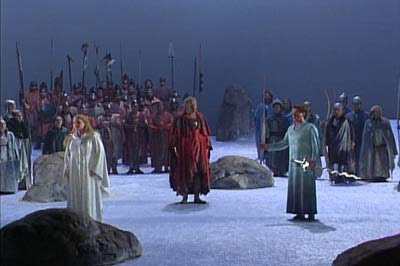
Keeping up with the Telramunds: Waltraud Meier and Tom Fox in Lohengrin. © 2007 OpusArte
Director Nikolaus Lehnhoff brings a fresh look to Wagner's famous Romantic opera in this bold production of Lohengrin, filmed in Baden-Baden with Kent Nagano on the podium directing the Deutsche Symphonie-Orchester Berlin. Yes, the usual silver and blue background is present, used by directors ranging from Wieland Wagner to Robert Wilson. But the stiff acting and slow pace that can bog this opera down (especially in the second act) are nowhere to be found. Rather, this is a nuanced performance--a Lohengrin of dramatic subtlety.


Lehnhoff has chosen to set this opera in a repressive society. Everyone is in proper Ascot-style suits or military uniforms, except Lohengrin himself. Played by the exceptional young tenor Klaus Florian Vogt, the swan knight arrives without a boat, or even a swan. Rather, he's just another face in the crowd, one in an Italian cut, silver three-piece suit, matching tie, duelling saber and dorky helmet. Vogt is blessed with a fluid tenor that soars against Nagano's conducting, singing with the blend of nuance and power that is needed in this role. And he opens the pipes full blast for the big heroic moments, delivering a ringing "In fernem land," the opera's most famous aria.

He is evenly matched by the superb Elsa of Solveig Kringelborn, a physical and vocal fit for this role--and a good actress.. Elsa is often reduced to a still figure looking anxious for three acts. Kringelborn throws herself into a physical, edgy performance that's uncomfortable for the audience--is this fragile girl is really off the rails in the first act? She grows and matures, however, as the opera continues. Although she is dominated thoroughly in Act II by Waltraud Meier's superbly bitchy Ortrud, she is a strong, even match for Lohengrin in the bridal chamber scene, and a picture of shattered isolation in the latter half of the third act.

Speaking of that Act Three opening, the director chose to skip the usual "giant bed" and instead substitute a baby grand piano in front of a huge blue arris curtain. There, Lohengrin can be seen obsessing over the composition of the Bridal Chorus rather than paying attention to his brand new wife. This is a typical "male moment," and a funny comment on Lohengrin as the lone "creative type" in the repressive society of Wagner's Brabant. That society, is represented by a round, arena-like setting. With the simple drop of a curtain, the bridal chamber reverts back to the stadium set. Nothing fancy, and all the more effective in its simplicity.

That famous married couple: the Telramunds are in the excellent hands of Waltraud Meier and veteran baritone Tom Fox. Neither is any stranger to Wagner--Fox has been recording since the 1960s, and Meier is the finest Kundry of the last 25 years. They rock the house in their Act II duet, with Meier channeling the great Wagner divas of the past, mixed with notes of Gloria Swanson and the Wicked Witch. And those dead-animal headpieces are just fabulous, darling.

Hans-Peter König is a round-voiced, fatherly King Heinrich, Roman Trekel a stentorian Herald. The choral forces--so important in this particular opera--are brilliant. The DVD, directed by Thomas Grimm, successfully captures the characters' nuance and depth with solid editing and well-timed close-ups.
Photos © 2007 OpusArte

Trending on Superconductor

Translate

Share My Blog!

Share |

Critical Thinking in the Cheap Seats