Support independent arts journalism by joining our Patreon! Currently $5/month.

About Superconductor

Our motto: "Critical thinking in the cheap seats." Unbiased, honest classical music and opera opinions, occasional obituaries and classical news reporting, since 2007. All written content © 2019 by Paul J. Pelkonen. For more about Superconductor, visit this link. For advertising rates, click this link. Follow us on Facebook.
Showing posts with label new ring cycle. Show all posts

Thursday, May 30, 2019

Recordings Review: Meet the New Gods

Marek Janowski records his second Das Rheingold.
by Paul J. Pelkonen
Second time around: Marek Janowski conducted his second recording of the Ring 
in Berlin. Photo by Felix Bored for PentaTone.
(Note: This is an updated version of a 2013 Superconductor review, republished in advance of coming reviews of the rest of the cycle in the next week.)

Any recording of Das Rheingold, the "preliminary evening" to Wagner's mighty tetralogy Der Ring des Nibelungen must, in the course of review be compared to the classic Decca recording made in 1958 with Georg Solti and the Vienna Philharmonic. So let's do that first. No, this new recording from Marek Janowski and the Berlin Radio Symphony Orchestra  (released in 2013 on the PentaTone label) doesn't have much similarity to the Solti. Nor is it the "new standard", "the best" or even the "best-sounding" recording of this four-scene prelude to the main action of the Ring. However, as a document capturing some interesting young artists and a snapshot of the current state of international Wagner singing, it certainly has value.

Friday, August 28, 2015

Recording Recommendation: The Shoe-String Ring

Valhalla on just $1.50 a day.
by Paul J. Pelkonen
The original cover of Die Walküre. Clearly not marketing the music.
All Photos by Christopher Whorf © 1968, the artist.

Hans Swarowsky's recording of the complete Ring Cycle was made in 1968 in Nuremberg. The sessions were a by-product of the Soviet invasion of Prague, which forced most of the Czech Philharmonic to flee to southern Germany. Under Mr. Swarowsky, the so-called "South German Philharmonic" dashed off these recordings quickly, releasing the entire cycle on the budget Westminster Gold label as a bargain-basement alternative to the Decca Ring with Georg Solti and the Vienna Philharmonic.

Tuesday, July 23, 2013

The Ring Goes West

First images of the new Bayreuth Ring revealed.
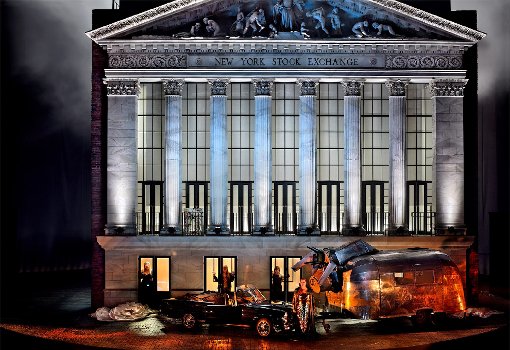
The New York Stock Exchange features in Götterdämmerung, possibly
standing in for Valhalla. Photo by Enrico Nawath © 2013 Bayreuth Festival.
The Bayreuth Festival has let slip stage images from the new production of Wagner's Ring, directed by German conceptual artist Frank Castorf.

Sunday, May 12, 2013

Opera Review: Countdown to Extinction

The Met presents the last Götterdämmerung of 2013.
by Paul J. Pelkonen
A fine romance: Brunnhilde (Deborah Voigt) sends Siegfried (Lars Cleveman)
off to battle in the Prologue to Wagner's Götterdämmerung.
Photo © 2013 The Metropolitan Opera.
At the time of this writing, it is uncertain if Saturdays matinee performance of Götterdämmerung at the Metropolitan Opera, was the final performance ever of the company's current production of Wagner’s Der Ring des Nibelungen. If this was the last performance of Ring (which premiered with Das Rheingold in 2010) before the Met decides to cut its losses, the quality of this performance may have earned a stay of execution, if not an acquittal for this troubled show.

Tuesday, May 7, 2013

Twilight of the Machine

Robert Lepage's Ring may face the scrap heap.
by Paul J. Pelkonen
Up in flames: a scene from Act III of the Metropolitan Opera production of Götterdämmerung.
Image © 2012 The Metropolitan Opera.
According to an article published yesterday on parterre.com, this might be the end of the road for the Metropolitan Opera's current production of Wagner's Der Ring des Nibelungen. The company has one performance of Siegfried and one of Götterdämmerung scheduled for later this week.

Sunday, April 21, 2013

Metropolitan Opera Preview: Götterdämmerung

The last chapter of Wagner's Ring returns for another burn.
by Paul J. Pelkonen
The Gibichung Hall in Act II of the Met's new Götterdämnerung.
Photo by Ken Howard © 2012 The Metropolitan Opera.
The six-hour final chapter of Wagner's Ring is in some ways the most conventional opera of the four. That's because Götterdämmerung (the title translates as Twilight of the Gods, though the opera was originally called Siegfried's Death) was the first libretto written. Twenty-four years later, this was also the last opera of the Ring to be completed, so it has the most complex music.

Saturday, April 13, 2013

Metropolitan Opera Preview: Siegfried

The third part of Wagner's Ring presents the greatest challenge for the tenor voice.
by Paul J. Pelkonen
Deborah Voigt wakes up on the Machine in Act III of Siegfried.
Photo by Ken Howard © 2011 The Metropolitan Opera.
Although it's part of the Met's much-hyped Robert Lepage production of the Ring Cycle, Wagner's Siegfried might have the worst reputation among the ten operas that are considered to be the German composer's main body of work. Wagner conceived the opera as the "light-hearted" section of the Ring. (In all fairness, it does have a happy ending!)

Monday, April 8, 2013

Opera Review: The Ghost in the Machine

With a clank and a clatter, the Met revives Das Rheingold.
by Paul J. Pelkonen
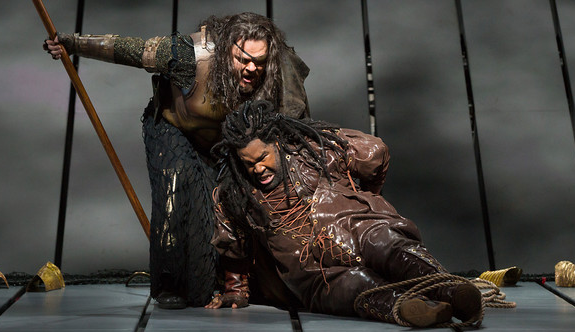
"Whaddya mean it's busted?" Wotan (Mark Delavan, standing) assaults
Alberich (Eric Owens) in Scene Four of Das Rheingold.
Photo by Marty Sohl © 2013 The Metropolitan Opera.
The Robert Lepage production of Wagner's Ring has returned to the stage of the Metropolitan Opera. Yes, the "Machine" is back, that multi-million dollar unit set with 24 rotating planks that serve as acting area and projection surface for Mr. Lepage's digital scenery. And for the first half of Das Rheingold on Saturday afternoon, things were going pretty well. Mr. Lepage's high-tech story-book approach proved surprisingly engrossing, carried along by the brisk conducting of Fabio Luisi.

Then the Machine malfunctioned.

Thursday, April 4, 2013

Once More Unto the Planks

Gearing up for another Ring Cycle.
by Paul J. Pelkonen
Siegfried (Jay Hunter Morris, left) rows up the Rhine as the Gibichungs look on.
Act I, Scene 1 of the Met's production of Götterdämmerung.
Photo by Ken Howard © 2012 The Metropolitan Opera.
I wasn't all that enthusiastic about seeing the Ring again.

I'll admit that in the buildup to the 2010 premiere of the Metropolitan Opera's new Robert Lepage production of Der Ring der Nibelungen, I was excited, even enthusiastic. I had enjoyed the concerts and theatrical productions that I'd seen him put on: Peter Gabriel's Growing Up tour, the Met's fully staged 2008 Le Damnation de Faust and Cirque de Soleil's Ka in Las Vegas.

Tuesday, August 7, 2012

Waiting For the World to End

A Superconductor Editorial.
by Paul J. Pelkonen
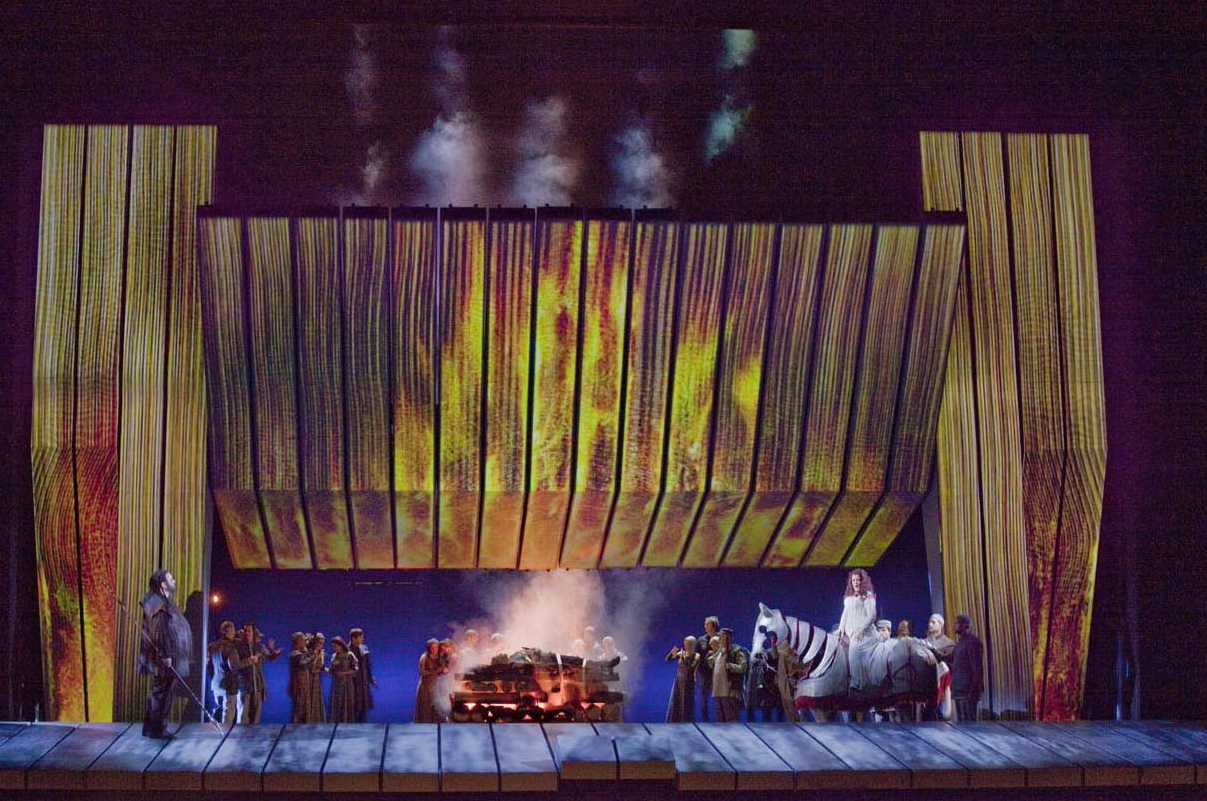
The final conflagration at the end of the Met's new Ring Cycle.
Photo by Ken Howard © 2012 The Metropolitan Opera.
The Metropolitan Opera has announced the release date for its DVD and Blu-Ray sets of the company's Robert Lepage production of Der Ring des Nibelungen:

September 11, 2012.

The sets, which are re-packagings of the Met's Live in HD performances of Das Rheingold, Die Walküre, Siegfried and Götterdämmerung, are scheduled for general release on the 11th anniversary of attacks on New York and Washington, DC that destroyed the World Trade Center and part of the Pentagon.

Friday, July 20, 2012

Movie Review: Behind the Planks

Documentary Wagner's Dream shines (some) light on the Lepage Ring
by Paul J. Pelkonen
Wagner's Dream offers an inside look at the Met's new Ring Cycle.
Image from Wagner's Dream © 2012 The Metropolitan Opera.
There are many memorable moments in Wagner's Dream, the new documentary by Susan Frömke, delving into the inner workings of the Metropolitan Opera's multi-million-dollar mounting of Wagner's Ring Cycle. However, nothing is more telling than what happens after Deborah Voigt fell off the set.

The soprano, who was making her debut in the key role of Brunnhilde took her tumble in the opening moments of Act II of the premiere of Die Walküre. The movie shows the build-up to the accident, and the fall itself. The cameras track Ms. Voigt afterwards, recording her embarrassment at tripping over her long Valkyrie skirt, and her determination to have that precarious entrance altered in the following performances.

The next day, her decision was abruptly overruled by Met general manager Peter Gelb.

Wednesday, July 18, 2012

The Sons of the Batman

When criticism leads to...threats?
by Paul J. Pelkonen
Sometimes, I think this guy had it right: Heath Ledger as The Joker.
Promotional art for The Dark Knight.
© 2008 Warner Brothers/Detective Comics. Batman® is a registered trademark.
This post isn't really about classical music, opera, or modern music. It's about criticism, what it is, and why I choose to do it. It's also about...Batman.

 It started as a reaction to a recent news story involving movie critic Marshall Fine, whose review of the new Batman film The Dark Knight Rises (on his site Hollywood and Fine sparked vigilante-like rage from fans of the Caped Crusader on the film site Rotten Tomatoes.

Mr. Fine's negative (if even-handed) review of the film triggered an ugly upswell of comment from fans of the movies. Some of those comments were vulgar. Others were actually threatening, as if the writers were going to don cowls, fire up Batmobiles, and exert "street justice" in the name of their favorite superhero. One thinks of director Christopher Nolan's dead-on depiction of the "Sons of Batman" in the blockbusting, earlier film The Dark Knight.

Tuesday, May 22, 2012

Metropolitan Opera Attacks Opera News

Met Guild publication to cease reviews of Met productions.

(Ed. Note: This story has since been updated, with the Metropolitan Opera issuing a press release stating that Opera News will continue to review its performances. Read more about it here.)

Metropolitan Opera general manager Peter Gelb has struck again, this time close to his own opera house.

According to a report by Daniel J. Wakin in the New York Times, Opera News, the 76-year old publication of the Metropolitan Opera Guild, announced today that they will no longer be reviewing Metropolitan Opera productions. The decision comes following the Met's "dissatisfaction" with the magazine's reviews of recent Met shows, most notably its controversial, expensive production of Wagner's Der Ring des Nibelungen.

Tuesday, May 1, 2012

A Blogger Walks the Plank

Met management fights to defend the Ring...from reporters.
Women and bloggers first. Lego® sculpture by Sir Dillon.
Like the whirring, clanking planks that make up the set of its new multi-million dollar production of Wagner's Ring, Metropolitan Opera's general manager Peter Gelb has been spinning in recent weeks. His object: to draw audiences to the company's new production of the Ring Cycle in  following a scathing critique from Alex Ross in the pages of the New Yorker. The latest victim of the hype is WQXR blogger Olivia Giovetti.

Ms. Giovetti is one of the writers of OperaVore, the classical music station's blog covering the ups and downs of our fair city's opera companies. (It's kind of like this blog, without the humor and snappy color scheme.)

The Met general manager objected to Ms. Giovetti's recent post, Three Things We Learned From Peter Gelb Today. That post was then withdrawn from the WQXR website.

Tuesday, April 3, 2012

The Future Is Now

Met General Manager Peter Gelb unveils (some) plans through 2017.
Plenty of good seats available: general manager Peter Gelb poses on the balcony level
of the Metropolitan Opera House. Image © 2011 The Metropolitan Opera.
In an article published today in the New York Times, Metropolitan Opera general manager Peter Gelb spoke with Times critic Anthony Tommasini, outlining some of his future plans for the opera house's repertory.

The company plans to continue the initiatives established by Mr. Gelb's early tenure: a commitment to bringing in directors and artists from outside the operatic world, and the plan to bring in six or seven new productions each season.

Mr. Gelb, who acted last year to shut down the fan-run Metropolitan Opera Futures Page (which revealed carefully gleaned possible details of future opera seasons) teased the Times readers with some interesting productions planned for the next five years.


Here's a breakdown:

Eugene Onegin: Tchaikovsky's opera will open the 2013 season with Mariusz Kwiecien in the title role and Anna Netrebko as Tatiana. This is a new production by Deborah Warner. Valery Gergiev conducts in a return to the Met podium.

Prince Igor: Borodin's unfinished opera has not been seen since the Kirov (now Mariinsky) opera were in resindence at the Met in the 1990s. This new production will be mounted by Russian director Dmitri Tcherniakov.

The Merry Widow: It's springtime for Hitler's favorite operetta. Renée Fleming takes on the role of Hanna Glawari in this confection by Austrian composer Fritz Léhar. The staging will be mounted by Broadway director/choreographer Susan Strohman, whose credits include the musical version of Mel Brooks' The Producers.

Lulu: Artist William Kentridge, whose first Met production was Shostakovich's The Nose in 2009 returns to direct Alban Berg's story of a femme fatale who destroys every man she runs across--except for her killer, Jack the Ripper.

St. Francois d'Assise: Olivier Messiaen's lone opera is one of the most challenging, towering works in the repertory. This new production, planned for the 2017 season, will be mounted by Mr. Lepage. Bass Eric Owens, whose Alberich has been one of the breakout performances of the company's ne >Ring cycle, will sing the title role.

Mr. Gelb also defended the company's new Ring Cycle, directed by Robert Lepage from its detractors, which include this blog and Alex Ross in The New Yorker. In a recent column, Mr. Ross referred to this production as follows: "Pound for pound, ton for ton, it is the most witless and wasteful production in modern operatic history."

Mr. Gelb acknowledged that the show had its detractors. As he told the Times: "I reserve final assessment until I see how it all works out technically, when presented complete in the space of a week."

Responding to a 2011 column by Mr. Tommassini calling for the Met general manager to consider hiring a Director of Productions, Mr. Gelb asserted "I'm the director of productions. I hope you accept that."

Perhaps Mr. Gelb would consider the words of St. Francis, who said: "Above all the grace and the gifts that Christ gives to his beloved is that of overcoming self."

Friday, March 30, 2012

Twilight of the Ring

The Metropolitan Opera slashes the cost of Wagner.
Downwardly mobile: Wotan (Bryn Terfel) and Fricka (Stephanie Blythe) in Das Rheingold. Photo by Ken Howard © 2010 The Metropolitan Opera.
According to a report first posted on Norman Lebrecht's website Slipped Disc, the Metropolitan Opera has done the unthinkable, slashing prices across the board for upcoming performances of the three complete cycles of Wagner's Der Ring des Nibelungen. 

Checking ticket prices for an April 24 performance of Götterdämmerung (according to the Met website) are now as low as $45 for the rear of the Family Circle. Orchestra Balance seats (off to the side) are as low as $180 (formerly $275), with better seats (Orchestra Premium) going as high as $345 (down from $650.) There are even a few coveted aisle seats available for some shows.Das Rheingold has had ticket prices cut by as much as 50%, with Family Circle seats priced at the normal rate of $25-$35. A few days ago, they were $55.

Even more surprising: the wide availability of tickets for the April 13 Die Walküre, opening night of that opera, which is considered the most popular entry in the tetralogy. 

This quiet, unannounced move may be a desperate attempt to fill the house as the Ring approaches. The cycles launch with the return of Das Rheingold on April 4. No information is available as to whether ticket holders who already bought seats under the old price structure will receive some sort of remuneration from the Met.

The Metropolitan Opera's current production of the Ring, designed and directed by Robert Lepage, has met with mixed reviews as the four operas have launched over the last two years. The multi-million dollar production, constructed around a massive movable set (sarcastically dubbed "The Machine" by the stage crew) has had its share of performance malfunctions, occasionally forcing singers to improvise on the stage apron. More serious were two onstage accidents, both during 2011 performances of Die Walküre.

The January premiere of Götterdämmerung featured some shaky special effects, including exploding plaster statues that were meant to evoke the fall of Wagner's Germanic gods but caused the opening night audience to laugh at the opera's climax.

This month marks the first "full" performances of the cycle, which are traditionally sold to the Met audience as four-opera packages at double the face value of ordinary seats at the Met. The company's former production, by the German team of Otto Schenk and Gunther Schneider-Siemssen, was notable for being one of the company's most coveted tickets, and a perennial sellout.

Met ticket prices have steadily gotten higher in the last three seasons, as the house has had to cover increased operational costs. These include general manager Peter Gelb's pricey Met Live in HD series, which brings Met operas to movie screens around the world on Saturday afternoons. Next season's brochure features a "staggered" ticket policy with higher rates being charged for new productions and of course, Wagner operas.

In other news, the company has been generating much hoopla over a planned series of Live in HD re-runs of the video broadcasts of the four operas in the Ring. These screenings are not new films drawn from the April and May Ring cycles, but re-broadcasts of the performances shot in 2010, 2011, and 2012.

Sunday, February 12, 2012

Opera Review: The Machine of the Nibelungs

We break down (poor choice of words) the Lepage Ring.
by Paul Pelkonen
The new Ring cost millions. Hope rich Uncle Pennybags™ likes opera.
Card from Monopoly™ © 1936 Parker Brothers Games.
So now that Götterdämmerung has been broadcast in the movie theaters, it's time to take a look at all four parts of the Metropolitan Opera's multimillion dollar production of Wagner's Ring.

Canadian director Robert Lepage came to Wagner's operas with what seemed to be a deliberately naïve view: to use high technology and digital projections to recreate a fairly literal version of the Germanic myths that inspired the composer. The costumes were directly drawn from old productions of the Ring, right down to the little metal helmets worn by the Valkyries and Wotan's undersized partisan-shaped spear.

To be sure, this cycle developed over the year and a half it took to premiere, with Siegfried and Götterdämmerung showing advances in technology that solved some of the serious problems existent in the earlier opera. But the biggest problem with this cycle is Mr. Lepage's decision to minimize the acting surface of the Met stage, giving his singers almost nowhere to go except the narrow grey board-walk of planks that stood on the lip of the stage underneath the Machine, or a trench underneath that hid the singers' legs from the view of the audience and made it harder for them to sing.

Saturday, January 28, 2012

Opera Review: The Last Plank

The Met opens Robert Lepage's Götterdämmerung.
by Paul Pelkonen
Wedding interrupted. Act II of Götterdämmerung with Deborah Voigt (center) as Brunnhilde.
Photo by Ken Howard © 2012 The Metropolitan Opera.
The Metropolitan Opera unveiled the final segment of the company's new Ring Cycle last night with the house premiere of Götterdämmerung. This is the Robert Lepage production, featuring a frequently moving unit set ("The Machine") that reconfigures itself as needed to serve as a huge projection screen for digital imagery by Ex Machina, Mr. Lepage's Canadian production house.

This is not the best cast ever put onstage for Götterdämmerung. Deborah Voigt's performance had its rough moments, thanks to a dodgy middle register and a wide vibrato that threatened to degenerate in Act II. But the red-wigged diva pulled her performance out of the fire, even as she rode a giant robo-horse into the flames, singing an impressive, noble Immolation Scene.

Jay Hunter Morris continues to impress with his energetic Siegfried, although his diction still sounds a little weird at times. (Maybe it's a Texas thing.) His voice is a little small for the part, but with careful conducting from Fabio Luisi in the pit, he navigated the role's rough spots or in one case (the Act II "impossible" octave drop) avoided them altogether. 

Friday, January 27, 2012

Götterdämmerung It

When Wagner meets Def Leppard.
It's hysteria, I tells ya. Original art elements © 1987 Def Leppard/Phonogram Records
Photo of Ms. Voigt by Brigitte Lacombe © 2011 The Metropolitan Opera.
This morning, I was thinking about the unlikely confluence of Richard Wagner and...Def Leppard. So without further ado, here's a parody of Def Leppard's 1987 pop-metal classic "Armageddon It", re-written as a playful plot synopsis of Wagner's Götterdämmerung, which has its premiere tonight at the Metropolitan Opera. Enjoy.

"Götterdämmerung It", a parody of "Armageddon It" by Def Leppard.
Parody lyrics by Paul Pelkonen © 2012 Paul Pelkonen.
Original song written by Def Leppard and Robert 'Mutt' Lange © 1987 Bludgeon Riffola/Phonogram Music.

Ya better take this Ring 'cos I'm going now
Gonna kick some butt down by the Rhine
We'll sing a full-volume "Heil" when I'm heading out
And then you give me back your noble Grane

You got it? It's Götterdämmerung.

You say that Siegfried soon will be comin' here
And you know that Hagen's got a big plan

You know ya can't stop it,
So don't knock it,
You know we'll get it.

Hey it's Götterdämmerung.
Götterdämmerung.
Cos he'll bring us the Ring.

Give him that memory potion (every little bit)
Make him drink every drop (every bit of it)
Then we'll slip him the notion (oh c'mon live a bit)
That your sister is hot.

Yeah but are you Nibelung? It's Götterdämmerung.
Son of Nibelung? Yes Götterdämmerung.

We're gonna go up there with the Tarnhelm
And switch places so she won't know who's who
And then I'll kidnap her and you'll marry her
and have a big wedding hullabaloo.

You got it? It's Götterdämmerung.

But when she figure it out she'll be mad as heck
And then she'll plan to have him stabbed in the back

You know ya can't stop it.
So don't knock it.
You know he'll get it

Hey it's Götterdämmerung.
Götterdämmerung.
Cos I'll wind up with the Ring.

[Repeat Bridge]
[Repeat Chorus]

C'mon, Hagen, get 'im!

[Steer-horn solo]

Give me, give me give me the Ring
Because if I don't get it, Dad won't let me sleep
Pull it, pull it pull it off his dead hand
'cos this was my whole stupid plan
('cos this was my whole stipid plan!)

Is the opera done? It's Götterdämmerung
Yeah it's almost done, it's Götterdämmerung.
Oh crap now she's got the Ring.

Pile up all of those logs now--every little bit
Put Siegfried on the pyre--every bit of it
And I'll take back the Ring now--cos I'm keepin git
Ride my horse through the fire--Oh it's Götterdämmerung.

Fly ravens to Valhalla--and tell Wotan it's
Time to light his own pyre--every bit of it
Time to burn down the castle--what a silly git
See the flames leaping higher--whoa hot isn't it?

See Hagen swimming--get a hold of the Ring now.
See Hagen drowning--Rhinemaidens pulled him down
See river flooding--this all happens so fast now
See world is ending--It only took six hours.

Tuesday, January 10, 2012

Valkyries on the Potomac

Washington National Opera to finally stage the complete Ring.
Act I of Die Walküre in Francesca Zambello's production of Der Ring des Nibelungen.
Photo courtesy of the San Francisco Opera.
Raw naked greed. Unnecessary construction projects. And workers at each other's throats after going unpaid. All on the banks of the Potomac.

No, we're not talking about the 112th Congress. According to a report by Anne Midgette in the Washington Post, the Washington National Opera has announced that it will (finally) present their complete production of Der Ring des Nibelungen, directed by new WNO Artistic Adviser Francesca Zambello. The production will be staged at the opera house in the Kennedy Center in 2016.

Act I of Siegfried in Francesca Zambello's production of Der Ring des Nibelungen.
Photo courtesy of the San Francisco Opera.


Ms. Zambello's production of the Ring was originally planned to premiere in 2009. WNO staged Das Rheingold in 2006, Die Walküre in 2007, and Siegfried in May of 2009. But a radical drop in donations, caused by the 2008 financial crijsis led to the company nixing the premiere of the last segment, Götterdämmerung. The longest opera in the Ring, which has the most expensive and difficult technical requirements of any Wagner opera, was presented in 2009 in two concert performances.

The complete Zambello Ring Cycle had its full premiere at the San Francisco Opera in 2011. It is colloquially known as the "American Ring." The director makes Wagner's Germanic story the vehicle for a pell-mell ride through American history, presenting the gods as old-fashioned capitalists and Siegfried as an industrial worker. Uniquely, the staging is visualized as paralleling the American expansion westward, with Hunding's hut as a prairie settlement, Mime's cave as a trailer house and the Gibichung Hall atop a skyscraper.

Act II of Götterdämmerung in Francesca Zambello's production of Der Ring des Nibelungen.
Photo courtesy of the San Francisco Opera.
The San Francisco run also afforded Jay Hunter Morris the opportunity to make his debut in of the title role Siegfried, a part which he repeated with great success at the Metropolitan Opera in October of 2011. Mr. Morris will sing his first Götterdämmerung at the Metropolitan Opera on Jan. 27.

In other WNO news, the company is also planning New American Works, an initiative to present home-grown operas to audiences. The plan is three-fold, with 20-minute works commissioned from student composers, hour-long operas by composers on the rise, and productions of reliable works by what the company is calling "American Masters." Ms. Midgette's article also pointed out that since the WNO is officially part of the Kennedy Center, the Opera can use the smaller theaters in the Center to present chamber works and experimental operas. 

Casting details for the Ring are not available. The full 2012-2013 Washington National Opera season will be announced in March.

Trending on Superconductor

Translate

Share My Blog!

Share |

Critical Thinking in the Cheap Seats