Support independent arts journalism by joining our Patreon! Currently $5/month.

About Superconductor

Our motto: "Critical thinking in the cheap seats." Unbiased, honest classical music and opera opinions, occasional obituaries and classical news reporting, since 2007. All written content © 2019 by Paul J. Pelkonen. For more about Superconductor, visit this link. For advertising rates, click this link. Follow us on Facebook.
Showing posts with label Wagnerism. Show all posts

Saturday, April 20, 2019

Metropolitan Opera Preview: Götterdämmerung

The Ring comes to a curiously old-fashioned conclusion.
The three Norns (Elizabeth Bishop, Ronnita Miller, and Wendy Bryn Harmer) weave the rope of
destiny as the Machine "looms" above. Photo by Ken Howard © 2019 The Metropolitan Opera.
The last and longest chapter of Wagner’s Ring Cycle, Götterdammerung (”The Twilight of the Gods”) also had the longest gestation period. (Wagner wrote this libretto first, but the music was the last part of the project to be completed.) This opera demands commitment, even from the most fervent Wagnerian. A performance is six hours with intermissions but it goes by with the speed of a bullet train.

Friday, March 30, 2018

Comment: The Wound that Will Not Heal

Good Friday morning, Wagner's Parsifal and James Levine.
by Paul J. Pelkonen
Placido Domingo and Jessye Norman as Parsifal and Kundry
in the old Met production of Wagner's Parsifal.
Photo detail from the album cover of the
1994 Deutsche Grammophon Parsifal © 1994 DG/UMG and the Metropolitan Opera.
I have a "ritual" I like to do on Good Friday morning. I like to be completely alone and have a long, meditative listen to Wagner's Parsifal. The composer's final opera concerns itself with matters of spirituality and redemption, of the idea of unimagineable, infinite suffering that is only alleviated with the arrival of a savior figure.

Sunday, April 30, 2017

Opera Review: When Her Ship Comes In

The Met revives Der fliegende Holländer.
by Paul J. Pelkonen
I will leave you, loudly: Amber Wagner and Michael Volle in a scene from
Der fliegender Holländer. Photo by Richard Termine © 2017 The Metropolitan Opera.

There's been a lot of excitement about the Metropolitan Opera's late-season revival of Der fliegende Holländer ("The Flying Dutchman") which opened last week and was seen by this writer at Saturday's matinée performance. This revival marks the first Wagner excursions at the Met for both Yannick Nézet-Séguin, the company's newly anointed incoming music director, and baritone Michael Volle, who has been tabbed by general manager Peter Gelb as both Wotan and Hans Sachs in seasons to come.

Saturday, July 30, 2016

The Wagner Project: Parsifal

In Wagner's last stage work, "time becomes space."
by Paul J. Pelkonen
Baritone Ryan McKinny as Amfortas in the new Bayreuth production of Parsifal
which opened just this week. Photo by Enrico Nawath © 2016 Bayreuther Festspiele.
Parsifal is Wagner's last opera, the sum tota of everything he tried to achieve in his tumultuous career. It chronicles the journey of its title character from innocent fool to wise ruler of the kingdom of the Holy Grail. It's also a close, and at times unsettling examination of religious belief, Christian imagery and the power of faith. Maddeningly slow at first hearing, it sonic beauties are veiled even deliberately enigmatic--but more rewarding with each listen.

Tuesday, June 21, 2016

Superconductor Audio Guide: The Wagner Operas

A new approach to old opera recordings on Superconductor .
by Paul J. Pelkonen
Richard Wagner at warp speed.

On Saturday night,  I was coming out of Carnegie Hall and the last concert of the season (which was Yefim Bronfman playing Prokofiev--review to follow.) And even though my vacation is coming up, I had an idea for an article series: to write a comprehensive Superconductor guide to the ten major Wagner operas and then maybe use that as a launch point for the tricky business of writing about some of the great recordings I know and love.

Friday, March 18, 2016

Concert Review: Old School, Young Baton

Christian Arming conducts the NJSO at NJPAC.
by Paul J. Pelkonen
Conductor Christian Arming.
Photo by Koichu Miura.
On Thursday afternoon at the gorgeous (but never full) New Jersey Performing Arts Center (NJPAC) it was the turn of Austrian conductor Christian Arming to lead the New Jersey Symphony Orchestra in a program of Wagner, Schumann and Brahms. Mr. Arming, a protégé of Seiji Ozawa and the current music director of the Liège Royal Philharmonic in Belgium revealed himself to be a conductor of insight and considerable ability. His skills became apparent early with a slow and transparent reading of Wagner's Siegfried Idyll.

Friday, October 9, 2015

Opera Review: To Venus and Back

Wagner's Tannhäuser returns to the Met.
by Paul J. Pelkonen
Meeting Venus: the goddess (Michelle DeYoung, left) seduces Tannhäuser
(Johan Botha, right) in the first act of Richard Wagner's opera Tannhäuser. 
Photo by Marty Sohl © 2015 The Metropolitan Opera.
On Thursday night, the Metropolitan Opera revealed its lone Wagner offering of the current season, a revival of the company's worn but much loved 1977 production of Tannhäuser from the team of Otto Schenk and Gunther Schneider-Siemssen. The problem child among Wagner's thirteen operas, Tannhäuser is the story of an itinerant minstrel knight (the title character, played here by tenor Johan Botha) caught between his love for the saintly Elisabeth and his erotic obsession with the goddess Venus and her underground pleasure palace, a plot element that led Wagner to consider naming the work Der Venusberg, or "The Mountain of Venus." Eventually, good taste prevailed.

Thursday, June 25, 2015

DVD Review: Miracles Out of Nowhere

The Royal Opera of Covent Garden mounts Parsifal.
by Paul J. Pelkonen
The wounded and the penitent: Gerald Finely as Amfortas and Angela Denoke as
Kundry in a scene from Act II of Parsifal at Covent Garden.
Photo by Clive Barda © 2013 Royal Opera House of Covent Garden
Parsifal is the final completed stage work of Richard Wagner. For better or for worse, it is also the work that  lends itself most easily to radical interpretation. This latest DVD issue of the opera (released earlier this year on OpusArte) comes from the Royal Opera House of Covent Garden, and shows director Stephen Langridge's vision of the opera. He puts a secular spin on this story, re-imagining the Grail legend as a story of innocence lost and miracles achieved, although not always in a way that one would expect.

Monday, June 15, 2015

DVD Review: Call in the Swiss Navy

Opernhaus Zürich presents Der Fliegende Holländer.
by Paul J. Pelkonen
Heart of darkness: Bryn Terfel (center) is the Dutchman in Opernhaus Zürich's
Der Fliegende Holländer. Photo © 2013 Opernhaus Zürich/DG/UMG.
With the 1843 premiere of Der Fliegende Holländer (The Flying Dutchman) Richard Wagner created the first of ten operas that constitute the canon of his work. He also created a serious problem for stage directors, as the romance between a ghostly ship's captain and an obsessive young woman ends with the latter hurling herself off a nearby cliff and the reunited couple "ascending to Heaven" as the opera's final bars crash home.

Tuesday, May 19, 2015

DVD Review: Back to the Valkyrie Rock

Daniel Barenboim conducts the La Scala Die Walküre.
by Paul J. Pelkonen
Nina Stemme sleeps under sun-lamps--er Magic Fire in Act III of Die Walküre. 
Photo by Brescia e Amisano © 2014 Teatro alla Scala.
In the early 1990s, conductor Daniel Barenboim shot to the forefront of Wagner interpreters with a gutty, anachronistic and thoroughly entertaining audio and visual recording of Wagner's Der Ring des Nibelungen from the Bayreuth Festival. That staging, by German director Harry Kupfer, channeled the Mad Max films of George Miller to create a high-octane cycle set along a post-apocalyptic road. In this new cycle, Mr. Barenboim is paired with director Guy Cassiers, who combines the latest technical wizardry with detail-heavy acting to create a bold and entertaining  show.

Thursday, November 14, 2013

Opera Review: The Trumpet of the Swan

Parsifal at Lyric Opera of Chicago.
by Paul J. Pelkonen
Hunting license: Gurnemanz (Kwangchal Youn) confiscates Parsifal's (Paul Groves) bow  in Act I of
Parsifal, as Kundry (Daveda Karanas) looks off. Photo by Todd Rosenberg © 2013 Lyric Opera of Chicago.

The Lyric Opera of Chicago's new production of Parsifal (by director John Caird, making his house debut) is at once modern and old-fashioned, re-imagining Wagner's medieval iconography (Spear, Grail, magic garden) in a way that makes sense to a modern audience and still respects the rich stage history of this opera at Bayreuth and elsewhere. Mr. Caird's production uses six principal dancers (the choreographer is Tim Claydon) to create a vision of flying swans, woodland creatures (Kundry arrives by anthropomorphic horseback) and more movement than one usually sees in this static opera. The results are emotionally satisfying and magical, and familiar enough to please even the most conservative Wagnerite.

Tuesday, July 23, 2013

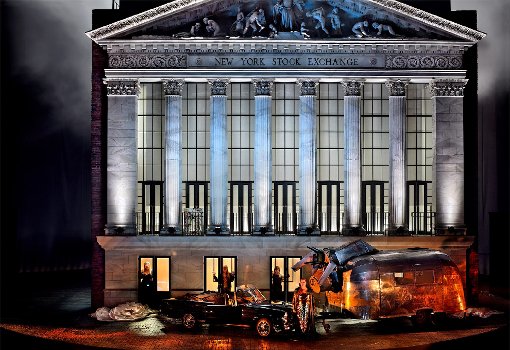
The Ring Goes West

First images of the new Bayreuth Ring revealed.
The New York Stock Exchange features in Götterdämmerung, possibly
standing in for Valhalla. Photo by Enrico Nawath © 2013 Bayreuth Festival.
The Bayreuth Festival has let slip stage images from the new production of Wagner's Ring, directed by German conceptual artist Frank Castorf.

Friday, February 22, 2013

Opera Review: Tristan: The Hot Parts Version

The Chicago Symphony Orchestra presents Act II of Wagner's opera.
by Paul J. Pelkonen 
Esa-Pekka Salonen. Photo by Clive Barda © EsaPekkaSalonen.com
The Chicago Symphony Orchestra has a long tradition of presenting Wagner operas, from its 1891 stint accompanying the touring Metropolitan Opera (in an Italian-language performance of Lohengrin) to a 1995 concert performance of Die Meistersinger  (which became a Grammy-winning 1997 recording) with the late Sir Georg Solti.

On Thursday night, conductor Esa-Pekka Salonen offered his own spin on this tradition with a 90-minute, intermission-less concert that paired the Prelude from Act I of Tristan with the complete second act of that opera. Performing  the work in this fashion allowed the audience to hear this familiar music in a new way and focus on the grand love duet that dominates the second act. More importantly, Mr. Salonen, an award-winning composer himself showed the connection between the famous Tristan chord and the tragic events that end the opera's second act.

Mr. Salonen took an idiosyncratic approach to the Act I Prelude, He waited for absolute silence in Orchestra Hall before launching into the three-note figure that forms this opera's orchestral signature. The conductor sped up as the swell sound increased, leading the heaving central climax at a passionate clip. Throughout, there was a perfect, limpid clarity of strings, wind and horns, right down to the two cello plucks that lead into Act I.

Thursday, February 14, 2013

The Grail-Shaped Beacon

Some (more) thoughts on Wagner's Parsifal.
by Paul J. Pelkonen
"You know where you can find me again." Jonas Kaufmann in Act II of the Met's new Parsifal.
Rehearsal photo by Ken Howard © 2013 The Metropolitan Opera.
Why is it that whenever I'm having one of these days where I'm feeling blocked and vaguely like I can't write anything, that I can always turn to one opera for support?

That opera is Parsifal. Wagner's final stage work not only has amazing music, but it also has a timeless, quasi-religious quality to it, the sound of spiritual meditation and yes, even prayer. Regular readers of this blog know that this is an opera I write about regularly, when a new CD or DVD recording comes out. With the Met about to open a new François Girard production tomorrow night, this is the time to stop and think about what this work means, both to me and in general.

I own a lot of Parsifals. (Eleven at last count.) In fact, it was the first opera that I ever owned a recording of on CD when I was in college. That was the 1985 James Levine recording from the Bayreuth Festival, a set I first encountered because it featured the beautiful Waltraud Meier as Kundry, the opera's principal female character. (This recording is among the longest in the catalogue, timing out at 4 hours and 26 minutes. Mr. Levine's Parsifal is not for the faint-hearted.)

Monday, January 30, 2012

Opera Review: Inside the Circus Maximus

The Opera Orchestra of New York revives Rienzi.
Image © 2012 Rienzi Foods. Nothing to do with opera, and not a paid advertisement.
For Wagnerians, the composer's ten "mature" operas are near-sacred texts. They are (generally) not cut (much) or edited in performance. They are never interrupted by applause during an act. And they are revered by critics and fans of German opera alike. 

The same cannot be said of Rienzi, a five-act grand opera written in the style of Giaocomo Meyerbeer and completed in 1840. Wagner's third opera is a huge potboiler. If the score, with its endless processions, choruses and a huge ballet was played uncut, it could run longer than Die Meistersinger. Based on a novel that Wagner devoured,  the story retells and romanticizes the political career of Cola di Rienzo, a "man of the people" who rose to power in 14th century Rome. 

Rienzi is early Wagner, written in a style that imitates Meyerbeer, but with plot and music elements that show up in later gesamtkunstwerks: Lohengrin, Götterdämmerung and even Parsifal. Although the opera has never been played at Wagner's custom-built Festspielhaus in Bayreuth, it took the stage regularly in the first half of the 20th century. Following World War II,  word got out that Rienzi was the favorite opera (and possible political inspiration) of one Adolf Hitler. Now, it's revived maybe once a decade.

Over its long history, the Opera Orchestra of New York, (which specializes in concert presentations of rare operas)  have made something of a tradition of Rienzi. On Sunday afternoon at Avery Fisher Hall, former OONY music director Eve Queler led the OONY, two choruses, three offstage bands and a full cast in a three-hour performing version that excised about 40 minutes from Wagner's king-sized score.

The title role is sheer murder. This was the first of Wagner's "super-tenor" parts, with a high, loud tessitura that must cut through trumpets, multiple snare drums and dominate all of Rome with oratorial skill.  British heldentenor Ian Storey sang with pungent tone, delivering the required volume with a steady delivery, but looking uninvolved with the proceedings. Also, he kept leaving the stage during scenes involving his character, making an already shortened, confusing opera even more chaotic for the audience. Some redemption came in the last act, when Mr. Storey put everything into Rienzi's Prayer, the show's biggest hit.

As Rienzi's sister Irene, Elisabete Mateos displayed piercing high notes and ringing metal in her voice. Unlike Mr. Storey, she milked her character for all of its dramatic worth.  She was as fiery as the oranges and yellows of her first gown of the evening, (a blinding affair.)  Her performance, (and her fashion sense) got better as the opera wore on.

The best performance was Geraldine Chauvet as Adriano Collonna, who winds up on the opposite side of the opera's political plot. Ms. Chauvet was thoroughly invested in her character, elevating the proceedings with a sweet tone and high-energy stage presence. This was an agile, attractive instrument in a rare (for Wagner) trouser part, making the most of her dramatic and vocal opportunities. It would be good to see her in a better opera.

Despite some stiff phrases in the opening phrases of the Overture, Eve Queler brought a smooth, sweeping approach to this complicated score. She was in her glory in Act IV, where the audience was assaulted by Berlioz-like squads of offstage trumpets and drums. Video monitors and skilled assistant directors helped make this difficult scene the most exciting part of the show. 

Ms. Queler rode the momentum of this scene into the final act of the opera. She brought noble tone out in the brass for the Prayer, and created a suitably intense crowd scene with help from the New York Choral Society. Mention must be made of the children's choir Vox Nova and an anonymous group of professional singers, a late substitution for the West Point Glee Club. In the final bars, the diminuitive conductor was in her element: bringing the thunderous sound of rare opera to the ears of appreciative New Yorkers.

Trending on Superconductor

Translate

Share My Blog!

Share |

Critical Thinking in the Cheap Seats