Albert Einstein once said that the definition of insanity is doing the same thing over and over again and expecting different results. Which might account for why the Metropolitan Opera chose this spring to revive its huge, hideously expensive and critically pounded Robert Lepage staging of Wagner's Der Ring des Nibelungen. There are three cycles this season, and a few extra performances of the opera. Saturday afternoon marked the start of Cycle I, a sold-out Das Rheingold that, unaccountably still had a few empty seats.
Sixteen years after its Salzburg premiere and fourteen years after the first North American performances, the Metropolitan Opera finally stages L'Amour de Loin ("Love From Afar") by contemporary Finnish composer Kaija Saariaho, in a new production by Robert Lepage.
According to an article published yesterday on parterre.com, this might be the end of the road for the Metropolitan Opera's current production of Wagner's Der Ring des Nibelungen. The company has one performance of Siegfried and one of Götterdämmerung scheduled for later this week.
Richard Wagner's Siegfried is the least popular chapter in the Ring cycle. Wagner thought audiences would eat up this fairy-tale story of a blond muscleman who grows up in the forest and embarks on a career as a dragon-slayer before wooing the Valkyrie maiden Brunnhilde. But he didn't put any women in the first three hours of the opera. The 11am start time at the Metropolitan Opera House might also account for the number of empty red velvet seats at Saturday's matinee performance, the first of three this season.
The six-hour final chapter of Wagner's Ring is in some ways the most conventional opera of the four. That's because Götterdämmerung (the title translates as Twilight of the Gods, though the opera was originally called Siegfried's Death) was the first libretto written. Twenty-four years later, this was also the last opera of the Ring to be completed, so it has the most complex music.
Although it's part of the Met's much-hyped Robert Lepage production of the Ring Cycle, Wagner's Siegfried might have the worst reputation among the ten operas that are considered to be the German composer's main body of work. Wagner conceived the opera as the "light-hearted" section of the Ring. (In all fairness, it does have a happy ending!)
In a dreary Metropolitan Opera fall season dominated so far by (dull-to-competent) revivals, the New York premiere of Thomas Adés' opera The Tempest (seen from the very last row of the house on opening night) provides a sorely needed breath of musical and dramatic innovation.
The Metropolitan Opera has announced the release date for its DVD and Blu-Ray sets of the company's Robert Lepage production of Der Ring des Nibelungen:
September 11, 2012.
The sets, which are re-packagings of the Met's Live in HD performances of Das Rheingold, Die Walküre, Siegfried and Götterdämmerung, are scheduled for general release on the 11th anniversary of attacks on New York and Washington, DC that destroyed the World Trade Center and part of the Pentagon.
There are many memorable moments in Wagner's Dream, the new documentary by Susan Frömke, delving into the inner workings of the Metropolitan Opera's multi-million-dollar mounting of Wagner's Ring Cycle. However, nothing is more telling than what happens after Deborah Voigt fell off the set.
The soprano, who was making her debut in the key role of Brunnhilde took her tumble in the opening moments of Act II of the premiere of Die Walküre. The movie shows the build-up to the accident, and the fall itself. The cameras track Ms. Voigt afterwards, recording her embarrassment at tripping over her long Valkyrie skirt, and her determination to have that precarious entrance altered in the following performances.
The next day, her decision was abruptly overruled by Met general manager Peter Gelb.
According to a report first posted on Norman Lebrecht's website Slipped Disc, the Metropolitan Opera has done the unthinkable, slashing prices across the board for upcoming performances of the three complete cycles of Wagner's Der Ring des Nibelungen.
Checking ticket prices for an April 24 performance of Götterdämmerung (according to the Met website) are now as low as $45 for the rear of the Family Circle. Orchestra Balance seats (off to the side) are as low as $180 (formerly $275), with better seats (Orchestra Premium) going as high as $345 (down from $650.) There are even a few coveted aisle seats available for some shows.Das Rheingold has had ticket prices cut by as much as 50%, with Family Circle seats priced at the normal rate of $25-$35. A few days ago, they were $55.
Even more surprising: the wide availability of tickets for the April 13 Die Walküre, opening night of that opera, which is considered the most popular entry in the tetralogy.
This quiet, unannounced move may be a desperate attempt to fill the house as the Ring approaches. The cycles launch with the return of Das Rheingold on April 4. No information is available as to whether ticket holders who already bought seats under the old price structure will receive some sort of remuneration from the Met.
The Metropolitan Opera's current production of the Ring, designed and directed by Robert Lepage, has met with mixed reviews as the four operas have launched over the last two years. The multi-million dollar production, constructed around a massive movable set (sarcastically dubbed "The Machine" by the stage crew) has had its share of performance malfunctions, occasionally forcing singers to improvise on the stage apron. More serious were two onstage accidents, both during 2011 performances of Die Walküre.
The January premiere of Götterdämmerung featured some shaky special effects, including exploding plaster statues that were meant to evoke the fall of Wagner's Germanic gods but caused the opening night audience to laugh at the opera's climax.
This month marks the first "full" performances of the cycle, which are traditionally sold to the Met audience as four-opera packages at double the face value of ordinary seats at the Met. The company's former production, by the German team of Otto Schenk and Gunther Schneider-Siemssen, was notable for being one of the company's most coveted tickets, and a perennial sellout.
Met ticket prices have steadily gotten higher in the last three seasons, as the house has had to cover increased operational costs. These include general manager Peter Gelb's pricey Met Live in HD series, which brings Met operas to movie screens around the world on Saturday afternoons. Next season's brochure features a "staggered" ticket policy with higher rates being charged for new productions and of course, Wagner operas.
In other news, the company has been generating much hoopla over a planned series of Live in HD re-runs of the video broadcasts of the four operas in the Ring. These screenings are not new films drawn from the April and May Ring cycles, but re-broadcasts of the performances shot in 2010, 2011, and 2012.
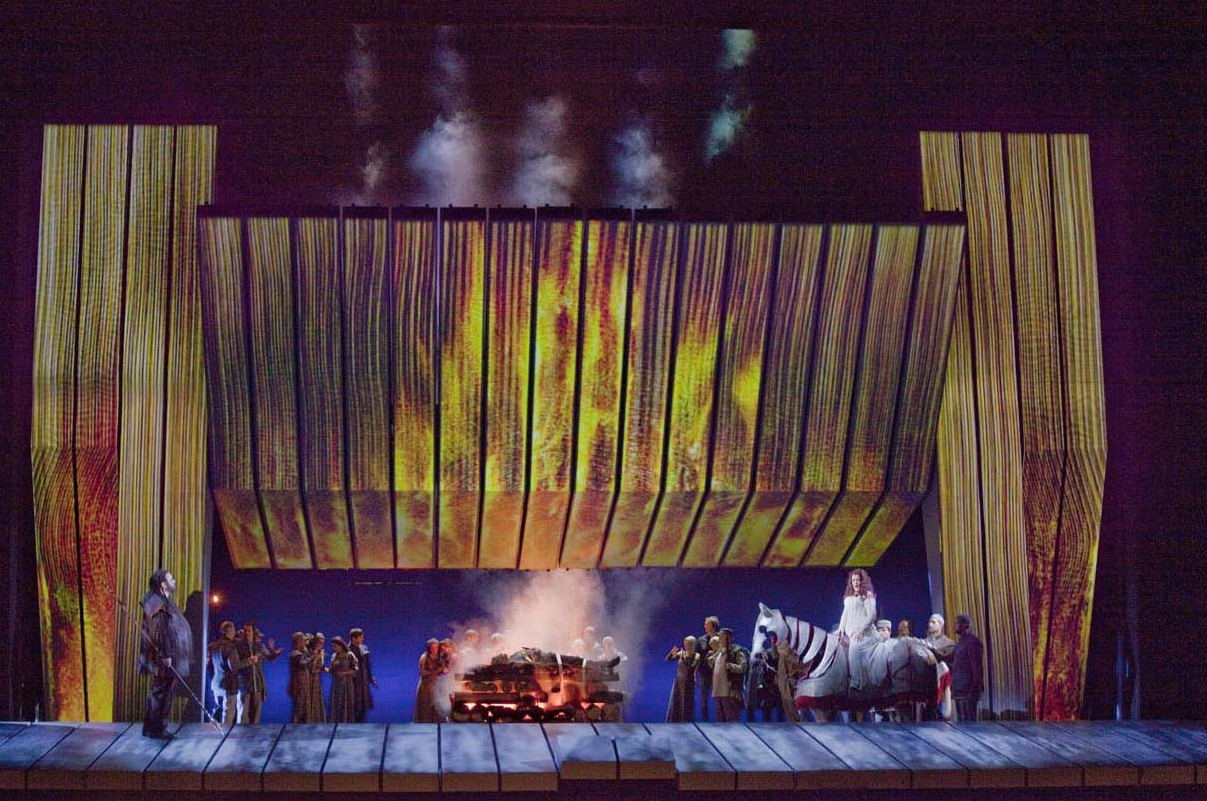
The Metropolitan Opera unveiled the final segment of the company's new Ring Cycle last night with the house premiere of Götterdämmerung. This is the Robert Lepage production, featuring a frequently moving unit set ("The Machine") that reconfigures itself as needed to serve as a huge projection screen for digital imagery by Ex Machina, Mr. Lepage's Canadian production house.
This is not the best cast ever put onstage for Götterdämmerung. Deborah Voigt's performance had its rough moments, thanks to a dodgy middle register and a wide vibrato that threatened to degenerate in Act II. But the red-wigged diva pulled her performance out of the fire, even as she rode a giant robo-horse into the flames, singing an impressive, noble Immolation Scene.
Jay Hunter Morris continues to impress with his energetic Siegfried, although his diction still sounds a little weird at times. (Maybe it's a Texas thing.) His voice is a little small for the part, but with careful conducting from Fabio Luisi in the pit, he navigated the role's rough spots or in one case (the Act II "impossible" octave drop) avoided them altogether.
Gött-er-dämm-erung. Even the name sounds intimidating, pronounced with an "er" on the first syllabule and a slightly elongated nasal "a on the third. The English title, "Twilight of the Gods" also sounds kind of scary.
So you've decided to see it. Whether you're a die-hard Wagnerite with six Ring cycles under your belt or a novice going to the opera for the first time, here's a quick survival guide to one of Wagner's most imposing operas. Well, not that quick: Götterdämmerung is really long.
This is the last chapter in the Ring of the Nibelungs, a four-opera cycle dealing with the legends of Siegfried, Brunnhilde and various dwarves, giants and gods feuding over possession of a magic ring that allows its holder to rule the world. It's also a powerful evening of opera, with rape, betrayal, murder and redemption coming in surprisingly quick succession over the course of a long opera.
Here's an opera-goer's synopsis:
Although it is performed in three acts, the first part of Götterdämmerung is really a combined Prologue and Act I. At two and a half hours, it is long as a Puccini opera. There are no stops for applause, and no bathroom breaks. You can't leave the theater until intermission. In other words, pee before it starts.
The opening scene (a prologue to the Prologue) with the Norns may sound boring. It's not--there's some really neat music, but it's basically set-up for everything that follows. Wagner wrote this scene originally to explain everything that was about to happen to the audience--who Siegfried was. He later wrote prequels to the libretto for the original Siegfrieds Tod--and it is those prequels that make the first three parts of the Ring.
Next the tenor and soprano take the stage and sing a big love duet with lots of "Heils." As this is high, exposed music, you can soon assess whether these are singers that are worth your time or whether it's time to start rooting for Hagen. The duet is followed by the Rhine Journey, a mini-tone poem for orchestra that covers the scene change.
The action then moves to the Gibichung Hall. The descending theme of the Gibichungs marks the proper start of Act I, although the music never stops. This is your chance to see if the bass singing Hagen has a black, rounded tone in his instrument, necessary to express what an evil bastard this character is. Then Siegfried shows up, and promptly drinks a potion of forgetfulness. He then falls in love with the first available woman, Gutrune.
The toughest stretch of Act I comes in the scene known to Wagner geeks as "Hagen's Watch." The opera's bad guy sits himself down, and in a long bass aria, explains who he is and what his evil plan is to the audience. There is then a long orchestral passage while the scenery transforms before your eyes, from the Gibichung castle on the shore of the Rhine, back to Brunnhilde's fiery rock.
Wagner follows these two slow passages with a long dialogue between Brunnhilde and her Valkyrie sister Waltraute, about how their father Wotan (king of the Gods) wants to kill himself and end the world. Things pick up again with the arrival of the drugged, disguised Siegfried, who is wearing the Tarnhelm, Elmer Fudd's original magic helmet. Disguised as Gunther, the poor tenor has to pretend to be a baritone in order to kidnap his soon-to-be-ex. This deception sets up the crisis in Act II.
Here's the good news. If you've made it through these two long scenes, the rest of the opera (though long) is easy.
Act II is an hour, and gripping from start to finish. Hagen sings the Summoning of the Vassals, bellowing over a huge orchestral outburst. This brings the chorus onstage. There's a big wedding procession, and then Brunnhilde realizes that Siegfried was the one who kidnapped her. Her reaction isn't good. The act ends with a vengeance trio as Brunnhilde, Hagen, and Gunther (Hagen's wimpy brother) plan to murder Siegfried.
Act III is basically three scenes. It starts with the still-drugged, newly married Siegfried confronting the Rhinemaidens (with some pretty music) and is followed by the hunting party where Siegfried gets stabbed in the back. The tenor takes about five minutes to die. Next: the funeral music, which allows the orchestra to show off.
Finally, we come to the Immolation Scene. This is essentially a 20-minute scena for the soprano that sums up and wraps up all the plot points of the Ring before she jumps on her horse and rides it into Siegfried's funeral pyre. Hopefully, there's some cool conflagatory business going on for you to look at.
Once that conflagration happens it's home-stretch--there's just five minutes to go in the Ring. Sit back, enjoy the cascading chords as they resolve around you, and be proud--you've just made it through one of the toughest German operas ever written.
Contact the author: E-mail Superconductor editor Paul Pelkonen.
Kaboom! Director Michael Bay and his ideas for Götterdämmerung.
We're about two months away from the opening of the Metropolitan Opera season, and three months away from the premiere of Siegfried, the third part of the company's new Ring cycle designed and directed by Robert Lepage.
Or is it?
According to an item on parterre box, the Canadian director is considering bringing in a "ghost director" to work on Siegfried and Götterdämmerung, the last two operas in the massive mythological cycle. No information was given on who this might be--whether it's an assistant director from the house or another big-name professional.
Mr. Lepage's Ring has met with mixed reviews for the first two installments. Das Rheingold was stagey and beset with blocking problems, including a conspicuous pair of non-threatening Giants.
Die Walküre went off smoothly, despite an Act I set that looked shipped in from IKEA and the bizarre decision to have a double play Brunnhilde as she slept on top of her mountain. Speculation: this arrangement could have been made to ensure extra rehearsals for Deborah Voigt's summer run of Annie Get Your Gun at the Glimmerglass Festival.
Since we here at Superconductor have no information beyond the parterre snippet, the time has come to engage in rabid speculation as to who this "ghost director" might be. Here's five candidates:
Herbert von Karajan: Sure, he's dead. But the former Austrian conductor would probably like finish his incomplete cycle at the opera house from the 1970s. Could the spirit of von Karajan descend from the heavens above Austria and lead an inspired Götterdämmerung? Barring that, could he direct?
Julie Taymor: The trials and tribulations of the U2-written musical Spider-Man: Turn Off The Dark were one reason the Met's technological issues with the Ring didn't hold the headlines. Ms. Taymor might return to the scene of her triumphant Die Zauberflöte. Her dragon is better-looking anyway.
Otto Schenk: The people's choice! Herr Schenk directed the company's wildly successful staging of the Ring that held the boards at the Met for 20 years. I'm sure that there's a container somewhere in New Jersey that still has the old sets, and that they can be whipped back into shape for the complete cycles planned for next Spring. But that would make too much sense.
Stephen Wadsworth: He's directed the Ring in Seattle. Last year, he took just six weeks to stage the Met's new Boris Godunov after German director Peter Stein cancelled in mid-July. The most likely candidate on this list.
Michael Bay: The Hollywood filmmaker understands the manufacture of "entertainment" where huge, clanking machinery takes higher priority than the safety of performers, and heart-warming drama is replaced by soulless technology and ginned-up computer-generated special effects. The man who gave us Transformers, Revenge of the Fallen and Dark of the Moon is the guy they should have hired in the first place.
The debut of part II of the Robert Lepage production of Wagner's Ring Cycle features Deborah Voigt in the title role and Bryn Terfel as Wotan. Jonas Kaufmann is Siegmund, singing his first Wagner role at the Met. James Levine is scheduled to conduct the run of performances.
My old music teacher James Kurtz pointed out that Walküre was the first opera in the Ring to involve actual human beings with real emotions after the abtruse world of Rheingold with its gods, dwarves and giants. It also has some of Wagner's "greatest hits", including the "Winterstürme" aria, the Ride of the Valkyries, and the Magic Fire scene. Put those two facts together, and you have one of the most popular operas Wagner ever wrote.
The plot of Walküre concerns an act of incest and adultery between the twins Siegmund (Jonas Kaufmann) and Sieglinde, (Eva Maria Westbroek) the half-human Wälsung children of Wotan the king of the Gods. The rest of the opera is a chase, with the twins' half-sister Brunnhilde attempting to save them from the wrath of their father Wotan. Siegmund is killed. Sieglinde goes into exile. But the ultimate result of their union: the hero Siegfried, is the title character of the next opera in the Ring.
Recording Recommendations:
For recommendations for a complete Ring, click here.
For a recommendation of a recording of Das Rheingold, click here.
There are probably more recordings of Walküre out there than any other Wagner opera, for the simple fact that it's the one opera from the Ring that stands alone without being part of a complete cycle. But when it comes to this opera, there are basically two contenders.
Bayreuth Festival, 1966, cond. Karl Böhm (Philips, (currently Decca) 1970)
This is a really special performance, recorded live at the Festspielhaus. What sells it is James King and Leonie Rysanek as an ardent, nearly unbeatable pair of lovers. This is the recording with the famous Rysanek scream: it comes at the end of Act I when Siggy pulls the sword out of the tree.
The later acts feature the solid Wotan of Theo Adam and the great Birgit Nilsson, the one soprano of the golden age of recordings who could sing Brunnhilde, Isolde, Turandot and Elektra and not seem fatigued. Karl Böhm keeps things moving at a lively clip, and the orchestra plays superbly.
To hear what the Ring sounded like in the silver age of Bayreuth, this is the recording to own. The fact that it comes as part of an excellent complete Ring on 14 discs for about $56 bucks should sweeten the deal.
Berlin Philharmonic cond. Herbert von Karajan (DG, 1968)
Karajan's Berlin recording of the Ring is not without its admirers--and I'm one of them. The Austrian maestro has a special touch with Wagner, creating chamber-music dynamics out Wagner's huge set pieces, and making his crack Berlin troops respond with tender, languid playing that makes the first act feel, well, erotic.
This recording boasts a great pair of Walsüngs: Jon Vickers and Gundula Janowitz. For the casting of La Janowitz as Sieglinde, we can thank the confines of the recording studio: the role was far too heavy for this middle-weight soprano to tackle onstage.
The same applies to Regine Crespin, a controversial Brunnhilde (she recorded Sieglinde on the Solti Ring four years before) in a different mold from Nilsson. In the studio she brings a youthful freshness to the young warrior maiden. Thomas Stewart's performance as Wotan is under-rated.
Wednesday night at the Met featured the return of the Robert Lepage production of Das Rheingold, with a few changes in the cast and in the orchestra pit. Principal guest conductor Fabio Luisi subbed in for an ailing James Levine.
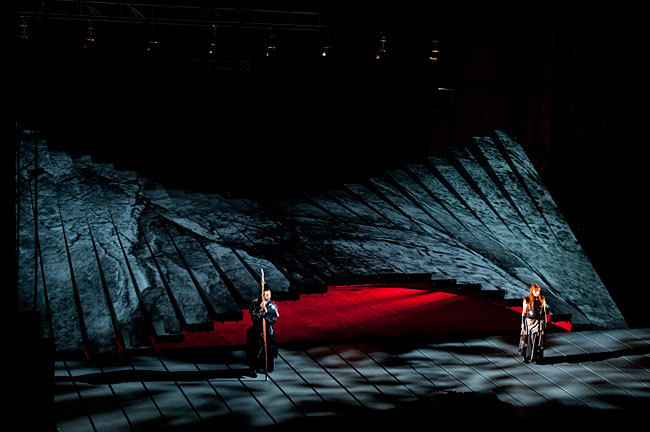
It also brought some fresh perspectives on the staging, seen this time from the back row of the orchestra standing room. From eye level, Mr. Lepage's "Machine" set--24 computer-controlled planks that form the many landscapes of Wagner's imagination, remains curiously featureless.
The underwater opening still successful, helped this time by the presence of baritone Richard Paul Fink as Alberich. Mr. Fink played the dwarf with cunning, humor, and full baritone voice, managing to cope with sliding up and down the computer-generated riverbed as he chased the Rhinemaidens about.
The "rocks" configuration (used for Scenes Two and Four) is more problematic. Wagner calls for a mountain height, but this looks more like an aircraft carrier, with battleship gray Machine-planks looming like tank cannons aimed at the audience. The split-level staging ensures distance between the gods and giants, removing the giants' ability to threaten the gods. There are also balance problems, with the basses Franz-Josef Selig (Fasolt) and Hans-Peter König (Fafner) rendered inaudible at times. On the bright side, a steep tilt of the set makes it easy to get Fasolt's corpse off the stage. (James Bond villains, take note.)
Despite the production issues, things are getting better on the road to Valhalla. Bryn Terfel seemed more secure of tone as Wotan. An experienced villain actor, the burly Welshman improves as Wotan gets meaner, culminating in a completely bloodless theft of the glowing Ring. Stephanie Blythe had a great night as Fricka, singing with ample, rounded tone. The tension between them was palpable, a portrayal of the classic bad marriage.
The best addition to this cast is Arnold Bezuyen, making his company debut as a pointed, sarcastic Loge. He brought interest and involvement to the fire god's Narrative, something lacking in October's performance. It's too bad the costume department made him look like the Baron Harkonnen from David Lynch's movie version of Dune.
On the podium, Mr. Luisi drew out some interesting textures. The bass trumpet was accented at the end of the Prelude. The anvil-driven Nibelung rhythms had punch. The conductor's best moment was in the Erda scene. At that point, all the hype about the cast, the Met and the Machine went away and you were drawn deeply into Wagner's mythological story. But that didn't come until two hours in.
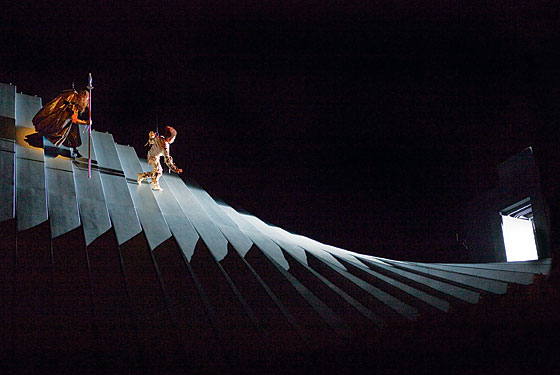
The production continues to boast some innovative visual ideas--the descent into Nibelheim, the Gods' climb up the face of the machine to Valhalla. Unfortunately, like many Met stagings, the best visuals are well above the stage, and hard to see from under the overhang of the parterre boxes. But they probably looked great from the parterre seats.
Opera offerings at the Brooklyn Academy of Music are sparse this season, but this exquisite production of Stravinsky's The Nightingale (imported from the Toronto-based Canadian Opera Company) provided ample compensation--the unique spectacle of a Russian opera, set in China and performed as a water-based ballet of intricate puppets.
"I want to know why they (meaning the Metropolitan Opera) re-staged the Ring. The Met was the only opera house in the world that had a staging that was as Wagner wrote it. People from all over the world came to see it and it was always sold out!! So, Why? I would really like your opinion."
And that sounds like a great excuse for a post about Wagner.
So here are some reasons why the Metropolitan Opera has decided to mount a new production of Der Ring des Nibelungen.
Ten reasons, in fact.
1) The Question of "Authenticity": To start with, the production in question, designed by Gunther Schneider-Siemssen and directed by Otto Schenk, was in no way "as Wagner wrote it." It was pretty close, but certain visual elements (and livestock) were eliminated. Herr Schenk created an innovative staging that used available 1980s technology to approximate what Wagner put in his librettos. But it was in no way the same as the first staging of the full Ring in 1876.
Following Wagner's death in 1883, Cosima Wagner maintained her husband's productions of the Ring and Parsifal until the sets practically fell apart. It wasn't until the 1900s, when her son Siegfried Wagner took over the management of Bayreuth, that new productions were allowed. And those were all based on the old ones. Authentic theatrical innovation did not come to Bayreuth until 1951, following the fall of the Nazis and the re-opening of the Festspielhaus under Wieland Wagner and his brother Wolfgang. And even their ideas ossified and were replaced, leading to the Bayreuth policy of new productions of the Ring every eight years.
2) Shelf Life: The Bayreuth Festival stages a new Ring every eight seasons, running a production for seven years and then taking a year off from the Ring before mounting a new one. Since the Met Ring's lifetime (counting the point from when the staging was first planned in the early '80s), Bayreuth has seen new Rings from Patrice Chereau, Sir Peter Hall, Harry Kupfer, Alfred Kirchner, and others while the Met has been duct-taping their show back together every few years or so.
By way of comparison, the Schenk Ring was on the boards of the Metropolitan Opera house for 22 years. (Die Walküre premiered in 1986, and the final performance of Götterdämmerung was in 2008.)
3) Boredom: Audiences, believe it or not, who live in New York, get tired of seeing the same show over and over. I saw the Schenk Ring in 1993 (in part), 1997, 2000, 2004 and 2008. Every time, the lighting was different. The cast was different. And the show got either better, or worse. The best I saw was that last cycle in May of 2008. While the last Ring I went to in 2008 had great singing, the show itself was getting tired.
4) Administration: The Met has a new general manager in Peter Gelb. He's still the new guy, and putting a new Ring on is part of him doing his job and making sure the Met remains a living, breathing, theatrical institution and not some dusty museum that caters to the tourist trade. And by the way, the Met's biggest money-maker is the Zeffirelli La bohéme, which has been running for 30 years as of this season.
5) Media: The old production has already been recorded and filmed with a cast of singers that are now either retired from the stage (Siegfried Jerusalem) or on the verge of calling it a career (James Morris, Jessye Norman.) It's exciting to have a fresh-voiced cast of new talent on the Met stage. They deserve a new production. And when Ben Heppner sings in Siegfried and Götterdämmerung (planned for 2011 and 2012) opposite Deborah Voigt, I think that the results will be worth the wait.
The "Magic Fire" scene from Bayreuth, in the 1988 Harry Kupfer production of Die Walküre.
6) Storage and Wear: Sets have to be repaired. Props and costumes break, get lost, or decay. They have to be stored. Lights and visual effects (gels, gobos, magic fire machines) wear out and have to be replaced. Costume restoration and storage of the massive sets (all those mountains and valleys and castles and stuff, not to mention the two dragons) required expenditure on the Met's already tight budget. A new Ring, with the unit set, makes financial sense even if the Met had to pay to reinforce the left side stage in order to store the heavy set.
7) Money: Opera houses in America are not funded with government handouts, unlike in Europe. They rely on private and corporate donors in order to stay solvent. That is, open. It's more attractive to ask those donors to donate to a new staging (one that they can make their "own") then to ask donors and corporate sponsors to spend on the upkeep of the old one.
8) The Director: Robert LePage has fresh, innovative ideas about the Ring, that are actually conventional at heart and close to Wagner's own. And he's making a new Ring using modern technology to tell the same story Wagner did. He's doing the same thing as Otto Schenk. But using lights and projections instead of papier-mâché and fake rocks.
9) The Composer: Wagner himself would have been excited about the new production. After all, the old Meister once said: "Children! Go do something new!" Not that they listened.
10) Time: It's a new century, a new millennium and New York deserves a new Ring. I can't wait for Walküre.
Hagen's Watch, from the Otto Schenk production of Götterdämmerung.
The Metropolitan Opera's new production of Das Rheingold, designed and directed by Robert LePage, has its share of jaw-dropping moments. Monday night's performance featured a virtuoso performance from James Levine and the Met orchestra, supporting a strong (if not quite ideal) cast. But all eyes were on the staging, a multi-million dollar affair that uses high-tech machinery to produce Wagner's mythic world.
The Metropolitan Opera's new computer-driven mounting of The Damnation of Faust is a showcase for the staging techniques of Robert Lepage, the Quebecois director best known for his work with Peter Gabriel and Cirque de Soleil. It is the Met's first attempt to stage this Berlioz work since 1906.