Support independent arts journalism by joining our Patreon! Currently $5/month.

About Superconductor

Our motto: "Critical thinking in the cheap seats." Unbiased, honest classical music and opera opinions, occasional obituaries and classical news reporting, since 2007. All written content © 2019 by Paul J. Pelkonen. For more about Superconductor, visit this link. For advertising rates, click this link. Follow us on Facebook.
Showing posts with label Box set. Show all posts

Monday, April 9, 2012

Recordings Review: I Pity the Fool

Marek Janowski's 2011 Berlin Parsifal.
by Paul J. Pelkonen
Parsifal and Kundry as painted by Rogellio de Egusquiza.
This is a live recording of Wagner's Parsifal made on April 8, 2011 before an audience at a single Berlin concert. in a single Berlin concert. It is the third entry in Marek Janowski's ambitious plan to record and release all ten Wagner operas on PentaTone, an independent German label (distributed by Naxos) that specializes in multi-channel hybrid Super Audio CDs. It falls among recordings like Pierre Boulez' and Herbert Kegel's that favor a lean and mean approach to presenting Wagner's final opera.

Sunday, November 27, 2011

Superconductor 2011 Gift Guide Part II: Orchestral Boxed Sets

One of these boxes has music in it.
With the major labels constantly merging and trying to re-sell old recordings, there are excellent opportunities for the collector. The recordings here are all orchestral music, with great conductors tackling familiar works. Buy one of these for someone you know, and they'll be happy you did.

Nielsen: The Masterworks Vol. 1: Symphonies 1-6, Orchestral works (Da Capo, 4 CDs, 2 DVDs)
Danish National Orchestra cond. Michael Schønwandt. 
Those of us who stayed in New York this summer can tell you that Mr. Schønwandt's performance of Nielsen was a concert highlight of those hot months. The Danish conductor brings his razor-sharp ensemble to a complete cycle of the six symphonies. Recommended here: the bold Inextinguishable Symphony (No. 4) and the brisk Four Temperaments (No. 2). The set also includes overtures and rarely heard excerpts from Nielsen's stage works, not often played outside of Denmark.

Bruckner Symphonies No. 3-9, Sacred Works (EMI, 12 CDs)
Munich Philharmonic cond. Sergiu Celibidache
The Romanian conductor Sergiu Celibidache worked at the height of the recording boom. Yet, the maverick maestro famously refused to join the frenzy of record-making, preferring to let his live performances speak for themselves. When he died, his family did not hesitate to make his performances available on CD. These EMI reissues are at a budget price, featuring his mystic approach to Bruckner with the Munich Philharmonic.

Stravinsky: The Complete Ballets and Symphonies (Decca, 7CDs)
Orchestre symphonique de Montreal cond. Charles Dutoit
Cleveland Orchestra cond. Vladimir Ashkenazy
Royal Concertgebouw Orchestra cond. Riccardo Chailly
This is pretty good Stravinsky. Not absolute top-rank: that's Pierre Boulez' DG recordings or the composer's own readings on Sony. There are some great performances here though: Charles Dutoit's Montreal account of The Firebird and Vladimir Ashkenazy's Cleveland Rite of Spring. The set also includes more modern ballet scores like Agon and the composer's neo-classical symphonies and works for piano and orchestra.

Charles Munch: Late Romantic Masterpieces  (RCA 7 CDs)
Boston Symphony Orchestra cond. Charles Munch 
Charles Munch's Boston recordings have enjoyed something of a renaissance this year, with two boxed sets celebrating his musical legacy. Here is your chance to hear his approach to Wagner, with soprano Eileen Farrell joining the orchestra for scenes from the operas. In addition to solid symphony performances (the Tchaikovsky 4, 6, and Dvořák 8) this set also includes classic concertos.  Violinist Henryk Szerying plays the Tchaikovsky, and cellist Gregor Piatagorsky tackles the Dvořák concerto.

The Mahler Symphonies (RCA, 16 CDs, 1 DVD)
Tonhalle Orchester Zurich cond. David Zinman
I'm just going to quote my own review here:
"The Swiss forces are not as showy a "name" as the Vienna or Berlin Philharmonics or the American "big five." But on these recordings, they play Mahler with freshness, enthusiasm and love for this composer's particular genius. They are led by Mr. Zinman, who chooses brisk, but not rushed tempos, with some exceptions."

"It also includes a fascinating documentary, Going Against Fate, that chronicles the sessions for the Sixth Symphony. The film delves into the complexities of playing in a modern state-sponsored orchestra, from the tuba player's need for brass oil to a bassoonist demonstrating the proper way to wrap and blow a double reed."

Check out the rest of the 2011 Superconductor Gift Guide:
Part III: Beethoven for Christmas
Part IV: Opera Recordings
Part V: Piano Mania

Friday, November 25, 2011

Superconductor 2011 Gift Guide Part I: Giant Boxed Sets

The Doorstop Division: 20 discs and up.
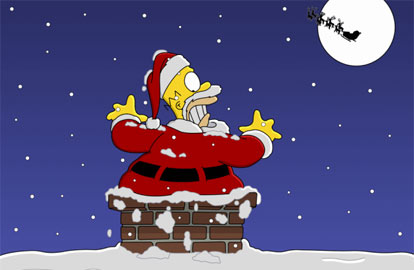
These boxed sets might not fit under your tree--or down your chimney.
Image by Matt Groening © Gracie Films/20th Century Fox.
In the last decade, as Americans have gotten more obese (see photo) classical music has too. Companies have put out huge, bloated "complete collections":
  • All the operas of Richard Wagner including the Ring. (34 discs, on average.)
  • All the piano music of Franz Liszt (99 discs) 
  • Complete editions of Bach, Beethoven, Brahms and Mozart (157, 60, 85 and 170 discs, respectively.) 
  • The Great Pianists of the 20th Century (Now out of print, but it was 200 discs and came in two suitcases.)
You get the idea. It might have had something to do with the millennium, as record labels scrambled to push their music out into the world (again) before the Y2K clock fried their databases. Or it might have been the simple greed that has nearly driven those labels out of business. Only Norman Lebrecht knows for sure.

Despite the bloat (and subsequent devaluing of music to something that you buy the same way you buy cheese)these make  great gifts for the hard-core music lover in your life. They can also make a handy doorstop after spending the holidays ripping the CDs into your hard drive. Which is why Amazon.com is now making it possible to download entire boxed sets with a minimum of effort.

Anyway, here's five picks. They're big, but they're really good. I promise.


Bach: Complete Cantatas cond. Helmuth Rilling (Hänssler Classics, 71 CDs) 
There are several comprehensive sets of Bach cantatas on the market, from Nikolaus Harnoncourt and John Eliot Gardiner. This entry from Helmuth Rilling, the founder of the International Bach Academy in Stuttgart may not be on a flashy major label, but it is more than competitive.

Vivaldi Masterworks Various Artists (Decca, 28 CDs)
When the Philips label was unceremoniously folded into Decca under the banner of Universal Music Group, the catalogue lost the great Vivaldi recordings made by the ensemble I Musici under the direction of Vittorio Negri.

They're all present and accounted for here, along with great performances from period performance  specialists Philip Pickett and Christopher Hogwood. All the Vivaldi you could possibly want, except for the operas. Those will probably be along on another boxed set, as soon as somebody gets around to recording them.

Wilhelm Furtwängler: The Legacy (Membran, 107 CDs) 
Wilhelm Furtwängler was one of the most important conductors of the 20th century, with a unique, flexible approach to Romantic music. This gigantic set preserves his memory with accounts of Wagner, Brahms, Beethoven, Bruckner, and possibly the kitchen sink. Lovingly packaged with small mini-boxes inside the big case for easier management, the whole set is the size of a small Dachsund. This is the gift for the lover of German music.

Tchaikovsky Edition (Brilliant Classics, 60 CDs)
This shelf-bending set of Tchaikovsky is from Brilliant, the same label that brought you the back-breaking editions of Bach, Haydn, Mozart and Beethoven mentioned at the top of the column. It includes the piano concertos, ballet scores, and even the rarely performed early operas. Another weighty entry in a comprehensive series of composer surveys from Brilliant Classics. Includes the major operas alongside lesser-known works like Oprichnik and Mazeppa. 

The Liszt Collection (Deutsche Grammophon, 34 CDs)
If you read this blog regularly, you might remember an article that I wrote comparing (in some detail) the huge boxed sets that were coming out this year to celebrate the 200th birthday of composer, pianist and cigar fancier Franz Liszt. For more detail about the Complete Liszt Piano Music (performed by pianist Leslie Howard) and the other competing sets, please consult this article.

From the out of print Giuseppe Sinopoli recordings of the Dante and Faust Symphonies to the piano music and songs sung by Dietrich Fischer-Dieskau, this is a sweeping collection that celebrates Liszt the composer, and not just of piano music. That is certainly the core here, but orchestral works get equal time, and there's even some rarely heard choral music.

But wait, there's more!
Check out the rest of the 2011 Superconductor Gift Guide: 
Part III: Beethoven for Christmas
Part IV: Opera Recordings
Part V: Piano Mania

Thursday, November 24, 2011

Outside the Box: The 2011 Superconductor Gift Guide

A guide to shopping for the music nut in your life--even if it's you.

You could do worse.
Well, here it is folks, your guide to the very best of classical music and opera. The focus is on releases and reissues within the last year, with some stone classics thrown to make things a little more interesting.

But first, a few words from your editor. That's me.

The arts are struggling in this country. Corporate underwriting has faded with the fluctuations in the market and collapse of big financial institutions. Musicians need to be paid, trips have to be booked, and concert halls have to be heated. Many orchestras are facing program cuts, labor troubles and other signs that have cast a pallor over their seasons. 

If you're an American concert-goer who loves classical music and reads Superconductor, consider donating to your local orchestra or opera company. You get a neat membership card, and in some cases a magazine, newsletter or discounts at local restaurants.

So donate! And then get yourself something nice. After all, it's the holiday season. 

OK. That's the sermon. Now on with the music. The guide this year is in four parts. Well, five if you count this splash page. All products are sold through Amazon.com in my online store.

Everything on this page is 30 discs and up. Sounds like a lot of music? It is but these are for bargain-hunters, catalogue completists, or the serious collector who just can't get enough. 

A personal favorite: these are cool stocking stuffers. All the discs are in envelopes to minimize shelf space and clutter. Of course if you have a lot of them....

Part III: Beethoven for Christmas
All you want for Christmas is an irascible deaf guy who can't hear very well. That's either your Uncle Al or Beethoven. Beethoven wrote better music.


Part IV: Opera Recordings
The best full-length opera recordings to come out in the past year, on CD and DVD. The weird part is, most of them are from the Metropolitan Opera.
For the piano student or the aficionado, classic recordings and new releases. This is going to be a long Liszt, especially since this is the year that all the labels are celebrating the Hungarian pianist's 200th birthday.

Thursday, July 28, 2011

Bland Beyond Belief

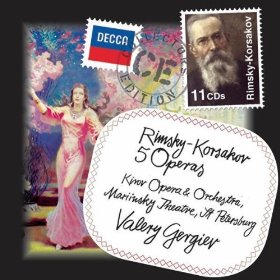
The original album cover of
The Legend of the Invisible City of Kitezh.
© Universal Music Group
The Age of the Nondescript Megabox
So I finally knuckled under to temptation and got myself one of the new boxed sets of opera re-issues that have come out from the good folks at Universal Classics.

The box is from the Mariinsky Opera Orchestra under the baton of Valery Gergiev: a set of five operas by Nikolai Rimsky-Korsakov. I remember the release of these sets on the now defunct Philips label, beautifully packaged in the Mariinsky's trademark eggshell blue, with baroque, painted covers or exotic photographs of the artists.

Now the CDs come in envelopes (which is good) but they're bundled in a cheap black cardboard box with a stock photo of the composer, some kind of painting behind it, and the clever new title: "5 Operas".

5 Operas? Did the marketing department get paid for that one?


Rimsky (best known in the West for his tone poem Scheherezade) was a master colorist, an expert at infusing his orchestrations with the smoky tang of Russian folktales. He is an important opera composer, and stands as the bridge between his friend Mussorgsky (a fellow member of the informal group of composers known as the "Russian Five" or the "Mighty Handful") and his pupil, Igor Stravinsky.

Yeah. This is a much better title.
Especially the number "5" instead of "Five."
These are wonderful recordings, essential listening if you want to take your interest in Russian opera beyond Tchaikovky and Boris Godunov.. These are fairy tales come to life. Sadko is a series of gorgeous tableaux and is set, like the opening scene of Das Rheingold, entirely underwater.

The most important opera in the set is the improbably titled The Legend of the Invisible city of Kitezh and the Maiden Fevronaya (yes, that's the whole title--the opera is also known as "the Russian Parsifal"). Rimsky's harmonies rise to meet the ear, seducing the listener with visions of mythological Russia.

And then there's the casts. These sets feature Russian singers who have become househould names in the last two decades. Dmitri Hvorostovsky, Olga Borodina and of course Mr. Gergiev himself, who has risen to become one of the most-demanded and highest paid conductors in the world.

These are the only major recordings of these works in the catalogue. But with this kind of packaging, no-one will hear them--or want to.

Monday, June 6, 2011

CD Review: He Knew Where His Towel Was

James Levine's 1970s Mahler Symphonies
by Paul J. Pelkonen
James Levine: the early years. Photo from Metropolitan Opera Archives.
The current epidemic of Mahler mania (2010 and 2011 mark both the composer's 150th birthday and the centennial of his death) has caused the four remaining major record labels to flood the shrinking market with reissues of Mahler symphonies. This "incomplete" set of Mahler symphonies (the Second and Eighth are missing) features a much younger, healthier James Levine, at the peak of his powers and staking his claim as a great conductor of Mahler's music.

Monday, May 23, 2011

CD Review: The Grand Master's Wagner

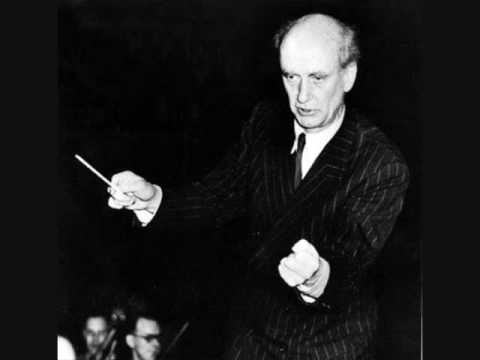
The conductor Wilhelm Furtwängler, in action.
The last decade has seen a slew of bargain-box reissues of Wagner's Ring Cycle. The latest of these, issued by EMI on May 17th in North America to (hopefully) coincide with the composer's 198th birthday, is Wilhelm Furtwängler's second recording of the four operas, made for Italian radio in 1953.

Furtwängler is celebrating his 125th birthday this year. One of the most controversial, and important Wagner interpreters of the 20th century, he was a born Romantic. Specializing in Wagner, Bruckner and Beethoven, he conducted with an organic feel, letting tempos fluctuate in order to mine greater meanings and depths of expression. On these discs, new and exciting details of the score come forth. As expected, the orchestra stretches and flexes under his baton, taking the music in fascinating new directions.

Examples of this idiosyncratic approach include an ultra-slow version of the charging Act III prelude from Siegfried, the rapid Rhine Journey, and the devastating heaviness brought out in Hagen's Watch.. This is always one of the most difficult parts of Götterdämmerung, and the maestro does the right thing: speeding up with anticipation as the scene changes back to Brunnhilde's rock, and then pausing, seeming to stop breathing as the next scene starts.

Big climactic moments, like the Entrance of the Gods, the Magic Fire scene and of course, the Immolation are heard with a new freshness that makes this set hold up on repeated listens. The orchestra plays beyond their abilities, as the maestro makes his Italian band sound like Bayreuth's finest. And yes, it's in mono sound, but the voices sound fresh and immediate, with details leaping out of the orchestra. There is an audience--they applaud enthusiastically at the end of each act--but they make minimal noise otherwise.

The singing is very good. Ludwig Suthaus recorded Tristan with Furtwängler in 1952, and that experience pays off in his Siegfried. Wolfgang Windgassen sings Siegmund here, a rarity for the tenor who preferred the role of Siegfried. (He also sings Loge in Das Rheingold.) Soprano Martha Mödl was recorded here at the height of her powers. brings all of her resources to Brünnhilde, creating a compelling portrait over three operas.

These discs also preserve Ferdinand Frantz' memorable portrayal as Wotan, the deal-breaking god of Das Rheingold, the tormented father in Die Walküre and the sad and lonely Wanderer of Siegfried. This is a towering performance. Gottlob Frick is a brutish Hunding. Josef Griendl a memorable, venomous Hagen. And in Siegfried, tenor Julius Patzak shows that the role of Mime can be sung, not screeched.

Wagner lovers and Furtwängler aficionados probably own this set already. But if you've only heard of the conductor, or only heard whispers of his legendary podium prowess, this is worth checking out. Sure, the packaging is ugly and somewhat unimaginative. There's no libretto included. But for top-notch Wagner at about $4 per disc, the price is certainly right.

Monday, March 21, 2011

Happy Birthday, Johann Sebastian Bach!

Johann Sebastian Bach
Today is the 326th birthday of Johann Sebastian Bach, the greatest composer of the baroque era, and one of the most influential musicians to ever walk the Earth.

Bach composed complex, contrapuntal music, firmly rooted in music theory and tradition, anchored by a rock-solid belief in God. His vast catalogue of compositions includes cantatas, concertos, keyboard compositions and a veritable textbook of organ music. Along the way, he invented the cello suite and wrote the Passions of St. Matthew and St. John, among the most powerful religious music ever written.

And four of his kids grew up to be famous composers.

For some listeners, Bach's mathematically perfect works suggest a divine, ideal form, with carefully constructed spires of counterpoint rising toward Heaven. For others, the precision of Bach can be used to define the triumph of man's reason over superstition. So in other words, the genius of Bach can be used to defend almost any argument.

Luckily, Bach lovers have many options to explore the master's music on disc and mp3, from esoteric high-end performances to giant budget box sets that offer a complete overview of Bach's genius.

Here's a quick look at the best Bach boxes.

Various Artists: Complete Bach Edition (Brilliant Classics, 155 CDs)
This authoritative compilation features the entire Bach ouevre, recorded in high digital quality. These performances do not feature the flashy, big label stars, but the musicians and singers range from adequate to exceptional. Mostly recorded in Holland and Belgium, this massive set will provide two solid weeks of musical education, and that's just at one sitting. Whew.

Ton Koopman, Organ: Complete Organ Works (Warner Brothers Classics/Das Alte Werk 16 CDs)
An exhaustive survey of Bach's works for organ. This reissue features the Dutch organist Ton Koopman, an organist and conductor who also recorded the complete cantatas for Erato. Koopman plays on eight different organs in Holland and Germany. Two of them (the organs in Freiburg and Hamburg) were played on by Bach himself. Other organists that are worth checking out include Simon Preston and the legendary, blind Helmut Walcha.

Concentius Musicus Wein cond. Nikolaus Harnoncourt;
Leonhardt Consort cond. Gustav Leonhardt:
Complete Cantatas (Warner Brothers Classics, 60 CDs)
Nikolaus Harnoncourt is a former cellist who rose to fame by conducting Bach. (Incidentally, he's also a count, and a descendant of Holy Roman Emperors.) He's also a gifted conductor who built an international recording career on the back of these recordings. This was the first complete cycle of Bach cantatas ever recorded and is a milestone in the catalogue of Bach works.

English Baroque Soloists cond. John Eliot Gardiner: Sacred Choral Works and Cantatas (DG Archiv, 22 CDs)
This one's been mentioned before. Recently reissued, this set combines all of Gardiner's stellar recordings of the major Bach choral works: the two Passions, the Mass in B Minor and the oratorios, alongside the first few discs in his cycle of Bach cantatas before the conductor left DG and started his own record label. Crisply played performances in sterling sound.

Glenn Gould, Piano: Glenn Gould Plays Bach (Sony, 6 CDs)
When the 22-year old Glenn Gould recorded his 1955 run-through of the Goldberg Variations, he unknowingly made the first runaway classical hit of the LP era. He also put the pieces on the map as essential repertory for pianists.


Historical performance: Glenn Gould plays Bach's Third Partita for Piano.
Historical importance aside, the idiosyncratic (OK, downright weird) Canadian pianist had a unique interpretative touch. There are other exceptional Goldbergs in the catalogue, but none are as famous. This newly issued set includes Gould playing the Well-Tempered Clavier, the Inventions, Toccatas and Partitas. Not complete, but essential.

Sunday, May 30, 2010

Cosmic Oceans: A Buyer's Guide to Bruckner


Anton Bruckner appears on Austria's 1,000-schilling note.
Start listening to the mighty symphonies of Anton Bruckner and you'll notice two things immediately. One: these are big slow moving works, infused with the composer's rapt religious convictions. They're practically church music. Two, given the massive size of their individual movements, you've now moved into what's considered the "deep end" of 19th century symphonic repertory.
Here's a swimmer's guide to the cosmic oceans of sound: Bruckner's symphonies.

Gunther Wand
The Günter Wand Cycle
This excellent set of the nine numbered symphonies (Wand leaves out the '00' and '0' works) is available in an old-fashioned "doorstop box" from RCA Red Seal. Wand had a long podium career, and became a Bruckner specialist later in his career. His Cologne-based orchestra is quite good, with above-average horns and woodwind. But the selling point here is the conductor's devotion to the absolute letter of Bruckner's scores. This set is a good starting point.

The George Tintner Naxos Cycle
Although he was battling cancer at the time, the late George Tintner made a landmark cycle of Bruckner symphonies. He coaxed great performances from a series of obscure orchestras. This super-budget set includes the, proving that you didn't have to have a big name to play great Bruckner. The set includes Symphony No. 0 (Die Nullte) and the even rarer Symphony No. 00, which Bruckner rejected as being a mere student work.

Royal Concertgebouw Orchestra
cond. by Bernard Haitink; cond. by Riccardo Chailly
Two excellent cycles from the great Dutch orchestra, each featuring a fine conductor. Haitink recorded complete cycles of most of the major symphonists. Under his baton, one hears the classic Concertgebouw sound, a certain mellow orchestral quality that is difficult to duplicate anywhere else. Chailly's set is in more modern digital sound, and showcases this great orchestra under more fiery leadership. His cycle also includes the best performance of "Die Nullte" on this list.
Sergiu Celibidache
Berlin Philharmonic
cond. by Eugen Jochum; cond. by Herbert von Karajan; cond. by Daniel Barenboim
The Berliners cement their reputation as one of the world's top orchestras with these three fine cycles. Jochum is brisk and no-nonsense. His cycle is like Wand's, close to the letter of the text and a sturdy presence in the CD catalogue for years. Karajan is very comfortable in this music and takes a relaxed Romantic approach. These Berlin recordings are better than his later "Karajan Gold" recordings with the Vienna Philharmonic.


The more recent Barenboim recordings (his second complete cycle of the symphonies--the first has been deleted) are the most idiosyncratic, with odd decisions in matters of tempo and dynamic. Still, the Berlin forces play their hearts out, and it is interesting to hear Barenboim puts his unique stamp on each symphony.

The Recordings of Sergiu Celibidache
Special mention must be made of this maverick Romanian conductor. Like Wand, Celibidache was a Bruckner specialist. However, unlike most conductors, Celibidache did not believe in making recordings. Luckily his family preserved tapes of radio broadcasts of some of his performances. These were released after his death in a series of issues on EMI and Deutsches Grammophon. These are not complete cycles, (Symphonies Nos. 1 and 2 are missing, and the DG set omits No. 6 as well) but the performances are moving and in most cases, super-slow. Not the best first performances to own, but these are favorites of Bruckner devotees.

Monday, May 24, 2010

A Complete History of the 'Complete Edition'


The Deutsche Grammophon label has just announced the release of two new "Complete Editions": one featuring all the works of Robert Schumann and one with the complete works of Gustav Mahler.

Schumann: The Masterworks consists of 35 CDs including the piano works, choral music and the quasi-operatic "Scenes from Goethe's Faust" comes out this week. Gustav Mahler: The Complete Edition arrives on June 22. It compiles great DG and Decca recordings of the symphonies by a starry galaxy of conductors, including Claudio Abbado, Herbert von Karajan, and Leonard Bernstein along with pieces like Das Klagende Lied and Das Lied von der Erde.


Complete Editions are boxed sets of CDs, featuring all of the works by one composer, gathered into a large budget-priced box. Most often, the sets come with the CDs packaged in simple paper sleeves. There is usually a small booklet, although some labels save printing costs by making the booklet into a CD file and putting it on a CD-Rom.

The now-defunct Philips label put out the first "complete edition" when they repackaged a lot of old recordings and some new ones as the Complete Mozart Edition to celebrate the 250th anniversary of the composer's birth. This consisted of 180 discs packaged in boxed sets, starting with the symphonies and ending with Die Zauberflöte. The total cost was about $3,000. Luckily, the sets were available seperately, and "mid-priced" at about $11 a CD.

Eventually, the set was reissued again, costing about $1,000, but also available seperately. The clunky, brittle jewel boxes were replaced by 16 cardboard cases and paper sleeves But with the absorption of the Philips catalogue into Decca/London as part of the Universal Music Group, the Mozart Edition sets are again out of print. In 1999, Teldec (now Warner Classics) released the Bach 2000 Edition. (153 discs, 12 box sets.) DG answered with a suitcase-sized Complete Beethoven Edition. Both of these are also out of print.


In recent years, Brilliant Classics have put out Complete Editions of Bach, Beethoven and Mozart, featuring recordings by more obscure ensembles, along with reissues of out-of-print recordings from the Berlin, Decca, and Telarc catalogues. Priced at a dirt-cheap rate (the $145 Mozart Edition consists of 170 CDs--less than a dollar a disc!), these sets are about the size of a loaf of bread. These exhaustive surveys are a cornucopia for music lovers as well as those scholarly types who write long articles about record company reissues for classical music blogs.

Last year, DG got on the bandwagon (again) with their Brahms Edition, which was 46 discs, a veritable cosmic cube of music. They've also put out an excellent Chopin Complete Edition. With the release of the Mahler and Schumann sets, it can only be hoped that the reissues and repackaging of these excellent classical catalogues will continue in the current decade.

Trending on Superconductor

Translate

Share My Blog!

Share |

Critical Thinking in the Cheap Seats