Support independent arts journalism by joining our Patreon! Currently $5/month.

About Superconductor

Our motto: "Critical thinking in the cheap seats." Unbiased, honest classical music and opera opinions, occasional obituaries and classical news reporting, since 2007. All written content © 2019 by Paul J. Pelkonen. For more about Superconductor, visit this link. For advertising rates, click this link. Follow us on Facebook.
Showing posts with label Tristan und Isolde. Show all posts

Monday, December 18, 2017

The Chords That Bind

Superconductor explores a connection between Tristan und Isolde and Siegfried. 
by Paul J. Pelkonen
Left: Ludwig and Maria Schnorr von Carolsfeld as Tristan and Isolde.
Interrupting them: Jean de Rezke as Siegfried. Most rude of him. Equally rude photoshop by the author.
In the operas of Richard Wagner, there is a sort of musical interconnectivity that exists: not just between the leitmotifs of the four operas of Der Ring des Nibelungen but between the other operas too. Certain themes recur in operas with similar ideas. (A famous example is the "Dresden Amen") which appears in both Tannhäuser and Parsifal.) This morning, while having a listen to the 2012 Decca remaster of the Georg Solti/Vienna recording of the Ring, I discovered another such musical connection. In the first act of Siegfried I found the Tristan chord.

Saturday, December 31, 2016

The Year in Reviews 2016: Opera

The best productions and singing that kept vigil in a dark year.
by Paul J. Pelkonen
Vigil in a wilderness of mirrors: Nina Stemme (center) in Tristan und Isolde.
Photo by Ken Howard © 2016 The Metropolitan Opera.
This was an interesting year for opera, marked by Rossini rarities, 18th century operas worthy of the occasional revival and a season-opening Tristan und Isolde that left audiences enraptured and traditionalists confused. Plus the Met did some wish fulfillment (for this writer anyway, finally staging Rossini's Guillaume Tell. Here are ten of the many fine opera performances reviewed on Superconductor in the year 2016.

Tuesday, September 27, 2016

Opera Review: Spirits of the Vasty Deep

The Metropolitan Opera opens with Tristan und Isolde.
by Paul J. Pelkonen
Stuart Skelton and Nina Stemme are Tristan und Isolde in the Met's new staging.
Photo by Ken Howard © 2016 The Metropolitan Opera.

Richard Wagner's Tristan und Isolde is the most demanding of operas. The two leading parts demand tenacious singers who can stay the course for five hours of demanding music. The still-revolutionary score demands a conductor who can navigate its wide, intimidating oceans of chromatic sound, music that changed the way people heard music when the work premiered. Finally, the simple, intimate story demands a setting that makes sense of Wagner's concept: undying, illicit love that transcends marriage, law, life and finally, death. The Metropolitan Opera's new production, launched last night in a special 5pm premiere performance, had all these qualities and more.

Thursday, September 1, 2016

The Superconductor Preview: September, 2016

We launch a new monthly preview feature...right now. 
(isn't that exciting?)
by Paul J. Pelkonen
We at Superconductor celebrate a new monthly preview feature launching with a....

The clock of the classical music season starts running early this month, just two short days after Labor Day. As we prepare to fire the starting gun on the 2016-17 season here are five don't miss events for September, 2016.


BAM NextWave: the loser
David Lang's one-act opera about a pianist who happened to be in the same competitions as Glenn Gould is the opening work of the 2016 BAM NextWave Festival. Starts Sept 7. at the Howard Gilman Opera House.

New York City Opera: Aleko/Pagliacci
The resurgent New York City Opera launches its first fall season since 2009 with this twin bill, pairing Rachmaninoff's first opera Aleko with the classic Leoncavallo work. The story of a vendetta among Gypsies should dovetail nicely with the familiar tale of a knife-wielding clown on a killing spree. At the Rose Theater in the Time Warner Center, starting Sept. 8.
An iconic shot from Woody Allen's Manhattan.
© 1979 Woody Allen, MGM/UA


New York Philharmonic: The Art of the Score
The Philharmonic season actually opens with a gala concert on Sept. 21, but that will be prefaced with the annual The Art of the Score film festival, featuring the orchestra playing Leonard Bernstein's score for West Side Story (Sept. 13-15) and the George Gershwin-fuelled score of Woody Allen's black and white classic Manhattan. (Sept. 16)

LoftOpera: Cosí fan tutte
For some opera companies, the season never ended. LoftOpera returns with their stripped-down and saucy version of Mozart's Cosí fan tutte, mounted at its new location 101 Varick Ave. in  East Williamsburg, Brooklyn.

Stage image from the Met's new Tristan und Isolde.
Metropolitan Opera: Tristan und Isolde
The Met opens its season Sept. 26 with the ultimate feel-bad Wagner opera, a tragic love story here presented in a new production. If you can't get tickets for the opener, go to Times Square and watch it for free on the giant televisions, where Wagner's music should stun a few tourists. Other early Met shows this year include Don Giovanni and the perennial revival of La bohéme.

Friday, August 5, 2016

Metropolitan Opera Preview: Tristan und Isolde

The Met opens its season with Wagner's transcendental tragedy.
by Paul J. Pelkonen
Nina Stemme is Isolde in the Met's new production of Wagner's Tristan und Isolde.
Photo by Ken Howard © 2016 The Metropolitan Opera.
It's love and death on the high seas. The 2016 Met season is set to open with this new nautical staging of Tristan und Isolde starring Nina Stemme and Stuart Skelton as Wagner's star-crossed lovers.

Wednesday, July 13, 2016

Superconductor Audio Guide: Tristan und Isolde

Love, death and infidelity, both on stage and in real life.
Promotional image for the 2015 production of Tristan und Isolde at
The Bayreuth Festapielhaus. Direction and concept by Katherina Wagner
Copyright 2015 Bayreuther Festapiele.
There is nothing in the opera repertory quite like Tristan und Isolde. Wagner’s meditation on love, death and longing baffled performers and audiences, taking almost a decade to finally reach the stage. When it was finally premiered in 1865 the tenor sang just four performances before dying. Since that inauspiciously start, Tristan has claimed the lives of two conductors since: both Felix Mottl and Joseph Keilberth died after conducting its second act.

Wednesday, February 17, 2016

Splitting the Apple: The Metropolitan Opera Announces its 2016-17 Season

A heap more variety for next season, and a freeze in ticket prices.
by Paul J. Pelkonen
Christian van Horn as Gessler in a scene from Pierre Audi's production of Guillaume Tell.
Photo © 2013 Netherlands Opera.
Today at noon, the Metropolitan Opera announced an ambitious schedule of operas for 2016-17, with six new productions and twenty revivals, including a slew of productions that have been largely ignored in the past decade. And in a refreshing change, there's no operetta on the schedule, with the company's Jeremy Sams-ified versions of The Merry Widow and Die Fledermaus given merciful (and hopefully permanent) rest. This season will mark 50 years since the Met pulled up stakes for Lincoln Center, a fact that is being celebrated with a big opera gala in the spring of 2017. There's a lot in this press release, so let's get to it, starting with the six new productions planned for next year.

Saturday, August 29, 2015

Film Review: Just Don't Lend Him Money

Sir Richard Burton as Richard Wagner.
by Paul J. Pelkonen
Obsessive genius: Sir Richard Burton as Richard Wagner in Wagner.
Image © 1983 Hungarofilm/Kultur.
The turbulent life of composer Richard Wagner (1813-1883) is a fascinating and at times repellent subject. Tony Palmer's film is now available on Amazon Prime, allowing the curious and the dedicated to take a leisurely tour through this  expansive retelling of the convoluted life of the German composer. Divided here into three manageable episodes of three hours each, it is an experience that all serious Wagner lovers should try at least once. Then again, the same may be said of a trip to Bayreuth.

Monday, June 15, 2015

"It Must Have Been the Wagner."

Opera, eroticism and the joys of Penny Dreadful.
by Paul J. Pelkonen

Decadence: Eva Greene and Reeve Carney in Penny Dreadful
Image © Showtime Network, used for promotional purposes only.

The elaborate Showtime drama Penny Dreadful is a riot: a gleeful mash-up of Gothic literary figures. Framed as a horror/adventure show and taking its title from the cheap novels of the 19th century, Dreadful combines Frankenstein's monster, werewolves, witches, vampires and a possession case similar to The Exorcist into a heady brew of horror, sex and special effects. Now in its second season, the show has become notable not only for its  intense visuals but for its incorporation of the operas of Richard Wagner into its tapestry of Victorian decadence.

Wednesday, September 25, 2013

Opera Review: The Relief Princess

Iréne Theorin saves WNO Tristan und Isolde.
by Paul J. Pelkonen
Iréne Theorin is Isolde in Washington National Opera's Tristan und Isolde.
Photo by Scott Suchman © 2013 Washington National Opera/The Kennedy Center.
For her first production as artistic director of the Washington National Opera, Francesca Zambello chose  Wagner's Tristan und Isolde. One of Wagner's most abstract and ambitious works, this tale of doomed romance  realized at the Kennedy Center in a handsome production imported from Opera Australia. This reviewer attended the Sept. 24 performance, the last of this run to feature the "first" cast.

Wednesday, May 22, 2013

Who Wants to Be a Wagnerite?

or...Happy Birthday, Richard Wagner!
by Paul J. Pelkonen
Ernestine Schumann-Heink as Waltraute in Götterdämmerung.
Original photograph © Bettmann/Corbis. 
Festive birthday cupcake added by the author.
Today is Richard Wagner's 200th birthday, and rather than give you a listicle full of dubious recommendations for the best Ring Cycle or another review of a new recording of Die Walküre, I thought I'd talk about something important.

Wagner takes patience. Endurance. Commitment. And yes, it takes a certain degree of physical (and possibly emotional) masochism to sit through the Waltraute scene from Götterdämmerung or the marathon first act of Parsifal. Don't get me started on Die Meistersinger, a six-hour comedy that ends with the public humiliation of the local bureaucrat and a speech on the importance of "holy German art."

That's another column.

Thursday, May 31, 2012

DVD Review: Queen Takes Knight

Nina Stemme in the Glyndebourne Tristan und Isolde.
by Paul Pelkonen
First-date jitters: Isolde (Nina Stemme) confronts Tristan (Robert Gambill) at Glyndebourne.
Photo © 2007 Glydebourne Festival/Opus Arte.
In the last decade, soprano Nina Stemme has transited from singing Mozart to heavier German repertory. This three-DVD set, released in 2008 by OpusArte captures Ms. Stemme as Isolde in the Glyndebourne Festival's first-ever staging of a Wagner opera. Jiří Bělohlávek conducts the London Philharmonic in a sweeping, slow reading of the score that draws out much of Wagner's musical detail.

The Irish princess is one of the most complicated roles in opera, traveling from rage to redemption and stopping along the way to fall in love with Tristan, the Cornish knight assigned to bring her to his feudal lord, King Marke. Ms. Stemme sings the two Act I narratives with power and detail, injecting vivid meaning into each word as she tells Brangäne of Tristan's betrayal.

In this Spartan setting by Nikolaus Lehnoff, those details are necessary for the viewer to understand what's going on. Set designer Roland Aeschlimann creates an abstract space, a large torus that looks like the "Guardian of Forever" on the original Star Trek. All the characters move through this torus which is carefully lit to reflect contrasting moods. The only ill effect of this "mystic donut" is that it muffles the chorus and offstage horns.

Monday, February 14, 2011

Five Operas for Valentine's Day

He's dead, Jim.
It's February 14. In addition to being Renée Fleming's birthday, today is a good day to talk about that all important component of opera.

L'amour. Amore. Liebe. любовь.

Mozart: Don Giovanni
Sure it all goes to hell for the amorous Don in Mozart's Dramma giocoso. Mozart and da Ponte conjured this libretto based on the old Spanish legend of a nobleman whose romantic conquests range into the thousands. But Mozart's greatest opera has some of his most romantic music, including the unforgettable "La ci darem la mano."

Rossini: Il Barbiere di Siviglia
This prequel to The Marriage of Figaro finds the titular character playing cupid for Count Almaviva, who is determined to marry Rosina out from under her guardian: cranky old Dr. Bartolo. This is an immortal comedy, with memorable melodies, the famous "Largo al factotum" aria, and much manic comic business. And unlike some of the operas on this list, it ends happily!

Donizetti: L'Elisir d'Amore
There are a number of great Donizetti comedies--and this is the greatest. Elisir is the tale of a country bumpkin who woos the prettiest girl in town armed with nothing but a bottle of cheap vino (which was sold to him as a "love potion" by the duplicitous Dr. Dulcamara). And it features "Una furtiva lagrima", a signature aria from Caruso to Pavarotti to Juan Diego Florez. And it's coming to City Opera in March!

Gounod:Roméo et Juliette
Shakespeare's tragedy reimagined as French opera. There are a few operatic adaptations of the play floating around (Bellini's I Capuletti i il Montecchi comes to mind) but this version by the composer of Faust comes closest to capturing the spirit of the play. Coming to the Met next month, with Angela Gheorghiu and Matthew Polenzani in the title roles.


Wagner: Tristan und Isolde
Love potions also figure prominently in Tristan, which Wagner wrote in a fit of passion for Mathilde Wesendonck, the wife of his patron. The romance didn't last, but the opera resulted in Wagner creating a four-hour paean to passion and adultery in medieval Cornwall.

The three-act opera starts with a famous, dissonant chord (known as the "Tristan Chord"). The dissonance then remains unresolved for three acts, up until the final apotheosis: when Isolde achieves a state of post-Romantic transcendence while singing gloriously over Tristan's corpse.

In other words, this is Wagner's "unending melody": four hours of shifting tonalities and tectonic plates of brass, strings and voices. While it's unbearably gorgeous, the score of Tristan may not be the best music to make out to. Unless that's your thing, of course.

Saturday, June 19, 2010

Concert Review: Music of the Past, Present, and Future at the New York Philharmonic

Håkan Hardenberger on the trumpet. Photo courtesy Yamaha Corporation © 2010.
Friday morning's New York Philharmonic concert featured the orchestra's second performance of Aerial, a two-movement concerto for trumpet and orchestra by Austrian composer H.K. Gruber. To ease the pill of modern music for concert-goers, Music Director Alan Gilbert thoughtfully sandwiched the work between a Mozart symphony and two familiar works by Richard Wagner.

The concert opened with an ethereal performance of the Siegfried Idyll, Wagner's only work written to a chamber-orchestra scale. The stripped down Philharmonic produced lovely sounds, particularly the stirring horn solo played by Philip Myers and the cheerful bird-calls in the woodwinds. The Idyll was written as a birthday present for Cosima Wagner, and is built from many of the themes that would later be used to construct the finished score of the opera Siegfried.


Trumpet soloist Håkan Hardenberger alternated between three different instruments to meet the musical challenge of Aerial. Switching between regular trumpet, piccolo trumpet and a cow horn, he produced tentative sounds at first, soaring to incredible heights against a melodic wash of orchestral texture. The second movement was far mor exciting, as the composer set difficult trumpet parts against stuttering, kinetic rhythms inspired by Slavic dances. Musically, it reminded one of the lurching dance movements of Mahler, with its shadowy passages and complicated cross-rhythms.

Mozart's Symphony No. 25 is one of the first products of his maturity, We were back down to a smaller orchestra for it, as the crack Philharmonic players delved into the four movements with joy. Mr. Gilbert led a tight performance, playing the notes as the composer intended with a precise sense of rhythm. It may not have been a flashy performance, but it was beautiful.

The concert concluded with the Prelude and Liebestod from Tristan und Isolde, Wagner's most romantic opera. From the sounding of the first three, dissonant chords (including the famous "Tristan Chord") Mr. Gilbert led a sweeping performance that consolidated all the drama and longing of the opera into fifteen beautiful minutes. The Liebestod, (Isolde's final aria, sung over Tristan's corpse) was sung out by the sweeping strings and soaring horns of the Philharmonic in a peroration of Wagner's "music of the future." If this is an indication of how this young Wunderkind conducts Wagner, maybe he should get a gig at the opera house next door.

Thursday, January 31, 2008

CD Review: The Kleiber Tristan

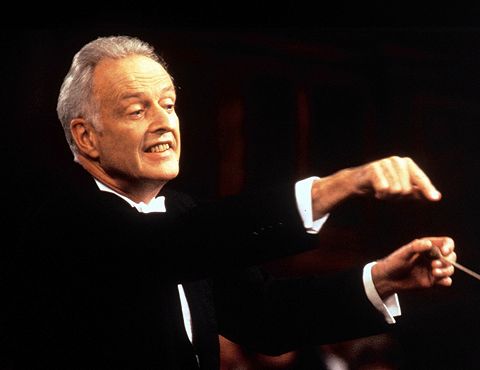
Carlos Kleiber, when he felt like conducting.
This 1982 recording of Tristan und Isolde, made by the Dresden Staatskapelle under the direction of the late Carlos Kleiber, is one of the most unique readings of this Wagner opera available on disc. It has recently been reissued as a DG Original, at mid-price, with each act fitted onto a single CD.

This Tristan is another brilliant, maverick take on a difficult opera, from a conductor who only made a few studio recordings. Under Kleiber's baton, the nuances and textures of Wagner's complex score unveil themselves to the listener in fresh, fascinating ways. The Staatskapelle is superbly managed and tautly controlled. There are outbursts of raw power--Isolde's entrance in Act III, the "Kornwall, heil!" chorus--but the whole is never lacking in lyrical flow. Kleiber makes this tricky score breathe--he allows the music to be as natural and romantic as Verdi while still having Wagnerian power and thrust.

As fitting an opera about men versus women, we'll go through the singers by gender. Rene Kollo is Tristan here, on the downward slope of his long career. Kollo recorded every Wagner tenor role in the studio (except Siegmund and Siegfried) and the mileage shows on his voice. But this is a brilliant, carefully thought out performance, just on the edge of hysteria in the third act.

Kurwenal is in the person of Dieter Fischer-Dieskau. One of the greatest lieder artists of the 20th century, Fischer-Dieskau always sounds a little bemused in Wagner, as if the proceedings swirling through the orchestra are a bit too vulgar and he'd rather get back to his nice Schubert. Kurt Moll sounds grand and grandfatherly as Marke, but misses the emotional heart of the character.

The controversy of this set is the casting of Margaret Price--a soprano known mostly for her work in Mozart and Puccini--as Isolde. True, she is occasionally overpowered by the orchestra, most notably at the start of Act II and at one moment in the Liebestod. There are moments in this score where a laser-like voice is needed to slice through the Wagnerian texture. But that weakness makes her more vulnerable than some Isoldes. After all, Tristan is falling in love with a princess., not boarding a battleship. Brangaene is sung by Brigitte Fassbaender, an intelligent mezzo who, like Fischer-Dieskau, brings a lied sensibility to the role.

Trending on Superconductor

Translate

Share My Blog!

Share |

Critical Thinking in the Cheap Seats