Support independent arts journalism by joining our Patreon! Currently $5/month.

About Superconductor

Our motto: "Critical thinking in the cheap seats." Unbiased, honest classical music and opera opinions, occasional obituaries and classical news reporting, since 2007. All written content © 2019 by Paul J. Pelkonen. For more about Superconductor, visit this link. For advertising rates, click this link. Follow us on Facebook.
Showing posts with label juilliard. Show all posts

Friday, November 18, 2016

Opera Review: We Don't Have To Take Our Shoes Off

Juilliard Opera lifts off with Jonathan Dove's Flight.
by Paul J. Pelkonen
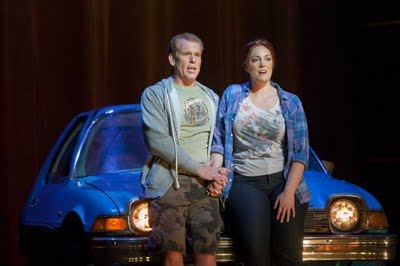
Stuck in the aurport with you: the Refugee (Jakub Józef Orliński, left) and anunhappy couple in a scene from Flight. Photo by Rosalie O'Connor for The Juilliard School. 
It is rare to encounter a contemporary opera that is, at once musically rich, dramatically moving and funny as hell. Such an opera is Jonathan Davis' 1998 opus Flight, which landed on the stage of Juilliard's Peter Jay Sharp Theater on Wednesday night. This is the second New York production of this contemporary masterpiece, with a witty libretto owing something to Lorenzo Da Ponte. Flight is a comedy for our modern age, chronicling the travails of anonymous travelers trapped in an airport terminal overnight, their trips delayed by an electrical storm.

Thursday, June 23, 2016

Spring Breakdown 2016: The Operas

The Five Best Operas of Spring 2016
by Paul J. Pelkonen
Theo Hoffman (right) and Kara Sainz as Papageno and Papagena
in Act II of Die Zauberflöte at Juilliard. Photo by Richard Termine for the Juilliard School.
This was a strange operatic spring for Superconductor. I missed most of the Met season (which turned out to be due to a computer battery problem (I couldn't sync with their computer to get rush tickets and it is still house policy not to bestow press tickets upon bloggers) so there were no Superconductor reviews of Les Pecheurs de PerlesManon Lescaut or even Roberto Devereux. As they say, c'est la guerre.

Tuesday, March 15, 2016

Obituary: Peter Maxwell Davies (1935-2016)

The former Master of the Queen's Music was 81.
by Paul J. Pelkonen
Composer Peter Maxwell Davies. Photo © Stephen Lock.
Sir Peter Maxwell-Davies, the groundbreaking British composer known for bold symphonies and iconoclastic operas died yesterday at his home on the island of Sanday in the Orkney Isles. His death was reported by the BBC.  The composer was 81. He had been suffering from leukemia in recent years.

Monday, November 23, 2015

Opera Review: The World Has Gone Mad

A modern double bill opens Juilliard Opera.
by Paul J. Pelkonen
"HALLO-HALLO!" The Drummer (Amanda Lynn Bottoms, right)
announces the Emperor's intentions in a scene from Der Kaiser von Atlantis.
Photo by Nan Merriman © 2015 The Juilliard School.
As I write this, our world as we know it is under siege. In Paris, religious fanatics fire machine-guns into crowds, punishing people for daring to go out-of-doors. Here in America, capitalist fanatics engage in racist rhetoric in  an attempt to become the leader of the free world. It is apt, then that the Juilliard Opera chose to open its 2015 season with a double-barreled blast of cynicism: Poulenc's Les Mamelles de Tirésias and Ullmann's Der Kaiser von Atlantis.

Saturday, April 25, 2015

Opera Review: An Old-Fashioned Wedding

Juilliard Opera stages Le Nozze di Figaro.
by Paul J. Pelkonen
Shenanigans: The Count (Takaoki Onishi, center) confronts Susanna (Ying Fang, right)
as Cherubino (Virginie Verrez) looks on. Photo by Ken Howard © 2015 The Juilliard School.
On Friday night, Juilliard Opera opened its last production of the spring season, a Stephen Wadsworth staging of Le Nozze di Figaro with a stellar young cast and a staging approach that was refreshingly true to the opera's text. This is the third (and final) Mozart/Da Ponte opera to be mounted by Mr. Wadsworth at Juilliard on the stage of the Peter Jay Sharp Theater. With designer Charlie Corcoran, he continues to rely on simple multi-proscenium sets, period costumes, lots of stage action, and young singing actors thoroughly steeped in performance tradition.

Monday, January 5, 2015

2014 In Review: The Five Best Opera Performances

Severed heads and demonic visitors made for an entertaining year.
by Paul J. Pelkonen


Depravity: Salome (Camilla Nylund) with the head of Jokanaan (Alan Held)

at the climax of Salome at the Kimmel Center in Philadelphia.
Photo by  Dominic M. Mercier © 2014 Opera Philadelphia/The Philadelphia Orchestra


Opera may be the trickiest of all art forms but it nonetheless remains the beating and sometimes bleeding heart of this blog. And this year, there haven't been quite as many opera reviews...but there have been some most impressive performances. Here's a look at 2014 in opera with the five best things I saw appearing below in chronological order.

Friday, May 30, 2014

Opera Review: The Pigs Take Over

The NY PHIL BIENNIAL unveils Gloria--A Pig Tale
by Paul J. Pelkonen
The thin line between love and sausage: Alexander Lewis (with knife) and
Lauren Snouffer in Gloria: A Pig Tale at the Metropolitan Museum of Art.
Photo by Chris Lee © 2014 The New York Philharmonic.
Opera is a serious art. Unless its perpetrator is H.K. Gruber, the imaginative Austrian composer whose Gloria--A Pig Tale is the second new stage work to have its New York premiere in the early days of the first NY PHIL BIENNIAL. This new production was a collaboration between New York Philharmonic music director Alan Gilbert, director Doug Fitch and AXIOM, a Juilliard-based ensemble devoting itself to the interpretation of contemporary music.

Thursday, November 21, 2013

Opera Review: An Invasion, Tastefully Decorated

The Juilliard School presents Handel's Radamisto.
by Paul J. Pelkonen
Radamisto (John Holiday) consoles Zenobia (Virginie Verrez) in a scene from Handel's Radamisto.
Photo by Nan Melville © 2013 The Juilliard School.
The Juilliard Opera is more than just a student ensemble--this is one of the most innovative companies at Lincoln Center. Each season, the students and guest artists at the Peter Jay Sharp Theater find ways to present a vast and diverse repertory. On Wednesday night, Juilliard opened its 2013 opera season with a new production of Handel's Radamisto by James Darrah. The performances, featuring the school period ensemble Juilliard 415, marked the conservatory debut of conductor Julian Wachner.

Wednesday, March 27, 2013

The Superconductor Interview: The Attacca Quartet

A morning sit-down with this New York chamber ensemble.
by Paul J. Pelkonen
Fiddlers on the roof: The Attacca Quartet
(L.R. Amy Schroeder, Keiko Tokunaga, Andrew Yee, Luke Fleming)
Image © 2013 The Attacca Quartet.
"On the second day of undergraduate," Andrew Yee says, "there was one of those team-building seminars, I met Amy (Schroeder) who was a friend of a friend. After we met we asked each other, 'Do you like chamber music?'"

Saturday, February 16, 2013

Opera Review: The Aged and the Restless

Don Pasquale at the Juilliard Opera.
by Paul J. Pelkonen
Bad romance: Deanna Breiwick, Tobias Greenhalgh and Jeongchal Cha
in Act II of Juilliard's new Don Pasquale. Photo by Nan Merriman © 2013 The Juilliard School.
Among the mature comedies of Gaetano Donizetti the most enchanting of these is his last: Don Pasquale. This is a morality play about a covetous septeguenarian who decides to disinherit his callow nephew and enhance his love life--by getting married. It's also the latest comic treat put before a discerning New York opera audience by the Juilliard Opera, a student ensemble whose Lincoln Center productions are among the highest quality works that performing arts complex has to offer.

Pasquale is part con game and part rough-and-tumble farce, with the old man (played here by the vigorous Korean bass-baritone Jeongcheol Cha) turning rapidly from suitor to victim as his new wife turns out to be a spendthrift and worse yet, a shrew. Mr. Cha (star of last year's Juilliard Don Giovanni) proved adept at both sides of the character, bumptious and unlikeable in the first two act and a rather pathetic figure once the tables are turned. He also proved adept at the role's low tessitura and difficult patter, spouting the rapid-fire parlando lines with ease.

Mr. Cha also proved an adept physical comedian. In the first act, he makes use of an onstage personal trainer to get pumped up for marriage, engaging in physical comedy with a jump rope, an iron barbell and even a medicine ball to get ready for his big night. When the wedding goes to hell, he incorporates a stooped posture, a walking stick and even a wheelchair to age and deteriorate before the eyes of the audience.

Sunday, November 18, 2012

Opera Review: A Snake in the (fake) Grass

Juilliard and the Met collaborate on Cosí fan tutte.
by Paul J. Pelkonen
Fiordiligi (Emalie Savoy) attempts to elude Ferrando (Matthew Lewis) in Juilliard's Così fan tutte.
Photo by Nan Melville © 2012 The Juilliard School/The Metropolitan Opera.
Stephen Wadsworth's handsome new production of Così fan tutte, the latest collaboration between Juilliard and the Metropolitan Opera is set in a claustrophobic garden. Looming, convent-like walls trap the participants in Mozart's "school for lovers." Significantly, the doors are locked. Occasionally, Don Alfonso (Evan Hughes) the perpetrator of this experiment in spit and partner swapping peers over the walls, to check how his subjects are getting along.

This production (seen at the Nov. 17 matinee at the Peter Jay Sharp Theater) is a sequel (of sorts) to Mr. Wadsworth's Juilliard Don Giovanni, seen at the conservatory last Sprig. Charlie Corcoran has again mounted the comic action in a series of handsome, receding picture frames that provide entrances and exits. Nature-images abound, from the (working) water pump, the grassy (AstroTurf) carpet, and the large orange tree that dominates the scene.

Given the plot of Così, the last collaboration between Mozart and his librettist Lorenzo da Ponte, one expects a serpent to slither out and bite the dunder-headed protagonists, two young soldiers who swap their partners, (a pair of sisters) to prove their fidelity and win a bar bet. The cynicism of the libretto and question-mark ending can sometimes leave an audience feeling downright queasy, despite the glittering music.

Monday, April 30, 2012

Opera Review: The Fast Track to Hell

Juilliard Opera ends its season with Don Giovanni.
by Paul Pelkonen
Donna Elvira (Devon Guthrie) the Don (JeongChal Cha) and Leporello (Alexander Hajek)
party on in Stephen Wadsworth's new Don Giovanni. Photo by Nan Merriman © 2012 The Juilliard School.
In the past two years, the Juilliard Opera has produced performances at the Peter Jay Sharp Theater that have regularly outshined their bigger, flossier neighbors at the opera house with (hocked) Marc Chagall paintings in its windows. This week, they did it again with a new Don Giovanni, a sleek, uproarious production that captures the anarchist spirit of Mozart's darkest comedy.

This new production by Steven Wadsworth is also a treat for Mozart nerds (like this writer.) Mr. Wadsworth chose to present the 1788 Vienna edition of the dramma giocoso, which has a new scene for Leporello and Zerlina, and a number of important stage cuts (one tenor aria and the Epilogue.) The opera now ends with Don Giovanni's damnation and Mozart's bleak D minor chords.

Thursday, April 19, 2012

Concert Review: Choose Your Mountain

The Juilliard Orchestra tackles the Alpine Symphony.

"Spock, you didn't tell me there were two Alpine Symphonies last night!"
Image from Star Trek V: The Final Frontier © 1989 Paramount Pictures.
As a concert-goer, I was faced with an unusual dilemma on Wednesday night. Two competing performances of Richard Strauss' Alpine Symphony were being offered at the same time: one at Avery Fisher Hall by the Juilliard Orchestra; the other at Carnegie Hall by the European Youth Orchestra conducted by Vladimir Ashkenazy. 

Tuesday, January 31, 2012

Concert Review: Cage Match

The Juilliard Percussion Ensemble pays homage to John Cage.
Fingers on the hammers: John Cage prepares a piano.
Monday night at Juillard's Sharp Theater was the second concert in this year's FOCUS! Festival. This year, the festival celebrates the coming centennial of John Cage, the always quotable, often imitated father of the avant-garde movement in American concert music. When needed, New York Philharmonic percussionist Daniel Druckman conducted.

For the uninitiated, Cage's music grew out of the experimentation of composer Henry Cowell, who was a pioneer in writing "tone clusters" (mashing down multiple keys of a piano at once) and to "prepare" a piano (holding down the strings with we objects.) Cowell's Ostinato Pianissimo led off the program, a shimmering, airy web of sound that seemed to emerge, unfold in the air, and dissolve. 

It was followed by Three2, a late Cage composition for three players. The percussionists stood at distance from the stage, making soft noises on a snare drum, eerie wailings on a lumber saw and gentle tones on tuned gongs. The music was wispy, almost insubstantial. Then it was gone.

The Third Construction is an earlier Cage work, with four percussionists playing in sync like a particularly noisy gamelan. Noisy, because the instruments include large coffee cans, bamboo cricket callers and a "lion's roar" (performed with a bass drum and a rope.) But despite the clatter, the music never sounded cacaphonous.

The second half of the concert opened with Mr. Cage himself. His disembodied voice, lecturing on the concept of "Nothing", filled the air of the Sharp Theater, sounding uncannily like the HAL-9000 computer from 2001: A Space Odyssey. Eerie, fascinating and a performance in itself.


The silence was soon ended, by Cage's Credo In Us, which pitted a prepared piano and percussion instruments against a recording of the Largo from Antonín Dvořák's New World Symphony. The older piece was turned on and off seemingly at random, creating chopped phrases of English horn, 'cellos and brass that jabbed their way into the textures created by the percussion players. When the electronic orchestra was cut off mid-phrase, the piece was over.

The concert ended with the Concerto for Organ with Percussion Orcestra by Lou Harrison, a longtime associate of John Cage. The Harrison Concerto featured the organist playing his instrument with fingers and wooden blocks on the keys, creating liud tonal clusters for the percussion to clatter and bash against. The second movement was quieter, and more atmospheric. The third returned to the high-volume non-chords and discordant percussion, creating brusque blocks of sound for the audience to contemplate.

Saturday, January 21, 2012

Concert Review: An Afiara to Remember

Elegant Schubert and Beethoven in Murray Hill.
The Afiara Quartet: (l.-r.) Yuri Cho, violin; Adrian Fung, cello;
Valerie Li, violin and David Samuel, viola.
On Thursday night, the Montréal Chamber Music Festival offered an intimate evening of intricate works by Beethoven and Schubert. The concert was held at the WMP Concert Hall, an unlikely jewel box recital hall tucked behind a storefront on East 28th St.

With its vintage furniture, hanging chandelier and antique mirrors on the wall, the WMP Hall is an urban anachronism, looking more like a small conservatory chamber in the Schonbrunn or Esterhazy than what it is, a New York concert hall slipped into a neighborhood where music lovers rarely tread.

The performances, by cellist Denis Brott and the Afiara String Quartet, were equally elegant. The concert opened with Beethoven's A Major Sonata for Cello and Piano, with Mr. Brott accompanied by pianist Kevin Loucks. The A Major Sonata is also notable for its second movement, which has the rhythmic seeds of the famous Scherzo from the Ninth Symphony.

The cello sonatas are among Beethoven's least appreciated chamber works, charming examples of his genius. Here, this music was played with warm tones from Mr. Brott's cello and the house Bösendorfer, intertwining to make two instruments resound like an orchestra in the tiny space. 

Mr. Brott put the composition in context by reading a translation of the famous "Immortal Beloved" letter between movements, giving an emotional underpinning to the eloquent music. But the real beauty came in his passionate bowing, playing Beethoven's rhythm-driven melodies with a sure touch. With playing like this, the letter, though historically interesting, proved superfluous. 

Without taking an interval, the piano was moved back and Mr. Brott was joined by the Afiara String Quartet to play Schubert's String Quintet in C Major. With an unusual configuration (the second 'cello replaces the more traditional viola, this expansive, symphonic quintet derives much of its power from the interlocking cello counterpoint that plays throughout its four movements.

With Mr. Brott taking the second cello part, the Afiara Quartet forged ahead with a bold interpretation that made the most of Schubert's melodies without sacrificing energy and drive. From the opening movement with its three traded-off main themes, the players' interaction in the small space showed both their experience playing together and joy in this glorious music.

The second movement evokes the same Viennese lyricism as Beethoven's Scene by the Brook in the Pastorale Symphony. It was played tenderly and with delicate care. The third featured potent rhythms, played with taut precision. The finale brought the performance to a stirring conclusion, a whirling dance of melody with a tinge of Hungarian folksiness that looks forward to Brahms.

Monday, December 26, 2011

The Year in Reviews: Opera in 2011

The 11 Best Operas of 2011
By Paul Pelkonen.

They are the 99%. Tenor Roger Honeywell, soprano Meagan Miller and fine four-fendered friend.
Act III of Die Liebe der Danäe at the Bard SummerScape. Photo by Corey Weaver © 2011 Bard Festival.
This was a busy year. I saw a total of 69 opera performances. 5 of those were broadcasts or live telecasts, but they count. Anyway it's a sexier number than 64. Here's the 11 best opera performances of 2011. Chronological order.


Boston Lyric Opera: The Emperor of Atlantis (Feb. 6)
"Kevin Burdette made an impressive company debut as Death, mugging with John Cleese-like abandon and delivering his noble, impressive music with flair. Heroic tenor John Mac Master was a good choice for Harlequin, Death's companion and a representation (I think) of the madness of war."

Opera Lafayette: Le Magnifique (Feb. 22)
"As the heroine Clémentine, soprano Elizabeth Calleo displayed a pleasing soprano with an unusual, woody timbre. She sounded best in the ensembles, paired with mezzo Marguerite Krull or the paired villains, played by Jeffrey Thompson and Karim Sulayman."

New York Philharmonic: The Cunning Little Vixen (June 24)
"Isabel Bayrakdarian displayed an agile soprano instrument with a pleasing tone and the right amounts of light and shade. She also manipulated the complex costume (including a nearly prehinsile fox-tail) easily, coping with the challenging choreography on the somewhat limited stage."

Royal Danish Opera: Selma Jezkova  (July 30)
"Ylva Kihlberg was a magnetic, heart-tugging presence in the title role, a character created for the film by Icelandic singer Björk. Under Michael Schønwandt's skilled baton, Ms. Kihlberg seduced the listener, leading the audience in Selma's downward spiral."

Bard SummerScape: Die Liebe der Danäe (Aug. 1)
"The soprano part is both long and treacherous, all the way up to a high C# at the very end. Meagan Miller, a past grand finalist at the Metropolitan Opera's vocal competitions, handled the part with power and beauty of tone. Baritone Carsten Witmoser was a moving presence as Jupiter, a high baritonal part that is a mirror of Strauss himself."


Budapest Festival Orchestra: Don Giovanni Aug. 8
"Tassis Christoyannis sang with pleasing tone, tripping nimbly through the Champagne Aria and breaking out an unexpected, sweet head voice for his canzonetta in Act II. His death scene was well played: defiance turned to curiosity but never to fear as he met his fate."

Berlin Ensemble: Der Dreigroschen Oper (Oct. 6)
This is not your standard opera-style singing, but Mr. Kurt embodied the character with cynicism, warmth and energy. His Macheath was a homicidal dandy-about-town who owed something to Jack Nicholson's portrayal of the Joker in the 1989 Tim Burton film Batman.

Metropolitan Opera: Satyagraha (Nov. 9)
"Richard Croft combines his powerful tenor voice and skilled acting to inhabit the part of Mr. Gandhi. Although the nature of the text prohibits dialogue in the manner of a conventional biography, the singer uses movement and gesture to convey the story. He makes a physical transition as well, from suited, briefcase-toting lawyer to the more familiar figure of the Mahatma, clad in a homespun dhoti and carrying a staff."


Gotham Chamber Opera: Dark Sisters (Nov. 13)
"Mr. Muhly writes  for different types of female voices. He explores the different combinations effectively, having the five women sing in canon, or breaking them out into duets and later, arias. The musical idiom incorporates American hymns, folk music, Adams-style melodic fragments and straight melodic lines."

Juilliard Opera: Kommilitonen! (Nov. 17)
Conductor Anne Manson held this complex score together with tight, sprung rhythms in the orchestra and clear delineation of tone-rows in the woodwinds. Add in  the marching band, the offstage chorus and singers up in the balconies, and Peter Maxwell Davies' opera becomes a tough set of challenges. It came off razor-sharp.

Collegiate Chorale: Moïse et Pharon (Dec. 1)
(Mr. Cutler is) an old-fashioned bel canto tenor who can sing with pliability, accuracy and still be heard over the orchestra. He did a splendid job, despite looking corralled in the close quarters of the concert seating.

Honorable mentions: The Bartered Bride at Juilliard, Cardillac at Opera Boston (R.I.P.), Otello with the Chicago Symphony Orchestra at Carnegie Hall, Ariadne Auf Naxos at dell'Arte Opera Ensemble, Moshe at HERE, Les Contes d'Hoffmann at Regina Opera, Bluebeard's Castle and Erwartung at the New York Philharmonic, L'Elisir d'Amore at New York City Opera, Guillaume Tell at Caramoor, Faust, La Traviata, Le Comte Ory at the Met, La Calista at Vertical Player Repertory.

Visit the rest of the 2011 Year in Reviews, our account of the year that went to "'11".


Contact the author: E-mail Superconductor editor Paul Pelkonen.

Friday, April 1, 2011

Opera Review: Unfinished Mozart

Zaide at Zankel Hall
An unfinished portrait of Mozart, circa 1786.
Painted by the composer's brother-in-law Joseph Lange.
On Thursday night, David Robertson led the Ensemble ACJW in a rare performance of Zaide, the two-act Mozart singspiel that counts among the composer's unfinished operas. For this concert, Mr. Robertson combined the Mozart fragments with Vor während nach Zaide, a sort-of completion of the work by Italian composer Luciano Berio. This concert marked the New York premiere of the Berio composition.

Arias from the first two acts of Zaide are all that is left. They were discovered among Mozart's papers by his widow Constanze. But the torso of an opera (Mozart planned three acts) remained unperformed until 1866. One aria, "Ruh sanft, mein holdes Leben" has gained prominence as a concert number. But the work remains a rarity. With the addition of Mr. Berio's music, not so much a completion as a contrasting series of short tone poems inspired by Mozart, the work becomes a fascinating theoretical exercise in what might have been.


Mozart was not a composer to let his good ideas go to waste, and much of Zaide was recycled into later operas. You can see inspirations for the plot (a harem escape) in his completed, hugely successful singspiel, The Abduction from the Seraglio. Much more interesting are the passages that presage Die Zauberflöte. Listening to Zaide, one can hear melodic fragments and hints of the source material for that other "Z" opera. And that alone makes this an invaluable work to hear.

Mr. Berio's interludes and orchestral music were interleaved throughout the evening, serving as curtain-raisers, intermezzi, and a final comment on Zaide. The modern works were mostly instrumental, incorporating lyric poetry recited in Italian, a series of choristers scribbling noisily on chalkboards, and a presentation of the dialogue, digitally projected in white letters on the wall above the orchestra. The juxtaposition was musically effective.

Mr. Robertson led an enthusiastic performance of this work, stopping the orchestra on a dime and conducting with pin-point precision. He was blessed with a young, vigorous cast, featuring soprano Deanna Breiwick in the title role. Zaide is a harem girl who escapes the seraglio with her beloved Gomatz (Paul Appleby). Ms. Breiwick posseses a pleasing, lyric instrument with a hard, silvery edge. Readers of this blog might remember Mr. Appleby from a February performance of The Bartered Bride at the Juilliard School. He has an appealing onstage manor, and sang in fluid, easy, German. He was well-suited to the melodrama passages, spoken German monologues performed over Mozart's music.

The parts in Zaide are short, but that did not stop the rest of the cast from making strong contributions. City Opera veteran Kelly Markgraf brought an agile baritone to the role of Allazim. The promising bass Shenyang (seen recently as Colline in the Met's 2011 run of La bohéme, was a fine comic presence as Osmin, a character who was later recycled into the opera Die Entführung aus dem Serail. As the sultan, tenor Jeffrey Hill made the most of his aria. His outburst of rage recalled another, more celestial ruler: the Queen of the Night.

Tuesday, December 14, 2010

Concert Review: "Young Gun" Nézet-Séguin Takes Alice Tully Hall

Yannick Nézet-Séguin in action.
On Monday night, a free concert by the Juilliard Orchestra gave New Yorkers a chance to hear Yannick Nézet-Séguin, taking a break from his duties leading Don Carlo at the Met. The 35-year-old French-Canadian maestro, who is scheduled to take over the Philadelphia Orchestra in 2011 showed his conducting chops with a bold program of 20th century music.


First up was the Third Piano Concerto by Serge Prokofiev. Alan Woo played the solo part, a second-year Juilliard student whose lanky build and long fingers recalled another Russian composer: Sergei Rachmaninoff. Like Rachmaninoff, Prokofiev was a virtuoso performer as well as a composer. The "Prokofiev Three" is not a long work, but it requires nerves of steel and fingers to match. Mr. Woo displayed both.

In addition to noble themes and slow, elegaic melodies, there are passages in the first and third movements when the soloist has to play with both hands in the same octave, one on the white keys and the other trilling on the black. Mr. Woo met these individual challenges with assured technical skill. Mr. Nézet-Séguin conducted the large student orchestra with gusto, connecting with the soloist and driving the orchestra forward through the three movements.

The second half of the program featured the original version of Maurice Ravel's ballet score Daphnis et Chloë.. Written in 1910, the ballet was later adapted into a pair of orchestral suites, which are popular concert item. But it is rare to hear the work as Ravel originally intended it, complete with a wordless, melismatic mixed chorus that adds the texture of human voices to the already enormous orchestra.

Commanding the Dessoff Choirs along with the expanded Juilliard Orchestra, Mr. Nézet-Séguin led an exciting performance of the work, maintaining Ravel's narrative drive despite the absence of dancers from the stage. The student orchestra responded well to his direction, producing ferocious rhythms for the work's central "Barbarian Dance" and dreamy textures for the romance of the work's titular characters.

Exceptional performances from the principal horn, English horn and alto flute made this Daphnis an immersive, thrilling experience. The tricky passage at the start of Part III, where the strings enter in a 10-part ensemble while removing their mutes is just one example of the precise nature of Ravel's vision. Mr. Nézet-Séguin brought the final pages of the work home with a mighty climax, a thunderous wall of sound that belies the impression that impressionistic music always means "quiet."

Thursday, November 18, 2010

Opera Review: Lust for Life

Poppaea Sabina, Empress of Rome
L'incoronazione de Poppea at Juilliard.
L'incoronazione de Poppea is Claudio Monteverdi's final opera. He died less than a year after its Venice premiere in 1643. On Thursday night, Juilliard's sexually charged new production showed that the first master of opera laid the groundwork for everything that followed.

Looking for sensuous arias that prefigure bel canto? They're here. Plot twists, assassination attempts, cross-dressing? Poppea has all those things. The first opera to eschew mythology for historical events, Poppea is the story of the Roman Emperor Nero and his attempts to upgrade his marriage. His intent: to replace his loving wife Ottavia with Poppea, ancient Rome's answer to Amy Fisher.

The student cast met the opera's decadence with a lush performance that caressed the ears for three hours. Korean soprano Haeran Hong made the most of Poppea, singing the high-lying music with a clear, sparkling instrument. She was ably matched with Cecilia Hall, in trousers and splendid mezzo voice as Nerone. In this opera, rampant lust leads to gorgeous duets. The Act II love scene where Poppea shaved Nero with a straight razor (while they're singing) explored the twisted depths of their relationship and produced the loveliest melodies of the evening.

Poppea has a complex cast of Roman politicians, mistresses, gigolos, would-be assassins, and even gods. As Ottavia, Naomi O'Connell has a bright, diamond-hard soprano which reflected her tenuous state in Nero's court. Nick Zammit's handsome countertenor suited the hapless Ottone, who gets suckered into the assassination plot. Devon Guthrie sang with warmth and lyric power as Drusilla, whose attempt to take the fall for the cross-dressing Ottone nearly lands her in Nero's torture chamber.

Liam Moran made a fine impression as Seneca, the philosopher and Roman senator who is rewarded for his hard work tutoring Nero with a death sentence. This might be the first serious role for a bass in the operatic repertory, and Mr. Moran hit some splendid low notes in his death scene. At the other end of the spectrum, tenor Daniel Curran nearly stole the evening as Poppea's female attendant Arnalta. He sang the role in full drag (a la Dustin Hoffman in Tootsie) and provided much-needed comic relief amidst all the backstabbing.

This production has opted for Roman columns, cafe tables and modern dress for its leads. The gods leap on and offstage, interfering with the already complex lives of the mortals. The modern dress makes the drama seem more relevant, and allows the cast to make the most of the gender-bending nature of casting Monteverdi in an age where there are no longer castrati.

Harry Bickett led the Juilliard415 Musicians. Conducting from the harpsichord, he lead a crisp, tight performance that made this opera's long running time fly by for the listener as the plot unfolded. This is one of the essential period-music performances of the fall season, and a chance to see one of the most brilliant, original operas ever written. Monteverdi was a genius. And with Poppea, he set the bar for everything that followed.

Trending on Superconductor

Translate

Share My Blog!

Share |

Critical Thinking in the Cheap Seats