Marek Janowski records his second Das Rheingold.
by Paul J. Pelkonen
Second time around: Marek Janowski conducted his second recording of the Ring
in Berlin. Photo by Felix Bored for PentaTone.
(Note: This is an updated version of a 2013 Superconductor review, republished in advance of coming reviews of the rest of the cycle in the next week.)
Any recording of Das Rheingold, the "preliminary evening" to Wagner's mighty tetralogy Der Ring des Nibelungen must, in the course of review be compared to the classic Decca recording made in 1958 with Georg Solti and the Vienna Philharmonic. So let's do that first. No, this new recording from Marek Janowski and the Berlin Radio Symphony Orchestra (released in 2013 on the PentaTone label) doesn't have much similarity to the Solti. Nor is it the "new standard", "the best" or even the "best-sounding" recording of this four-scene prelude to the main action of the Ring. However, as a document capturing some interesting young artists and a snapshot of the current state of international Wagner singing, it certainly has value.
It may seem silly, considering that this blog is in the middle of reviewing another recordig of Wagner's Ring, to jump back and take a look at a different conductor's approach to Das Rheingold the "preliminary evening" that is a heroic undertaking in its own right. Here though, that conductor is the always interesting Sir Simon Rattle, whose own discography is extensive though generally not dipping far into the Wagner repertory. (This is technically his fifth recording of Das Rheingold, but the first to be commercially available.) This is a live recording with the Bavarian Radio Symphony Orchestra, and released (in 2015) on the BRSO's own BR Klassik label.
Believe it or not, Wagner's enormous 15-hour Der Ring des Nibelungen (hereafter referred to as "the Ring Cycle) was originally supposed to be just one opera. In 1848, Richard Wagner sketched an opera called Siegfrieds Tod, which would retell the most famous incident from German myth and epic: the death of the hero Siegfried and the later fate of his beloved, the valkyrie (warrior maiden) Brunnhilde. And then, much like the ambitious god Wotan he realized that one opera wouldn't be enough.
On the mic: Music director Alan Gilbert (left) and Philharmonic president Matthew Van Besien
announcing the coming 2016-17 season at the Rubinstein Atrium. Photo by the author.
The coming season represents two milestones in the illustrious history of the New York Philharmonic. It is the ensemble's 175th season, and as such has a reassuring focus on traditional favorites like Dvorak and Tchaikovsky. And it's also the last season for current music director Alan Gilbert, whose tenure has been marked by an interest in programming new music and an attempt to make America's oldest orchestra reach a contemporary audience.
Hans Swarowsky's recording of the complete Ring Cycle was made in 1968 in Nuremberg. The sessions were a by-product of the Soviet invasion of Prague, which forced most of the Czech Philharmonic to flee to southern Germany. Under Mr. Swarowsky, the so-called "South German Philharmonic" dashed off these recordings quickly, releasing the entire cycle on the budget Westminster Gold label as a bargain-basement alternative to the Decca Ring with Georg Solti and the Vienna Philharmonic.
The Prelude to the Ring Cycle is either the ideal first Wagner opera--or a torture test for dyed-in-the-wool opera lovers who are forced to sit still for two and a half hours. Das Rheingold begins underwater. Three Rhinemaidens are hit on by a sexed-crazed Nibelung dwarf, Alberich. Alberich copes with their rejection by stealing their treasure, the gold titular "Rhine gold." He uses the gold to forge the Ring, a powerful trinket that will pass from hand to hand until the end of the cycle 15 hours later.
It seems that the Metropolitan Opera is not the only place where mounting Wagner's epic Ring Cycle is an occupational hazard.
Reports are coming out of Darmstadt, Germany that a Feb. 11 performance of Das Rheingold at the Darmstadt Stadttheater came to an early end when a section of the set came unfastened and crashed onto the stage, landing in the orchestra pit and injuring a musician. This story was first reported (in English) on Norman Lebrecht's blog Slipped Disc.
The Darmstadt production of Rheingold modernizes Wagner's drama, with Wotan as a pinstriped industrialist and the Giants as construction workers in safety helmets. From the photographs on the theater's website, Valhalla appears to be a nuclear plant. The production is by John Dew.
The incident took place towards the end of the two and half hour opera, when a piece of press-board, which framed the action, was 26 feet high and 4 feet wide. Apparently it fell forward with one end landing in the orchestra pit and striking a member of the orchestra in the head. The performance was stopped immediately, and the woman was taken to a nearby hospital.
Perhaps this is why Wagner designed the famous "covered" pit at the Bayreuth Festspielhaus?
So this evening I was relaxing at home, watching (for the umpteenth time) Harry Potter and the Sorcerer's Stone (or Philosopher's Stone as it's known outside the U.S.) That's the first movie in the recently completed film series, for you Muggles who read my blog.
The last decade has seen a slew of bargain-box reissues of Wagner's Ring Cycle. The latest of these, issued by EMI on May 17th in North America to (hopefully) coincide with the composer's 198th birthday, is Wilhelm Furtwängler's second recording of the four operas, made for Italian radio in 1953.
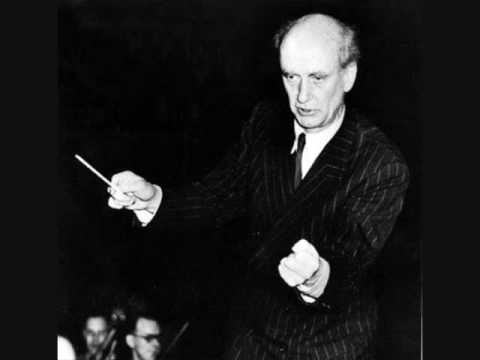
Furtwängler is celebrating his 125th birthday this year. One of the most controversial, and important Wagner interpreters of the 20th century, he was a born Romantic. Specializing in Wagner, Bruckner and Beethoven, he conducted with an organic feel, letting tempos fluctuate in order to mine greater meanings and depths of expression. On these discs, new and exciting details of the score come forth. As expected, the orchestra stretches and flexes under his baton, taking the music in fascinating new directions.
Examples of this idiosyncratic approach include an ultra-slow version of the charging Act III prelude from Siegfried, the rapid Rhine Journey, and the devastating heaviness brought out in Hagen's Watch.. This is always one of the most difficult parts of Götterdämmerung, and the maestro does the right thing: speeding up with anticipation as the scene changes back to Brunnhilde's rock, and then pausing, seeming to stop breathing as the next scene starts.
Big climactic moments, like the Entrance of the Gods, the Magic Fire scene and of course, the Immolation are heard with a new freshness that makes this set hold up on repeated listens. The orchestra plays beyond their abilities, as the maestro makes his Italian band sound like Bayreuth's finest. And yes, it's in mono sound, but the voices sound fresh and immediate, with details leaping out of the orchestra. There is an audience--they applaud enthusiastically at the end of each act--but they make minimal noise otherwise.
The singing is very good. Ludwig Suthaus recorded Tristan with Furtwängler in 1952, and that experience pays off in his Siegfried. Wolfgang Windgassen sings Siegmund here, a rarity for the tenor who preferred the role of Siegfried. (He also sings Loge in Das Rheingold.) Soprano Martha Mödl was recorded here at the height of her powers. brings all of her resources to Brünnhilde, creating a compelling portrait over three operas.
These discs also preserve Ferdinand Frantz' memorable portrayal as Wotan, the deal-breaking god of Das Rheingold, the tormented father in Die Walküre and the sad and lonely Wanderer of Siegfried. This is a towering performance. Gottlob Frick is a brutish Hunding. Josef Griendl a memorable, venomous Hagen. And in Siegfried, tenor Julius Patzak shows that the role of Mime can be sung, not screeched.
Wagner lovers and Furtwängler aficionados probably own this set already. But if you've only heard of the conductor, or only heard whispers of his legendary podium prowess, this is worth checking out. Sure, the packaging is ugly and somewhat unimaginative. There's no libretto included. But for top-notch Wagner at about $4 per disc, the price is certainly right.
Wednesday night at the Met featured the return of the Robert Lepage production of Das Rheingold, with a few changes in the cast and in the orchestra pit. Principal guest conductor Fabio Luisi subbed in for an ailing James Levine.
It also brought some fresh perspectives on the staging, seen this time from the back row of the orchestra standing room. From eye level, Mr. Lepage's "Machine" set--24 computer-controlled planks that form the many landscapes of Wagner's imagination, remains curiously featureless.
The underwater opening still successful, helped this time by the presence of baritone Richard Paul Fink as Alberich. Mr. Fink played the dwarf with cunning, humor, and full baritone voice, managing to cope with sliding up and down the computer-generated riverbed as he chased the Rhinemaidens about.
The "rocks" configuration (used for Scenes Two and Four) is more problematic. Wagner calls for a mountain height, but this looks more like an aircraft carrier, with battleship gray Machine-planks looming like tank cannons aimed at the audience. The split-level staging ensures distance between the gods and giants, removing the giants' ability to threaten the gods. There are also balance problems, with the basses Franz-Josef Selig (Fasolt) and Hans-Peter König (Fafner) rendered inaudible at times. On the bright side, a steep tilt of the set makes it easy to get Fasolt's corpse off the stage. (James Bond villains, take note.)
Despite the production issues, things are getting better on the road to Valhalla. Bryn Terfel seemed more secure of tone as Wotan. An experienced villain actor, the burly Welshman improves as Wotan gets meaner, culminating in a completely bloodless theft of the glowing Ring. Stephanie Blythe had a great night as Fricka, singing with ample, rounded tone. The tension between them was palpable, a portrayal of the classic bad marriage.
The best addition to this cast is Arnold Bezuyen, making his company debut as a pointed, sarcastic Loge. He brought interest and involvement to the fire god's Narrative, something lacking in October's performance. It's too bad the costume department made him look like the Baron Harkonnen from David Lynch's movie version of Dune.
On the podium, Mr. Luisi drew out some interesting textures. The bass trumpet was accented at the end of the Prelude. The anvil-driven Nibelung rhythms had punch. The conductor's best moment was in the Erda scene. At that point, all the hype about the cast, the Met and the Machine went away and you were drawn deeply into Wagner's mythological story. But that didn't come until two hours in.
The production continues to boast some innovative visual ideas--the descent into Nibelheim, the Gods' climb up the face of the machine to Valhalla. Unfortunately, like many Met stagings, the best visuals are well above the stage, and hard to see from under the overhang of the parterre boxes. But they probably looked great from the parterre seats.
"I want to know why they (meaning the Metropolitan Opera) re-staged the Ring. The Met was the only opera house in the world that had a staging that was as Wagner wrote it. People from all over the world came to see it and it was always sold out!! So, Why? I would really like your opinion."
And that sounds like a great excuse for a post about Wagner.
So here are some reasons why the Metropolitan Opera has decided to mount a new production of Der Ring des Nibelungen.
Ten reasons, in fact.
1) The Question of "Authenticity": To start with, the production in question, designed by Gunther Schneider-Siemssen and directed by Otto Schenk, was in no way "as Wagner wrote it." It was pretty close, but certain visual elements (and livestock) were eliminated. Herr Schenk created an innovative staging that used available 1980s technology to approximate what Wagner put in his librettos. But it was in no way the same as the first staging of the full Ring in 1876.
Following Wagner's death in 1883, Cosima Wagner maintained her husband's productions of the Ring and Parsifal until the sets practically fell apart. It wasn't until the 1900s, when her son Siegfried Wagner took over the management of Bayreuth, that new productions were allowed. And those were all based on the old ones. Authentic theatrical innovation did not come to Bayreuth until 1951, following the fall of the Nazis and the re-opening of the Festspielhaus under Wieland Wagner and his brother Wolfgang. And even their ideas ossified and were replaced, leading to the Bayreuth policy of new productions of the Ring every eight years.
2) Shelf Life: The Bayreuth Festival stages a new Ring every eight seasons, running a production for seven years and then taking a year off from the Ring before mounting a new one. Since the Met Ring's lifetime (counting the point from when the staging was first planned in the early '80s), Bayreuth has seen new Rings from Patrice Chereau, Sir Peter Hall, Harry Kupfer, Alfred Kirchner, and others while the Met has been duct-taping their show back together every few years or so.
By way of comparison, the Schenk Ring was on the boards of the Metropolitan Opera house for 22 years. (Die Walküre premiered in 1986, and the final performance of Götterdämmerung was in 2008.)
3) Boredom: Audiences, believe it or not, who live in New York, get tired of seeing the same show over and over. I saw the Schenk Ring in 1993 (in part), 1997, 2000, 2004 and 2008. Every time, the lighting was different. The cast was different. And the show got either better, or worse. The best I saw was that last cycle in May of 2008. While the last Ring I went to in 2008 had great singing, the show itself was getting tired.
4) Administration: The Met has a new general manager in Peter Gelb. He's still the new guy, and putting a new Ring on is part of him doing his job and making sure the Met remains a living, breathing, theatrical institution and not some dusty museum that caters to the tourist trade. And by the way, the Met's biggest money-maker is the Zeffirelli La bohéme, which has been running for 30 years as of this season.
5) Media: The old production has already been recorded and filmed with a cast of singers that are now either retired from the stage (Siegfried Jerusalem) or on the verge of calling it a career (James Morris, Jessye Norman.) It's exciting to have a fresh-voiced cast of new talent on the Met stage. They deserve a new production. And when Ben Heppner sings in Siegfried and Götterdämmerung (planned for 2011 and 2012) opposite Deborah Voigt, I think that the results will be worth the wait.
The "Magic Fire" scene from Bayreuth, in the 1988 Harry Kupfer production of Die Walküre.
6) Storage and Wear: Sets have to be repaired. Props and costumes break, get lost, or decay. They have to be stored. Lights and visual effects (gels, gobos, magic fire machines) wear out and have to be replaced. Costume restoration and storage of the massive sets (all those mountains and valleys and castles and stuff, not to mention the two dragons) required expenditure on the Met's already tight budget. A new Ring, with the unit set, makes financial sense even if the Met had to pay to reinforce the left side stage in order to store the heavy set.
7) Money: Opera houses in America are not funded with government handouts, unlike in Europe. They rely on private and corporate donors in order to stay solvent. That is, open. It's more attractive to ask those donors to donate to a new staging (one that they can make their "own") then to ask donors and corporate sponsors to spend on the upkeep of the old one.
8) The Director: Robert LePage has fresh, innovative ideas about the Ring, that are actually conventional at heart and close to Wagner's own. And he's making a new Ring using modern technology to tell the same story Wagner did. He's doing the same thing as Otto Schenk. But using lights and projections instead of papier-mâché and fake rocks.
9) The Composer: Wagner himself would have been excited about the new production. After all, the old Meister once said: "Children! Go do something new!" Not that they listened.
10) Time: It's a new century, a new millennium and New York deserves a new Ring. I can't wait for Walküre.
Hagen's Watch, from the Otto Schenk production of Götterdämmerung.
The Metropolitan Opera has announced that the vuvuzela, the plastic B♭ horns that are a prevailing feature of the FIFA World Cup will be 'employed extensively' in the coming 2010 opera season.
This fascinating 1973 film of the first opera's of Wagner's Ring provides a window into another era of Wagner singing, while detailing Herbert von Karajan's lyric approach to the score. Intended as the first film of a complete cycle, Das Rheingold combines cinematic techniques and crude Star Trek-style special effects to give us a detailed version of the first night of the Ring in all its spear-carrying glory.
Although Thomas Stewart sang Wotan on Karajan's recordings of Die Walküre and Siegfried, he was replaced by Dietrich Fischer-Dieskau for Das Rheingold. So this is the sole record of his collaboration with Karajan in this opera. Stewart is an imposing, noble Wotan, using his fine baritone to tremendous effect. The reliable Brigitte Fassbaender is solid, if unconventional casting for Fricka. The young Jeanine Altmeyer, who would later graduate to singing Sieglinde and Brunnhilde, is a good choice for Freia.
The greatest treasure in this performance is Peter Schreier, a Mozart and Bach specialist who dons the red leather suit to play Loge. His is the finest voice on display here and his entrance lifts the opera to the next energy level. It is also wonderful to have a visual record of Zoltan Kelemen, the Hungarian baritone who was one of the great Alberichs of the 1970s. Here, he is paired with character tenor Gerhard Stolze, whose harsh, grating Mime is all too familiar to owners of the classic Solti cycle or Karajan's underrated recording for Deutsche Grammophon.
The biggest flaw in this film is the decision to have two of the actors dubbed in the studio. Vladimir de Kanel is Donner, but the part is sung by Leif Roar and the lips do not match. This is especially noticeable at his entrance in Scene II. Also, Gerd Nienstedt's fine bass is dubbed by Karl Ridderbusch in the role of Fasolt. Karajan may have wanted a more lyric sound, but why didn't he just get Ridderbusch to appear in the film?
This is prime Karajan, conducting his crack Berlin Philharmonc in a razor-sharp performance. The strings are lyric, the horn players are everything they should be--even the percussion effects are stirring. Ever the control freak, Karajan also directs the film and the stage action, which is competent, but not brilliant or ground-breaking.It's all a little dated, but this is a compelling look at the way Wagner operas were done before Patrice Chereau's revolutionary Bayreuth Ring of 1976.




 combines cinematic techniques and crude Star Trek-style special effects to give us a detailed version of the first night of the Ring in all its spear-carrying glory.
 or
or for Deutsche Grammophon.

