Support independent arts journalism by joining our Patreon! Currently $5/month.

About Superconductor

Our motto: "Critical thinking in the cheap seats." Unbiased, honest classical music and opera opinions, occasional obituaries and classical news reporting, since 2007. All written content © 2019 by Paul J. Pelkonen. For more about Superconductor, visit this link. For advertising rates, click this link. Follow us on Facebook.
Showing posts with label DVD. Show all posts

Wednesday, June 10, 2015

DVD Review: Coming Down to Earth

Valery Gergiev and the Mariinsky Opera take on Die Frau Ohne Schatten.
by Paul J. Pelkonen
Lost in the darkness: Mlada Khudoley (left) and Avgust Amonov as the Empress and Emperor
in Richard Strauss' Die Frau Ohne Schatten.
Photo © 2011 Mariinsky Opera.
Die Frau Ohne Schatten is composer Richard Strauss' most ambitious collaboration with librettist Hugo von Hofmannsthal. A Magic Flute-style quest (in this case for the missing "shadow" of the title) written on a Wagnerian scale, Frau has a complex libretto that requires its director to make frequent transitions between the everyday world and the realm of faerie, ruled by the merciless Keikobad. The titular Frau is  Keikobad's daughter, the Empress. She seeks to cast a shadow and bring fertility to her loveless marriage. With five leading roles and a heavyweight orchestration, it is a formidable challenge for any opera house.

Tuesday, May 19, 2015

DVD Review: No Glove, No Love

Daniel Barenboim conducts the La Scala Das Rheingold.
by Paul J. Pelkonen
A game of thrones: Johannes Martin Kränzle as Alberich in Das Rheingold.
Photo by Koen Broos © 2013 La Scala ArtHaus Musik.
(This is a repost in anticipation of forthcoming reviews of the rest of this Ring  later this week.)

There are a lot of familiar theatrical ideas at work in this Das Rheingold, a DVD issue of the 2010 La Scala production of Wagner's Der Ring des Nibelungen. Digital back projections, dancers serving as scenery (and occasionally, props and furniture) and little square pools of water onstage for the singers to splash in are not new. However, director Guy Cassiers succeeds in combining all these elements to present the "preliminary evening" of the Ring in a fresh and intelligent way. With an emphasis on acting and singing over technology and spectacle, this is a production for these economically uncertain times.

Wednesday, July 24, 2013

DVD Review: Bigger Than Infinity

Gustavo Dudamel conducts the Mahler Eighth.
by Paul J. Pelkonen
Conductor Gustavo Dudamel. 
Even when it is measured against Mahler's other nine enormous symphonies, the Symphony No. 8 in E is ambitious. Working in a white-hot creative fever in the summer of 1906, the composer discarded traditional symphonic form for a two-part structure. Part I is a gigantic setting of the medieval hymn "Veni, creator spiritus!" a massive opening shout that can deafen an audience and overload even the most durable speakers. Mahler follows this peroration with a Part II that is twice as long: a setting of the impenetrable (and very mystic) final scene from Part II of Goethe's Faust.

Tuesday, August 7, 2012

Waiting For the World to End

A Superconductor Editorial.
by Paul J. Pelkonen
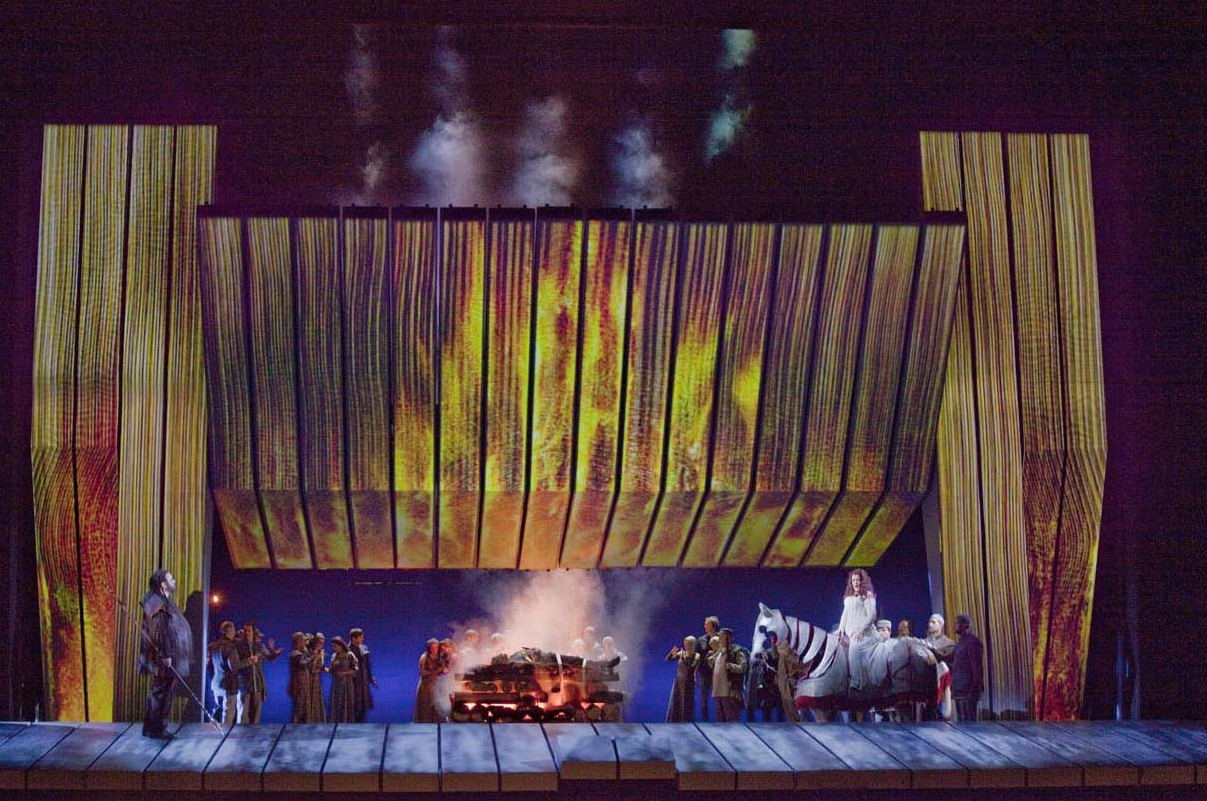
The final conflagration at the end of the Met's new Ring Cycle.
Photo by Ken Howard © 2012 The Metropolitan Opera.
The Metropolitan Opera has announced the release date for its DVD and Blu-Ray sets of the company's Robert Lepage production of Der Ring des Nibelungen:

September 11, 2012.

The sets, which are re-packagings of the Met's Live in HD performances of Das Rheingold, Die Walküre, Siegfried and Götterdämmerung, are scheduled for general release on the 11th anniversary of attacks on New York and Washington, DC that destroyed the World Trade Center and part of the Pentagon.

Thursday, May 31, 2012

DVD Review: Queen Takes Knight

Nina Stemme in the Glyndebourne Tristan und Isolde.
by Paul Pelkonen
First-date jitters: Isolde (Nina Stemme) confronts Tristan (Robert Gambill) at Glyndebourne.
Photo © 2007 Glydebourne Festival/Opus Arte.
In the last decade, soprano Nina Stemme has transited from singing Mozart to heavier German repertory. This three-DVD set, released in 2008 by OpusArte captures Ms. Stemme as Isolde in the Glyndebourne Festival's first-ever staging of a Wagner opera. Jiří Bělohlávek conducts the London Philharmonic in a sweeping, slow reading of the score that draws out much of Wagner's musical detail.

The Irish princess is one of the most complicated roles in opera, traveling from rage to redemption and stopping along the way to fall in love with Tristan, the Cornish knight assigned to bring her to his feudal lord, King Marke. Ms. Stemme sings the two Act I narratives with power and detail, injecting vivid meaning into each word as she tells Brangäne of Tristan's betrayal.

In this Spartan setting by Nikolaus Lehnoff, those details are necessary for the viewer to understand what's going on. Set designer Roland Aeschlimann creates an abstract space, a large torus that looks like the "Guardian of Forever" on the original Star Trek. All the characters move through this torus which is carefully lit to reflect contrasting moods. The only ill effect of this "mystic donut" is that it muffles the chorus and offstage horns.

Friday, February 3, 2012

DVD Review: The Low End Theory

Plácido Domingo's Simon Boccanegra, from La Scala.
Plácido Domingo gets elected in Simon Boccanegra from La Scala.
Photo by Marco Brescia © 2010 Archivo Fotografico del Teatro alla Scala.
This DVD, filmed at La Scala in 2010, is the third visual record of tenor Plácido Domingo's attempts to scale the summit of Verdi baritone repertory: the title role in Simon Boccanegra. For the most part, it is a success, thanks the the sensitive, intelligent conducting of Daniel Barenboim.

There is no question that Mr. Domingo commits himself wholly to acting the part of Boccanegra. But it sounds like what it is: a thickened, aged tenor voice pushed down to the bottom of its register, struggling to avoid those heights to which he can still scale. Without the low-end bloom and rich, baritonal sound that is expected from this authoritative character. He produces a noble tone in certain scenes, but lacks the dark mystery in his voice that makes this wily pirate turned politico an attractive protagonist.

Wednesday, April 20, 2011

DVD Review: Battle for the Radioactive Donut

Der Ring des Nibelungen from Valencia, with La Fura dels Baus.
by Paul J. Pelkonen
The Rhinegold appears in the form of a large baby in La Fura del Baus' staging of Wagner's Ring.
Photo © 2009 © Unitel Classics.
This 2009 Unitel release of the complete Ring, filmed in 2008 in Valencia, Spain under the baton of Zubin Mehta is a compelling, visually arresting, and best of all, well-sung version of Wagner's mythological cycle. It should appeal to Wagnerians who want to hear the next generation of singers, and those curious opera-lovers who want to see what a modern Ring looks like without stage machinery that goes "clunk."

Friday, January 22, 2010

DVD Review: 'Tis Sweet to be Remembered

The Met's classic Aida on DVD.
by Paul Pelkonen.

Everybody on stage: Act II of Aida at the Met.
Ten years ago, this Deutsche Grammophon release was one of the first operas released on DVD by the Yellow Label. It remains a stone classic, a performance that has lost none of its power to impress the viewer and the listener. And it's as good an interpretation of live performance to digital medium as you'll find. It was filmed at the Met in 1990, when Placído Domingo was at the peak of his powers, and there were no titles on the backs of the seats.

This production, is a tradtional Aida with everything except the elephants. The Triumphal Scene boasts over 200 people onstage, realistic looking temples and pyramids, and the Met ballet corps in white dresses and Cleopatra wigs. One prop, the statue of the god Ftha, is so big that you only get to see its ankles! Equally impressive are the small details and visual grace notes (a crumbling statue, wall paintings in the palace) that come to light on DVD, details that are only visible from the very best seats in the house.

Aprile Millo's career at the Metropolitan Opera was not without its share of controversy. (After all, she is the only singer besides Ezio Pinza to have a piece of the building named after her--the famed "Millo Pole.") This performance finds Millo in excellent form, floating out the big climaxes in "Ritorna vincitar!" and "O Patria Mia." She is well-matched with Dolora Zajick as an angry, shrewish Amneris who displays great emotional growth over the opera's four acts. Amneris is one of Zajick's signature roles, and this performance shows why.

Domingo is Radames, the Egyptian general caught in the middle. He starts strong in "Celeste Aida" and that golden voice gets better as the evening goes on. In the Tomb Scene, he blends carefully with Millo as the two singers use up all of their oxygen in the most beautiful way possible. As Amonasro, the great baritone Sherrill Milnes does not enter until Act II, but when he does the opera's energy level jumps. The third act is terrific Georgian bass Paata Burchuladze giving one of his finest recorded performances as the high priest, Ramfis. Twenty years on, this performance of Aida remains as compelling as it was in the theater.

I should know. I was there.


Watch Aprile Millo in a reel of highlights from Aida
Contact the author: E-mail Superconductor editor Paul Pelkonen.

Thursday, March 13, 2008

DVD Review: Night Of the Comet

The post-apocalyptic Baden-Baden Parsifal.
by Paul Pelkonen
Gurnemanz (Matti Salminen) presides over the devastation in Act I of Parsifal.Image © 2006 OpusArte/Baden-Baden Festival
The composer Richard Wagner once said, "Children, go do something new!" This new 3-DVD set, which captures Nikolaus Lehnhoff's remarkable production of Parsifal, filmed here on a good night in Baden-Baden takes the composer at his word. Lehnhoff is not the first director to stage a post-apocalyptic version of the Grail legend, but this desolate production (also seen at Covent Garden and the San Francisco Opera) is chillingly effective.


Tuesday, March 11, 2008

DVD Review: The Golden Ring

It's Vagner Veek again at Superconductor, where the focus is almost exclusively on the music of the Meister of Bayreuth. No, there won't be a review of the Met's Tristan revival. (Illness made it impossible for us to attend the opening last night) but there will be articles, comments and other stuff that's more exciting than an ordinary opera review. Here goes....


The Golden Ring is a 90 minute black-and-white BBC documentary chronicling the recording of the first-ever studio Götterdämmerung in Vienna in 1964. Directed by Humphrey Burton, the movie captures the pressure and stress of opera in the studio, broken down into ten-minute segments and recorded ata breakneck pace. The sessions caught here were part of an eight-year project, during which the Decca engineers (led by John Culshaw) and the Vienna Philharmonic (led by a young Georg Solti) recorded the entirety of Wagner's Ring cycle for release in stereo. (Rheingold was recorded in '58, Siegfried in '60. A 1966 Walküre completed the cycle.)

The Solti Ring, as it is known to collectors, is considered to be one of the finest Wagner recordings--and one of the finest opera recordings--ever made. Working with the early stereo format, the engineers hung microphones over the recording space and moved the singers around on the stage, panning their voices to the left and to the right. Vocal effects and audio effects allowed the engineers, using analog equipment, to create a "theater of the mind" that would give the listener the illusion of experiencing the events of the opera in a different way than one would in the opera house. In addition to transforming voices through the use of distant microphones and isolation booths, Culshaw and company stuck closely to the letter of Wagner's work, using 18 tuned anvils, alphorn, lead blocks, and in Götterdämmerung, steer-horns to complete the aural illusion.

The documentary captures much of this frenzied activity. You sit in on orchestral rehearsals, watch the singers make "test" recordings, and then see the final, recorded performances. Birgit Nilsson (Brunnhilde) falls victim to a memorable practical joke. Dietrich Fischer-Dieskau discusses the problems with Wagner the person versus Wagner the composer. We visit a cocktail party in the producers' apartment, built right above the studio.Solti (nicknamed the "Screaming Skull" during hiis Covent Garden tenure) yells at the Vienna Philharmonic. All that is very interesting, but the real glory here is the performance, with Gottlob Frick's black-voiced Hagen, Wolfgang Windgassen's experienced Siegfried, and Nilsson's indomitable Brunnhilde.

This is an important document, but the DVD release has two drawbacks. One is the poor source quality, a worn-out, damaged video tape that shows white lines and silver squiggles on the image. Worse yet is the sketchy mono sound which becomes scratchy when the orchestra kicks into full Wagnerian gear. If you want to hear these performances for real, get the recordings on LP or CD. But then, see this film--it is an interesting inside look at an era of opera recording long since passed.

Click here HERE to watch a clip from The Golden Ring--the scene where Birgit Nilsson gets pranked. Then watch her sing magnificently in the Immolation Scene from Götterdämmerung.

Sunday, February 17, 2008

DVD Review: Horse Opera

Susan Graham as Didon in Les Troyens.
Les Troyens from the Théâtre de Chatelet.
by Paul J. Pelkonen
No French opera has had a more difficult road to the stage than Les Troyens, the five-act magnum opus of Hector Berlioz. Based on Virgil's Aeneid, (with a libretto written by the composer) Troyens went through as many trials and tribulations as its titular heroes.

In2003, the Théâtre de Chatelet honored the 100th anniversary of Berlioz' birth, by giving the long-overdue Paris premiere of the full five-act version of the opera, played in one evening (with no cuts) as the composer intended.

Troyens has been dogged by bad reputation and worse luck. At the opera's 1863 premiere, the producers split the five acts into two nights, and then dropped the first half (The Sack of Troy) entirely. The five-act version did not premiere until 1890. These performances reinforce the brilliance of Berlioz' sweeping design.

Part One: The Sack of Troy mirrors the eventual fate of the Carthaginians at the hands of the Romans.Cassandra, (Anna Caterina Antonacci), the Trojan prophetess, has a spiritual sister in Didon (Susan Graham), the love-struck Carthaginian queen. (It is not a coincidence that both characters commit suicide onstage.) Énée (Gregory Kunde) is caught in the middle, torn between Trojan survivors' guilt, his genuine love for Didon, and the voices of the Trojan dead, urging him to sail for Italy and found the Roman state.

Thursday, March 8, 2007

DVD Review: Die Walkure--...the World-Ash Will Fall


The second installment of Harry Kupfer's Barcelona Ring continues in the same bizarre vein as the first. Once more, effective use is made of the "grid" background, providing lighting accents and color during the second act. The tree-image is also crucial to this opera--Wotan' outburst of "Das Ende!" causes an enormous branch of the rotting wood to smash down onto the stage. For the "Ride of the Valkyries," the wall opens two Valhalla-sized doors, through which the diapered corpses of the dead warriors walk on their way to the afterlife.

Despite the neo-Wagnerian weirdness, this is a pretty good Walküre. Human drama is the order of the day here, and the Gods are both fallible and flawed. Deborah Polaski is effective in the title role. This is not always the most beautifully sung performance--all the notes are present and accounted for--but it is dramatically sound and there are some lovely moments, especially in her Act III dialogue with Wotan. Polaski is not afraid to take chances with the role--when she is being dragged across the stage, clutching to the end of Wotan's spear, the image is heartbreaking. Her final lines


Falk Struckmann is a capable Wotan. While his baritone veers between dramatic darkness and resonant warmth, he compensates with some really good acting. With his ponytail and one-lensed Gargoyle shades, this is a wannabe God--more like a gang leader than a deity. He captures all of the character's inner conflict--it is when that conflict becomes public that Wotan shoots himself in the foot, ensuring his own doom by renouncing and banishing Brunnhilde. That said, his Farewell scene is poignant, and wonderfully sung, with the piano notes in place and a resonant warmth that is both welcome and necessary in the final scene of this opera. The dramatic chemistry between Struckmann's Wotan and Polaski's Brunnhilde is palpable and tangible--their final scene together is sexier than anything the Wälsung twins do in the first act.

As Siegmund, Richard Berkely-Steele has his own strange bits of stage business to contend with. Most notably, the bizarre Annunciation of Death scene, in which Polaski's Brunnhilde smears cold cream (or greasepaint, or something white could have been yogurt or Cool Whip) over his face, neck and hair, presumably in preparation for the afterlife. For one moment, you ask if this is Pagliacci. His sister is sung by the capable soprano Linda Watson. whose path from abused housewife to raging bundle of hormones is one of the joys of this production. She sings well throughout the performance, almost outshining Polaski in "O Heiliges wunder."

Erik Halfvarson's acting skills come to the fore in the unlovable role of Hunding. Halfvarson plays him as an abusive schmuck who deserves to lose his wife. The Icelandic singer colors the role splendidly with his sturdy bass. Lioba Braun continues her excellent Fricka--her big Act II duet with Wotan is one of the highlights of the long second act.

Once more, Bertrand de Billy is able on the podium, although he has an annoying habit of slowing everything down for the big moments (like the first appearance of the "Siegfried theme" in Act III. Other than that, he produces a light, transparent texture for his singers to work with, and an effective balance in the pit.


Photos: (right) Brunnhilde asleep in the Magic Fire scene.
(left) Falk Struckmann (Wotan) and Deborah Polaski (Brunnhilde) share a family moment.
© 2005 Antonio Bofill/Opus Arte.

Saturday, March 3, 2007

DVD Review: Lohengrin: The Silver Savior


Keeping up with the Telramunds: Waltraud Meier and Tom Fox in Lohengrin. © 2007 OpusArte
Director Nikolaus Lehnhoff brings a fresh look to Wagner's famous Romantic opera in this bold production of Lohengrin, filmed in Baden-Baden with Kent Nagano on the podium directing the Deutsche Symphonie-Orchester Berlin. Yes, the usual silver and blue background is present, used by directors ranging from Wieland Wagner to Robert Wilson. But the stiff acting and slow pace that can bog this opera down (especially in the second act) are nowhere to be found. Rather, this is a nuanced performance--a Lohengrin of dramatic subtlety.


Lehnhoff has chosen to set this opera in a repressive society. Everyone is in proper Ascot-style suits or military uniforms, except Lohengrin himself. Played by the exceptional young tenor Klaus Florian Vogt, the swan knight arrives without a boat, or even a swan. Rather, he's just another face in the crowd, one in an Italian cut, silver three-piece suit, matching tie, duelling saber and dorky helmet. Vogt is blessed with a fluid tenor that soars against Nagano's conducting, singing with the blend of nuance and power that is needed in this role. And he opens the pipes full blast for the big heroic moments, delivering a ringing "In fernem land," the opera's most famous aria.

He is evenly matched by the superb Elsa of Solveig Kringelborn, a physical and vocal fit for this role--and a good actress.. Elsa is often reduced to a still figure looking anxious for three acts. Kringelborn throws herself into a physical, edgy performance that's uncomfortable for the audience--is this fragile girl is really off the rails in the first act? She grows and matures, however, as the opera continues. Although she is dominated thoroughly in Act II by Waltraud Meier's superbly bitchy Ortrud, she is a strong, even match for Lohengrin in the bridal chamber scene, and a picture of shattered isolation in the latter half of the third act.

Speaking of that Act Three opening, the director chose to skip the usual "giant bed" and instead substitute a baby grand piano in front of a huge blue arris curtain. There, Lohengrin can be seen obsessing over the composition of the Bridal Chorus rather than paying attention to his brand new wife. This is a typical "male moment," and a funny comment on Lohengrin as the lone "creative type" in the repressive society of Wagner's Brabant. That society, is represented by a round, arena-like setting. With the simple drop of a curtain, the bridal chamber reverts back to the stadium set. Nothing fancy, and all the more effective in its simplicity.

That famous married couple: the Telramunds are in the excellent hands of Waltraud Meier and veteran baritone Tom Fox. Neither is any stranger to Wagner--Fox has been recording since the 1960s, and Meier is the finest Kundry of the last 25 years. They rock the house in their Act II duet, with Meier channeling the great Wagner divas of the past, mixed with notes of Gloria Swanson and the Wicked Witch. And those dead-animal headpieces are just fabulous, darling.

Hans-Peter König is a round-voiced, fatherly King Heinrich, Roman Trekel a stentorian Herald. The choral forces--so important in this particular opera--are brilliant. The DVD, directed by Thomas Grimm, successfully captures the characters' nuance and depth with solid editing and well-timed close-ups.
Photos © 2007 OpusArte

Thursday, February 22, 2007

DVD Review: Up the Blue Nile

Robert Wilson's Aida comes to DVD.
by Paul Pelkonen.
Mark Doss as Amonasro and Norma Fantini in Act III of Aida. Photo © 2007 Opus Arte
Sometimes impulse purchases have wonderful results. In this case, my curiosity about Robert Wilson's conception for "Aida"--and how the director, known for his stylized gestures and near-empty stage sets would approach this most crowded of Verdi operas. Would Wilson's near-uniform style of acting and directing--stylized hand movements, kabuki-like makeup and ultra-slow stage movement--mesh at all with the red-blooded world of Verdi's mythical "Egyptian business"?


The answer is, yes they do--sorta. Wilson keeps things simple in this visual presentation, using just enough in the way of visual reminders to tell the viewer that they are, in fact, in Egypt. His Egypt, with deep indigos, blues and blacks substituting for the usual desert colors. The three pyramids at Giza are picked out as chrome frameworks that suggest visual depth.

The Nile is a blue stripe across the all-black stage. And the Egyptians move like tomb paintings come to life--the clear inspiration for Wilson's hand-gestures and stylized movements. It is refreshing, for me anyway, to subtract the usual sandstone clutter and King Tut bling that is usually found in this opera.

The fact that there is less to look at highlights the singers, who are pretty good--not great. Norma Fantini's Aida is the best of the lot: elegant and regal, capturing much subtlety with her eyes and facial movements, especially when she is out of Amneris' line of sight. Her two big arias are beautifully rendered.

Ildiko Komlosi is ice-cold and regal in this part--no wonder Radames finds her tough to love. The facade cracks in the big Act IV scena. Mark Doss is an excellent, passionate Amonasro--he recalls a young Simon Estes. Only tenor Marco Berti seems out of place--but as Radames is essentially a passive character this doesn't necessarily kill the evening.

Kazushi Ono takes the brisk, lucid approach to conducting this score, managing the tricky choral ensembles and tempii with skill and a steady Verdian beat, building up to the occasional explosive "thump" on the bass drum.

Trending on Superconductor

Translate

Share My Blog!

Share |

Critical Thinking in the Cheap Seats