Support independent arts journalism by joining our Patreon! Currently $5/month.

About Superconductor

Our motto: "Critical thinking in the cheap seats." Unbiased, honest classical music and opera opinions, occasional obituaries and classical news reporting, since 2007. All written content © 2019 by Paul J. Pelkonen. For more about Superconductor, visit this link. For advertising rates, click this link. Follow us on Facebook.
Showing posts with label Wagner Ring. Show all posts

Saturday, April 13, 2013

Metropolitan Opera Preview: Siegfried

The third part of Wagner's Ring presents the greatest challenge for the tenor voice.
by Paul J. Pelkonen
Deborah Voigt wakes up on the Machine in Act III of Siegfried.
Photo by Ken Howard © 2011 The Metropolitan Opera.
Although it's part of the Met's much-hyped Robert Lepage production of the Ring Cycle, Wagner's Siegfried might have the worst reputation among the ten operas that are considered to be the German composer's main body of work. Wagner conceived the opera as the "light-hearted" section of the Ring. (In all fairness, it does have a happy ending!)

Friday, October 28, 2011

Only the Hunter...Survives

Jay Hunter Morris as Siegfried.
He will sing Götterdämmerung in 2012.
Photo by Ken Howard © 2011 The Metropolitan Opera.
Substitute tenor to take leading role in Götterdämmerung.
Jay Hunter Morris, the Texan heldentenor whose debut in the title role of Siegfried is one of the more successful elements of the Met's new Ring Cycle, has been inked to reprise the role in the Jan. 27 premiere of Götterdämmerung

Götterdämmerung is the final chapter of the Ring, and the most technically challenging to bring off onstage. Although the vocal demands of the tenor part are not as demanding as in Siegfried, there are some treacherous passages that are the terror of any would-be heldentenor. The Jan. 27 premiere will be Mr. Morris' debut in this opera.

The first of these comes at the end of Act I, after our hero has dominated the action of the opera for about 90 minutes. In the last scene of the act, a drugged, amnesiac Siegfried uses the Tarnhelm (a magic helmet, acquired in the previous opera) to disguise himself as Gunther, the king of the Gibichungs in order to abduct Brünnhilde.

The problem is, that the singer has to then take the helmet off and sing in his natural register, revealing his identity as Siegfried. In other words, Wagner requires his tenor to turn himself into a baritone for  singing in a dark, hollow register that sounds vaguely Gunther-like.

The second pitfall comes in Act II, when Siegfried's drug-induced treachery is revealed. After singing the arduous oath on Hagen's spear (which is then matched by the soprano in a higher register) Siegfried addresses the stunned assembly of wedding guests, inviting them into the hall. In a cruelly written phrase, he must navigate a full octave drop, over a 16th-note. The effect makes most singers' voices crack, although a smart conductor will slow the orchestra at this point and allow the tenor to safely navigate this tricky passage.

According to a New York Times report by Daniel J. Wakin, Mr. Morris will replace Gary Lehman. Mr. Lehman is still suffering from the effects of a virus, contracted one year ago after consuming shellfish. Mr. Morris will platoon the role with tenor Stephen Gould, and will be featured in the Metropolitan Opera Live in HD broadcast, to be shown in movie theaters on Feb. 11. The two singers will act as each other's covers for the winter performances of Götterdämmerung.

The change in cast has caused a shake-up at the San Diego Opera, where Mr. Morris was slotted to sing the demanding role of Captain Ahab in Jake Heggie's opera Moby-Dick. His replacement will be tenor Ben Heppner, who created the role of Ahab in the opera's 2010 premiere. Ironically, Mr. Heppner was the first singer under contract at the Met to sing Siegfried this season, but cancelled in February of 2011.

Opera Review: A Man, a Machine, and a Big Snake

The Met unveils its new Siegfried.
Snake-handler: Tenor Jay Hunter Morris confronts the serpentine Fafner in Act II of Siegfried.
Photo from the dress rehearsal, by Ken Howard © 2011 The Metropolitan Opera.
Even the most ardent Wagner addict finds Siegfried a tough pill to swallow. The necessary "middle chapter" of the Ring has a male-dominated cast, and its story of a genetically perfect super-man killing off dwarves and dragons presents problems for both the singers and the director.

Monday, October 17, 2011

Blues for a Monster

(or, when Wagner meets Star Trek.)
by Paul J. Pelkonen
A view of the space entity "V'Ger" from Star Trek: The Motion Picture.
Image © 1978 Paramount Pictures.
The second act of Wagner's Siegfried, (the third opera of the Ring Cycle, opening at the Met on Oct. 27) starts with a long, dark prelude, depicting the dark forest cave ("Neidhole") that is the resting place of the dragon Fafner. The prelude was dubbed  "Fafner's Repose" by musicologist Ernest Newman in his invaluable book The Wagner Operas.

A slow tremolo in the 'cellos and basses, and the timpani player taps out a dark, five-note theme representing the dragon. This is followed by a taxing contrabass tuba solo that pushes player and instrument to the utmost. This solo takes tremendous skill and breath control.

The curse theme (first heard in Das Rheingold) rings out in the bass trumpet and then gets a thorough working-out in the bass trombones. The timpani rhythm returns, setting the stage for the coming battle between the Wurm and the title character.

Here's what's going on in the scene: Fafner possesses the Ring of the Nibelung, and has done so for at least 40 years (counting from the birth of Siegmund and Sieglinde before the last opera Die Walküre.) Transformed by the Tarnhelm into a fearsome dragon, the ex-giant spends most of his time sleeping in a cave, contemplating the fact that he achieved ownership of the Ring, Tarnhelm, and Nibelung hoard by killing his brother.

Here's the music:

This  prelude was echoed, 100 years later, by Hollywood composer Jerry Goldsmith in his score for Star Trek: The Motion Picture. In the scene (depicted below) the Enterprise has its first close encounter with V'Ger, the 59-mile-long alien spacecraft that is threatening Earth.

Watch the scene below:

The Trek score makes use of similar orchestration, dark, growling strings and a lung-busting tuba solo that lets the viewer know what a majestic and totally badass Alien Entity this is. It also makes use of the Blaster Beam, a 20-foot long electric instrument (like a giant pedal steel guitar) that is either struck or played using an artillery shell as a slide.

Like the Wagner score, Jerry Goldsmith's music for V'Ger has a quality of dark loneliness brought on by absolute power. There is a grim, uncertain yearning in this music that makes it among the younger composer's best work.

V'Ger has travelled across the galaxy in search of its "creator." The giant craft, which obliterates everything it encounters (digitizing ships, space stations and whole planets as "data storage") lives in a giant "power cloud" twice the size of the distance from Earth to the Sun. 

Yet for all its impressiveness, V'Ger proves to be cold and empty inside. Both pieces, with their majestic but mournful tuba solos, do not inspire dread but a very human pity for the creature, hiding in the dark.

Tuesday, October 5, 2010

Opera Review: Machine Messiah

The Met's New Das Rheingold. 
by Paul Pelkonen
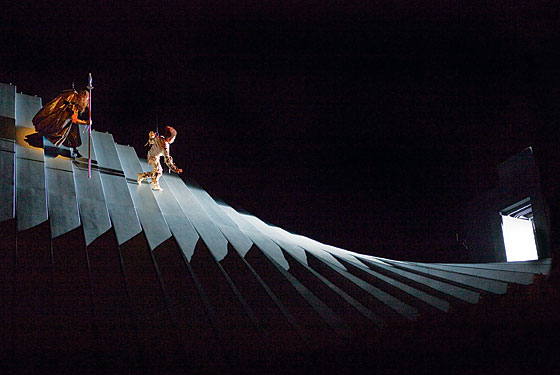
Stunt doubles make the journey into Nibelheim. Photo © Ken Howard/The Metropolitan Opera
The Metropolitan Opera's new production of Das Rheingold, designed and directed by Robert LePage, has its share of jaw-dropping moments. Monday night's performance featured a virtuoso performance from James Levine and the Met orchestra, supporting a strong (if not quite ideal) cast. But all eyes were on the staging, a multi-million dollar affair that uses high-tech machinery to produce Wagner's mythic world.

Trending on Superconductor

Translate

Share My Blog!

Share |

Critical Thinking in the Cheap Seats