Support independent arts journalism by joining our Patreon! Currently $5/month.

About Superconductor

Our motto: "Critical thinking in the cheap seats." Unbiased, honest classical music and opera opinions, occasional obituaries and classical news reporting, since 2007. All written content © 2019 by Paul J. Pelkonen. For more about Superconductor, visit this link. For advertising rates, click this link. Follow us on Facebook.
Showing posts with label igor stravinsky. Show all posts

Monday, March 9, 2015

Concert Review: A Superfluity of Musical Intelligence

The MET Chamber Ensemble at Zankel Hall.
by Paul J. Pelkonen
James Levine on the podium at the Metropolitan Opera House.
Photo by Jonathan Tichler © 2014 The Metropolitan Opera.
Within the constraints of his position as Music Director of the Metropolitan Opera, conductor James Levine can pretty much do as he pleases. On Sunday afternoon, he led the MET Chamber Ensemble and a group of young singers in a diverse program at Zankel Hall. Its focus: the development of modern music in the 20th and 21st century, from the early experiments of Charles Ives to the neoclassicism of Stravinsky, all the way up to modern experiments by John Cage, Elliot Carter and Charles Wuorinen.

Saturday, October 27, 2012

Opera Review: Magic on Mass. Ave.

Charles Dutoit conducts the Boston Symphony Orchestra.
"Now children, swish and flick." Charles Dutoit casts a magic spell.
Thursday night's Boston Symphony Orchestra concert at Symphony Hall featured a twin bill of 20th century operas by Stravinsky and Ravel. Although very different in sound, each 45-minute opera was dedicated to the exploration of fairy tale worlds and the use of vast orchestral resources to depict magical events. The program was conducted by Charles Dutoit.

The Stravinsky work was Le Rossignol, ("The Nightingale") an opera set in that same peculiar European vision of ancient China as Puccini's Turandot. This short three-act opera is based on a story by Hans Christian Andersen, of a Chinese emperor's complicated relationship with a nightingale (Olga Peretyako) whose song has the power to bring tears and ultimately, save the life of the dying Emperor.

Le Rossignol had a difficult genesis. In fact, the composer had only just finished the first act when he was commissioned by his friend Sergei Diaghalev to write a ballet for Paris, a work that turned out to be The Firebird. He did not complete the second and third acts until after the premiere of The Rite of Spring. The first act breathes with exoticism and orchestral combinations that are redolent of Stravinsky's teacher Rimsky-Korsakov. The second part features a thunderous Chinese march and strange tonalities permeating the final confrontation with Death.

Sunday, January 22, 2012

Concert Review: The Rites of Winter

Stravinsky Outside Russia at Carnegie Hall.
Conductor Leon Botstein. Photo © Bard College.
On Friday night, conductor and musical archaeologist Leon Botstein led the American Symphony Orchestra and the Collegiate Choral in a program exploring the music written by Igor Stravinsky in exile from his Russian homeland. The program was  part of the ASO's annual subscription season at Carnegie Hall.

Dr. Botstein assembled a slew of unfamiliar Stravinsky, opening up the composer's repertory beyond the composer's most frequently heard works: The Firebird, Petrushka and The Rite of Spring. Instead, there was a wide-ranging survey of songs, liturgical music, choral pieces, and even a short opera. Like Stravinsky's catalogue, this concert was bewildering in its its diversity.

The concert opened with a recent discovery: Stravinsky's orchestration of the Song of the Volga Boatmen. According to the program notes, Stravinsky may have written this orchestration for  legendary Russian bass Fyodor Chaliapin. It was sung by Keith Miller, the former NFL fullback turned bass-baritone. Mr. Miller sang the steady aquatic rhythms with steady, powerful tone.

Mr. Botstein then brought in the Collegiate Chorale for The King of the Stars, a choral work that finds the composer exploring the cosmos in with rich choral writing underpinned by the orchestra. Mr. Miller returned, joined by mezzo Ann McMahon Quintero for the Requiem Canticles, a funereal piece that the composer had performed at his own last rites.

The wrath of God yielded to comedy with a charming performance of Mavra, the composer's  last opera. This is Stravinsky at his most playful: The Rake's Progress freed from W. H. Auden's pesky moralizing. The score features a poke at Mahler--a funeral dirge as the Mother (Ms. Quintero) mourns her old cook. It opens with a tasty love duet for soprano Anne-Carolyn Bird and tenor Nicholas Phan, that would not be out of place in Smetana's Bartered Bride. 

Based on a short Pushkin farce, Mavra is about a suitor who resorts to cross-dressing to get a job as a cook in his girlfriend's mother's house. The singers made good impromptu use of the concert setting, with Ms. Bird's shoulder wrap becoming "Mavra's" headscarf. A shave kit was brought out for the climactic scene, and Mr. Phan made good his escape by running across the stage and hiding behind the organ.

The haunting, antiphonal Canticum Sacrum opened the second half. Mr. Phan and baritone Jonathan Beyer sang long melodic lines, originally written to sound across the vast Basilica of San Marco in Venice. Here, the singers engaged in call-and response with the chorus, organ and sparse orchestra, bringing an air of religiosity to the friendly confines of Carnegie Hall. That pious vein continued with Babel : a short retelling of the Old Testament linguistic crisis featuring the chorus and narrator John Douglas Thompson. 

The concert ended with the more familiar Symphony of Psalms a work that is exceptionally challenig for the chorus. The Collegiate Chorale responded ably, handling Stravinsky's tricky cross-rhythms and harmonics. With the odd melody and rhythmic quotations drawn from the score of the Rite of Spring, this symphony sounds as if the prehistoric Russian pagans of that famous ballet finally went and got religion.

Sunday, October 9, 2011

Concert Review: Agon and Ecstasy

Stravinsky meets Tchaikovsky at Severance Hall.
Franz Welser-Möst leads the Cleveland Orchestra at Severance Hall.
Photo by Roger Mastroianni © 2010 The Cleveland Orchestra.
The Cleveland Orchestra's Saturday evening subscription concert explored the divide between reason and passion. Two cerebral pieces by  Igor Stravinsky were followed by Tchaikovsky's Fourth Symphony. Music Director Franz Welser-Möst made this program a cogent argument for pairing these very different Russian composers.

The program opened with Stravinsky's Concerto in D, written solely for strings.  This is a concerto in the baroque style, with entire sections offering commentary instead of pitting a soloist against the whole orchestra. It is in the composer's neo-classical  style. Stravinsky creates dialogue between the five sub-sections of the strings. Each principal  player held forth independently, creating a conversation among the strings that made for fascinating listening. Mr. Welser-Möst led the work in his customary, efficient manner.

The Concerto was followed by Agon, the thorniest of Stravinsky's ballet scores. This is an example of Stravinsky's serial style, where music is built from predetermined tone-rows instead of the typical scale. However, Agon is melodic, and its sardonic wit is unmistakeable Stravinsky. The twelve-part work uses the entire orchestra as its palette, calling for solo parts from all four sections and emphasizing some unusual instruments.

Mr. Welser-Möst brought maximum clarity to this work, which had not been heard at Severance Hall in nearly four decades. The orchestra responded brilliantly, as the knotty musical lines untangled themselves and the work coalesced. The brass, asked to make difficult contributions in this work, responded admirably, as did the superb woodwind section.


The Tchaikovsky Fourth finds the composer setting aside naturalism and nationalism for an unyielding exploration of his own psyche. Mr. Welser-Möst tackled the opening movement head-on, opting for a bold, aggressive approach in this famous movement. The blast of brass that opens the work became a strident expression of rage at this fast speed, clashing with the folk-like second theme.

The second movement features a sad oboe theme against the strings that builds to a quiet chorale in the brass. Mr. Welser-Möst slowed the tempo accordingly for this more contemplative music, which featured fine playing from the principal oboe and the English horn. Pizzicato strings led off the Scherzo as the grim mood started to lift in anticipation of the finale.

The last movement brings the struggle to a head, as the violent brass theme from the first movement attempted a comeback. This was ultimately rejected in favor of a more optimistic rising theme, that brought the symphony to a flowing finish. Again, fast tempos were taken, emphasizing the war inside Tchaikovsky's head, one ultimately won by the forces of light.

The enthusiastic reception of this bold Fourth led to a magnificent encore: the slow Prelude to Act III of Die Meistersinger. Reflective playing from the cellos gave way to a hushed choir of horns, creating tones that might have been created on Severance Hall's pipe organ. The Wagner piece ended with a simple, added cadence. This was either a teaser for a future Cleveland Meistersinger, or a measure to prevent playing the full two-hour act.

Sunday, August 21, 2011

Concert Review: Grief, Joy, but no Mozart

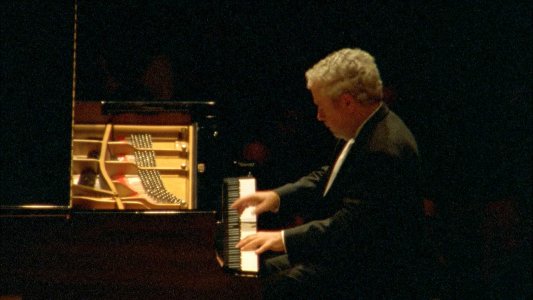
New world elegance: pianist Nelson Freire.
The composer whose name adorns the festival was absent from Mostly Mozart on Friday night, as the Festival Orchestra offered a program pairing Stravinsky's Symphony in C with Beethoven's Fourth Piano Concerto. Nelson Freire made his Festival debut as the featured soloist in the latter work.

Igor Stravinsky's neo-classical period saw the composer turn away from programmatic ballets in an effort to write pure music. But the wartime Symphony in C has autobiographical elements, with its relentless opening and melancholy writing for the wind section. Small wonder: Stravinsky had begun his wartime exile from Europe.

The mournful Larghetto may reference the deaths of his wife and daughter from tuberculosis. Mr. Langree led an eloquent reading of this underperformed work, with superb playing from the bassoons, oboe and English horn. The grim Largo that ends the work in a series of hushed, mysterious chords that never quite climax, created a spellbinding effect.

The Brazilian pianist Nelson Freire played Beethoven's Fourth piano concerto with Old World elegance. Subtly accompanied by Mr. Langree, Mr. Freire played the arpeggiated runs and figures with a sweet, almost joyful tone, offering an almost pastoral tour through the opening movement. This was pianism of a high order, gracious but with a restrained power underneath.

The slow movement of this concerto bears some resemblance to the composer's Waldstein sonata, in that it serves as a lead-up to a dazzling finale. Again, Mr. Freire spoke with his fingers, winding out the lazy melodies with ease. But there was nothing languid about the finale, a joyful storm up and down the keyboard with Mr. Freire's sure technique leading the charge.

Mr. Freire added to the work's challenges by playing the cadenzas of composer/pianist Ferrucio Busoni. Busoni, one of the most underperformed and challenging composers of the early 20th century, elaborated and expanded Beethoven's original work as part of his own concert repertory. The cadenzas are challenging: of such complexity that they amount to works in themselves.

The short concert was followed by an enthusiastic reception. Mr. Freire's first encore was a transcription from Gluck's opera Orfeo et Euridice, played with elegance and warmth. The second piece, a searching work that fell between impressionism and modal jazz, was from the 20th century and probably penned in Mr. Freire's native Brazil. It might have been by Villa-Lobos.

Friday, July 29, 2011

Concert Review: Broadway At Last

Nielsen and Stravinsky mark RDO's overdue debut
Royal Danish Orchestra's Music Director Michael Schønwandt.
The art of programming symphony concerts is a tricky one. Finding the links between disparate pieces, by different composers, in different genres is hard. And some music directors settle for the fact that the two or three scheduled works are from the same historic period, or refer to the same book, or something equally esoteric.

Michael Schønwandt, music director of the Royal Danish Orchestra, displayed his mastery of this art on Thursday night, as the RDO made its long-awaited debut at Alice Tully Hall as part of this summer's Lincoln Center Festival. The Copenhagen-based orchestra was founded in 1448, and ranks as Europe's oldest performing orchestra. For this concert, Mr. Schønwandt offered a pairing of works by Carl Nielsen and Igor Stravinsky.

This skillfully chosen program made the connection readily apparent. The Russian and the Dane were innovative orchestrators, skilled in the use of rhythm. Both sprinkled their compositions with welcome doses of humor. That was evident in Nielsen's brief Pan and Syrinx, a tone poem that pushes the woodwinds of the orchestra to the fore in an entertaining dialogue. Exceptional playing from the clarinet, English horn and bassoon was the order of the day, underpinned by a swift current of harmonies in the strings.

The clarinet moved to the front of the stage for the next work, Nielsen's Clarinet Concerto with RDO principal John Kruse. Mr. Kruse demonstrated the full expressive range of his instrument in the difficult solo part. He drew different voices from the clarinet, from a series of sad, minor-key groans to the instrument's more familiar, sunny register, racing up and down the instrument's range to thrilling effect.

The 27-minute single-movement work offered considerable challenge, including a long solo cadenza that spiralled gracefully downward before being caught on an updraft of orchestral sound. The piece opens with a fugal, almost baroque feel. Nielsen then veers into modern territory, developing a long conversation between soloist and orchestra.


The concert concluded with Pulcinella, a work firmly in the neo-classical mode that defines the middle period of Stravinsky's career. Although the dance movements and allegros recall the writing of Handel and Mozart, Stravinsky throws the occasional orchestral curve-ball at the listener. He has the musicians stop on a dime, or play an ostinato rhythm that is characteristically Russian underneath the instrumental filigree.

Mr. Schønwandt conducted with flair, lip-synching along as he directed the three singers in their solo arias and brief ensembles. Mezzo Tuva Semmingsen brought intelligence and pointed meaning to her arias. Tenor Peter Lodahl sang with sweet, plaintive tone. Baritone Jochen Kupfer sang Stravinsky's bass part with a dark, warm tone that fit beautifully with the other two soloists.

As Pulcinella develops, more and more of Stravinsky's unique voice comes through. Most notable: the emphatic trombone solo in the latter third of the work that recalls the early recordings of New Orleans jazzman Kid Ory. This rambunctious part was a breath of fresh air, played with gusto by soloist Torbjørn Kroon. As the work concluded with another trio and a fast Allegro, the orchestra's long-overdue New York debut came to a triumphant close.

Thursday, May 5, 2011

Concert Review: Finding Their Marbles

The Philadelphia Orchestra brings Stravinsky to Carnegie Hall.
The Philadelphia Orchestra's chief conductor: Charles Dutoit

The Philadelphia Orchestra has been in the headlines lately, not for the band's musical prowess, but for their board's decision to file for Chapter 11 bankruptcy. The Philadelphians are the first major American orchestra to declare bankruptcy, a decision that has sent rumblings of doom throughout the classical music industry.

Those rumblings were silenced at the Orchestra's Tuesday night appearance at Carnegie Hall under the baton of chief conductor Charles Dutoit. The Swiss maestro brought a contrasting program of works by Igor Stravinsky: the sunny ballet score Apollo and the opera-oratorio Oedipus Rex. The result was an effective contrast of light and dark, exploring two aspects of Stravinsky's neo-classical period.

The  succulent, dark tone of the Philadelphia strings have been a trademark of this orchestra since the heady days when Leopold Stokowski stood upon the podium. This performance of Apollo, a work written just for the strings, featured this rich, thick carpet of sound, with soaring solos from the principal players in each section. Apollo marks a very different Stravinsky from the tribal thunder of the Rite of Spring: a work of neo-classical elegance that recalls the music of Haydn.


The jarring, heavy chords that mark the opening bars of Oedipus Rex have the opposite effect. Oedipus uses huge, rough blocks of brass and percussion, combined with an all-male Latin chorus to evoke the marble and masks of Greek tragedy. The Latin setting of Sophocles (by Jean Cocteau) features no onstage action, and all the events of Oedipus' downfall are described by an omniscient narrative before they happen.

In other words, this is the perfect opera to do in a concert setting.

Tenor Paul Groves was a strong Oedipus, exuding confidence in the first act that slowly degenerated into panic. Baritone Robert Gierlach doubled the roles of Creon and the Messenger. While he has a fine voice, he had trouble being heard over the orchestra at full blast. Petra Lang made an impressive vocal entrance as Jocasta, but sounded unusually harsh of tone in the latter half of her scene with Oedipus. Then again, it could have been her character's panic at realizing who her husband really was.

Mr. Dutoit moved the blocks of sound around with the ease of an Athenian work crew, although the heavy orchestra occasionally overwhelmed the soloists. The orchestra played with precision, with rich trombone tones and deadly, precise percussion. The men of the Philadelphia Singers Chorale made the strongest impression as the citizenry of plague-struck Thebes, by turns terrified, enraged, and horrified at the fate of their king. Philadelphia-based Shakespearean actor David Howey was strong and sympathetic as the Narrator.

Friday, March 4, 2011

Opera Review: The Life Aquatic with Robert Lepage

The Canadian Opera Company presents The Nightingale and Other Short Fables at BAM.
by Paul J. Pelkonen
The three bureaucrats (lower left) confront the Nightingale as the chorus looks on.
Photo from the COC production of The Nightingale © 2011 Canadian Opera Company.
Opera offerings at the Brooklyn Academy of Music are sparse this season, but this exquisite production of Stravinsky's The Nightingale (imported from the Toronto-based Canadian Opera Company) provided ample compensation--the unique spectacle of a Russian opera, set in China and performed as a water-based ballet of intricate puppets.

Monday, May 10, 2010

Concert Review: One Last Sacrifice

New York Philharmonic plays Stravinsky with Gergiev.
by Paul J. Pelkonen

Valery Gergiev, looking remarkably like the bad guy in the Vin Diesel movie xXx.

Saturday morning marked the final performance of The Russian Stravinsky, the New York Philharmonic's three-week festival focusing on the composer and his works. At this concert, Valery Gergiev presented a fresh, completely original approach to one of Stravinsky's most familiar scores: The Rite of Spring.

Trending on Superconductor

Translate

Share My Blog!

Share |

Critical Thinking in the Cheap Seats