Support independent arts journalism by joining our Patreon! Currently $5/month.

About Superconductor

Our motto: "Critical thinking in the cheap seats." Unbiased, honest classical music and opera opinions, occasional obituaries and classical news reporting, since 2007. All written content © 2019 by Paul J. Pelkonen. For more about Superconductor, visit this link. For advertising rates, click this link. Follow us on Facebook.
Showing posts with label Simon keenlyside. Show all posts

Sunday, January 20, 2019

Metropolitan Opera Preview: Don Giovanni

Mozart's libertine nobleman returns to add to his catalogue.
by Paul J. Pelkonen
Peter Mattei returns to the role of Don Giovanni at the Met this year.
Photo by Marty Sohl © 2019 The Metropolitan Opera.
Some evils never die, and some productions keep getting revived. Such is the case with the Metropolitan Opera's Michael Grandage staging of Don Giovanni. It's back, and it's going down in flames. Good thing then that it's one of the best operas ever written.

Wednesday, September 28, 2016

Opera Review: Fireproof

Simon Keenlyside makes a comeback as Don Giovanni.
by Paul J. Pelkonen
The statue of the dead Commendatore (Kwangchal Youn, left) takes Don Giovanni 
(Simon Keenlyside) down to Hell as Leporello (Adam Plachetka) cowers on the right.
Photo by Marty Sohl © 2016 The Metropolitan Opera.
The Metropolitan Opera's current production of Don Giovanni, introduced at the opera house by director Michael Grandage in 2011 is an uninspired, ugly hash with a some impressive, yet noisy fire effects at the end. And yet, Mozart's opera remains immortal. Its music, when properly delivered, would work if the singers were in burlap sacks with paper bags over their heads, an image one must be cautious with lest it inspire some young theater director looking to mount Don Giovanni in the future.

Monday, March 16, 2015

Concert Review: Last Stop: Endsville

Thomas Adès conducts the New York Philharmonic.
by Paul J. Pelkonen
Carry a big stick: Thomas Adès conducts Totentanz.
Photo from the premiere of Totentanz at the Proms, from the Royal Albert Hall.

Thomas Adès is at the front rank of today's contemporary composers, thanks to bad-boy operas like Powder Her Face and The Tempest. On Thursday night, before a packed house that included Icelandic singer Björk and Metropolitan Opera general manager Peter Gelb, Mr. Adès led the New York Philharmonic for the first time, conducting the New York premiere of his cantata Totentanz with early compositions by  Beethoven and Berlioz.

Wednesday, October 24, 2012

Opera Review: Practical Magic

Thomas Adés' The Tempest opens at the Met.
by Paul J. Pelkonen
Ariel--aerialist: Audrey Luna flies high in The Tempest.
Photo by Ken Howard © 2012 The Metropolitan Opera.
In a dreary Metropolitan Opera fall season dominated so far by (dull-to-competent) revivals, the New York premiere of Thomas Adés' opera The Tempest (seen from the very last row of the house on opening night) provides a sorely needed breath of musical and dramatic innovation.

Sunday, October 14, 2012

Metropolitan Opera Preview: The Tempest

(Reposted from the 2012-13 Metropolitan Opera Preview.)
The Met goes back to the...um..."ensorcelled atoll."
by Paul J. Pelkonen
Simon Keenlyside is Prospero, out for revenge--starting with his tattooist.
Promotional image for The Tempest. Photo by Anne Deniau © 2012 The Metropolitan Opera.
The Met unveils its first ever production of Thomas Ádes' Shakespearean opera, with the composer himself conducting. Simon Keenlyside sings the key role of Prospero, with talented young singers (Isabel Leonard, Iestyn Davies, Audrey Elizabeth Luna) filling out the cast.

The Tempest marks the return of Robert Lepage to the Met. The French-Canadian director may still be smarting over the critical backlash received by his staging of Wagner's Ring. According to the Met website, this staging "recreates the interior of 18th-century La Scala, including the hidden workings underneath the stage, where Prospero, the banished Duke of Milan, practices his otherworldly arts."

This is the second new opera at the Met this year to be based on William Shakespeare's final play. The Tempest (with a libretto by Meredith Oakes) is a far more serious take on the story of Prospero, the sorcerer who creates a brave new world on a mysterious, enchanted island. (Sorry, couldn't resist.)

The Tempest will have its New York premiere on Oct. 23.

Monday, October 24, 2011

Concert Review: Reality Check

Britten's War Requiem at the White Light Festival.
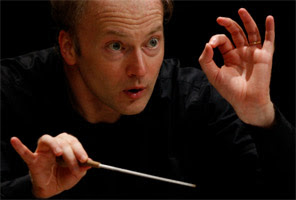
Okey-Dokey. Conductor Gianandrea Noseda led huge forces in Sunday's War Requiem.
Photo by John Super © 2011 London Symphony Orchestra.
The enormous resources called for in Benjamin Britten's War Requiem were almost beyond the means of Avery Fisher Hall on Sunday afternoon. They included the full strength of the London Symphony Orchestra and Chorus, a small chamber orchestra (drawn from LSO players and squeezed in around the conductor's podium), three vocal soloists and the American Boychoir. The kids had to sing through a door leading offstage.

In these tight quarters, the spacious antiphonies of this complicated work (premiered in 1962 at the dedication of the new Coventry Cathedral following the destruction of the original by Luftwaffe bombs in 1940) didn't quite work. Giandrea Noseda did an admirable job of marshaling his forces, achieving a remarkable aural balance of the four groups. He conducted with vigor.

The London Symphony Chorus was a force unto itself, declaiming the Latin text of the mass with the authority of the Metatron. The fiery incantations of the Dies Irae (featuring ear-splitting playing from the brass in the "Tuba Mirum") blazed forth with power. They were also key contributors to the success of the later movements, especially the slow-moving setting of the Agnus Dei.

The Offertorium is the dark heart of this strange piece. Here, the composer re-tells the story of Abraham and Isaac. However, Isaac is sacrificed by his father in the accompanying Wilfred Owen poem: an echo of the horrors of war. This is Britten at his most cutting. The hollow fugue at the end was a grim, Shostakovich-like joke.

Tenor soloist Ian Bostridge sang repertory that was suited to his unique instrument. Mr. Bostridge took advantage of Britten's high vocal lines, airing them easily over the chamber ensemble. He added emotional weight to these words, making the bleak landscapes of war-torn Europe flicker with ghostly light.

He was paired with baritone Simon Keenlyside, an opera star in his own right. Mr. Keenlyside's smallish, dark-hued instrument was perfect for "At the thrust of Lightning in the East" in the Sanctus. Soprano Sibina Civilak also sang beautifully from the space between the orchestra and chorus, tossing off some glorious notes in the Lacrimosa.

The small cadre of boy trebles also made an important contribution from their offstage post. The two singers joined voices on on the last poem, "Strange Meeting." The scene: an encounter between two wounded enemy soldiers in a tunnel full of corpses. As Mr. Bostridge and Mr. Keenlyside sang out the lines of the poem, the women of the LSO Chorus echoed with  "In paradisum" from the Libera me section of the Mass. This made for a stratospheric, if icy climax.

Benjamin Britten was a committed pacifist, and did not pull punches in his work that combines the Latin Mass for the Dead with battlefield poetry. This is one of the composer's most dramatic and most popular pieces, a work that is all too apt for today's audiences. The White Light Festival may be about bringing its audience out of their daily lives, but under Mr. Noseda the Requiem was a sharp reminder of reality.

Tuesday, April 6, 2010

Opera Review: Dead Again, for a Ducat

Simon Keenlyside is Hamlet
by Paul J. Pelkonen
Simon Keenlyside gets stabby in Hamlet.
Photo © 2010 The Metropolitan Opera. 

The arrival of a major new artist on the stage of the Met is a cause for celebration for opera lovers. Monday night saw the Met debut of Canadian soprano Jane Archibald in the role of Ophélie, the doomed love interest in Ambroise Thomas' opera Hamlet.

Trending on Superconductor

Translate

Share My Blog!

Share |

Critical Thinking in the Cheap Seats