Support independent arts journalism by joining our Patreon! Currently $5/month.

About Superconductor

Our motto: "Critical thinking in the cheap seats." Unbiased, honest classical music and opera opinions, occasional obituaries and classical news reporting, since 2007. All written content © 2019 by Paul J. Pelkonen. For more about Superconductor, visit this link. For advertising rates, click this link. Follow us on Facebook.
Showing posts with label bryn terfel. Show all posts

Tuesday, December 12, 2017

No Roads Lead to Rome

Sir Bryn Terfel pulls out of the new Met Tosca.
by Paul J. Pelkonen
Sir Bryn Terfel (center) has exited the Met's troubled new Tosca, opening Dec. 31.
Photo by Cory Weaver © 2010 The Metropolitan Opera.
First they lost their leading lady. Then the conductor. The Cavaradossi quit. And then the second conductor. Now, Sir Bryn Terfel has become the latest artist to pull out of the Metropolitan Opera's increasingly troubled new production of Puccini's Tosca.

Thursday, September 24, 2015

The Many Joys of Figaro


Some thoughts on thirty years of life with Mozart's opera.
by Paul J. Pelkonen
A piano score for The Marriage of Figaro featuring
Cherubino in the chair,  discovered by the Count.

The Marriage of Figaro and I have been through a lot together. I first saw Mozart's opera at the New York City Opera with my parents and while my young self may have snoozed through some of its four hour length (I think I was ten years old at the time) what I remembered of the show was engrossing, the madcap household and its goings-on, with the supremely confident and nimble Figaro at its center had immediate appeal.

Monday, June 15, 2015

DVD Review: Call in the Swiss Navy

Opernhaus Zürich presents Der Fliegende Holländer.
by Paul J. Pelkonen
Heart of darkness: Bryn Terfel (center) is the Dutchman in Opernhaus Zürich's
Der Fliegende Holländer. Photo © 2013 Opernhaus Zürich/DG/UMG.
With the 1843 premiere of Der Fliegende Holländer (The Flying Dutchman) Richard Wagner created the first of ten operas that constitute the canon of his work. He also created a serious problem for stage directors, as the romance between a ghostly ship's captain and an obsessive young woman ends with the latter hurling herself off a nearby cliff and the reunited couple "ascending to Heaven" as the opera's final bars crash home.

Monday, March 10, 2014

Concert Review: Savories, But No Salvation

The New York Philharmonic revives Sweeney Todd.
by Paul J. Pelkonen
Savories: Emma Thompson (left) and Bryn Terfel serve up "A little priest"
in Sweeney Todd: The Demon Barber of Fleet Street.Photo by Chris Lee © 2014 The New York Philharmonic.
The audience never saw it coming.

When the lights went down in Avery Fisher Hall for the final performance of the New York Philharmonic's concert production of Stephen Sondheim's Sweeney Todd: The Demon Barber of Fleet Street, the stage looked set for a typical and staid gala in the usual manner of this venerable orchestral institution. Charming floral arrangements sat in pedestal vases at the wings. Alan Gilbert and the cast entered in neat evening wear, filing to music stands past an enormous concert grand downstage. They carried scores in neat binders, as if about to sing some Mendelssohn oratorio or perhaps Handel's Messiah.

Tuesday, May 7, 2013

Twilight of the Machine

Robert Lepage's Ring may face the scrap heap.
by Paul J. Pelkonen
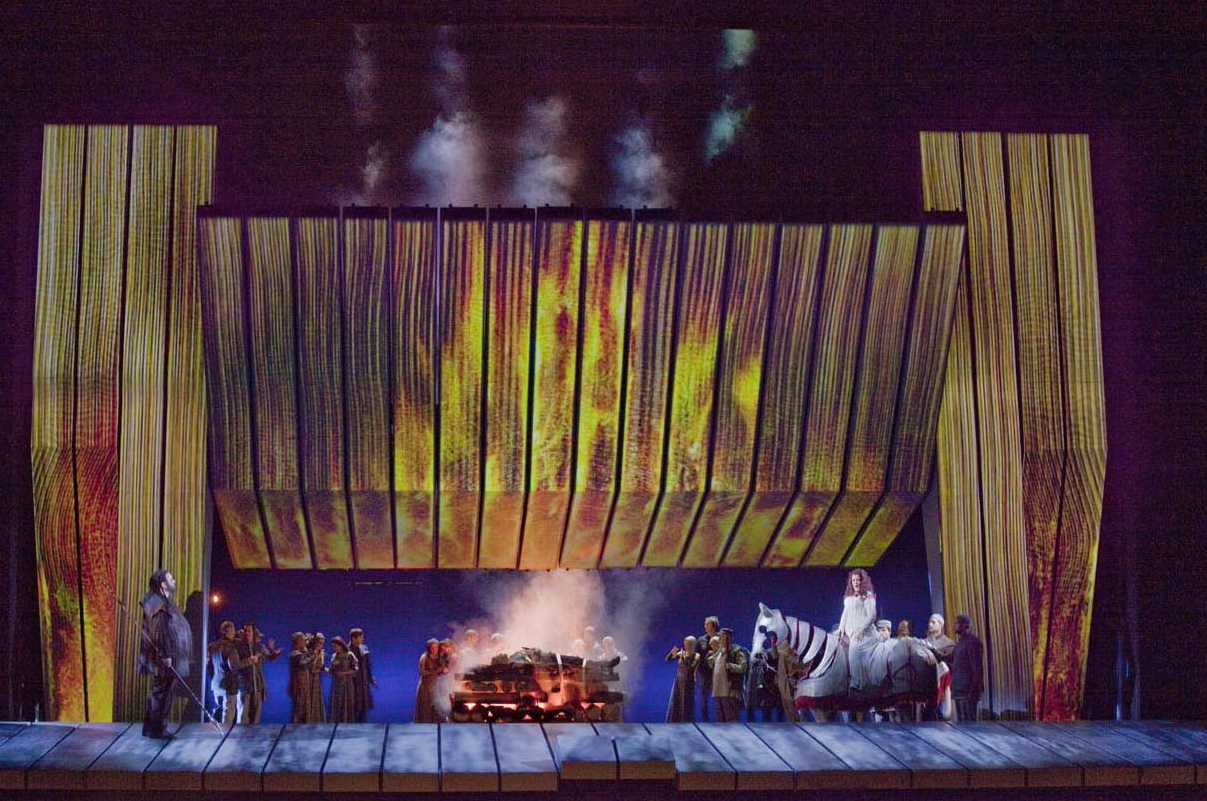
Up in flames: a scene from Act III of the Metropolitan Opera production of Götterdämmerung.
Image © 2012 The Metropolitan Opera.
According to an article published yesterday on parterre.com, this might be the end of the road for the Metropolitan Opera's current production of Wagner's Der Ring des Nibelungen. The company has one performance of Siegfried and one of Götterdämmerung scheduled for later this week.

Saturday, March 30, 2013

Metropolitan Opera Preview: Das Rheingold

The Ring Cycle starts over.
by Paul J. Pelkonen
Underwater love: the three Rhinemaidens cavort at the start of Das Rheingold.
Photo by Ken Howard © 2010 The Metropolitan Opera.


The Prelude to the Ring Cycle is either the ideal first Wagner opera--or a torture test for dyed-in-the-wool opera lovers who are forced to sit still for two and a half hours.  Das Rheingold begins underwater. Three Rhinemaidens are hit on by a sexed-crazed Nibelung dwarf, Alberich. Alberich copes with their rejection by stealing their treasure, the gold titular "Rhine gold." He uses the gold to forge the Ring, a powerful trinket that will pass from hand to hand until the end of the cycle 15 hours later.

Tuesday, August 7, 2012

Waiting For the World to End

A Superconductor Editorial.
by Paul J. Pelkonen
The final conflagration at the end of the Met's new Ring Cycle.
Photo by Ken Howard © 2012 The Metropolitan Opera.
The Metropolitan Opera has announced the release date for its DVD and Blu-Ray sets of the company's Robert Lepage production of Der Ring des Nibelungen:

September 11, 2012.

The sets, which are re-packagings of the Met's Live in HD performances of Das Rheingold, Die Walküre, Siegfried and Götterdämmerung, are scheduled for general release on the 11th anniversary of attacks on New York and Washington, DC that destroyed the World Trade Center and part of the Pentagon.

Friday, March 30, 2012

Twilight of the Ring

The Metropolitan Opera slashes the cost of Wagner.
Downwardly mobile: Wotan (Bryn Terfel) and Fricka (Stephanie Blythe) in Das Rheingold. Photo by Ken Howard © 2010 The Metropolitan Opera.
According to a report first posted on Norman Lebrecht's website Slipped Disc, the Metropolitan Opera has done the unthinkable, slashing prices across the board for upcoming performances of the three complete cycles of Wagner's Der Ring des Nibelungen. 

Checking ticket prices for an April 24 performance of Götterdämmerung (according to the Met website) are now as low as $45 for the rear of the Family Circle. Orchestra Balance seats (off to the side) are as low as $180 (formerly $275), with better seats (Orchestra Premium) going as high as $345 (down from $650.) There are even a few coveted aisle seats available for some shows.Das Rheingold has had ticket prices cut by as much as 50%, with Family Circle seats priced at the normal rate of $25-$35. A few days ago, they were $55.

Even more surprising: the wide availability of tickets for the April 13 Die Walküre, opening night of that opera, which is considered the most popular entry in the tetralogy. 

This quiet, unannounced move may be a desperate attempt to fill the house as the Ring approaches. The cycles launch with the return of Das Rheingold on April 4. No information is available as to whether ticket holders who already bought seats under the old price structure will receive some sort of remuneration from the Met.

The Metropolitan Opera's current production of the Ring, designed and directed by Robert Lepage, has met with mixed reviews as the four operas have launched over the last two years. The multi-million dollar production, constructed around a massive movable set (sarcastically dubbed "The Machine" by the stage crew) has had its share of performance malfunctions, occasionally forcing singers to improvise on the stage apron. More serious were two onstage accidents, both during 2011 performances of Die Walküre.

The January premiere of Götterdämmerung featured some shaky special effects, including exploding plaster statues that were meant to evoke the fall of Wagner's Germanic gods but caused the opening night audience to laugh at the opera's climax.

This month marks the first "full" performances of the cycle, which are traditionally sold to the Met audience as four-opera packages at double the face value of ordinary seats at the Met. The company's former production, by the German team of Otto Schenk and Gunther Schneider-Siemssen, was notable for being one of the company's most coveted tickets, and a perennial sellout.

Met ticket prices have steadily gotten higher in the last three seasons, as the house has had to cover increased operational costs. These include general manager Peter Gelb's pricey Met Live in HD series, which brings Met operas to movie screens around the world on Saturday afternoons. Next season's brochure features a "staggered" ticket policy with higher rates being charged for new productions and of course, Wagner operas.

In other news, the company has been generating much hoopla over a planned series of Live in HD re-runs of the video broadcasts of the four operas in the Ring. These screenings are not new films drawn from the April and May Ring cycles, but re-broadcasts of the performances shot in 2010, 2011, and 2012.

Monday, February 13, 2012

Guess Who's Coming to Dinner?

Another cancellation for the Met's Don Giovanni.
Dinner guest: Bryn Terfel.
Photo © 2012 Deutsche Grammophon.

In October of 2011, one of the biggest stories coming out of the Met involved Mariusz Kwiecien, who was replaced in the title role of the Met's new production of Don Giovanni after being injured in a rehearsal. He was replaced by Peter Mattei, and the show went on.

Now there are problems with the second cast. Bass John Relyea, scheduled to sing eight performances as Leporello, has bowed out of the production, according to a report on The Wagnerian's blog. Mr. Relyea's doctor ordered the singer to rest his voice. 

Their replacements for the upcoming shows will be Kyle Ketelsen, who will sing the first four performances, and none other than Bryn Terfel, who will sing the last four shows in March. 

Mr. Terfel, last seen as the Wanderer in the Met's new production of Wagner's Siegfried made his early reputation with this opera, singing and recording Masetto (with Arnold Östman) the Don (with Sir Georg Solti) and Leporello (with Claudio Abbado.) He first sang Leporello at the Met in 1995, and the Don in 2000 

This run of the company's new Michael Grandage production pairs the singers with Canadian baritone Gerald Finley in the title role. The cast also includes Matthew Polenzani as Don Ottavio, Marina Rebeka as Donna Anna and Isabel Leonard as Zerlina. James Morris (another famous Met Wotan) is the Commendatore. Andrew Davis conducts.

Don Giovanni returns on Feb. 21.

Recording Recommendation
Don Giovanni is one of the most frequently recorded Mozart operas, and many fine recordings are available. Here are three that I like.

Vienna Philharmonic cond. Josef Krips (Decca, 1955)
Don Giovanni: Cesare Siepi
Leporello: Fernando Corena
Donna Anna: Suzanne Danco
Donna Elvira: Lisa della Casa
Il Commendatore: Kurt Böhme
One of the first stereo recordings of this opera, the Krips recording captures singers of a different age in the fertile ground of Vienna, just a decade after the war. Siepi and Corena play the roles of master and servant with gusto, and the conducting is terrific.

Chamber Orchestra of Europe cond. Claudio Abbado (DG, 1998)
Don Giovanni: Simon Keenlyside
Leporello: Bryn Terfel
Donna Anna Carmela Remigio
Donna Elvira: Soile Isokoski
Il Commendatore: Matti Salminen
This was Bryn Terfel's third recording of the opera, and his first as Leporello. (He was the Don for Solti's recording, and also recorded Masetto.) The Welsh baritone seems much more comfortable as the Don's slippery servant, and gives a great reading of this part. Abbado's conducting is spot on, as is Matti Salminen's terrifying Commendatore.

Thursday, March 31, 2011

Opera Review: Another Crack at the Rainbow Bridge

The Return of the Lepage Das Rheingold.
Scene Two of Rheingold with Bryn Terfel (center) as Wotan.
Photo by Ken Howard © 2010 The Metropolitan Opera.
Wednesday night at the Met featured the return of the Robert Lepage production of Das Rheingold, with a few changes in the cast and in the orchestra pit. Principal guest conductor Fabio Luisi subbed in for an ailing James Levine.

It also brought some fresh perspectives on the staging, seen this time from the back row of the orchestra standing room. From eye level, Mr. Lepage's "Machine" set--24 computer-controlled planks that form the many landscapes of Wagner's imagination, remains curiously featureless.

The underwater opening still successful, helped this time by the presence of baritone Richard Paul Fink as Alberich. Mr. Fink played the dwarf with cunning, humor, and full baritone voice, managing to cope with sliding up and down the computer-generated riverbed as he chased the Rhinemaidens about.

The "rocks" configuration (used for Scenes Two and Four) is more problematic. Wagner calls for a mountain height, but this looks more like an aircraft carrier, with battleship gray Machine-planks looming like tank cannons aimed at the audience. The split-level staging ensures  distance between the gods and giants, removing the giants' ability to threaten the gods. There are also balance problems, with the basses Franz-Josef Selig (Fasolt) and Hans-Peter König (Fafner) rendered inaudible at times.  On the bright side, a steep tilt of the set makes it easy to get Fasolt's corpse off the stage. (James Bond villains, take note.)


Despite the production issues, things are getting better on the road to Valhalla. Bryn Terfel seemed more secure of tone as Wotan. An experienced villain actor, the burly Welshman improves as Wotan gets meaner, culminating in a completely bloodless theft of the glowing Ring. Stephanie Blythe had a great night as Fricka, singing with ample, rounded tone. The tension between them was palpable, a portrayal of the classic bad marriage.

The best addition to this cast is Arnold Bezuyen, making his company debut as a pointed, sarcastic Loge. He brought interest and involvement to the fire god's Narrative, something lacking in October's performance. It's too bad the costume department made him look like the Baron Harkonnen from David Lynch's movie version of Dune.

On the podium, Mr. Luisi drew out some interesting textures. The bass trumpet was accented at the end of the Prelude. The anvil-driven Nibelung rhythms had punch. The conductor's best moment was in the Erda scene. At that point, all the hype about the cast, the Met and the Machine went away and you were drawn deeply into Wagner's mythological story. But that didn't come until two hours in.

The production continues to boast some innovative visual ideas--the descent into Nibelheim, the Gods' climb up the face of the machine to Valhalla. Unfortunately, like many Met stagings, the best visuals are well above the stage, and hard to see from under the overhang of the parterre boxes. But they probably looked great from the parterre seats.

Thursday, April 15, 2010

Opera Review: The Redemption of Tosca

A strong cast saves the Met's new production...for now.
by Paul J. Pelkonen
Bryn Terfel as Baron Scarpia in Tosca.
Photo by Corey Weaver © 2009 The Metropolitan Opera.
The Metropolitan Opera revived the ill-received Luc Bondy production of Tosca on Wednesday night. Armed with an exceptional cast and expert conducting by Fabio Luisi, the company may yet succeed in changing the public's perception of this production.

Trending on Superconductor

Translate

Share My Blog!

Share |

Critical Thinking in the Cheap Seats