Of the fifteen operas written by Richard Strauss none are more complicated, more esoteric or more demanding than Die Frau ohne Schatten. Written during the First World War and premiered in Vienna in 1916, this was the composer’s sixth opera, and his third collaboration with librettist Hugo von Hoffmannsthal. Frau or “Fr-o-sch” as the composer affectionately nicknamed it (the German word for "frog") is a fairy tale for grown-ups, told on a scale that would make Richard Wagner envious.
Die Frau Ohne Schatten is composer Richard Strauss' most ambitious collaboration with librettist Hugo von Hofmannsthal. A Magic Flute-style quest (in this case for the missing "shadow" of the title) written on a Wagnerian scale, Frau has a complex libretto that requires its director to make frequent transitions between the everyday world and the realm of faerie, ruled by the merciless Keikobad. The titular Frau is Keikobad's daughter, the Empress. She seeks to cast a shadow and bring fertility to her loveless marriage. With five leading roles and a heavyweight orchestration, it is a formidable challenge for any opera house.
Paul J. Pelkonen
Editor, Superconductor
*** 44th St. Apt. *
Brooklyn NY 11220 USA
Dr. Richard Strauss,
The Villa Strauss, 42 Zoeppritzstraße,
Garmisch-Partenkirchen, Germany 82467 June 11, 2014
Dear Dr. Strauss:
I know we don't know each other and I am sure you are getting a lot of birthday greetings today. I wanted to take this occasion to wish you the very happiest of 150th birthdays and to write a little about what your music has meant to me in the past 25 years of my life. I'm an American music critic living and working in New York City, and my music blog Superconductor is frequently devoted to writing about your work.
The stars are aligned.
The twelfth messenger has arrived.
The red falcon has come home.
In other words, the Metropolitan Opera finally revived Richard Strauss's Die Frau ohne Schatten last night. This handsome production by the late Herbert Wernicke has been absent from that company's stage for nine years, an almost unforgivable oversight by one of the few North American companies capable of mounting this difficult work.
Die Frau ohne Schatten is a beloved Richard Strauss opera, but like a comet, it is only seen occasionally. Constructed on an enormous scale and requiring a huge orchestra, this 1919 work is at once a fairy tale, an ode to domestic harmony and a celebration of the joys of having children.
The historic early days of the recording era are at the center of Christof Loy's stripped-down Salzburg production of Die Frau ohne Schatten, the longest and most challenging of Richard Strauss' fifteen operas. Mr. Loy moves the action of this fairy-tale opera to a Vienna recording studio, a replica of the Sofiensaal ballroom which served as a crucible for the modern industry of recording classical music and opera.
This summer marks 30 years of opera for me. My first was Turandot at the New York City Opera, in the summer of 1982. And since then I've seen hundreds of operas.
Add to that the operas I've seen on home video and DVD and you have an enormous list. So in the interests of fun (and because I'm recovering from illness and missed yesterday's shows at Mostly Mozart) here's a new feature for Superconductor: a look at some of my favorite opera productions that I've seen in my three decades sitting in the dark.
These aren't necessarily reviews--more like reminiscence. Some of them I saw live, others, only on video. So please bear with--it's an attempt to loosen up the format of the blog and give myself something fresh to write about.
Die Frau ohne Schatten("The Woman Without a Shadow") was the second opera I saw at the Metropolitan Opera House (my first was Aida with Plácido Domingo and Aprile Millo). It was the start of a long (and still ongoing) love affair with the operas of Richard Strauss.
Die Frau ohne Schatten at the 2011 Salzburg Festival
by Paul J. Pelkonen
(Ed. Note: the following is based on watching about an hour's worth of clips from the performance, published this week on YouTube by OperaZine. They were called to my attention by my good friend La Cieca at Parterre Box. No, I didn't suddenly fly to Salzburg. But this is so worth writing about.)
This utterly fascinating new production of Richard Strauss' Die Frau ohne Schatten succeeds through simplicity. By eliminating all the visual difficulties that go with this most complex opera,the Salzburg creative team has stripped Frau to its brilliant core: the music. Director Christof Loytakes opera-goers back to the Sofiensaal, a disused, unheated ballroom in post-war Vienna. The period: that magical era of 1958-1965, when a team of enterprising British engineers created the first stereo recordings of Wagner's Ring Cycle, Strauss' Salome and Elektra, and Verdi's Aida.
Dressed in winter coats and appropriate, period clothing, the singers perform at score desks, carrying battered, well-marked copies of the vocal score of Frau. In between, they sit at rehearsal desks, sip tea and shiver. If Mr. Loy is trying to capture the tedious truth of being stuck in a recording session, he achieved that. A singer then moves to one of the music stands, positions around a carefully marked-off grid on an elevated platform in the middle of the ballroom.
The process depicted here (which eventually became branded and promoted as "Decca Sonicstage") was the brain-child of producer John Culshaw. His positioning system (aallowed the sound of the singers to be panned back and forth across the sonic palette, giving the listener the illusion that the singers were standing to the right or the left, communicating and interacting as if they were on a "real" operatic stage.
As they perform/record the roles in the opera, the singers are accompanied by a score-wielding assistant engineer, and monitored from a "control booth" high in the ballroom set. Much of the action involves the assistant engineer positioning singers on the stage, a team of maids providing the artists with coffee, and the re-blocking of music stands for the scene changes.
The first clip featured the duet of the Empress and the Nurse in Act I, and the pell-mell journey down to the world of Men which marks the opera's first major scene-change. Anne Schwanewilms has the right silvery voice for the Empress, with steel underneath for cutting through Strauss' thick orchestration. Michaela Schuster is a complex presence as the Nurse, being pulled deeper and deeper into the slippery role as the opera develops.
The excerpt from Act II features a pair of well-dressed, confused looking "backers" and a line of dancing girls who may be rehearsing another performance altogether. (They take the place of the illusory servants that the Nurse conjures for the Dyer's Wife in Act I and II.) It's a backstage look at opera being created, at a recording process that no longer exists, in a building that is no longer used.
Evelyn Herlitzius is all raw power and emotion as the Dyer's Wife, whose Faustian bargain with the Nurse is at the heart of the opera's plot. Baritone Wolfgang Koch is all depression and defeat as Barak. Finally, there is too little of tenor Stephen Gould as the Emperor included in these excerpts, but he sounds firm and noble in the finale. The choral singing (what I could hear of it) was top-flight.)
It is no disservice to this strong cast of singers to say that the brightest star of this performance is the Vienna Philharmonic, playing this marvelous music as few orchestras can, under the expert and enthusiastic guidance of Christian Thielemann. Mr. Thielemann shows his experience with this complicated music, and his pride of place as the conductor best qualified to tame Strauss' beast of a score. The orchestra seems inspired by the production setting, a hearkening back to the glory years of its Decca contract.
At the finale, the cast reappears in evening clothes, surrounded by the Vienna Boys' Choir for the choral finale. The Sofiensaal is adorned with Austrian state banners and a giant holiday tree. Their audience: you, as if they were giving a recital that night following a long day's recording session. Also the intimacy between the characters has been restored as it should be at the conclusion of this long opera about resolving marital difficulties. The finale becomes a gift from the Vienna Philharmonic to the city that they call home. It is a perfect way to end the opera.
Watch the opening of Act III of Die Frau ohne Schatten from Salzburg.
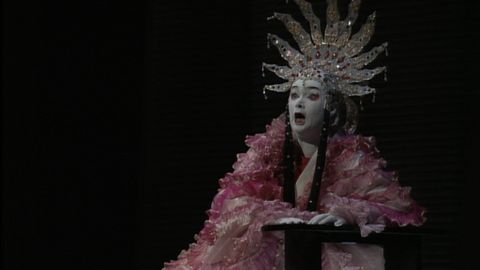
Richard Strauss's Die Frau ohne Schatten is his grandest work, a three-act fairy tale on an enormous scale. The piece requires seven stellar singers, a giant orchestra, and a panoply of visual effects to depict events on three different planes of existence as the story follows the marital troubles of two couples in their struggle to conceive children. This stunning production was filmed in Nagoya, Japan in 1992, was scheduled for broadcast on Japanese television, but objections from that country's censors led to the broadcast never being aired.
If any listener needs convincing regarding the transcendent podium abilities of Herbert von Karajan they need look no further than this 1964 recording of Strauss' Die Frau Ohne Schatten. Made at the conclusion of Karajan's Vienna tenure, this live radio broadcast illustrate' the conductor's ability to draw the maximum amount of intensity and emotional impact from this admittedly difficult work.
It doesn't hurt that this fresh-sounding performance has a cast made up of some of the most important singers of the 1960's, caught here well before their decline. Jess Thomas is ideal as the Emperor. His voice is the right size for this difficult part. There is a thrilling moment in his Act One aria when the orchestra swells so an enormous climax and there is applause before the music detonates in a flood of emotional rapture. This recording is full of moments like that where the inhabitants of Hofmannsthal' arcane world spring thrillingly to life.
Leonie Rysanek's Empress is ethereal, yet fully realized in a dramatic sense. She tracks the character's path to full womanhood with unerring clarity and the sweetness of tone that marks the best Strauss sopranos. She is well-matched by the Dyer's Wife, sung with characteristic intelligence by Christa Ludwig. Finally, Grace Hoffman is a cunning Nurse, delivering all facets of the most complex character in the opera.
The veteran of the cast is Walter Berry in the key role of the dyer, Barak. His baritone conveys the warmth and complex emotions of the character with nuance and respect for the text. The Vienna Philharmonic plays with intelligence and clarity, and their love for this music is obvious. Karajan intended these performances to be his farewell gift to Vienna upon his departure.
This is a live recording, and stage noises are audible, but not to the point of distraction. The only drawback is a series of major cuts to the score, which are most noticeable in the latter two acts. Act Two has an entire scene excised, a cut taken by Karajan. The third act has the standard cuts, which render the drama a little confusing. However, the singing and superb orchestral performances make this a must-have for Strauss lovers.
Elektra may seem like a weird choice for a holiday offering. The blood-spattered Greek tragedy brings the sledge-hammer orchestration of Richard Strauss to the bloody tale of Orest and his return to the House of Atreus, where he slaughters his mother and her lover in a series of events that wouldn't be ouf of place in a George R. R. Martin fantasy novel.



 . Made at the conclusion of Karajan's Vienna tenure, this live radio broadcast illustrate' the conductor's ability to draw the maximum amount of intensity and emotional impact from this admittedly difficult work.

