Support independent arts journalism by joining our Patreon! Currently $5/month.

About Superconductor

Our motto: "Critical thinking in the cheap seats." Unbiased, honest classical music and opera opinions, occasional obituaries and classical news reporting, since 2007. All written content © 2019 by Paul J. Pelkonen. For more about Superconductor, visit this link. For advertising rates, click this link. Follow us on Facebook.
Showing posts with label comedy. Show all posts

Friday, August 31, 2018

The Verdi Project: Falstaff

The 87-year old composer gets the last laugh with his last opera.
by Paul J. Pelkonen
Falstaff in the Laundry Basket by Johann Heinrich Füssli, painted in 1792.
(Ed. note: This is the last installment in The Verdi Project, Superconductor's deep dive into the major operas of Giuseppe Verdi. This project started with Nabucco back in February of this year and has covered fourteen (half) of the composer's twenty-eight operas. In coming weeks, Superconductor will finish The Richard Strauss Project and then figure out what composer is next.)

Sometimes the end is the beginning and sometimes the beginning is the end. In order to understand Falstaff, Giuseppe Verdi's final opera and only successful comedy, one must look back to the year 1840 when the composer than a young man had a miserable failure at La Scala with Un Giorno di Regno, his second opera. This was a forgettable comedy of mistaken identities surrounding the royal court of Poland. Today, Un Giorno di Regno is infrequently revived, usually as part of "marathon" performances of all twenty-eight Verdi operas.

Friday, April 14, 2017

Opera Review: The Last Waltz

Many partings mark the Met's new Rosenkavalier.
by Paul J. Pelkonen
Kiss the girls: Octavian (Elīna Garanča) woos the Marschallin (Renée Fleming) in Act I of Der Rosenkavalier. Photo by Ken Howard © 2017 The Metropolitan Opera.
 The end of an era is the subject of Robert Carsen's fascinating new production of Der Rosenkavalier which bowed at the Metropolitan Opera on Thursday night. Updated to Vienna in 1910 (the year of the opera's genesis) this show crackles with nervous energy, a wild party on its final round of the night. Fittingly, this show also marks Renée Fleming's final appearances as the Marschallin in this opera, a part she has played at the Met since the year 2000.

Sunday, August 28, 2016

The Mozart Project: Le Nozze di Figaro

Mozart's high-speed comedy of domestic chaos yields infinite rewards.
by Paul J. Pelkonen
The measuring tape and bonnet from the opening scene of The Marriage of Figaro.
Image collage by the author.
It was really hard to start writing this newest Superconductor Audio Guide devoted to five great recordings of Mozart's Le Nozze di Figaro. It is an opera that (for this writer anyway) cures all ills. Not only does this mix of genuine pathos and knockabout comedy have some of Mozart's most sublime writing for the voice, but its message that the little guy can have his day and defeat the evils of patriarchy and patronage still resounds, inspired and comforts listeners today.

Sunday, July 17, 2016

The Wagner Project: Die Meistersinger von Nürnberg

Wagner's longest opera happens to be one of the great comedies.
by Paul J. Pelkonen
A medieval woodcut depicting the city of Nuremberg.
In 1848, Wagner had two ideas for operas. One, the saga of the swan knight, became Lohengrin, the other was Die Meistersinger von Nürnberg ("The Mastersingers of Nuremberg." Meistersinger (as it is usually called) was sketched as a rustic comedy, kind of like Tannhäuser with less sex and a happy ending. 19 years later, when Die Meistersinger finally appeared, it became Wagner's longest opera, a profound reflection on the composer's own career and the search for the meaning of German art. It remains one of his most popular operas. And yes, it's a comedy.

Thursday, April 3, 2014

Opera Review: They Can't Dance

Les Arts Florissants revives Rameau's Platée.
by Paul J. Pelkonen
Les Arts Florissants. That's William Christie in the lower right.
Photo by Guy Vivien © 2013 Erato Records.
On Wednesday night, William Christie's period performance ensemble Les Arts Florissants returned to Lincoln Center. The occasion: a  concert performance of Platée, the astonishing comédie lyrique by Jean-Philippe Rameau that marks the birth of comic opera in France. The year was 1745.

Written for the comic sensibilities of the court of Louis XV, the comedy in Platée is both hilarious and somewhat repellent. It is the story of the god Jupiter, who dallies with the hideously ugly swamp-dwelling nymph Platée in order to convince his jealous wife Juno that he is actually faithful. In the end, Platée is spurned and outraged, laughed at by the assembled cast and chorus.

Tuesday, December 17, 2013

Opera Review: The Magic Piccolo

The Met presents its "family-friendly" Flute.
by Paul J. Pelkonen
Twitter feed: Ashley Emerson (left) and Nathan Gunn as Papagena and Papageno in The Magic Flute.
Photo by Marty Sohl © 2013 The Metropolitan Opera.
With its mix of popular Viennese music hall song, classical-style arias and spoken dialogue, Mozart's Die Zauberflöte has suffered cuts and alterations ever since the original Papageno (Emanuel Schickenader) pranced upon the stage of the Theater auf der Wieden in 1791. On Monday night, the Metropolitan Opera opened its one-act, 95-minute Flute as this year's holiday offering, geared towards exposing New York's next generation to the magic of Mozart's final opera.

Saturday, August 3, 2013

Metropolitan Opera Preview: The Nose

The Shostakovich comedy is back for another run.
(For the Superconductor review of The Nose, visit this link.) by Paul J. Pelkonen
The Nose makes a run for it as the Met revives William Kentridge's 2010 production.
Image © 2010 The Metropolitan Opera.
Opera fans, rejoice: the beezer is back.

The Nose, based on a story by Nikolai Gogol is Shostakovich's first opera, a wild, absurdist comedy that recounts the story of Kovalyov, an unfortunate bureaucrat (Paulo Szot, reprising his performance from 2010) who receives an unexpected total rhinectomy from his barber one morning.

Saturday, February 16, 2013

Opera Review: The Aged and the Restless

Don Pasquale at the Juilliard Opera.
by Paul J. Pelkonen
Bad romance: Deanna Breiwick, Tobias Greenhalgh and Jeongchal Cha
in Act II of Juilliard's new Don Pasquale. Photo by Nan Merriman © 2013 The Juilliard School.
Among the mature comedies of Gaetano Donizetti the most enchanting of these is his last: Don Pasquale. This is a morality play about a covetous septeguenarian who decides to disinherit his callow nephew and enhance his love life--by getting married. It's also the latest comic treat put before a discerning New York opera audience by the Juilliard Opera, a student ensemble whose Lincoln Center productions are among the highest quality works that performing arts complex has to offer.

Pasquale is part con game and part rough-and-tumble farce, with the old man (played here by the vigorous Korean bass-baritone Jeongcheol Cha) turning rapidly from suitor to victim as his new wife turns out to be a spendthrift and worse yet, a shrew. Mr. Cha (star of last year's Juilliard Don Giovanni) proved adept at both sides of the character, bumptious and unlikeable in the first two act and a rather pathetic figure once the tables are turned. He also proved adept at the role's low tessitura and difficult patter, spouting the rapid-fire parlando lines with ease.

Mr. Cha also proved an adept physical comedian. In the first act, he makes use of an onstage personal trainer to get pumped up for marriage, engaging in physical comedy with a jump rope, an iron barbell and even a medicine ball to get ready for his big night. When the wedding goes to hell, he incorporates a stooped posture, a walking stick and even a wheelchair to age and deteriorate before the eyes of the audience.

Tuesday, February 5, 2013

DVD Review: It's Not Delivery

It's Un Giorno di Regno, Verdi's second opera.
by Paul J. Pelkonen
The wife of bath: Anna Caterina Antonacci as the Marchesa in Un Giorno di Regno.
Image © 2012 C Major Entertainment
(Ed. Note: This is the second step in a planned Superconductor celebration of Verdi's 200th birthday. The idea is to write about different recordings or DVDs of all of the Verdi operas plus the Requiem, ideally ending with Falstaff in October. The series started in January with a review of Oberto.)

Un Giorno di Regno ("King for a Day") was Verdi's second opera and his first attempt at comedy. It was also the first catastrophic failure of his career, premiering to hisses and boos at La Scala in 1840. Faced with a choice of libretti, the young composer selected a text originally titled La Finta Stanislao. This was an attempt at madcap, Da Ponte style comedy, the story of a a young nobleman who has to pretend to be a Polish king at a French court so the real King can slip off to Warsaw and legitimize his reign. And yes, it's based on historical incident.

This DVD was shot at the Teatro Regio di Parma in January of 2010. It is the first release of Un Giorno for home video, and the second of Tutto Verdi: a series of DVDs of all the Verdi operas on the C Major label. With a young cast of singers and an energetic conductor in Donato Renzetti, one had hopes that this lost Verdi comedy might be the latest of his many operas to be rehabilitated for the world stage.

Sunday, November 18, 2012

Opera Review: A Snake in the (fake) Grass

Juilliard and the Met collaborate on Cosí fan tutte.
by Paul J. Pelkonen
Fiordiligi (Emalie Savoy) attempts to elude Ferrando (Matthew Lewis) in Juilliard's Così fan tutte.
Photo by Nan Melville © 2012 The Juilliard School/The Metropolitan Opera.
Stephen Wadsworth's handsome new production of Così fan tutte, the latest collaboration between Juilliard and the Metropolitan Opera is set in a claustrophobic garden. Looming, convent-like walls trap the participants in Mozart's "school for lovers." Significantly, the doors are locked. Occasionally, Don Alfonso (Evan Hughes) the perpetrator of this experiment in spit and partner swapping peers over the walls, to check how his subjects are getting along.

This production (seen at the Nov. 17 matinee at the Peter Jay Sharp Theater) is a sequel (of sorts) to Mr. Wadsworth's Juilliard Don Giovanni, seen at the conservatory last Sprig. Charlie Corcoran has again mounted the comic action in a series of handsome, receding picture frames that provide entrances and exits. Nature-images abound, from the (working) water pump, the grassy (AstroTurf) carpet, and the large orange tree that dominates the scene.

Given the plot of Così, the last collaboration between Mozart and his librettist Lorenzo da Ponte, one expects a serpent to slither out and bite the dunder-headed protagonists, two young soldiers who swap their partners, (a pair of sisters) to prove their fidelity and win a bar bet. The cynicism of the libretto and question-mark ending can sometimes leave an audience feeling downright queasy, despite the glittering music.

Monday, February 6, 2012

Rumpole of the Opera

How an English television show hooked me on opera.
The opening title-card of Rumpole of the Bailey, with Leo McKern (l.) and the Statue of Justice.
© 1977 Thames Television.
For as long as I can remember, the British television series Rumpole of the Bailey (and the accompanying novels and short stories by John Mortimer) were a fixture in my life.

I first saw Rumpole in 1983 on Mystery! a still-running PBS series that airs British television mysteries. (The show was produced in the U.K. by Thames Television.) For those of you who are unfamiliar with the character, Horace Rumpole is a portly, curmudgeonly British criminal barrister who "never pleads guilty", lives on his wits, cheap red wine and smelly small cigars, and refers to his wife Hilda as "She Who Must Be Obeyed."

Here's the show's theme, featuring a memorable bassoon part. It was written by composer Joseph Horovitz:

Leo McKern as Horace Rumpole, Barrister-at-Law.
Probably from Rumpole's Return.
While Rumpole himself is not a tremendous lover of music, (he has an affinity for vaudeville shows and songs like "Roll Out the Barrel" and "My Little Sister") the opera plays an important part in the series. Some episodes incorporate excerpts from Beethoven's Moonlight Sonata (Rumpole and the Bright Seraphim) and Schubert's chamber music (Rumpole and the Eternal Triangle.) But the most frequently heard composer on Rumpole is Richard Wagner.

Claude Erskine Brown Q.C. (that's "Queen's Counsel") is the resident Wagnerian of No. 3 Equity Court. He's a hopeless prosecutor with an almost masochistic affinity for music drama, referred to in one episode as the man "who can sit through Tannhäuser without laughing." He's married to the busy Phillida Erskine-Brown Q.C., (the "Portia" of Chambers--she later becomes a judge), and they have two children: Tristan and the younger Isolde.

Feeling ignored by his busy wife, Claude makes repeated efforts to take another barrister to Covent Garden. This is "Mizz" Liz Probert, a fierce left-wing radical feminist who does her best to quash Claude's romantic ambitions. In one episode, he tells his wife that his guest for the opera was an elderly barrister, Thomas C. "Uncle Tom" Rowley. Uncle Tom claimed he enjoyed the "happy bits" of Tristan, particularly "If You Were the Only Boy in the World."

Rumpole (Leo McKern) sleeps through a recital as Guthrie Featherstone (Peter Bowles, r.) looks on.
Frame-grab from Rumpole and the Case of Identity © 1980 Thames Television.
It was thanks to Claude's misadventures that I first heard much of the Wagner catalogue, long before I owned any recordings or saw the operas. The show includes excerpts from the Prelude to Act III of Meistersinger. The Wach Auf chorus shows up, faintly, in another episode, along with the Ride of the Valkyries and the Liebestod from Tristan und Isolde

We'll end with Rumpole and the Official Secret has a scene filmed in the Royal Box at Covent Garden. Rumpole goes to interrogate a suspect during Act I of Tosca. The villain (who is earlier said the be the "only chap in the office who could actually whistle Wagner") doesn't stick around for the third act. He hurls himself to his death in the London Underground against the crashing Scarpia chords. 

Monday, December 5, 2011

New Horizons in American Opera: I Cugini

A new opera based on hit MTV reality show Jersey Shore.
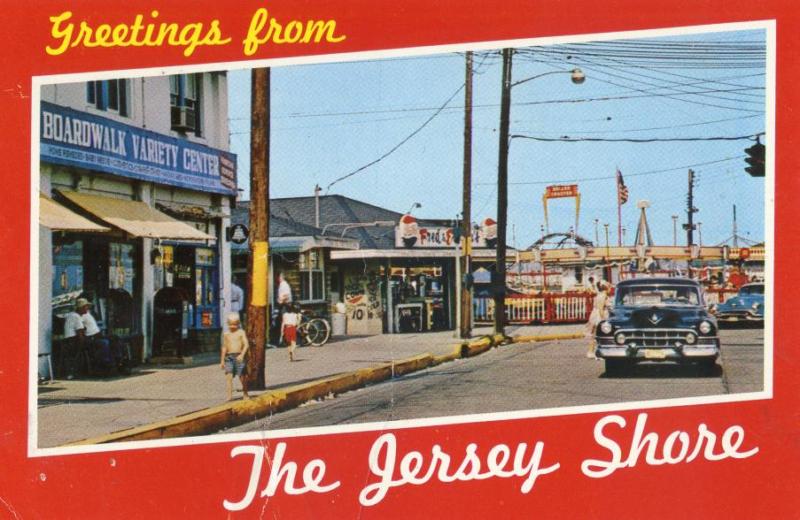
This vintage postcard shows the boardwalk in Keansburg, NJ.
In recent years, modern American opera has drawn from the news, from popular literature, and from the movies. Now, we present the first opera inspired by a cable reality show. The opera is I cugini (The Cousins) based on the wacky adventures of America's favorite reality stars. Any similarities between the plot and a certain show on MTV networks is purely coincidental and done in the interest of parody.

Written by composer Lucca Pastafagiole and librettist I. Nesistenti, I Cugini follows the romantic misadventures of four would-be celebrities in Seaside Heights, a resort beach town located in New Jersey. The opera will have its premiere on Feb. 30, 2012 at the Boardwalk Mall in Wildwood, NJ.

Cast of characters:
Paolo D, an unemployed goldsmith: Tenor.
Nicola, (known as "Snooki") an unemployed hairdresser. Soprano.
Michele, (called "Il Situazione") a former male stripper, now in barber college. Baritone.
Ginevra Urca, ("JWow") a wanton. Mezzo-soprano.
Giovanni Bongiovi, a karaoke singer. Tenor.

Act I: The boardwalk in Seaside Heights, NJ. In the background, Nicola's beach house.
Paolo D, an unemployed goldsmith, has fallen madly in love wih Nicola, a young woman who lives in a large house in the beach community of Seaside Heights.  He appears on the board-walk outside her beach house as dawn breaks over the Atlantic Ocean. Paolo sings her a serenade: "Di l'altezza del Mar."

Enter Michele, a student at the local barber college. He sings of his skill at hooking up his friends: "Io sono la Situazione." As he sings, Michele does a slow strip-tease down to his Dolce & Gabanna briefs. In the aria's cabaletta, he quickly puts his warm-up suit back on.

Paolo enlists Michele's help to get him into the house in order to score with the Nicola. He agrees to work in exchange for a gift card from Century 21. (Duet: "Credito illimitato.") Nicola enters and sings an aria from the pool deck of the house: "Mi chiamano Snooki." Paolo sings a reprise of his serenade. She tosses down a piece of paper with her Skype ID and they sing a long passionate duet. A patrolman arrests Paolo for loitering. He sings "Nessuno sa la fatica che ho visto."

Act II: A ballroom aboard a cruise ship anchored off the shore.
Nicola is out a party on an off-shore cruise ship: the Orrizonte degli Eventi. The chorus sings a rousing drinking song "Facciamo tutti ottenere martellato." Nicola finds herself in a booth with Michele. She asks him about Paolo. They exit to discuss him further--and make out.

Bongiovi, a karaoke singer  steps onto the dance floor and sings a power ballad: "Voluto, vive o morto." He follows with a cabaletta: "Vi darà l'amore di una cattiva reputazione."

Paolo enters, drunk. He meets Ginevra Urca, his former girlfriend. The lights dim and music slows in the club and they dance together. Just then, Nicola enters, recognizing Ginevra. The two of them have a clawing catfight as the men, embarrassed try to lead the crowd in a reprise of the drinking song as the girls fall into the water, still fighting.

Act III: The abandoned amusement park.
Michele waits for Nicola in front of an abandoned roller coaster. He sings an aria. She enters, and tells him she is leaving him for Paolo. He swears vengeance in an aria: "Io vado a calci nel culo."
She urges him to remember their past love "Sotto il lungomare." The scene shifts back to the previous summer, and the amusement park suddenly becomes operational. The lovers are paired off, Ginevra with Paolo, Michele with Nicola. An elaborate ballet is staged as the boards of the stage start to glow like a disco floor, and the whole cast does "The Hustle."

Act IV: Inside the beach house.
Morning. The orchestra evokes the sun rising over the sea. Paolo, Nicola, Ginevra and Michele wake up in the master bedroom, having all slept in the same bed. A comic quartet "Che cosa diavolo è successo?" starts, with each cast member trying to reconstruct the events of the night before. Suddenly the back walls part and a television crew is revealed, having filmed their exploits. The crew sings a chorus "Che cosa è la realtà." The walls close again.

The characters decide to all live in the house. Bongiovi enters, and they sign a contract for a new television reality show. In the opera's finale, Michele leads off a comic fugue: "Assicurati di vederci ogni settimana." Nicola sings of her love for both men and that she will be able to pay off the beach house. Paolo sings of his new job driving the beach tram. "Guarda il tram per favore." The curtain falls on a massive pillow fight.

Sunday, April 17, 2011

Classical Music Goes to the Movies...Again

(or..."Hey, isn't that Sibelius?")

Classical music has been a big part of film ever since the early days of silent movies played to piano accompaniment. But works by the great masters show up in some pretty unexpected places. Here's a quick look at some (less than) famous appearances of the great composers' works in Hollywood.
On the run, with a cello. James Bond (Timothy Dalton)
and Kara Milovy (Maryam D'Abo) in The Living Daylights. 
© 1987 EON Productions/MGM-United Artists/Danjaq S.A.
The Living Daylights (1987)
Timothy Dalton's first Bond film was John Barry's las, and the late great British soundtrack composer loaded it with classical music. There's excerpts from Act II of Le Nozze di Figaro, the andante from Borodin's String Quartet No. 2, and the finale of Dvorak's Cello Concerto. Small wonder: the "Bond girl" in Daylights is a Czech cellist played by Maryam D'Abo.

The movie's most memorable music-related image: Dalton and D'Abo escaping into Austria...riding on a speeding cello case.

Die Hard 2 (1990)
Michael Kamen's score for the first Die Hard movie made extensive use of Beethoven's Ninth Symphony to accompany its tale of a lone-wolf cop (Bruce Willis) trapped by terrorists in an L.A. skyscraper. The sequel (yes it's also known as "Die Harder") was directed by Finnish filmmaker Renny Harlin.
"Whaddya mean there's no Beethoven in this one?" Bruce Willis in Die Hard 2.
© 1990 20th Century Fox/Silver Pictures
Like the first, Die Harder is set at Christmas. Our hero is at Dulles Airport, during a snow storm, when it gets taken over by (you guessed it) terrorists. Inspired by the winter setting (and possibly the Finnish director) Kamen chose to make Finlandia, the nine-minute tone poem by Jean Sibelius, the heart of the soundtrack. The ominous opening chords accompany the terrorist takeover, while the triumphant final march section bursts forth as Bruce Willis (once again) saves the day.


Anaconda (1997)
Verdi's least popular, least-performed opera, Alzira, is set in South America. But that didn't stop the makers of Anaconda from using the opera composer's music in their film about hapless explorers and one very big, very hungry computer-generated snake.

As their boat chugs up the river, one of the characters blasts ""Dio Che Nell'alma Infondere", the friendship duet that comes early in Don Carlo. It's the Metropolitan Opera recording with Michael Sylvester as the Don and Vladimir Chernov as the Marquis de Posa. The giant snake doesn't attack during this scene. Guess it liked opera.


The fountain scene from Ocean's 11. © 2001 Warner Brothers Pictures.
Ocean's 11 (2001)
This star-studded remake of the classic Vegas heist flick makes extensive use of Debussy's Clair de lune from the Suite Bergamesque. It first appears on the soundtrack in a modified electronic version when Tess Ocean (Julia Roberts) makes her entrance, and represents her character throughout the movie.

Later, you hear Eugene Ormandy conducting the Philadelphia Orchestra in the orchestral version of the piece, as the gang celebrates a successful triple casino robbery by standing and contemplating the fountains in front of the Bellagio. If this seems familiar it is: director Steven Soderbergh included the scene as an homage to the ending of The Right Stuff.

xXx
 (
2002)
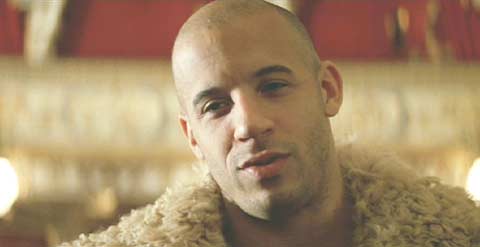
Vin Diesel's hyperkinetic take on spy movies and extreme sports culture features live performances by German metal band Rammstein and the British electronica duo Orbital. But when he's brought in for a briefing with the "M"-like Augustus Gibbons (Samuel L. Jackson) you hear...Mozart?
"Oh you've gotta be kidding me." Vin Diesel as Xander Cage (Agent XXX) in xXx.
Frame capture from xXx, © 2002 Revolution Studios.
Gibbons conducts his briefing in a Prague opera house, where he's enjoying a dress rehearsal of Don Giovanni. (Never mind that these two guys are talking through the first act.) Vin's response to this cultural exposure? The famous "Oh, you've gotta be kidding me."

Friday, April 1, 2011

Sssssnake ssssignss for Sssssiegfried

The Bronx Zoo Cobra: "Mr Lepage, I'm ready for my close-up."
Photo by Julie Larsen Maher © Wildlife Conservation Society
At an early press breakfast Friday morning at the Bronx Zoo, the Metropolitan Opera introduced the newest member of the cast for its new production of Siegfried: the Bronx Zoo Cobra.

Wednesday, March 16, 2011

Metropolitan Opera Preview: Le Comte Ory

Juan Diego Flórez makes a welcome return to the Met in the title role of Le Comte Ory.
The Metropolitan Opera continues its trend of reviving Rossini rarities with this staging of Le Comte Ory, the composer's last comic opera. This is the Met's first production of this infrequently heard opera.

Le Comte Ory was written in 1828 for the Paris Opera, right before Rossini's retirement from active opera composition. In some ways it stands alone in the composer's canon of works as a comedy written in French. It tells the story of a nobleman, determined to win the hand of Countess Adèle, through disguise, deception, and more disguises than Bugs Bunny.

At the MetTalks presentation on March 10, director Bartlett Sher explained his concept of the new production. He is taking the work back to its 1828 roots: a wooden stage within the Met's cavernous auditorium. The second act, in the convent, will be staged by candlelight. Yes, you read that right.

The production reunites the team of Juan Diego Flórez and Diana Damrau, the tenor and soprano who wowed audiences with a stunning display of bel canto fireworks in the company's 2008 staging of Donizetti's La fille du Regiment. The opera also features mezzo-soprano Joyce DiDonato in the trouser role of Isolier, the page who is also attempting to woo the Countess.


A video clip of Juan Diego Flórez in Le Comte Ory.
The staging is by Bartlett Sher, and is the third collaboration between the Met and the Tony®-award winning director.

Recordings Recommendation
I don't really know this opera. But there are three recordings of Le Comte Ory available. I haven't heard them, so I've included what I could learn about them. They are:

Glyndebourne Festival Orchestra cond. Vittorio Gui (EMI, 1956)
Count Ory: Juan Oncina
Countess Adèle: Sari Barabas
Isolier: Cora Canne-Meuer
A mono recording made at Abbey Road, and based on a staging at the tiny but wonderful Glyndebourne Festival, a gem set in the English countryside. This set was originally released by EMI and can be purchased from Amazon as a download, with each disc forming one MP3 track. Yes, that's a pain, but on the bright side, you get the whole opera for $1.98. Caveat emptor!

Orchestre et Choeur de l'Opera de Lyon cond. John Eliot Gardiner (Philips, 1988)
Count Ory: John Aler
Countess Adèle: Sumi Jo
Isolier: Diana Montague
This was one of John Eliot Gardiner's early opera recordings. The period performance expert accompanies the sparkling soprano of Korean soprano Sumi Jo. This was an award-winning recording and has long been considered an industry standard of this rare opera. Since the entire Philips catalogue was effectively deleted when that label was absorbed into Decca, this set was re-released by ArkivMusic in 2006.

Orchestra del Teatro Comunale di Bologna cond. Jesús López-Cobos (DG, 2004)
Count Ory: Juan Diego Flórez
Countess Adèle: Stefania Bonfadelli
Isolier: Marie-Ange Todorovitch
This recording was made at the Rossini Festival in Pesaro in 2003, and was one of Mr. Flórez' first exposures on the internatonal operatic stage. Featuring Maestro López-Cobos, an experienced Rossini conductor who brings charm and sparkle to this composer's music. The rest of the cast is middling--it is Mr. Flores' presence that is the selling point here.

Sunday, March 13, 2011

CD Review: On the Rocks With Intermezzo

Soprano Elisabeth Söderström, who sings Christine Storch
in Richard Strauss' domestic opera comedy Intermezzzo.
This is the latest in Chandos Records' trove of BBC recordings, a live performance of Richard Strauss' Intermezzo, one of the composer's most charming but least-performed operas. This high-quality 1974 performance, released in good stereo, may do much for the reputation of this neglected, underrated work.

Intermezzo (1924) is the story of a famous composer/conductor, his shrewish, difficult wife, and a misunderstanding that nearly destroys their happy marriage. The libretto, written by Strauss, was based on a real incident from his tempestuous marriage to his wife Pauline. The result: a conversation-filled series of snapshots, depicting a busy conductor, saddled with a difficult wife. The opera ends in a portrait of domestic bliss once harmony is restored.

With its quick-fire dialogue and fast-moving plot, this is an opera that is best heard in the listener's native language. In fact, Elisabeth Söderström, who sings the long, difficult role of Christine Storch on this set, wanted the complexity of the libretto to be understood by the Glyndebourne audience. The Swedish diva insisted that these performances, which marked the opera's premiere in the United Kingdom, were to be sung in English.


Ms. Söderström brings her considerable vocal resources to the role of Christine Storch, capturing the complex, multifaceted nature of the character. She is bossy, elegant, kind, shrewish, generous, rude, and occasionally condescending. But the love that Strauss had for his wife shows in the warmth of her vocal writing, even when the good lady contemplates a fling. Ms. Söderström was at an early peak when she made this recording, and having her version of this memorable role only adds to the value of this set.

She is well matched with baritone Marco Bakker in the role of Robert Storch, the composer's self-portrait. Mr. Bakker is a true baritone, and sails through the rapid-fire dialogue, coming into his own in the long duet that ends the opera. It is a pleasure also to hear Anthony Rolfe Johnson at the start of a great career, singing the role of Stroh, a fellow maestro. The similarity of the names is deliberate, leading to a case of mistaken identity that nearly sinks the Storch/Strauss marriage.

John Pritchard does well with the challenging score, leading the London Philharmonic through the many intermezzos that are scattered through the opera. (Strauss had a musical sense of humor.) The set was recorded at the Glyndebourne Festival, and the close miking, which allows listeners to hear the rustle of score pages in the orchestra pit, the breath of players and even the prompter, only lends to the sense of intimacy of a truly great evening at Britain's greatest opera festival.

Monday, March 7, 2011

Lino e Lucia di Arachidi, an Opera Parody

An Opera, with music by Vincenzo Guaraldi (and occasionally, Beethoven and Mendelssohn.)
Carlo Marrone (left) following the wedding night in Act III of Lino e Lucia di Arachidi
Art and costume design by Charles Schultz.
Image © Estate of Charles Schultz/United Features Syndicate
(With apologies to Charles (Carlo) Schultz. Any resemblance of this to the beloved Peanuts® characters means that you spend entirely too much time at the opera.)

Overture: "Lino e Lucia."

Act I: (Near a baseball diamond, after practice. To the left, the kite-eating tree.)
Lucia is a member of the van Pelt family. They live in a big spooky house in Suburbia which is haunted by the ghost of the Barone Rosso, who perished in aerial combat during the First World War with Snoopido.

She enters, flying a kite. After it gets caught in the tree, she sings a lengthy aria: "Le gioie di essere scorbutico."

Lucia (and her kite) are rescued by Schroedero, an itinerant local musician who is leaving to study Beethoven at a nearby conservatory. They sing a lengthy duet "Se tu fossi l'ultima ragazza sulla terra!" and declare fealty to each other. Schroedero promises to marry Lucia when he knows how to play the Hammerklavier sonata from memory.

Act II: (A room in the van Pelt house.)
Lucia's conniving brother, Lino van Pelt, is determined to save the family pumpkin patch by marrying his sister off to another nobleman, Carlo Maroni. Lino in turn will (reluctantly) marry Carlo's little sister Alva, thus saving the family blanket factory. Carlo and Lino sing a duet cementing their friendship: "Perché tutti sempre prendersela con me?"

(An outdoor wedding chapel in the pumpkin patch.)
As the two couples approach the altar (with Snoopido, the faithful Maroni family companion, acting as the minister) Alva notices that Carlo keeps looking at a little red-headed girl in the front row. She sings a two-part aria about her devotion to Lino ("O mio babboo caro!...Non è forse la cosa più carina?") but Lino is clearly only interested in the marriage from a business perspective.

Just after both couples sign the marriage contract, Schroedero bursts in, runs to the piano and plays the opening movement of the Hammerklavier, stopping the opera dead for twelve minutes. While everyone applauds his performance, he is too late to stop the wedding. All sing a massive ensemble, ("O buona dolore!" sung to the tune of "Hark! The Herald Angels Sing!") and the "minister" does the happy dance.


Act III: (On the roof of the Cane di Casa, a ramshackle dwelling)
On that same evening, Lino confronts Schroedero on top of the local residence (where Snoopido lives.) They agree to a piano duel, the next morning at a local brick wall belonging to Carlo Maroni.

(The main hall of  Van Pelt Castle)
Lucia, (in her bright blue dress) goes up the grand staircase to the wedding chamber. A scream (Auuuuuuuuuugh!!!) is heard. Horror-struck, Snoopido slides down the balcony, and attempts to tell the guests (in a series of mute gestures and interpretive dances) what has happened. He is followed by Lucia, who is still in the blue dress and carrying a football.

In the famous "Really, Really Mad Scene," Lucia reveals that she had pulled the football out at the last minute, just as Carlo had attempted to kick it. Emotionally shattered by the ordeal, she sings a few bars of the Hammerklavier  to warm up, and then explains to the stunned crowd: "Ho dovuto farlo. Era un blocco di testa" in a lengthy aria.

Act IV: (At Carlo Maroni's wall)
Schroedero is alone with his piano. He plays the entire Hammerklavier sonata by Beethoven (stopping the opera dead for another 40 minutes) and finds out that Lucia has left him forever. She has moved to California, setting up a local practice offering:

[Psychiatric Help: 5¢.]

With his last breath, Schroedero sings his final two-part aria: "Il medico è qui" and collapses on his piano.
Curtain.

Tuesday, April 27, 2010

DVD Review: La Cenerentola from the Met

Welcome to the layer cake: Lawrence Brownlee and
Elina Garanca in 
La Cenerentola.
Photo © 2008 The Metropolitan Opera/UMG
This 2-DVD set preserves Elena Garanca's breakthrough performance in the title role of Rossini's comic fairy tale, as well as this wonderfully surreal production., which was originally designed for Cecilia Bartoli.

The staging, by the Italian team of Cesare Lievi (production) and Marizo Balò, (costumes and sets) combines Magritte-inspired surrealism (closets full of clocks, inexplicable stage fires, and the chorus dressed in suits and bowler hats) with a sense of bold slapstick that is entirely suited to Rossini. A small regret: this 2008 revival failed to include the apocalyptic onstage spaghetti fight that brought down the house at the premiere. (The Met costume department may be tired of cleaning marinara stains from the costumes.)

Garanca shines as Angelina, the "Cinderella" of the title. She has a resonant, finely controlled mezzo with a a warm deep range, and is capable of reaching the heights required by the final aria of this opera. It doesn't hurt the presenation that she is a good comic actress with the fresh quality needed for this role. The acid test of this role is the final scene, a long and difficult rondo where the much put-upon Angelina forgives her family for their abuses and begins her new life in the arms of her Prince atop of a giant wedding cake.

Lawrence Brownlee is a regular player in the Met's current Rossini craze, appearing in this season's stagings of Il Barbiere di Siviglia and Armida. He has a soaring bel canto instrument, and sings sweetly in the slower cantabile sections of his arias. Brownlee proves himself capable of navigating Rossini's difficult cabaletta sections, where the notes pile on top of each other in a dazzling display of  technique. However, his Act II aria was marred by a tendency to pull up sharp when he opened up his voice and reached for the highest notes. Things improved at the end of the act, and his Recognition scene with Garanca had this strong tenor back to form.


Alessandro Corbelli gives a magnificent performance as Don Magnifico. He plays the wicked father with more humanity, eschewing the cartoonish business that usually mars this character. Perhaps his experience in the role of the valet, Dandini gives him greater perspective?

In turn, Simone Alberghini is a fine Dandini, giving a comic performance that recalls Figaro at his very best. Rachelle Durkin and Patricia Risley are "absolutely fabulous" as the two evil sisters. John Relyea is a sonorous presence as Alidoro, the "golden angel" who takes the role of "fairy godmother" in this version of the tale. That man can really rock an ice cream suit with a pair of golden wings sprouting from his back.

This DVD was originally released as a "Met Live in HD" broadcast, hosted by Thomas Hampson. The copy reviewed had the disc labels backwards, with Act I on Disc 2 and vice versa. Hopefully, this problem has been corrected in future pressings of this otherwise excellent set.


Thursday, March 18, 2010

Movie Review: Meeting Venus

The comedy chronicling a particularly troubled production of Wagner's Tannhaüser was mostly ignored when it was released in 1991. At long last, Warner Archives has released it on DVD for the U.S. market.

Venus is the story of Hungarian conductor Zoltan Szanto, (Dutch actor Niels Arestrup) who has come to the "Opera Europa", a Paris-based international company "where you can be misunderstood in six different languages" to lead a new production of Tannhaüser.

Wagner's opera is the story of the medieval knight who is torn between his love for the saintly Elisabeth and his unearthly lust for the goddess Venus. As the married conductor begins an affair with his leading lady (played by Glenn Close and sung by Dame Kiri Te Kanawa), his personal life begins to mirror the complex world of Wagner's opera.

István Szantó's film captures the vibrant energy and backstage chaos of post-Communist Europe as the opera company's members try to overcome ego issues and language barriers to mount Tannhaüser. When a last-minute stagehands strike nearly kills the performance, the opera company's unique solution makes the entire film worth seeing.

At its heart, this is a movie about making music, and Meeting Venus includes some excellent excerpts from the opera, featuring the Philharmonia Orchestra led by Marek Janowski. The soundtrack includes the Pilgrim's Chorus, Elisabeth's "Dich, teurer Halle", and Wolfram's "Song to the Evening Star." Soloists include Rene Kollo (Tannhaüser), Waltraud Meier (Venus) and Håkan Hagegård (Wolfram.) Unfortunately, this cast only recorded highlights for the soundtrack and never got around to doing the entire opera.

Meeting Venus is released under the Warner Special Products label. The only way to get a copy is to order it direct from the studio, who will then manufacture the DVD and send it to you mail-order. It's not a perfect solution, but this underrated comedy is worth the effort for the opera lover.

Friday, March 5, 2010

Opera Review: Orange Crush

Il Barbiere di Siviglia at the Met.
by Paul Pelkonen
The lovers make their escape in Act II of the Barber.Photo by Andrea Kremperer
© 2009 Baden-Baden Festspiel/The Metropolitan Opera.
The Met's final 2010 performance of Il Barbiere di Siviglia was an occasion for sparkling vocal performances and robust comedy. In this kinetic staging by Bartlett Sher, the opera is re-imagined as Dr. Bartolo's fevered nightmare. The curtain rises during the overture, with Rosina's guardian asleep on the stage, accompanied by the mute Ambrogio (played to good slapstick effect by dancer Rob Besserer). Doors shift around mysteriously, explosions go off for no reason, and a gigantic anvil descends from the rafters, to destructive, if comic effect.

Trending on Superconductor

Translate

Share My Blog!

Share |

Critical Thinking in the Cheap Seats