Support independent arts journalism by joining our Patreon! Currently $5/month.

About Superconductor

Our motto: "Critical thinking in the cheap seats." Unbiased, honest classical music and opera opinions, occasional obituaries and classical news reporting, since 2007. All written content © 2019 by Paul J. Pelkonen. For more about Superconductor, visit this link. For advertising rates, click this link. Follow us on Facebook.
Showing posts with label Superconductor classical opera. Show all posts

Sunday, March 25, 2012

Concert Review: Flash of the Titans

Yefim Bronfman in recital at Carnegie Hall.
by Paul J. Pelkonen
Determination: Yefim Bronfman in concert. 
When the pianist Yefim Bronfman made his entrance at Carnegie Hall on Friday night, it was the start of a heroic confrontation between the burly Russian-born artist and the black Steinway: his vehicle to play sonatas by Haydn, Brahms and Prokofiev.

Saturday, March 24, 2012

Recordings Review: The Whole Flute

René Jacobs' 2010 studio Die Zauberflöte is three hours of Mozartean bliss.
by Paul J. Pelkonen

(Ed. Note: This is a slightly revised re-post of a recording from two years ago, with some further thoughts upon further listening. It's still like no other recording in the catalogue, but I have some reservations I needed to express.--P.) 
The new René Jacobs recording of Mozart's Die Zauberflöte stands apart from all the other recordings of this opera in the catalogue. Sprawling onto three discs and running almost three hours, this innovative set presents the opera as Mozart's original audience may have heard it in 1791.


Most early recordings of Mozart's final opera either eliminated the spoken dialogue altogether (as "unmusical") or had the singers (or worse yet, voice actors) recite the dialogue with no accompaniment whatsoever. Too often, the result was a series of dry, boring interruptions in the music that would have listeners reaching for the 'skip' button. This recording takes the opposite approach, opening up all the standard cuts and treating the opera's libretto as organic dialogue between living, breathing theatrical characters.

Jacobs has assembled a talented young cast, led by the pairing of Daniel Behle and Marlis Petersen as Tamino and Pamina. Daniel Schmutzhard is a warm, funny Papageno, able to cut loose in the opera's comic scenes. He is well matched with Sunhae Im as Papagena. (Ms. Im also does a convincing "old crone" voice for her character.) Marcos Fink is a sturdy baritonal Sarastro. Bass Konstantin Wolfff is all over the Temple in a triple role: he's the Speaker, one of the Priests and one of the Two Men in Armor.

The only serious hitch in the casting is the Finnish soprano Anna-Kristiina Kaappolla as theQueen of the Night. Although this is a short part, recorded under studio conditions, Ms. Kaapolla caps her arias with some ugly attempts that hover near a high F but sometimes pull sharp. (This is especially noticeable at the very end of "O zittre nicht.") Were these the best takes that the recording engineers could manage?

Character tenor Kurt Azesberger brings Monostatos to new depths of depravity, especially since he doesn't have most of his lines cut. His entry is accompanied by whip-cracks, making the slave-driving Moor a menacing figure. Also, the racist references in the libretto ("schwarz" and so on) are left in, along with the scene with the three slaves. All these effects sound like distractions, but they enhance the drama of the work, particularly in the complex second act with its rapid scene changes.

The addition of a pianoforte continuo helps accent the spoken dialogue. Also, this recording abounds in old-fashioned sound effects. Papageno is followed by the twitter of his captives, played on old-fashioned wooden bird-calls. The Queen of the Night gets a thunder-machine rattle every time she is even mentioned--and the big "bang"chord, mentioned by Schickenader in the libretto but left out of the sheet music.

Some "period" recordings of Mozart sound dry and stuffy. But here, the instruments have bloom and bite, played and conducted with pin-point accuracy. Mr. Jacobs selects brisk tempos for the most part, but his decision to slow down for dramatic effect at times (most noticeable in the "dancing slaves" scene in Act I) works too. It's all about serving the drama and making this opera come to aural life as a living theatrical experience. Simply put: this is The Magic Flute as you've never heard it before.

Friday, March 23, 2012

Concert Review: An Old-Fashioned Bacchanal

Christoph von Dohnányi at the New York Philharmonic.
by Paul Pelkonen
The ice man: Christoph von Dohnànyi, with baton in hand.
Photo by Chris Lee © 2009 NewYork Phiharmonic.
The music of Hans Werner Henze has never really caught on in America. Mr. Henze is one of Europe's most important living composer. His symphonies and operas are regularly played in concert halls and theaters on that continent. But his urbane, erudite music carries the whiff of modernity to it, and the fact that the composer is still alive (he's 85) doesn't help his case with skittish Philharmonic subscribers.

Perhaps that was the reason for the sparse attendance and empty rows at Friday afternoon's New York Philharmonic concert, conducted by Christoph von Dohnányi. Those more timid audience members missed a lush harmonic treat, a set of Excerpts from Mr. Henze's 1966 opera The Bassarids. It was paired with an audience favorite, Schubert's "Great" Symphony, which may (or may not) be his last.
The Bassarids (its German title is Die Bassariden) is a dark entry in the Henze operatic catalogue. These concerts mark the first U.S. performances of the Excerpts, four instrumental episodes that, like a miniature symphony, recap the important events of the opera.

Mr. Henze writes for enormous orchestral resources, forcing the management of Avery Fisher Hall to deploy the stage extension to accomodate the full force of the Philharmonic. However, this 25-minute suite proved to be tonal, tasteful, and elegantly orchestrated, with passages that recall Richard Strauss' late mythological  operas and the complex counterpoint of Bach. 

Based on The Bacchae by Euripides and with a libretto by W. H. Auden, opera tells of Pentheus, a Greek king who denies the divinity of Dionysius, the god of wine. For his trouble he is torn to pieces by the Maenads, the mad, drunken women who are sacred to that particular deity. This scene, depicted in the third section of the suite, was played with exceptional orchestral ferocity, with strong performances from the brass and the battery.


Solo bassoons and cellos took the vocal lines of singers, requiring the principals on those instruments to play with exceptional lyricism and skill. The whole was conducted with expertise by Mr. von Dohnányi. The 81-year old  conductor not only led the first 2004 performance of this suite, but the 1966 premiere of the opera itself.

The second half of the concert featured Schubert's Great Symphony, which, given the uncertainty regarding that composer's catalogue, may or may not be his last major work for orchestra. Mr. Dohnányi led a  engaging account of the score, supplanted by strong performances from the pared-down Philharmonic. 

Throughout the four movements, Mr. Dohnányi conducted with great respect for Schubert's song-like lyric line, from the boisterous theme that opens the symphony to the clarinet quotation of a key theme from Beethoven's Ninth in the finale. This was crisp orchestal playing of the highest caliber. Exhorted by the conductor (who was working without a score) the orchestra brought home Schubert's message of exuberant vitality, creating, in effect, a second ode to Joy. 

Tuesday, March 20, 2012

Concert Review: Miles To Go Before They Sleep

The Ebène Quartet plays Zankel Hall.
by Paul Pelkonen

The Ebène Quartet: Pierre Colombet, Gabriel Le Magadure,
Raphäel Merlin, Mathieu Herzog. Photo © 2011 21C Management.
In the staid world of chamber music, the Ebène Quartet are fast-rising stars. These four energetic young French musicians proved that status on Sunday evening with a concert at Zankel Hall, the final stop on their North American tour. The concert was evenly split between standard repertory of Mozart and Beethoven, and a second set that ranged from modal jazz to modern songwriting. 

This Quartet: violinists Pierre Colombet and Gabriel Le Magadure, violist Mathieu Herzog and cellist Raphäel Merlin, has been making waves lately with acclaimed performances of accepted chamber repertory to their fearless assaults on beloved jazz tunes. They have been playing for twelve years, and the tight interaction of these four young musicians makes their concerts fascinating to watch, as the sounds and energy travel telepathically between the players. 

The concert opened with the group's sweet, lyrical side with the D minor quartet written by Mozart and dedicated to Haydn. This allowed the players to sally forth in the galant style, producing rich, warm tone from their vintage instruments. Violins, viola and cello engaged in a sophisticated conversation, inviting the audience to witness the debate as they moved lightly through the four movements.

Beethoven's Quartet No. 14 (Op. 131) is one of the composer's most unconventional late creations. With seven short movements and a climactic central theme and variations, the "1-3-1" broke every compositional rule and laid the groundwork for the composer's last three musical statements. With a slow, sad fugue at the beginning and a bold sonata form at its end, it reversed the normal order of movements and added lilting baroque dances that looked back to Bach. 

The Ebène players brought passion and energy to this unconventional structure, unfolding the work like a complex murder mystery with the composer as the perpetrator.. They met the challenges of phrasing and expression with a head-on attack. The wildest and most chaotic moment: the "snap pizzicato" that predicted the percussive writing of Bartók kept its power to surprise unprepared members of the audience.

This was a passionate performance: expressive and deeply involved in the music. The fugue had an appropriate air of mystery. The dance and scherzo were filled with sad nostalgia. This was not the cosmic exploration that some ensembles bring to this music, but a deep, psychologically complex interpretation that culminated in the aggression of the final movement. They worked through the complex development and recapitulation to the coda, a final re-statement of the strange fugue that opens the piece.

The second half of the evening was devoted to a mix of jazz standards, popular songs and the occasional work by a contemporary composer. It opened with a lucid rendition of Wayne Shorter's jazz classic "Footprints", originally written for Miles Davis. Two violins and the viola took the horn and piano lines against Raphäel Merlin's steady, plucked bass.

The set also featured "Unrequited," a song by contemporary composer/pianist Brad Mehldau that breathed with longing, and a bold, raucous take on the much-covered "Come Together" from The Beatles' Abbey Road. This featured diverse instrumental techniques, from bowed verses to plucked phrases, with a grinding groove of the song's famous riff. 

The Quartet used the same arrangement for "So What" and "All Blues", selections re-arranged from the Miles Davis classic Kind of Blues. Here, the lines of Miles, John Coltrane and Bill Evans were flawlessly rendered, with the odd harmonic foray and re-orchestration representing the alto sax of Cannonball Adderly. 

The Quartet responded to the enthusiastic audience with one encore: an unconventional (and veyr French) take on "Someday my Prince Will Come," written by Frank Churchill for Disney's first feature, Snow White and the Seven Dwarfs. The four members sang the opening and closing verses a capella, returning to their instruments for the central section. The sung final bars ended this concert on a joyous, upbeat note. 

Read the Superconductor interview with the Ebène String Quartet.

Monday, March 19, 2012

Opera Review: Half Made-Up

The American Symphony Orchestra present Franz Schmidt's Notre Dame.
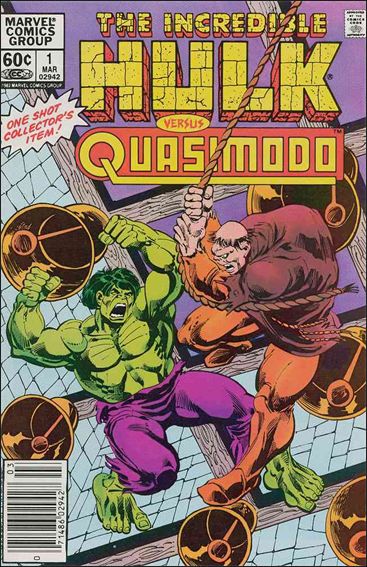
Another unlikely adaptation: The Incredible Hulk
vs. Quasimodo
. 
Art by Sal Buscema and
Steve Mitchell.© 1983 Marvel Comics Group.

In its long history, Victor Hugo's novel Notre-Dame de Paris (a.k.a. The Hunchback of Notre Dame) has been subject to many adaptations. On Sunday afternoon, Leon Botstein and the American Symphony Orchestra presented a rarely heard one: Franz Schmidt's 1914 opera Notre Dame

Schmidt (1874-1939) was an Austrian composer, the author of four powerful symphonies that are favorites with brass players. He faded into obscurity after World War II, although he has his champions: including Dr. Botstein and Austrian conductor Franz Welser-Möst. A post-Wagnerian (who played cello in the Vienna Philharmonic under the direction of Gustav Mahler) Schmidt's musical idiom falls between the brassy religiosity of Bruckner and the Viennese wit of Richard Strauss. 

The music uses leitmotifs, a series of short themes depicting Hugo's colorful characters. Traces of tambourine and minor-key Hungarian violins depict Esmerelda. Powerful brass themes  reference the bell-ringer and his master, the Archdeacon. The two acts feature three scenes each, separated by long symphonic intermezzos to cover the complex stagecraft needed for a full performance of this opera. An organ lends weight to the scene in front of the cathedral. The great bells of Notre Dame are depicted by crashing gongs at the opera's close. 

Leon Botstein managed the big forces of this opera with skill, drawing some beautiful lyric lines in the Intermezzo, the only part of this work performed with any regularity. There were some dynamic problems in the second act, with the soloists being drowned out by the waves of sound, but the last bars crashed home with stunning power. 

The opera moves the focus of Hugo's story away from Quasimodo, the hunchback, and onto Esmerelda, the innocent Gypsy girl. Here, she was played by soprano Lori Gulbeau, who has a pleasing soprano with spinto power and some flexibility. Ms. Gulbeau projected Esmerelda's deadly cocktail of sexuality and innocence, creating a moving portrayal of this compassionate character. Like a less ruthless version of Carmen, she is a force of nature, causing the downfall of all four male leads by simply existing.

The most significant of these four would-be paramours is the Arch-Deacon of Notre Dame. (Claude Frollo in the novel.) He is the very picture of religious rectitude and sexual frustration. Stephen Powell walked a fine line between piety and desparation, using his potent baritone in the prison scene to convincingly portray the deacon's capricious, ambivalent attitude toward Esmerelda. He repents at the last moment, crying for her to live as she is executed, but falls off the cathedral.

The most difficult casting requirement is a pair of heroic tenors. They're required to play Grigoire (Esmerelda's unloved Gypsy husband) and Phoebus, the young knight she falls for. requires two heldentenors for the roles of Phoebus and Gringoire. Robert Chafin moved between heroic voice and characterful, whispered singing as Grigoire. Corey Bix displayed impressive, ringing tone as Phoebus, with the right hint of metal in his voice. 

Turkish bass Burak Bilgili sang Quasimodo with a harsh,  guttural delivery, growling out the bell-ringer's part with power and authority. One sensed the hunchback's despair following the execution of Esmerelda and his subsequent murder of the Archdeacon. In this final scene, Schmidt's opera rose to the tragic heights of Victor Hugo's novel.

Saturday, March 17, 2012

Superconductor Interview: The Eclectic Slide

The Ebène String Quartet plays Beethoven, Bartók and...the Beatles.
by Paul Pelkonen
The Ebène Quartet takes the traditional approach to chamber music...
One does not always associate chamber musicians with jazz, electronica or surf music. For the Ebène String Quartet, this music is not only influential, but enjoys a place next to Beethoven in their concert repertoire.

I met with three members of the Ebène Quartet on Friday morning: violinists Pierre Colombet and Gabriel Le Magadure and cellist Raphäel Merlin. They conduct interviews like they play, picking up threads of conversation and tossing ideas back and forth around the round table in Landmarc, a bistro on the third floor of the Time Warner Center in Columbus Circle.

Friday, March 16, 2012

Concert Review: An End to Modernity

David Zinman winds up The Modern Beethoven.
by Paul Pelkonen
David Zinman demonstrates baton technique. Photo by Chris Lee.
© 2012 The New York Philharmonic.
This is the last week of The Modern Beethoven, the New York Philharmonic's spring festival pairing six of the composer's symphonies with unfamiliar concertos from the 20th century. This festival is the brain-child of David Zinman, the Bronx-born conductor whose uncompromising approach to music-making strips years of aural varnish from Beethoven's familiar scores.

The concert opened with a boisterous, no-frills reading of Beethoven's First Symphony. Mr. Zinman created a fresh musical statement from this early example of the composer's style, choosing energetic, but not hurried tempos. The orchestra responded, playing with great clarity and refinement.

The "modern" work on the program was the most interesting yet: the first Philharmonic performances of Karl Amadeus Hartmann's 1939 Concerto funèbre for violin and orchestra with soloist Gil Shaham. Despite a few Webern-esque squawks in the opening bars, this 20-minute concerto, played in one continuous movement, proved appealing, and yes, tonal.

A German composer who was profoundly unsympathetic to the Nazis, Hartmann wrote this piece as the storm clouds of World War Two gathered. Musically, this concerto forms a bridge between the diaphanous fabrics of Wagner's Parsifal (which it quotes, repeatedly) and the war symphonies of Shostakovich. Hartmann also incorporates Czech and Russian folk songs, expressing sympathy those countries, soon to be attacked by the Nazi war machine.

Mr. Shaham played with a keening, dry tone from the opening, a chorale based on a Hussite hymn from what is now the Czech Republic. The soloist was all business, making his instrument sob with grief in the slow section of the work, scratching out minor chords of rage like a speed-metal riffer in the Allegro. The finale featured a second chorale, evoking the fate of Russia as it stood in the path of the Nazi war machine. It came to a quiet close, then regenerated for a powerful coda, ending with loud, brash chords.

The concert ended with a Beethoven heavyweight: the 50-minute Eroica Symphony. Mr. Zinman's approach to this familiar score is to bring out details in the music that may have gone unheard before. The first movement had great detail, especially a theme in the low strings that later becomes the basis of the finale. The funeral march was philosophical, but not dragging in tone.

The infusion of energy common to this conductor's podium style occurred in the third movement, a boisterous scherzo that allowed the Philharmonic's woodwinds and brass their turn in the spotlight.Although the horns, led by principal Philip Myers did not sound their best here, the playing had a rude energy that made up for dodgy intonation.

Best of all was the finale, that famous theme and variations where the composer treats the sections and sub-sections of the ensemble as players in an oversized piece of chamber music. As the theme was tossed between the player, Mr. Zinman occasionally beckoned for more volume, or made an hermetic slashing pattern with his baton. The result: an invigorating performance of this famous symphony, and a fitting close to three weeks of The Modern Beethoven.

Opera Review: Making Plans for Duncan

The Metropolitan Opera revives Macbeth.
Thomas Hampson and Nadja Michael discuss dinner plans for King Duncan.
Photo by Marty Sohl © 2012 The Metropolitan Opera.
The Metropolitan Opera's recent hot streak continued Thursday night with the return of Verdi's Macbeth. This revival of Adrian Noble's stark 2007 show featured two debuts, making for an evening of bloody good Shakespeare.

As Macbeth, American baritone Thomas Hampson remains an uncommon singer, taking on a role that is on the heavy side for his smooth, pliant instrument. He pushed the limits of his voice at times, using all of his skill as an interpreter to find the dark, murderous heart of the character. His voice fades slightly at the lowest notes--audible in the Act III scene with the Witches. However, he handled the wide dynamic range, going from horrified whispers to shouts of bravado. The quality of singing in the final act made one long for Verdi's (original) 1847 ending, where the King gets a proper monologue and death scene at the opera's end.

Opposite him was German soprano Nadja Michael in her house debut as Lady Macbeth. Mr. Hampson and Ms. Michael have played the Macbeths before, notably at Covent Garden. They play Shakespeare's ambitious Laird and Lady as an old married couple, whose blood-drenched quest for the Scottish throne presents a welcome alternative to haggling over haggis.

Lady Macbeth is not a long part. Her vocal demands are even greater than those placed on the hapless husband, with whispered passages, muttered oaths, a soaring brindisi and moments of sheer, lung-busting power. Ms. Michael brought her 'A' game, starting with the Letter Scene. She brought steely determination to the central acts, egging on  Mr. Hampson, singing with power where a lesser soprano would have screamed.

But that was all appetizer for the main course: the Sleep-walk in Act IV. Here was a performance where Verdi's music expertly underpinned the translated Shakespearean text. Ms. Michael opened the door into the unworldly mind of the mad Lady M., hissing out "Va il tico maladetto" and floating the last notes of the scene with impressive technique.

Tenor Dimitri Pittas made one wish that Macduff was a bigger part with his Act IV aria mourning his murdered children. But his voice vanished after that scena into some ugly sounds. Günther Groissböck was a bluff Banquo who was more dramatically interesting as a ghost. The choristers were solid as the Witches, the Murderers (though the "Murderers Chorus" is Verdian overkill.) They also delivered a tight "Patria oppressa", an effective 19th century protest song.

Conductor Gianandrea Noseda showed his skill and experience, leading the revised 1861 version of the score minus the ballet. He chose fast tempos that had the orchestra moving briskly through Verdi's dark Scottish landscape. Mr. Noseda conjured the dark forces of the Witches scenes effectively, and brought off the complicated finale with panache.

Mark Thompson's set: soaring black columns, a fieldstone disk stage and background of trees scream of New Bayreuth. Goofy modern touches remain: Scottish warriors armed with AK-47s, IKEA furniture, and drop-down light fixtures. The Witches are a gaggle of society ladies, with lit flashlights in their clutch purses. Are they supposed to represent the donors who funded this show?

Thursday, March 15, 2012

The Devil is in the Details

Inside the Metropolitan Opera's new 'Dynamic Pricing.'
"Homer Simpson: you will renew your Metropolitan Opera subscription!"
Image from The Simpsons: Treehouse of Horror IV, © 1991 Gracie Films/20th Century Fox.
The Metropolitan Opera's 2012-13 season brochures are out. In the past year, it appears that the company has been hard at work figuring out how to squeeze as much money out of the pockets of New York opera-lovers. To that end, they've implemented two major changes to the way you buy your tickets.

Carving Up the Theater: 
In the old days at the Met, a subscriber had their seats in one of the opera house's six levels of seating: Orchestra, Parterre Box, Grand Tier, Dress Circle, Balcony, Family Circle. Each level had different prices for side (partial view) seats and for "main," with the box seats on one level corresponding in cost to the "main" seats on the level above. Starting in 2011, the Orchestra was divided into "Premium," "Prime" and "Balance." That should have been a warning for what was to come.

This year, each of those sections has been subdivided into Premium, Prime, Balance and Boxes, with corresponding price increases:
  • Premium: The first six rows in the center blocks of seats.
  • Prime: The remaining center seats. 
  • Balance: The back left and right corner seats, which do not afford the best view.
  • Boxes: Are the same as they were, although you can now order a whole season in a box. (This is a good thing, as long as you don't mind the wall that blocks your view of half the stage.)
What this means:
My 2011-2012 subscription seats in the Family Circle (Row B, 107-108, Row D, 106-107) are now "Family Circle Premium" and as a result I am faced with a choice: move back to cheaper seats or pay $10 more per ticket ") Since I have two subscriptions (part of my ongoing effort to keep writing about an opera company that doesn't want bloggers writing reviews of its shows) I'm looking at a renewal fee of approximately $850 for next season. 

Fees, Fies, Foes, Fum:
The Met has learned well from Ticketmaster, Live Nation, the New York Mets (who put this system in in the 1990s) and other legitimate ticket agencies: gouge your customers whenever possible. Each purchase made from the Met (even at the box office) has a "facilities" fee of $2.50. 

Ordering by phone or the Internet? Add on another $7.50 (again per ticket)  "convenience charge." That adds up to a hefty $10 fee per seat per night.

The Met continues its third year of charging fees to change your tickets. This year, the fees go up to $7.50 per ticket. So if you buy seats for the opera, it may be cheaper to keep them. If your grandmother dies or something, you can still donate them back as a tax-deductible contribution to the opera house. Doing some digging through the site reveals that certain productions are not available for exchange. 

Welcome to Alphabet City!
This year, the Met introduces a new "Price Categories" system, inspired by the price-gouging that goes on at Broadway houses. If you look at the individual ticket orders on the back pages of the program, you'll find little red letter grades next to the operas that are scheduled. 

Those letter grades (A, B, C, D, E, F, with F for "holiday" performances) have correspondingly higher ticket prices.  The higher the "letter grade" of the night you want to attend, the more you'll pay. The Met was already charging attendees more for performances on Friday and Saturday, but this is the next coldly logical step.

So if your seats are in the Family Circle on an "E" night, you could pay as much as $15 more per ticket, in addition to all the fees mentioned above.  If your seats are lower down in the house, the amount added gets higher, with an "E" ticket in the Orchestra Premium going up by a staggering $40.00.

Looking closely, it's apparent that the letter grade system (reminiscent of New York City's new health inspection grades) are not organized according to what opera is being performed. They're attached to the specific operatic performances (days of the week) that the Met believes will be the most popular of the season. 

What's next?
The next step is to start charging more for performances where stars are scheduled to appear. If that happens, and Anna Netrebko doesn't show up, don't expect the Met to give you a partial refund.

Want to know what you'll be paying for? Our first look at the 2012-2013 season is here on Superconductor.

A Serious Work of Socialist Realism.

Music by Dmitri Shostakovich. Enjoy.

Wednesday, March 14, 2012

Confessions of a Mozart Addict

The great composer as drug of choice.
by Paul Pelkonen
Trust him. He's got what you need: Wolfgang Amadeus Mozart.
OK. I admit it. I'm a Mozart addict.

The works of Wolfgang Amadeus Mozart take up one and a half shelves of my CD collection. Stacked, they'd make a collection about six feet high. Taller if you add the Complete Mozart Edition from Brilliant Classics, which goes nicely next to the older Complete Edition put out by Philips. (That one is incomplete--I'm missing a few sets. All in good time.)

I have (at last count) multiple complete recordings of Le Nozze di Figaro, (seven) Don Giovanni (six)  and Die Zauberflöte (seven). Those three operas never diminish for me upon repeated listenings. Many more have passed through my shelves in the 20 years I've been collecting CDs.


I have several Entführung aus dem Serails (three), Così fan tuttes (five) and Clemenza di Titos (two). I even own four: (counted 'em) four recordings of Idomoneo. Though it's not my favorite Mozart opera it's still one of the best examples of serious 18th century opera, and should be performed more.

I have piano concertos, symphonies and piano sonatas. Serenades, divertissements, and A Musical Joke.

I even own two recordings of his vulgar little Canon in B Flat Major: "Leck mich im arsch."

My first live Mozart opera was probably The Magic Flute although I seem to remember a City Opera attempt at the fragment L'Oca del Cairo.

My first date with a girl in high school: I took her to four hours of Le nozze di Figaro.

And I've been to Salzburg and Vienna, weeping at a performance in the Hohensalzburg of that old party favorite Eine Kleine Nachtmusik.

I know the details of his life. The real ones, not the dramatized falsehoods in Amadeus. I know that he was a genius, and no saint. His unusual gifts led to an unusual childhood, and 37 bright-burning years immersed in the creation of music that has lived in the consciousness of Western thoughts for over two centuries.

I'm hooked on Mozart....and I'm proud of it.

With the exception of the month of August and the occasional opera review, I don't get to write much about Mozart on this blog. But his music, with its rich humanity, endless inventiveness and capacity to surprise the ear even when you've heard it an uncountable number of times never ceases to amaze.

Even a turgid performance of one of the symphonies (like the one the other week) offers opportunities to analyze and marvel the perfect, crystalline structures of notes: houses of cards that glow in rich colors and never collapse.

Yep. I'm addicted. Thank God.

Tuesday, March 13, 2012

DVD Review: The Red Sword of Courage

La Forza del Destino from Vienna.
by Paul Pelkonen
Pistol packin' Presiozilla (Nadia Kristeva) confronts Don Carlo (Carlos Álvarez)
in Act II of La Forza del Destino. Image © 2008 Vienna State Opera
Giuseppe Verdi's La Forza del Destino remains the most challenging of the composer's operas to produce successfully. With a huge story that sprawls across two countries and many different locations, this attempt to completely destroy the dramatic concept of Aristotelian unity can be a director's nightmare. On this DVD from the Vienna State Opera, (filmed on March 1, 2008) British director David Pountey offers some innovative solutions, drawing inspiration from the spare writing of Cormac McCarthy. and the opera's wartime setting.


The production, designed by Richard Hudson, places most of the action on a unit set, a white rotating plinth with a door at one end. This unit does heavy duty as bed-chamber, tavern, monastery and battlefield as needed. In the last scene, it rotates one last time to become the area before Leonora's cave, with a door at one end the gateway to sanctuary and redemption.  A high scaffolding surrounds the action, providing different acting surfaces for the tavern scene and the battlefields of Act III.

Blood-red swords (indications of the coming fight between Don Alvaro and Don Carlo) are a recurring motif), doubling as crosses. Bodies hang from the scaffold as a grisly chandelier. Images of war and blood are projected on the action, which might have looked better in the theater than on video. The costumes move between Westerns and 20th century military dress, with the old fascist colors of red, white and black predominating.

Saturday, March 10, 2012

Concert Review: Riddle Me This

Week Two of The Modern Beethoven at the New York Philharmonic.
by Paul Pelkonen
David Zinman.
Photo by Priska Ketterer.

The Modern Beethoven is conductor David Zinman's three-week essay arguing the influence of Ludwig van Beethoven on 20th century composition. Thursday night's concert at the New York Philharmonic kicked off the second week of the festival. The program featured Samuel Barber's 1946 Cello Concerto, bracketed by the Eighth and Fourth Symphonies.

Although all nine Beethoven symphonies are the bread and butter of orchestral programming, the Eighth is infrequently heard. It is a seeming throwback to the composer's early style and the galant 18th century writing of Haydn and C.P.E. Bach. This is a work shot through with Beethoven's unique sense of musical humor, full of inside jokes, self-references and riddles for a skilled conductor to solve.

The first of these problems: the unique opening phrase of the first movement. It seems to start in the middle of a theme, almost as if the listener walks in just as the punch-line of a joke is being told. The resulting peal of orchestral laughter (that actually starts the symphony) was slightly muffed last night, though the Philharmonic players pulled things together to deliver a crisp reading.

The second movement owes its debt to the invention of the metronome. Steady ticking rhythms are plucked out and the sprightly main theme burbled over the meter. The final two movements were even better, Beethoven at his most cheerful interpreted by Mr. Zinman's seemingly casual, but fiercely accurate conducting.

For the "modern" portion of the program, cellist Alisa Weilerstein joined the expanded orchestra to play Samuel Barber's Cello Concerto. Ms. Weilerstein has established herself as a star on her instrument in the last decade. Here, she played Barber's thorny opening with a fierce attack, her left hand racing up the neck of her instrument as she bowed with intent and concentration. 

The slow movement breathed with a mourning air, possibly reflecting the work's post-World War Two origins. The final movement featured kinetic, breath-taking playing from Ms. Weilerstein. Her left hand leapt, spider-like from interval to interval. Mr. Zinman provided jazzy accompaniment, the music seeming to presage the film scores of the decades that followed the work's premiere.

The concert ended with another merry Beethoven symphony: the Fourth. This is a much simpler joke than the Eighth, with a slow introduction that leaps into a Haydn-like allegro without any warning. The four movements were played with clean, precise lines, with Mr. Zinman looking like he was having a marvelous time bringing this warm, good-hearted music before the ears of the public.

Thursday, March 8, 2012

DVD Review: Catch a Falling Tsar

A new edit of Boris Godunov from Turin.
by Paul Pelkonen
Throne for a loop: Orlin Anastassov in Andre Koncalovsky
Photo by Ramanella & Giannese @ 2010 Fondazione Teatro Regio di Torino.
In 1869, Modest Mussorgsky first submitted his opera Boris Godunov to the Imperial Theater. It was rejected for its lack of female characters and novel dramatic structure that placed equal emphasis on the plight of the titular Tsar and the suffering of the Russian people. His later revision (with some tweaking by Rimsky-Korsakov) was a success in 1874.

Today, opera directors and conductors usually choose one of these two versions. This DVD from OpusArte, shot in 2010 at the Teatro Regio del Turin, offers a compromise. Director Andre Konchalovsky chooses the 1869 version of Boris for its dramatic momentum, but inserts the finale of the revised version (the march of the false tsar Dmitry through the Kromy Forest) between the St. Basil's scene and the death of Boris.

Orlin Anastassov is a youthful, convincing Boris, giving the impression from the get-go of being in over his political head. His Mad Scene is something to behold, acted with wide, staring eyes, the camera unforgiving and in his face. Heldentenor Ian Storey sings with loud, raw tone as Grigory, the monk who becomes the false Dmitri. Unaccountably, he is alone in the Kromy Forest scene--his paramour Marina (star of the missing "Polish Act") does not appear in this production.

Wednesday, March 7, 2012

Concert Review: The Long Reliever

The Boston Symphony Orchestra plays Beethoven's Missa Solemnis.
From the bullpen: conductor John Oliver poses in Symphony Hall
The Boston Symphony Orchestra has had problems with conductors staying healthy. Its most recent music director, James Levine, had to step down after a series of cancellations and absenteeism. Former maestro Seiji Ozawa recently announced that he is taking a year's sabbatical for health reasons. The latest victim: Kurt Masur, who, at 83 has been looking frail in his recent appearances. Mr. Masur cancelled all of his planned appearances with the orchestra on Feb. 23, citing "physical" issues. 

This left the BSO with a massive choral work to perform, and the search for a conductor to lead it. The choice: John Oliver, who founded the Tanglewood Festival Chorus in 1970 and has led it ever since. Mr. Oliver is an acclaimed expert in the field of choral music, but most of his work is done in rehearsals, working with singers before the scheduled conductor leads the performance.

To make matters more difficult, the Missa Solemnis is a monster among Beethoven's works, an 85-minute marathon for four singers, chorus and orchestra that has some of the same inherent problems as the composer's Ninth Symphony. A choral setting of the Catholic liturgy, it is that was simply too big in scope for any church. (It might even be too big for the concert stage, but that's where the work is usually heard.) It points the way forward to the choral excesses of the 19th and 20th century, being an ancestor to Berlioz' Requiem, Mahler's Resurrection Symphony and Schoenberg's Gurrelieder.

Tuesday night's performance at Carnegie Hall was the opening of the BSO's three night stand in New York this week. The performance featured the orchestra,  Tanglewood Festival Chorus and an all-star team of soloists: soprano Christine Brewer, mezzo Michelle DeYoung, tenor Simon O'Neill, and bass Eric Owens. And at the head of this little army: Mr. Oliver, who seemed unbowed by the musical challenge ahead. 

The one-two punch of the opening Kyrie and Gloria was tightly played and sung, all the more impressive since Beethoven's vocal writing is not always flattering to singers. Ms. Brewer's soprano grazed the plaster of Carnegie Hall, while Ms. DeYoung declaimed her text with richness and warmth. Mr. Oliver was firmly in command, and the chorus, working without the usual sheet music books, responded ably to his leadership. This is powerful writing, with each movement capable of standing on its own merits.  

Beethoven's setting of the Credo is the center of this ceremony, a blow-by-blow interpretation of the Nicene Creed that stands somewhere between Bach's St. Matthew Passion and Mahler's Resurrection Symphony. It also has the greatest degree of difficulty for singers, with fine details of the ritual picked out in the orchestral and vocal writing. These range from the sharp stabs of sound to accompany the nailing of Christ to the cross to the glowing textures of affirmation that accompany the profession of faith in the light of the world to come.

The Sanctus is the slow movement of this work, building from a deceptively gentle beginning to a steady march of faith and determination. Mr. O'Neill displayed range in these sensitive pages, his voice intertwining with the concert-master in a kind of double concerto. The chorus provided hushed, celestial commentary in the most beautiful section of the performance.

Mr. Oliver is a skilled choral conductor, but he ran into problems with the closing Agnus Dei. This long setting of the prayer to the Lamb of God and the following Benedictus had Beethoven mining unknown musical territory with a mix of celestial harmonies, a contrapuntal fugato and a series of martial figures for trumpets and drums that reflects the war-torn state of Europe in the early 19th century.

The opening of the movement was led off by Mr. Owens, whose stentorian bass presaged the struggle to come. The problems started with the fugato, which seemed to meander around the orchestra. The brass figures were curiously muted, with the trumpets sounding somewhat timid. Although the soloists and chorus finished with a strong statement of Dona nobis pacem, the big finale didn't quite match the awesome movements that had come before.

Tuesday, March 6, 2012

Recordings Review: Sail of the Century

Marek Janowski's new Der Fliegende Holländer.
by Paul J. Pelkonen
The legendary Flying Dutchman sits down for a meal on SpongeBob SquarePants.
Promotional image for Ship O Ghouls, © 1999 United Plankton Pictures/Nickelodeon Studios.
The second installment of Marek Janowski's Wagner project for Pentatone Classics--a plan to record new concert versions of the ten "main sequence" Wagner operas is Der Fliegende Holländer. Again, this recording features the Berlin Radio Symphony Orchestra and Chorus, conducted by Mr. Janowski. This recording was made at one performance: on November 13, 2010.

Opera Review: Days of Wine and Voices

Juan Diego Flórez and Diana Damrau in L'Elisir d'Amore.
Back off: she's got an umbrella. Diana Damrau fends off Juan Diego Flórez in L'Elisir d'Amore.
Photo © 2012 The Metropolitan Opera.
During his tenure, Metropolitan Opera general manager Peter Gelb has made it his mission to phase out old productions of standard repertory operas. So Monday night marked the opening of the last run for John Copley's charming 1991 L'Elisir d'Amore. This popular production uses cardboard cutouts, wooden acting surfaces, bright Italian pastels, tri-color flags and a deliberate theatrical artifice to make the giant Met stage ideal for Donizetti's rural comedy.

Monday, March 5, 2012

The Spider and the Fiddle

Are spider-strand violin strings the future of chamber music?
by Paul Pelkonen
A golden orb-weaver spider in its web.
There's a fascinating article on the BBC News site today: a Japanese researcher has figured out how to make spider silk into violin strings.
Spider-man: Dr. Shigeyoshi Osaki
 in a hammock suspended
from rope made from spider-webbing.
Photo © 2011 Dr. Shigeyoshi Osaki.
First published in The Japan Times.

The strings, made from silk spun by the golden orb-weaver spider) have a high tensile strength. When bowed, they produce a softer tone than conventional strings, which are made from steel or cat-gut. The BBC article has an example of a violin played with the new spider-strings.

The scientist, Doctor Shigeyoshi Osaki of the Nara Medical University developed a method to produce large quantities of "drag-line silk" from 200 captured spiders. Each string required 3,000-5,000 strands to form a bundle. Three bundles, twisted together make up a string.

By the way, cat-gut is not made from cats--but from the stretched fibers of sheep or cow intestines. The term may be a corruption of cattle-gut, although the sawings of amateur players may suggest a small feline being tortured.


Contact the author: E-mail Superconductor editor Paul Pelkonen.

Saturday, March 3, 2012

Concert Review: The Empty Podium

The Vienna Philharmonic plays Sibelius at Carnegie Hall.
by Paul Pelkonen.
The Vienna Philharmonic at a concert in Berkeley, California in 2011.
Photo by Terry Linke © University of California at Berkeley.
The Vienna Philharmonic played the first of three New York concerts on Friday night. The venerable orchestra is currently touring with conductor Lorin Maazel, who, at 82, is celebrating a 50-year association with the orchestra that started with a performance of Beethoven's Fidelio in 1962.

Friday's program was one of Mr. Maazel's specialties: three symphonies by Jean Sibelius. Mr. Maazel has been conducting the symphonies of Finland's national composer for over half a century. He's also recorded the cycle twice: once with the Vienna forces and again with the Pittsburgh Symphony Orchestra. So it was somewhat surprising that these interpretations were missing the qualities of fire and emotion that are needed in the performance of these great works.

The program went chronologically backward, starting with the Seventh Symphony. This was the last of the composer's completed symphonies (an Eighth may have existed, but was probably destroyed), a condensedwork that packs all the development and ideas of four movements into a concise twenty minutes. Although the Vienna players brought warm string tone, searching woodwinds and their trademark horn sound to its pages, the Seventh sounded curiously workmanlike and uninspired.

The same problems plagued the first two movements of the Fifth: gorgeous playing that suffered from uninspiring leadership. This was particularly apparent in the central Andante. Matters improved considerably in the finale, driven by a bell-like, tolling figure in the horns that alternates with a sprightly woodwind melody. The best part: an eloquent, emotional statement in the cellos that was played with sentiment and warmth.

The second half of the concert featured the First Symphony, one of Sibelius' longest and most challenging pieces. It opens with a long clarinet cadenza, where the conductor stands with his arms down, mute before bringing in the whole orchestra. Mr. Maazel stood there, at rest, waiting for the solo to wind to its end. 

Then, his arms lifted. The white baton came up. And then the weird thing happened: the orchestra made its entry, but their timing had little to do with Mr. Maazel's. The principals of the four main string sections (first and second violins, violas and cellos), were working off each other, making eye contact and giving silent cues as they played through the piece. Nobody was looking at the conductor.

The phenomenon extended to other sections of the orchestra. Eyes fixed on their sheet music, the tuxedoed Vienna players were playing on orchestral auto-pilot, making use of their experience and ability to get through the four movements of the symphony. And for the most part, this trick (if it was one) worked.  . The orchestra's sound quality was gorgeous, worthy of their stellar reputation and world-wide fame. But throughout the First Symphony, it felt like the concert was being led from the first chairs, and not by Mr. Maazel.

Contact the author: E-mail Superconductor editor Paul Pelkonen.

Friday, March 2, 2012

Concert Review: Thoroughly Modern Ludwig

Week One of The Modern Beethoven with David Zinman.
by Paul Pelkonen.
Man in black: David Zinman conducts the New York Philharmonic.
Photo by Chris Lee © The New York Philharmonic.
On Friday afternoon, Bronx native David Zinman led the New York Philharmonic in a program pairing two Beethoven Symphonies (the Second and the Seventh) with a piece by Igor Stravinsky. This was the second concert of the first week of The Modern Beethoven, the Philharmonic's festival offering this spring.

Mr. Zinman (currently the Music Director of the Tonhalle Orchester Zürich) is a champion of the new, critical edition of Beethoven symphonies, made by Jonathan Del Mar in the 1990s. As a conductor, his principal achievement is one of lucidity. Minor sonic details suddenly rise to the surface with thrilling effect. The Philharmonic sounded fresh and revitalized on Friday afternoon, playing with a blend of rough energy and refined grace.

Starting this three-week festival with the Second Symphony--the least played and least loved of the cycle, is something of a statement of intent. Under his baton, this work's debts to Mozart were apparent. (The opening notes recall the beginning of Die Zauberflöte.) The Allegretto bustled with an energy that recalled Rossini, moving ahead with playfulness and determination.

That operatic grace continued in the Larghetto, which looked forward and back in time: to the Romantic excesses of the 19th century and the courtly music-for-hire that defined the 18th. This is the sound of Beethoven planning the revolution that he launched with the Eroica in 1805. 

Each week of The Modern Beethoven pairs two symphonies with a 20th century work. The idea is to show the correlations that exist between these famous works and lesser-known concerti from the past 100 years. Here, it was the  Capriccio for Piano and Orchestra by Igor Stravinsky, a 15-minute piece in the Russian composer's neo-classical style. Peter Serkin was the featured soloist.

Stravinsky had a love for stripping and altering the familiar forms of so-called "classical" music. The Capriccio is effectively a second piano concerto. Its three tightly connected movements, spanning just 16 minutes. Mr. Serkin played the intimidating solo part with  steely concentration and bright power, creating rapid-fire climaxes from the keyboard. Mr. Zinman provided expert accompaniment, with Stravinsky's orchestral parts benefitting from his energetic leadership.

By using a somewhat enlarged orchestra for the Seventh, Mr. Zinman created a heavier sound from his players without ever sounding heavy-footed. The work's whirling dance movements sparkled with the energy of life itself, while the famous dragging march (heard, famously in the 2010 film The King's Speech) was taken at speed: determined, but not rushed. 

Mr. Zinman brought out the joyful energy of the last two dance movements, driving his orchestra into a Dionysian whirlwind of energy. The second violins and low winds were heard with great clarity, leaping into the fray alongside the other sections as the finale boiled to its climax. This was Beethoven as he is imagined by the Romantics, with rough energy and genteel refinement.

Trending on Superconductor

Translate

Share My Blog!

Share |

Critical Thinking in the Cheap Seats