Support independent arts journalism by joining our Patreon! Currently $5/month.

About Superconductor

Our motto: "Critical thinking in the cheap seats." Unbiased, honest classical music and opera opinions, occasional obituaries and classical news reporting, since 2007. All written content © 2019 by Paul J. Pelkonen. For more about Superconductor, visit this link. For advertising rates, click this link. Follow us on Facebook.
Showing posts with label wolfgang amadeus mozart. Show all posts

Wednesday, July 3, 2013

Paging Doctor Mozart

Taking the Salzburg cure...in Brooklyn.
by Paul J. Pelkonen
Will Dr. Mozart please report to the white courtesy harpsichord?
I own a ridiculous amount of Mozart.

People who read this blog may know of my obsessions with Mahler, Wagner, Bruckner and Richard Strauss, the heavyweight champions of the symphonic and German opera canons. But the fact is, I have more Mozart in my CD collection than any other composer.

Wednesday, July 11, 2012

DVD Review: The Plunder Down Under

Teddy Tahu Rhodes in an Australian Don Giovanni.
by Paul J. Pelkonen
"Does this mask make me look fat?"
Teddy Tahu Rhodes as Don Giovanni.
Photo by Branco Gaica © 2011 Opera Australia.

This DVD of Mozart's Don Giovanni, shot at the Sydney Opera House in October of 2011, preserves a 20-year old production by Opera Australia that is most noteworthy for the leading character's fashion sense--or lack thereof.

That's baritone Teddy Tahu Rhodes camping it up in a black domino mask, hot leather boots, Chelsea boy-shorts, and little else in the opening scene, as the Don goes prowling the rooftops of Seville dressed like Zorro on his way to a fetish night. All this beefcake hides the fact that Göran Järvefelt's well-worn production is, at its heart a thoroughly conventional re-telling of the Mozart-DaPonte collaboration, which captures the brilliance of Mozart's writing without breaking any major new ground.

Watching this performance, I noticed a "tunnel" effect on all the voices, most clearly heard in "Dalla su pace," Don Ottavio's aria in the first act. This is probably caused by Carl Friedrich Oberle's dull set, a series of wood-and-faux-plaster chambers that look left over from an old Jean-Pierre Ponelle seem to swallow up the voices instead of allowing them to project out into the house. Some of the singers (notably Rachelle Durkin, the Donna Anna) have the vocal fortitude to get their voices out into the house, but many suffer from this effect.

Thursday, April 12, 2012

Opera Review: The Roman, the Witches, and the Wardrobe

Gotham Chamber Opera celebrates 10 years with Il Sogno del Scipione.
by Paul Pelkonen
Three on a mattress: Christine Biller (with shoe) Marie-Éve Munger and Michele Angelini
in Il Sogno del Scipione. Photo by Erin Baiano © 2012 Gotham Chamber Opera.
Wolfgang Amadeus Mozart's Il Sogno del Scipione ("Scipio's Dream") was written in 1772, when the composer was just 16 years old. Although the works of Mozart's adolescence have enjoyed some popularity in recent years, this allegorical opera seria has faced a long, hard rehabilitation. In 1913, musicologist Edward Dent labeled it as "formal and uninspired."

Happily, Wednesday night's premiere of the Gotham Chamber Opera's new production of Scipione (mounted by director Christopher Alden to commemorate the company's 10th anniversary) found much dramatic gold in this work. Scipione takes place almost entirely in the subconscious of its title character (sung by Michele Angelini). This is not the Roman general whose battlefield skill defeated Hannibal and won the Second Punic War--but his nephew and heir. What's really at stake though, is the conflict between goddesses: Constanza (Constancy, sung by Marie-Ève Munger) and Fortuna, (Fortune) played by Susannah Biller.

Mr. Alden places all three singers in bed together at the start of the one-act piece, an idea which recalls the opening of Der Rosenkavalier. The action is confined to one room, with no exits save the window. There is luxuriant shag carpeting, a wardrobe, and globe lighting that descends to indicate the heavenly spheres. Moving the work to New York (or possibly an IKEA® showroom) Mr. Alden explained (in a program note) that he chose a dramatic sensibility derived from the 1997 Robert Downey film Two Girls and a Guy.

Mr. Angelini is the major vocal discovery here, a flexable lyric tenor with an agile portamento and a pleasing, rounded low end. His sky-scraping final aria "Di che si l'arbitra'" was a heroic, compelling vocal workout, all the more so since the singer dressed himself, complete with tying a tie in a full Windsor knot without dropping a note. He was helped by the crisp leadership of Neal Goren in the Lynch Theater's small orchestra pit.

The two female leads were less pleasing. Mozart wrote considerably challenging arias for his two goddesses, but the singers added shrieks and stretched for difficult notes high above the stave. The personifications of Constancy and Fortune serves as harbingers of the Queen of the Night, who arrived some 20 years later. However, the young composer did not have the economy of thought that pervades Zauberflöte, and their long string of da capo arias proved exhausting.

Of the two goddesses, Ms. Biller excelled at chewing the scenery while rotating through a seemingly endless supply of costumes, from cowgirl to dominatrix to acid-green Coco Chanel. "A chi serena io giro" has a plethora of virtuoso passages. This leggy singer managed to make these over-written repeats more fun by moving around and acting as she switched outfits and moods. Constancy is naturally more restrained dramatically. Ms. Munger brought an even higher level of virtuosity to her part, tossing off arias like "Biancheggia il mar lo scoglio" and drawing her rival's wrath.

Far better was soprano Rachel Willis Sørensen in the small but crucial role of Licenza. This character is an Epilogue, addressing Mozart's patron and expressing good will towards the audience. Ms. Sørensen had an appealing stage presence, a plush, potent tone and her own acrobatics above the stave that never ventured into shrillness. A winner of the Metropolitan Opera's 2010 National Council Auditions, she is a singer on the way up.

The rest of the cast exists mostly in small parts. Of these, Scipio's uncle Publio (Arthur Espirito) and father Emilio (Chad A. Johnson) delivered impressive arias with their share of physical effort. Mr. Espirito did the entire performance on crutches with one leg tied back to indicate an amputation. Mr. Johnson arrived onstage in a wheelchair, emerging from a near catatonic state to sing with a pleasing tenor.

Wednesday, March 14, 2012

Confessions of a Mozart Addict

The great composer as drug of choice.
by Paul Pelkonen
Trust him. He's got what you need: Wolfgang Amadeus Mozart.
OK. I admit it. I'm a Mozart addict.

The works of Wolfgang Amadeus Mozart take up one and a half shelves of my CD collection. Stacked, they'd make a collection about six feet high. Taller if you add the Complete Mozart Edition from Brilliant Classics, which goes nicely next to the older Complete Edition put out by Philips. (That one is incomplete--I'm missing a few sets. All in good time.)

I have (at last count) multiple complete recordings of Le Nozze di Figaro, (seven) Don Giovanni (six)  and Die Zauberflöte (seven). Those three operas never diminish for me upon repeated listenings. Many more have passed through my shelves in the 20 years I've been collecting CDs.


I have several Entführung aus dem Serails (three), Così fan tuttes (five) and Clemenza di Titos (two). I even own four: (counted 'em) four recordings of Idomoneo. Though it's not my favorite Mozart opera it's still one of the best examples of serious 18th century opera, and should be performed more.

I have piano concertos, symphonies and piano sonatas. Serenades, divertissements, and A Musical Joke.

I even own two recordings of his vulgar little Canon in B Flat Major: "Leck mich im arsch."

My first live Mozart opera was probably The Magic Flute although I seem to remember a City Opera attempt at the fragment L'Oca del Cairo.

My first date with a girl in high school: I took her to four hours of Le nozze di Figaro.

And I've been to Salzburg and Vienna, weeping at a performance in the Hohensalzburg of that old party favorite Eine Kleine Nachtmusik.

I know the details of his life. The real ones, not the dramatized falsehoods in Amadeus. I know that he was a genius, and no saint. His unusual gifts led to an unusual childhood, and 37 bright-burning years immersed in the creation of music that has lived in the consciousness of Western thoughts for over two centuries.

I'm hooked on Mozart....and I'm proud of it.

With the exception of the month of August and the occasional opera review, I don't get to write much about Mozart on this blog. But his music, with its rich humanity, endless inventiveness and capacity to surprise the ear even when you've heard it an uncountable number of times never ceases to amaze.

Even a turgid performance of one of the symphonies (like the one the other week) offers opportunities to analyze and marvel the perfect, crystalline structures of notes: houses of cards that glow in rich colors and never collapse.

Yep. I'm addicted. Thank God.

Tuesday, October 18, 2011

Opera Review: Hunk City

The new Don Giovanni at the Met.
"Nobody move or the baritone gets it!"
Peter Mattei as Don Giovanni (with knife) threatens Luca Pisaroni's Leporello.
Photo by Marty Sohl © 2011 The Metropolitan Opera.
The Metropolitan Opera's new Don Giovanni has been beset by injuries. First, music director James Levine was replaced by new principal conductor Fabio Luisi. Then the star, rising "bari-hunk" Mariusz Kwiecien injured his back at the dress rehearsal, three days before the premiere.

Luckily, the Met had the also-hunky Peter Mattei on the roster this year, singing Figaro in Il Barbiere di Siviglia.. But with almost no time to prepare, rehearse, or work with Mr. Grandage, Mr. Mattei's vocally handsome performance felt like he had stepped in from another production. That said, he sang a lovely, genuinely seductive "Deh! vieni alla finestra." in the second act, and cut a striking figure in the fiery climax.

With the Don a cipher, the role of leading man falls to Leporello, sung by Luca Pisaroni. Mr. Pisaroni raises the energy level whenever he is onstage. The servant is as lecherous as his master, played with a curiously moral core that is straight out of Beaumarchais. Mr. Pisaroni brought a raw vitality to the proceedings, and has the makings of a great Don himself.

Michael Grandage's direction has the singers manage the negative space between their characters. The air seems to crackle between the pairs: Ottavio and Anna, Masetto and Zerlina. The opera's best couple? The disguised Leporello (posing as the Don) and Donna Elvira, played as a slightly manic stalker by the talented Barbara Frittoli. 

Don Ottavio is the weakest character in this opera. (Mr. Grandage compensated by arming him heavily.) Ramón Vargas' best weapon though, was his voice, a smooth, supple tenor that sang Ottavio's two difficult arias without seeming to pause for breath. The "optional" Act II aria  "Il mio tesero" was outstanding, with all of the ornamentation brought out and shining. 

Two young sopranos make their Met debuts in this run. Marina Rebeka sang "Non mi dir" with control and strong, if slightly shrill tone. At least she made Donna Anna more than a one-note character. Mojca Erdmann was a Zerlina from the coquette school, with a voice too small for the cavernous house. As Masetto Mr. Bloom, (a budding bari-hunk), made the most of playing a wife-beating shmo. Stefan Kocán's serviceable Commendatore would be better without the amplified echo on his voice in the graveyard scene. 

This is an urban Don Giovanni. The streets of Seville are presented on Christopher Oram's rotating set, consisting of high, curved tiers of multi-colored, louvred doors, each with its own balcony. (It looks like a seedy motel.) Occasionally, the "motel" opens to reveal a large courtyard, used for the wedding reception, the cemetery, and the Don's villa. The best visual: during the Catalogue Song, when all the doors open to reveal the Don's conquests in a manner reminiscent of Bartók's Bluebeard's Castle.  

Conducting from the harpsichord (and playing the continuo himself) Fabio Luisi made a case for his recent promotion, alternating between light comedy and the orchestral firestorm in the opera's climactic scene. The hellfire whooshed out of the stage, threatening to incinerate Mr. Pisaroni as Mr. Mattei was dragged down through a hole in the floor. But Mr. Luisi proved that the real heat was in Mozart's music, not in rock concert special effects.

Saturday, October 15, 2011

The Giovanni Shuffle

Baritone Mariusz Kwiecien ready to tackle Mozart opera.
Back to work: Mariusz Kwiecien as Don Giovanni.
Photo by Nick Heavican © 2011 The Metropolitan Opera.
Mariusz Kwiecien is coming back to the Metropolitan Opera.

The Polish baritone, who suffered a herniated disc in an Oct. 10 dress rehearsal of the Metropolitan Opera's new production of Don Giovanni, has been cleared to make his debut as the libertine Spanish nobleman on Oct. 25.

Mr. Kwiecien was taken to the hospital on a back board, and underwent surgery earlier this week. He was heard to be in good spirits as he was being lifted off the stage, predicting that he would see the cast "next Thursday." Recovery for this kind of operation can take from two to four weeks.

However, the Oct. 13 season premiere featured Swedish baritone Peter Mattei in the title role of Mozart's opera. Mr. Mattei was under contract to sing Figaro in the Met's current revival of Il Barbiere di Siviglia. He switched roles at the urging of Met management.


According to a report by Daniel Wakin in the New York Times Mr. Kwiecien has been cleared by his doctors to do all the physical activity required in this new staging, with the exception of a climb down a ladder in the opening scene. This includes the mandolin playing, sword-fighting, and the occasional attempted sexual assault.

The prognosis means that Mr. Kwiecien will be able to sing the role in the performance on Oct. 29, which will be broadcast live in movie theaters around the globe as part of the Met's Live in HD series. It is standard practice for the company to film the performance before the broadcast as "backup", so expect to see cameras in the house on Oct. 25.

The new production of Don Giovanni is by Tony-winning director Michael Grandage. It opened on Oct. 13. You can read a live blog of the opening night here. Mr. Mattei will be singing on Monday night. That performance will be reviewed on Superconductor next week.

Friday, October 14, 2011

Concert Review: The Return of Lorin Maazel


Former Philharmonic maestro returns with cheerful Mozart and Debussy.
Lorin Maazel and the wooden railing. Photo by Chris Lee © New York Philharmonic.
One of the highlights of the 2011-2012 New York Philharmonic schedule is the return of the three "M's": former Philharmonic music directors Lorin Maazel, Kurt Masur, and Zubin Mehta to the podium in Avery Fisher Hall. Mr. Maazel is the first of these. On Friday afternoon, the conductor appeared at Avery Fisher Hall for the first time in three years. This was his second concert of the weekend, a pleasant, if unadventurous program of works by Mozart and Debussy.

The concert opened with a broad reading of Mozart's Prague Symphony, the composer's 38th. Mr. Maazel and the orchestra sounded relaxed and genial in the opening movement, following the stirring slow introduction with a joyful leap into the main theme of the Allegro. Mr. Maazel was loose on the podium, sometimes using minimal movements of his long white baton, sometimes leading with one hand on the wooden railing behind him.

The conductor seemed happy to be back. The orchestra offered the same genial impression. The central slow movement was played with lush, almost hypnotic textures from the orchestra's wind section. The strings sounded crisp, but never stiff or hurried in the final movement, as the band flew through the pages of the Rondo, driven with a steady tick of the white baton.

The rarely heard Concerto for Flute and Harp followed. Mozart wrote this double concerto when he was 21, for a French nobleman (and flautist) whose harp-playing daughter was one of his music students. Pairing it with the "Prague" established contrast between the composer's more familiar, mature style and the galant music expected by his French clients. 
Flautist Robert Langevin and harpist Nancy Allen created a unique sound as they played together, using cadenzas that were written, not by Mozart but by Karl Hermann Pillney. The flute-and-harp combination wove melodic lines together creating a celestial texture against the expertly played orchestral accompaniment.

The second half of the program featured two contrasting works by Debussy. Jeux is one of the French composer's most demanding scores, an abstract ballet that has an almost total absence of melody. It's all little fragments of sound, arranged artfully in an aural shimmer.  Little stabs of struck cymbal and tambourine penetrate the complex fabric, alternating with short lines for winds and horns. Mr. Maazel led this difficult music in an engaging manner, opening up the sound-world of the piece and letting Debussy's inspired writing speak for itself.

Iberia is ten years older, a colorful work found in the larger collection Images.. This work, originally conceived as a piano duet finds Debussy in "tour guide" mode with sound-pictures of France's southern neighbor. (Ironically, the composer had not visited Spain before writing the piece!)

The work offers impressions of scenes in Spanish city life. Portraits of a street scene and a nocturne gave plenty of opportunity for orchestral color and shape. The Philharmonic responded admirably in these movements. The festive finale was dominated by the brass and percussion, in the manner of many past concerts under Mr. Maazel's baton.

Thursday, October 13, 2011

Live Simulcast Coverage: Into the Fire

Opening Night: Don Giovanni from the Met.
Not appearing tonight: Kurt Moll as the Commendatore in Don Giovanni
Image © 1989 Salzburg Festival/Deutsche Grammophon.
PREGAME SHOW:
7:12pm: So we're trying this LiveStream technology again, this time with the opening night of Don Giovanni. The stream should be up at 7:30pm but there's no pre-show this time with Met radio broadcast announcers. So I'll just provide some background.
7:18pm: Energy hustlers in cheap uniforms with clipboards at the front door of my Brooklyn co-op, trying to solicit personal information from my neighbors. Actually had to hold the door shut and wait for them to leave. Not like my servant invited them to dinner or anything--although the idea of people in disguise getting into the house is central to Don Giovanni.
7:20pm: The Met has had bad luck with Don Giovanni. I've made this point before. But this new production, mounted by Michael Grandage has had it worse than most. The first casualty was music director James Levine, who went down with a back injury after a fall on Labor Day Weekend. He's been replaced by Fabio Luisi.
7:23pm: Worse luck struck again at Monday's dress rehearsal, when star baritone Mariusz Kwiecien went down with an injured disc, not ten minutes into the opera. Mr. Kwiecien has had back surgery and his prognosis is good. His substitute: Peter Mattei, recently heard in Il Barbiere di Siviglia. Dwayne Croft remains the cover.
7:25pm: Welcome to the Metropolitan Opera Online Stream. Stay with us because tonight's broadcast will begin shortly.
7:29pm: ...and here's Margaret Juntwait and Will Berger.
Barbara Frittoli (l.) as Donna Elvira confronts Peter Mattei's Don.
This is from the old production. Photo by Ken Howard © 2009 Metropolitan Opera.
ACT I: 
7:30pm: Get well wishes for Mariusz Kwiecien and they're so glad Peter Mattei is here. Quick Act I summary for the listener going over the plot.
7:33pm: Conductor to the pit....
7:34pm: Audience applauds and it's game time. Act I.
7:35pm: Opening of the Overture measured, with those famous chords. "Hellfire" theme against solemn background of brass and timpani...orchestra sounds good. Now the second, faster theme, taken a little slow then gathering speed to the first climax. After this Luisi does not let up. Strings very crisp with fine pointing from the oboes and flute.
7:40pm: Curtain up and here's bass Luca Pisaroni as Leporello, kvetching about his boss.
7:42pm: Enter a vigorous-sounding Peter Mattei and an equally determined Donna Anna. Trio ensemble here not quite perfectly together but the dramatic energy is palpable.
7:43pm: Stefan Kocán as a resonant Commendatore. Swords drawn audibly. "Se voi morir!"
7:45pm: And he's down. Sword thrust, not a back injury as the Commendatore breathes his last--as a mortal, anyway.
7:46pm: Fabio Luisi moves to harpsichord for first recitatives. Love that he's doubling the two jobs. Lot of clomping about on the wooden set.
7:48pm: Bel canto tenor and Met veteran Ramon Vargas is unusual, luxury casting for Don Ottavio, the worst role in opera because the character (not the singer) is basically a jellyfish. Donna Anna has all the stingers!
7:52pm: This duet sounds "even" for once with Vargas singing with more power than most Don Jellyfish.
7:55pm: Barbara Frittoli makes her entrance as Donna Elvira.
8pm: Leporello and Elvira discuss the Don and his outrageous sex life. Here comes that famous er...number. Sound of a book being opened.
8:06pm Pisaroni gets the Catalogue song rolling with sprightly accompaniment from the pit. Audience laughter at "mil 'e tre." Thank God for MET Titles! Second subject with its courtly dance-figures (a little Mozartean joke) taken very slowly and delicately. Sung with warmth but not leering. Last part taken very slowly with some vocal showing off from Pisaroni.
8:07pm: How rude of me. LiveStream is HERE. We now rejoin our peasant wedding, in progress.
8:08pm: Peasants occupying the stage like it's Zuccoti Park. Sorry, couldn't resist. Joshua Bloom gruff and unsubtle as Masetto, Mojca Erdmann makes a good first impression as Zerlina.
8:12pm: Masetto may be a churl, but Joshua Bloom sang a good, very fast "Ho capito." BTW that is how you respond when someone gets in your face and says "Capeesh?" (I'm from Brooklyn.)
8:14pm: Peter Mattei coming into his own, the right mix of seduction and swagger as he goes to work on Zerlina and the lead-in to the most famous duet in Mozart. Tho he's wandering away from the mic.
8:15pm: Best part of duet: sensual, exquisite playing from the orchestra evoking Mozart's very carnal music. This is where Strauss got the sex scene that opens Rosenkavalier from, the pulsing, squeeze-box rhythms and parrying, dancing voices. Andiam!
8:20pm: The Don meets Anna and Ottavio. And cue Elvira.
8:25pm: The complex Quartet, beautifully executed by the ensemble. At least their timing seems to be down, which bodes well for next Monday (when I see this show in the house.)
8:31pm: Marina Rebeka an excellent Donna Anna singing "Or sai chi l'onore."
8:34pm: Vargas just floating those long notes into the air of the Met with remarkable control in "Dalla sua pace," stretching out the texture--he has the technique for this and Luisi is trusting his singer.
8:36pm: Now stretching out with vibrato--but not unsteadiness for the last notes, ending with an organ-like woodwind figure that shows up in a lot of Wagner operas.
8:39pm: Champagne aria taken at ridiculously fast speed with Mattei blustering through it and banging stuff around on stage. Not sure the grapes were stomped in France.
8:42pm: "Batti, batti O bel Masetto": the favorite aria of New York Rangers fans, who believe that Masetto clearly plays for the Islanders and wears No. 6.
8:46pm: Enter the chorus as the pieces move into position for the Act I finale. My brain always hears "Zerlinetta" as "Zerbinetta." Too much Strauss.
8:52pm: This finale is sometimes muddled but here it's crisp and sounds as if it's well-directed. (We'll know more Monday.) Some exquisite wind playing. Much more clomping around on the set and bustling about before everyone launches into the fast section. Luisi VERY tight here and the singers know their parts and sound great even with the last-minute cast change.
8:55pm: "Viva la liberta!" sung with extra meaning here. Is that because the cops are going to try to clear Zuccotti Park tomorrow at 6am on the pretext of "cleaning" away "Occupy Wall Street." OK. Back to opera.
8:57pm: Someone get the cast some nice soft Crocs. Clomp, clomp, clomp.
8:59pm: Last whizzing section of the finale launched at very high speed. Luisi a steely-eyed missile man in the pit leading a very fast ensemble and nobody missing a cue. Prompter must be working overtime down in the smallest room in the house. So far this has been a solid Don Giovanni off to a great start with an invigorating finish to the first act. Damn, that's fast, but everything is dead on. And last notes.

INTERMISSION: WB and MJ talking about the costumes and about everything going on in the pell-mell finale. Production described as "sweaty." Hmm.
9:14pm: Good interview with bass Bryn Terfel who has sung (at least) four roles in Don Giovanni. 9:18pm: He aptly described the Das Rheingold as "sparse." That's being kind.
9:25pm: Will Berger breaking down "chocolate in opera."
9:30pm: WB describing the stage set. Windows, balconies, a courtyard and a wall of windows. And enough fire effects to make Beavis happy.
The Act II Graveyard Scene, from the 1790 production in Prague.
Image from Wikimedia Commons.
ACT TWO:
9:34pm: First duet for master and servant. "Eh via, buffone." Chemistry and comic timing evident.
9:42pm: It sucks not having a program. Who's playing Donna Elvira's anonymous (but attractive) maid? Terzetto conducted sensually by Luisi with Pisaroni's sardonic comments drawing all the laughs. (Titles again.) Now we switch costumes.
9:51pm: "Deh vieni" sung with great delicacy and warmth by Mr. Mattei. All that guitar playing in Barbiere ("Se il mio nome") probably helped.
9:54pm: Erdmann singing with great tenderness and then a stunning high note in "Vedrai, carino."
9:58pm: The welcome return of Ramon Vargas. Usually don't feel that way about Don Ottavio but he's singing really well tonight. It's not the singer, it's the character.
10:02pm: Luisi is a bold conductor taking the sextet at a pace that recalls the John Eliot Gardiner recordings. But the singers are together in the sextet and all the words can be heard. Wow.
10:09pm: "Il mio tesoro"--Vargas has the house rapt, singing with a reached-for high note but generally with good breath control, ornamentation and more volume and power than you usually hear from Don Ottavio. And it's good that he gets both of his arias!
10:11pm: And the house responds accordingly. Bravo!
10:15pm: Fast tempos again for "Mi tradi" with Barbara Frittoli breath-y but engagingly sung.
10:18pm: To the cemetery scene!
10:20pm: And there's the statue. Voice sounds like it's through an echo effect or perhaps they're using the same rig for Fafner in the upcoming Siegfried. Too much echo.
10:23pm: "O statua gentilissima!" Pisaroni very good here. Really sounds scared and not like he's playing it for laughs. If you play this for laughs the ending doesn't work.
10:30pm: "Non mi dir" sung with great delicacy, Rebeka making Anna into a more sympathetic figure and not the hard-edged "revenge Valkyrie" who stalked the Zeffirelli production. Nice coloratura too. Audience really likes her. And they should.
10:34pm: Party at the Don's house. Guess who's coming to dinner? Lots of onstage movement going on, dishes, plates clinking--does the Don have a whip to hit Leporello with? (Find out Monday.)
10:37pm: And the banda played on. "Non piu andrai" well played by the Met winds, a titter of laughter from the house. Boy are they in for a shock when the dinner guest gets here.
10:38pm: Not you, Elvira.
10:39pm: 10...9...8...7...6...5...4...3...2...1....scream!
10:41pm: The dinner guest arrives. Echo effect turned down here. Met techies must read this post and take notes accordingly. Anyway Kocán sounds a lot better. Pisaroni too histrionic here--should be singing the lines not whimpering. Sing first. Whimper later.
10:42pm: Flames rising slowly in the pit. This might be best-conducted Don Giovanni I've heard at the Met and I've seen the opera there five times. This is on a level with Fischer this summer: very solid music-making, real dread coming out of the speakers. "Parla! Parla!"
10:45pm: Peter Mattei now has to make the Don win our sympathies even as he's dragged to hell. This is the crux of the opera: you wish you were brave enough like the Don not to repent and to choose eternal damnation rather than listen to that grumpy old statue. Mattei's voice is rising to the occasion too over the orchestra--this is a face-off of equals.
10:47pm: Luisi, orchestra, chorus, are literally raising hell. I can't wait to see this. And there's the hissing fire effects. Whooshwhooshwhoosh. Last chords. House absolutely going bonkers.
10:49pm: That last ensemble. Wrapping up while the damnation still rings in their ears. I always think this last bit should be cut but...18th century convention. It reminds me of the "Where are they now?" at the end of National Lampoon's Animal House. On the bright side, you get to hear Vargas sing again. Which is nice. Audience chuckling at the titles or at the idea of Elvira entering a convent?
10:53pm: That whizzing fugue-like ending borrowed by Verdi for Falstaff. 
10:54pm: The last curtain rings down on a successful prima. Bravo to all. Can't wait to see it!
10:55pm: Loud applause for Vargas. Cheering for Pisaroni's Leporello. Roars of approval for Latvian soprano Rebeka, one of two debut artists in this strong cast. The other is Erdmann. Peter Mattei appreciated--he saved this night by switching operas. Bravo! OK. Conductor and production team next.
10:57pm: Warm reception for Fabio Luisi now on the stage. Production team comes out. No audible boos. Everyone applauding at great volume and no "boo-birds." Good.

Hope you enjoy reading this, and if you stuck with us for the duration, I hope you had fun listening to Don Giovanni. Be sure to read Superconductor for the full review (from up in the Family Circle), running next Tuesday morning.

Tuesday, October 11, 2011

Another Juan Bites the Dust

Rehearsal accident sidelines Mariusz Kwiecien.
Disabled Don: Mariusz Kwiecien will
not sing the premiere of the new Don Giovanni.
Photo by Nick Heavican © 2011 The Metropolitan Opera.
Baritone Mariusz Kwiecien suffered a back injury during the Monday, Oct. 10 dress rehearsal of the Metropolitan Opera's new production of Don Giovanni. The staging, by Michael Grandage  is scheduled to open on Thursday night.

The singer suffered a back injury during the opening scene of the first act: a night-time swordfight between the libertine Don and the Commendatore, played by bass Stefan Kocan. According to an eyewitness who was at the rehearsal, Mr. Kwiecien and Mr. Kocan "were dueling. Something popped" during the energetic sequence.

Mr. Kwiecien was strapped to a back-board and removed to a nearby hospital. The rehearsal continued with the "cover", (baritone Dwayne Croft) in the title role. The eyewitness said that Mr. Kwiecien was conscious, in good spirits, and said "See you Thursday!"

Unfortunately, that won't be the case. In a roster shuffle, Mr. Kwiecien has been replaced for Thursday's performance by Peter Mattei, who last sang the role at the Met three years ago. Dwayne Croft will remain the cover. Mr. Mattei is currently under contract to sing Figaro in the Met's fall of Il Barbiere di Siviglia. (Review here.)

Peter Mattei (right) as Don Giovanni at the Met.
Photo by Ken Howard © 2009 The Metropolitan Opera.
Meanwhile, in an update by New York Times reporter Daniel J. Wakin, Mr. Kwiecien underwent back surgery for a herniated disc on Tuesday. His doctor says that the singer's prognosis is "excellent." We here at Superconductor would like to wish Mr. Kwiecien a swift and speedy recovery.

With Mr. Mattei trading in his straight razor for the Don's champagne glass, the role of Figaro will be taken over by Rodion Pogissov, who is also scheduled to sing the role of the barber in the company's spring run of the opera. Gerald Finley will sing the spring performances of Don Giovanni

The Superconductor review of Don Giovanni (with or without Mr. Kweicien) will appear following the Oct. 17 performance. Meanwhile, a preview of the production can be found here.

Monday, October 10, 2011

Metropolitan Opera Preview: Don Giovanni

A new production, but the leading man won't sing the premiere
by Paul Pelkonen.
Poker face: Mariusz Kwiecien as Don Giovanni.
Photo by Nick Heavican © 2011 The Metropolitan Opera.
UPDATE: Due to a back injury suffered during the Oct. 10 dress rehearsal, baritone Mariusz Kwiecien will not be singing the title role in the premiere performance on Oct. 13. The singer will be replaced by Peter Mattei for this performance. Read full details here.

The Met has ditched the unpopular brick-and-mortar Marthe Keller production of Don Giovanni for a new staging by Broadway director Michael Grandage. Hopefully, this will break the company's long-running Giovanni jinx.

Don Giovanni is unique: part rollocking sex farce and part morality play. Although the title character has slept with over two thousand women (1,003 in Spain alone, as detailed in the famous "catalog" aria) he never scores in the course of two acts. He meets his end at the hands of the Commendatore, the spirit of a man who he murdered in Act I, when the statue of the dead man comes to life and comes to dinner.

But this opera is more than a simple ghost story. The Don is a morally ambiguous hero, but there is something noble about his lust for life and refusal to knuckle under to the statue's orders to repent. This quality inspired the Romantic generation of writers and composers, even as the brilliant music pointed the way forward to Beethoven, Schubert and their successors. Its influence cannot be overstated.

Although this Don Giovanni boasts a starry cast, most attention has been on the podium in the run-up to the premiere. These shows were supposed to mark Met Music Director James Levine's return to conducting regularly at the Met following a six-month hiatus to get back into fighting shape. But a fall suffered by the maestro on Labor Day weekend put Mr. Levine back on the bench. His replacement is newly promoted Principal Conductor Fabio Luisi.

Recording Recommendations
Don Giovanni is one of the most frequently recorded Mozart operas, and many fine recordings are available. Here are three that I like.

Vienna Philharmonic cond. Josef Krips (Decca, 1955)
Don Giovanni: Cesare Siepi
Leporello: Fernando Corena
Donna Anna: Suzanne Danco
Donna Elvira: Lisa della Casa
Il Commendatore: Kurt Böhme
One of the first stereo recordings of this opera, the Krips recording captures singers of a different age in the fertile ground of Vienna, just a decade after the war. Siepi and Corena play the roles of master and servant with gusto, and the conducting is terrific.

Philharmonia Orchestra cond. Carlo Maria Giulini (EMI, 1959)
Don Giovanni: Eberhard Wächter
Leporello: Giuseppe Taddei
Donna Anna: Joan Sutherland
Donna Elvira: Elizabeth Schwarzkopf
Il Commendatore: Gottlob Frick
It's over 50 years old, and still the bench-mark. Carlo Maria Giulini is a brilliant conductor with the right blend of comic drive and high drama. The all-star cast (which also featurs Piero Cappucilli and Luigi Alva) was assembled by producer Walter Legge, a feat unimaginable today.

Chamber Orchestra of Europe cond. Claudio Abbado (DG, 1998)
Don Giovanni: Simon Keenlyside
Leporello: Bryn Terfel
Donna Anna Carmela Remigio
Donna Elvira: Soile Isokoski
Il Commendatore: Matti Salminen
This was Bryn Terfel's third recording of the opera, and his first as Leporello. (He was the Don for Solti's recording, and also recorded Masetto.) The Welsh baritone seems much more comfortable as the Don's slippery servant, and gives a great reading of this part. Abbado's conducting is spot on, as is Matti Salminen's terrifying Commendatore.
Return to the Metropolitan Opera Season Preview!

Contact the author: E-mail Superconductor editor Paul Pelkonen.

Sunday, October 9, 2011

Concert Review: Sunday Mass at Severance Hall

The Cleveland Orchestra plays Mozart and Strauss
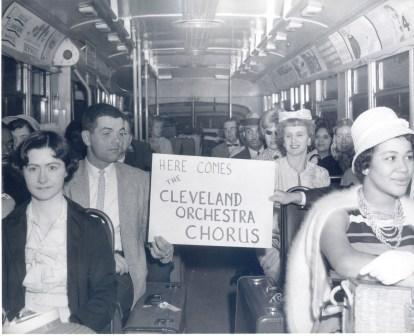
The men and women of the Cleveland Orchestra Chorus get ready to hit the road.
(This doesn't have much to do with this concert, but it's an awesome photograph!)
© 1962 The Cleveland Orchestra/Cleveland Orchestra Chorus.
In the course of Franz Welser-Möst's decade at the helm of the Cleveland Orchestra, he has pioneered the concept of residencies in other cities as a means of promoting the orchestra and raising much-needed revenues by having concerts outside of Severance Hall.

On Sunday afternoon, the orchestra offered the same program it will take to Vienna's historic Musikverein as part of a two-night residency in the capital of the conductor's home country. The program pairs Richard Strauss' mournful Metamorphosen with the Great Mass in c minor, a lesser-known, unfinished work by Wolfgang Amadeus Mozart.

 Metamorphosen is one of Richard Strauss' last works, a funereal piece written in 1944 for 23 solo strings. In the course of a 25-minute-span, Strauss looks back on the glories of Western music and realizes he is standing at the end of his art form. The music quotes and references 200 years of German music, from Mozart and Beethoven to Strauss himself. The subject matter: the death of German musical culture under the Nazi boot, and the destruction of famous music venues in Dresden and Vienna under the Allied assault in World War II.

Despite the serious nature of the subject matter, Metamorphosen ebbs and flows with Strauss' characteristic, long melodic lines. The Cleveland string players captured the autumnal glow that illuminates the score, the blend of small ensembles and solo melodic lines that weave together to create a dense, and ultimately soothing blanket of sound.

Part of the legend surrounding Mozart includes his Requiem, unfinished at the time of his death. No such drama surrounds the Great Mass--Mozart simply didn't finish the piece. But in this performing edition, assembled by musicologist H. Robbins Landon, Mr. Welser-Möst made a good case for this lesser-known work.

 He was reinforced by an able cast of singers, led by sopranos Malin Hartelius and Julia Lezhneva--the latter heard recently at this summer's Mostly Mozart Festival. Joined by tenor Martin MutterRutzner and bass Ruben Drole. the singers delivered the sacred text with warmth and devotion to Mozart's melodic lines.

The glory of this performance was the Cleveland Orchestra Chorus, under the direction of Robert Porco. The choristers made each movement of the Grosse Messe a powerful declaration of faith, not just in the religious subject matter but in the power of Mozart's music. Even in its torso state, this Mass is a raw gem. Here, it was polished with smooth precision under Mr. Welser-Möst's expert direction.

Sunday, September 11, 2011

When Mozart Meets Fantasy Football

Yeah. You read that correctly.
Former Chicago Bears QB Kyle Orton, after meeting a large dragon.
Uniform and image © National Football League/ Chicago Bears.
So I'm watching the ESPN pre-game show for Week One of the 2011 NFL season. In between the hand gestures, football analysis and season-opening hype, I catch the following commercial:

Commercial for NFL.com © 2011 National Football League

That's former NFL coaches Steve Mariucci and Dennis Green, having a little subterranean fantasy football draft. The soundtrack: the opening scene of Mozart's Die Zauberflöte. For those of you who don't play fantasy football, Coach Mariucci selected Arizona Cardinals wide receiver Larry Fitzgerald to his team in the second round, a smart move.


The operatic excerpt features Mozart's young hero, Tamino. As the curtain rises, he enters, like some NFL quarterbacks, literally running for his life. The pursuer: not James Harrison or Ray Lewis but a big ol' dragon, which (for no apparent reason) is patrolling the banks of the river Nile in Egypt. Of course, you could imagine your favorite NFL defenders in place of the beast.

The prince faints, rather than be sacked for a loss. The monster is defeated by the Three Ladies of the Queen of the Night. We're not sure whether the three spear-carrying warrior-women represent the other team's chop-blocking offensive line, or the on-field officials that pull the dragon off the prince with a well-placed  yellow flag.

By the way, the commercial features the 1954 recording of Mozart's Die Zauberflöte available as a bootleg from the European label Myto. The set features Rudolf Schock as Tamino, Theresa Stich-Randall, Josef Griendl and Hans Hotter. The perpetually underrated Joseph Keilberth conducts.

Monday, August 29, 2011

Concert Review: An Early Exit in a Hurricane's Path

Mostly Mozart ends with unfinished music.
The Mostly Mozart Festival Orchestra, led by conductor Louis Langrée.
Image courtesy Lincoln Center © 2010 Mostly Mozart/Lincoln Center.
The 2011 Mostly Mozart festival came to a premature end on Friday night. Due to the imminent arrival of Hurricane Irene this weekend, Saturday night's concert was cancelled. With the audiences from both nights combined at the last minute, a capacity crowd was on hand to hear the Mostly Mozart Festival Orchestra offer a program of Stravinsky, Schubert, and Mozart's last work, the Requiem. Louis Langrée conducted.

The packed house meant some unusual seating arrangements. My seat was on the stage, in one of the jury-box like arrangements that recall Wieland Wagner's 1961 production of Tannhäuser. Also, I could sight-read the double bass part over the musicians' shoulders during the Schubert "Unfinished" Symphony. For the Mozart Requiem I divided my attention between the choristers, the sheet music and conductor Louis Lortie.

The concert opened with Stravinsky's In Memoriam Dylan Thomas, a dirge-like setting of the poet's "Do Not Go Gently Into That Good Night." The work has an unusual chamber orchestration: four string players and four trombones. Tenor Joseph Kaisersang the complex vocal part (which belongs to Stravinsky's difficult, late style with fervent emotion and beauty of tone. As Hurricane Irene whirled slowly toward the city, the poem seemed an appropriate message for the assembled audience.

Schubert's Unfinished Symphony (his Eighth) remains a giant question mark in his career. Unlike Bruckner and Mahler (who also left incomplete symphonies) Schubert lived for several years after stopping work on this piece after only two movements. Those movements were played with sure beauty by the Festival Orchestra, coloring in the complicated woodwind parts and the rolling, eloquent main theme in the 'cellos. The second movement loped with easy grace, and the horns played with firm, ringing tone.

A great deal of myth swirls around Mozart's Requiem. Here's the truth: the work was commissioned by an eccentric nobleman: Count Franz Walsegg-Stupach who planned to pass it off as his own work.Mozart died having only completed the first movement. But he wrote out vocal sketches for the work up to the beginning of the Lacrimosa, the final section of the Dies Irae.. His widow Constanze hired composer Franz Xavier Süssmayer to finish the piece and meet the commission.

Unlike later Requiem masses by Berlioz and Verdi, Mozart eschews clock-you-on-the-head orchestration, relying on the power of the human voice to convey the message of the Latin text. This is most apparent in the Tuba mirum, where the Last Trumpet is announced by a ringing bass voice with brass accompaniment. Morris Robinson delivered this unearthly message with power and warmth. Soprano Julia Lezhneva, in her American debut, was impressive in the work's lyric passages, as was mezzo Kelley O'Connor.

The second half of the Requiem was written by Süssmayer. Strong choral contributions from the Concert Chorale of New York were prominent here, particularly in the Sanctus and Agnus Dei. The final passages of the work sound forth in a triumphal shout, quoting the very beginning of the mass. This might not be the most imaginative ending, but one can only imagine how Mozart would have done it.

Wednesday, August 24, 2011

Concert Review: Youths Gone Wild

French pianist, conductor debut at Mostly Mozart.
Debut artist: French pianist Bertrand Chamayou.
Photo by Laura Vaconi for Naïve Classics
One of the joys of attending Mostly Mozart concerts is the opportunity to hear new talent.  Tuesday night's Mostly Mozart concert featured French pianist Bertrand Chamayou in his U.S. debut and conductor Jérémie Rhor, leading his first New York concert. 

Mr. Chamayou opened the evening with a lovely prelude recital that paired Haydn's Variations in f minor with Mendelssohn's Varitions sérieuses. The elegant Haydn spooled forth with a liquid ease. Mr. Chamayou played softly before the small audience, using legato and relaxed fingers to convey the composer's warmth and good humor. The Mendelssohn is made of sterner stuff, but Mr. Chamayou used the same approach. By placing emphasis on Mendelssohn's melodic invention he made a good case for including more music by this composer in future Mostly Mozart programs.

The concert opened with Haydn's Symphony No. 21. Nicknamed "The Philosopher" for its stately, considered opening movement, this is an atypical example of Haydn in his Esterhazy period. The work's unique sound comes from the pairing of two English horns (instead of the usual oboes) with two French horns in the orchestra, creating a dark atmosphere. The effect (and the general tone of the movement) was borrowed by Mozart for Act II of Die Zauberflöte: specifically the scene with the Two Men in Armor.

The Haydn was played with crisp efficiency. But the same cannot be said for the Mozart piano concerto (No. 12 in A Major) in  that followed. Mr. Rhor jumped the gun, leading off the first movement before Mr. Chamayou was ready to play. This did damage the overall performance, as one felt that the young pianist was working hard to play catch-up to his countryman. Mr. Chamayou played the solo parts with a fleet, elegant touch with Mozart's own cadenzas, an early example of the composer's brilliant writing for that instrument.

Mozart's Symphony No. 29 in Symphony stands at the beginning of the composer's mature period, showing the way forward to the great symphonies that came in the last years of his life. Mr. Rhor conducted the work with vigor, charging into the elegant main theme with enthusiasm, if little grace.

The challenging horn parts of the first movement that provided thrills. But the two horn players had intonation problems in the finale, making ugly noises when graceful playing was needed. Mr. Rhor again seemed eager, racing through the staccato passages of the minuet and the tricky finale.

Thursday, August 11, 2011

Concert Review: Between Sacred Songs, a Secular Symphony

At Mostly Mozart, Ivan Fischer puts the Jupiter in context.
Ivan Fischer demonstrates a new baton technique.
Photo courtesy the Orchestra of the Age of Enlightenment
Tuesday night at Mostly Mozart featured an innovative program of that composer's music under the baton of Hungarian maestro Iván Fischer. At its heart stood Mozart's 41st and final symphony, the Jupiter.

This is one of Mozart's most well-known and popular symphonies. But instead of using its grand pre-Romantic gestures to ring down the curtain on the evening, Mr. Fischer placed it second, between the choral motet Ave verum corpus and the Vesperae solennes de confessore, a setting of five Psalms and the Magnificat written at the end of Mozart's Salzburg years.

Mr. Fischer led this concert with the same technique as in the excellent Don Giovanni performances of last week. He balanced the orchestral forces, driving them forward while allowing the melodies room to blossom and breathe. Ave verum corpus was sung with delicacy and simple faith. It led into a brief organ melody from Kent Tritle. As the chorus members filed out (as if they were leaving church,) Mr. Fischer lauched into Jupiter.


The opening movement was played with jubilance and strength. Mr. Fischer created a narrative flow that led into the Andante with its lyric subject. The rhythms of the minuet, were firm and precise. The complex finale, with its fugal sections and difficult wind parts was taken a mite slower than some conductors, allowing fresh details to emerge with the color and vibrancy of a restored painting.

It was refreshing to hear the instrumental Jupiter contrasted with liturgical music. This illuminated the influences that went into writing this great work. (Not everything in this boisterous symphony is sacred however--the last movement alludes to a certain vulgar choral round, also written by Mozart. It's K. 231. Look it up.)

Whether working with his own Budapest Festival Orchestra or the Mostly Mozart band, Mr. Fischer has proven himself able to make listeners hear familiar music with new ears. But he also made the less familiar Vesperae shine forth with clarity and beauty. The opening "Dixit Dominus" was a rock-like statement of faith, with deep power and commitment. The fourth movement, "Laudate pueri" had a Bach-like precision. Soprano Lucy Crowe soared through "Laudate Dominum", a gorgeous aria worthy of one of Mozart's operas. The final Magnificat was played with exultation, a gorgeous affirmation of Mozart's genius and the abilities of this remarkable conductor.

Saturday, August 6, 2011

Concert Review: Mozart Goes Last, But Comes First

Mostly Mozart, with Joshua Bell at Avery Fisher Hall.
Violinist Joshua Bell, and four-stringed friend. Photo courtesy Lincoln Center.
Friday night's Mostly Mozart concert at Avery Fisher Hall featured a conservative, crowd-pleasing program of Mozart, Bruch and Bach under the baton of fiery young Spanish conductor Pablo Heras-Casado. Mr. Heras-Casado was joined by soloist Joshua Bell, playing Bruch's First Violin Concerto.

Let me preface the review proper by stating that this was the first Mostly Mozart concert that I've seen at Avery Fisher Hall in over a decade. So it was news to me that in 2005, the Festival installed an acoustic modification, moving the orchestra to an extended stage closer to the center of the room. Extra lighting and seats were added to accomodate the change, shortening the sloped orchestra seating. Seating risers were added behind the ensemble, and to the sides.


The changes also include a new overhead lighting rig, with sonic baffles designed to make the sound bloom in the Hall's problematic acoustic. Although I did not detect any immediate sonic improvement, the packed audience seemed eager to have the musicians closer and at their center for the performance.

The concert opened with Bach's Orchestral Suite No. 4, billed here on the program under its French title: Overture No. 4. The Mostly Mozart musicians played this work standing up, in the Italian style that is increasingly fashionable for 18th century music. But the first movement was problematic, with muddled entrances and blurry chords when Bach's notes should sound sharp-creased. The later parts of the Suite were better, and the orchestra recovered form with a strong Réjouissance..

Bruch wrote three concertos for the violin, but the First is the one that most violinists master and make a centerpiece of their touring repertory. Mr. Bell played an exciting, crowd-pleasing performance, soaring through the lyric runs and arpeggios and duelling playfully with the principal strings of the Festival Orchestra. In the last movement, he led the folk dance (which progresses from friendly to frenetic) with skilful string technique and exciting cadenzas.

The best music-making of the evening came with the Mozart Symphony No. 40 in g minor. This is Mozart's penultimate symphony. It is among his most famous works, and looks forward to the future of music in the 19th century. The last movement has two themes that are quoted by Beethoven in the Eroica Symphony.

Here, it was led in a potent, authoritative performance by Mr. Heras-Casado. Working without a baton, the young conductor seemed to ride on Mozart's great waves of sound. His conducting brought out the subtle secondary themes of the first movement, and the elegance of the minuet. The sudden starts and stops of the finale seemed to have extra force as he lifted his arms, bringing them crashing down to drive the orchestra forward.

Friday, August 5, 2011

DVD Review: The Old Switcheroo

Così fan tutte from La Scala.
Dolores Ziegler (left) and Daniela Dessì in a frame-grab from Così fan tutte.
Image © 1998 OpusArte/Teatro alla Scala.
As Mostly Mozart opens this week, it's time to blow the dust off this underrated 1998 film of Così fan tutte from La Scala. Made during Riccardo Muti's tenure as music director, this fizzy performance is notable for an excellent ensemble cast and the pert Despina of Adelina Scarabelli.

Despina is a complex role, the maid-servant who sets Da Ponte's whirling plot in motion. She must be trusted confidante, smart servant, and immediately the most appealing character to the audience. As the female equivalent of Figaro in the earlier collaboration between Mozart and da Ponte, Despina is a challenging part for even the starriest singer.

With her low-lying, rapid-fire soprano, Ms. Scarabelli meets all of the requirements. Her "Una donna a quindici anni" is marvelously delivered, earning deserved "bravo" cries from the Milan audience. But she is also strong when disguised as the mesmerist and the notary in the finales of each act, delivering the dialogue with good comic acting and a minimum of irritating vocal effect.

She is surrounded by an excellent cast. Daniela Dessì and Delores Ziegler are a compelling pair as Fiordiligi and Dorabella, generating onstage chemistry with both of their leading men. A regular singer at the house during the Muti years, Ms. Dessì leads off "A ugarda della sorella" with sweet, carefully formed tone. She is well-matched with Ms. Ziegler, and the two voices blend well.

Alessandro Corbelli and Josef Kundlak are the two fellas who dress up as Albanians and go through all sorts of plot contrivances in order to see if their partners are willing to trade. The tenor and baritone (respectively) make the most of Da Ponte's cynical humor. Mr. Corbelli is especially compelling in the later acts, as the would-be girlfriend-swappers discover that they may not want to switch back. Claudio Desderi plays it fairly straight as Don Alonso, the old gentlemen whose bet with these two cads sets the story in motion.

This production was shot in Mr. Muti's salad days, when the raven-haired conductor ruled Scala with an iron fist and a velvet baton. Michael Hampe presents a traditional production in authentic-looking period costume, keeping the opera in its correct geographical setting. In today's age of regietheater run wild, this simple approach makes this DVD refreshing. The only device is a blue curtain which creates a theater-within-a-theater. But even this serves a dramatic purpose, allowing for quick changes and theatrical asides to the audience from Despina and Don Alonso.

Riccardo Muti is an underrated Mozart conductor whose recordings were drowned in the flood of major label releases at the end of the 20th century. Here, he leads Mozart's music in a crisp, even style, driving the action forward and setting an expert pace for the singers. It's a little fast when it has to be, but the big lyric moments in this extraordinary score are allowed to blossom fully.

One complaint. In the finale, the maestro makes a ghostly appearance over the stage, burned in digitally so the viewer can watch both maestro and performers. But the effect distracts mightily from the fine staging presented here, coming as it does at the most inopportune moments.

Tuesday, August 2, 2011

Guess Who's Coming to Dinner?

The Strange Case of Don Giovanni.

"A work without blemish, of uninterrupted perfection."
--Søren Kierkegaard, on Don Giovanni
Il dissoluto punito. Act II of Don Giovanni. Artist unknown.
For many writers, musicians and composers of the 19th century, Mozart's opera Don Giovanni stood at the very top of the operatic pyramid. The Don was unique: a rollocking comedy with a grand, tragic ending, a love story with multiple partners where love is never requited, and a wellspring of inspiration for other composers, from Liszt and Wagner in the 19th century to Stravinsky and Richard Strauss in the 20th.

From the thunderous chords that open the overture to the amazing parade of arias, duets and ensembles that constitute the bulk of the score, Don Giovanni has never failed to draw an audience. Listeners get satisfaction from the familiar numbers, sung with melting seduction in the very best performances.

Don Giovanni has survived in the repertory better than any other Mozart opera, with the possible exception of the Marriage of Figaro. It requires two star baritones for the Don and Leporello. Some singers switch off in the roles. (Bryn Terfel recorded both parts, as well as Masetto early in his career.) A good Don must be able to run the gamut from sensual ardor to outright defiance. A great Don must be the bad guy who audiences are willing to root against, yet want to visit backstage afterwards.

Leporello is also complex, a comic foil who is the grandfather of Verdi's Rigoletto. His character moves to the fore in the second act, when he is unable (despite his best efforts) to keep his master from bringing about his own doom. He must bring off the 'Catalogue' song with humor and aplomb, and display convincing terror when the famous stone guest comes to dinner.  The touching line: "Ah padron, siam tutti morti" (delivered while hiding under the table is a marvelous moment of despair: the everyman's perspective on the supernatural events in the banquet scene.

"The three finest things God ever made are the sea, Hamlet and Don Giovanni."
--Gustave Flaubert

The Commendatore is not a very long part, but he should be a "black" bass with an authoritative physical presence and a voice that can put the fear of God into an opera house packed with atheists. Donna Anna is a tragic heroine of Greek proportions. Her scenes with Don Ottavio provide contrast and the soprano must be involved to bring them off. Also, poor, faithful Don Ottavio, who had his best aria removed from the opera at the premiere, must try hard not to be a nebbish although his character certainly is.

Donna Elvira is the mezzo role. She is a jilted ex- of the Don's who is still interested in the old rascal. Her plot function is to show up and ruin whatever seduction the Don may be attempting and then pine for him to take her up again. Masetto should be a Leporello-in-training with a burly presence and the right burst of anger. And his feckless Zerlina, who gets two of the best numbers, (she sings 'La ci darem la mano' with the Don and the great 'Batti, batti O Masetto') should be a soprano with a light comic grace who can feign innocence.

"Don Giovanni, thanks to the unfading and inexhaustible strength of Mozart's inspiration, has aged only in a merely technical respect."--Piotr Ilyich Tchaikovsky


To make all these elements work, the opera requires a conductor who knows how to balance Mozart's classical structures with the budding seeds of early Romanticism that are buried in the rich soil of the score. The ideal Don Giovanni conductor will make the heaven-rending chords resound in the statue scene, but keeep the rest of the Don's doings moving along at a steady clip.

He should instruct the woodwinds to accompany Leporello with sardonic humor, and the Don's macking on the ladies with grace and charm. The Donna Anna scenes should be conducted as pure opera seria, letting the singers' voices carry the weight of Mozart's emotional message. In short, it doesn't matter if this opera is fast (Gardiner, Östman) or slow (Furtwängler, Klemperer). In competent hands, the score of Don Giovanni always makes an impact.

Then there's that ending, where the good Don gets dragged off to the abyss by his chthonian dinner guest recals the medieval morality plays where the sinner is punished before the audience. Don Giovanni is the great morality play of the Age of Reason. Mozart and librettist Lorenzo da Ponte originally ended the opera with the dinner scene, adding an appendix ensemble (complete with a moral admonishment) to the work after the opera's premiere.

Trending on Superconductor

Translate

Share My Blog!

Share |

Critical Thinking in the Cheap Seats