Support independent arts journalism by joining our Patreon! Currently $5/month.

About Superconductor

Our motto: "Critical thinking in the cheap seats." Unbiased, honest classical music and opera opinions, occasional obituaries and classical news reporting, since 2007. All written content © 2019 by Paul J. Pelkonen. For more about Superconductor, visit this link. For advertising rates, click this link. Follow us on Facebook.
Showing posts with label Il Barbiere di Siviglia. Show all posts

Friday, March 3, 2017

Opera Review: A Close Shave

Rossini's Barbiere cuts it up in Kanazawa.
by Paul J. Pelkonen
This store is in Minnesota but Rossini's Barbiere was open for business in Kanazawa, Japan last month.
Gioachino Rossini’s ‘Il Barbiere di Siviglia’ remains one of the most popular operas in the western canon, with a two hundred year performing tradition. On Sunday, February 20, that tradition came to the west coast of Japan, as the Orchestra Ensemble Kanazawa offered a semi staged, concert version of the Italian masterpiece, under the baton of Marc Minkowski. The performance, in the OEK's gorgeous, modern mid-sized concert hall, featured columnar LED titles (in Japanese) on either side of the acting area.

Thursday, January 19, 2017

Opera Review: One Last Chance at Rosina

Javier Camarena closes the book on Il Barbiere di Siviglia.
by Paul J. Pelkonen
The cast of Il barbiere di Siviglia clown it up in Act II of Rossini's masterpiece.
Photo by Marty Sohl © 2017 The Metropolitan Opera.
There's a reason some operas never go away. Take Rossini's Il Barbiere di Siviglia, which   is on the verge of celebrating 201 in the standard repertory this year. This month, the Metropolitan Opera's revival boasts an extraordinary cast, with Peter Maffei in the title role, soprano Pretty Yende as Rosina and tenor Javier Camarena, singing his final run as Count Almaviva before moving on to other repertory. All three stars shone at Wednesday night's performance, occupying their roles seamlessly in the company's flimsy but entertaining production by director Bartlett Sher.

Monday, January 2, 2017

Metropolitan Opera Preview: Il Barbiere di Siviglia

Rossini's comic brilliance lights up the Met stage...again.
by Paul J. Pelkonen
Figaro (on cart) makes his grand entrance in Act I of Il Barbiere di Siviglia.
Photo © 2016 The Metropolitan Opera.
The Met brings joy and warmth into the middle of winter with this January 2017 revival of Il Barbiere di Siviglia. This version of the opera is sung in Italian and presented without cuts.

Tuesday, December 15, 2015

Metropolitan Opera Preview: The Barber of Seville

The Met revives the Barber in "family-friendly" English.
by Paul J. Pelkonen
She's a vipera: Isabel Leonard returns as Rosina in The Barber of Seville.
Photo by Ken Howard © 2015 The Metropolitan Opera.
Rossini repackaged for the kids: with the most famous comedy in opera trimmed down to a lean 90 minutes. This is the Met's special holiday presentation of Gioachino Rossini's Barber of Seville with the radiant Isabel Leonard returning to the role of Rosina.

Thursday, June 11, 2015

Opera Review: The First Close Shave

On Site Opera presents Paisiello's Barbiere di Siviglia.
by Paul J. Pelkonen
Figaro (Andrew Wilkowske) and Rosina (Monica Yunus) share a moment
in Giovanni Paisiello's Il Barbiere di Siviglia.
Photo by Rebecca Fay © 2015 On Site Opera.
Giaochino Rossini's Il Barbiere di Siviglia celebrates its bicentennial birthday next year, having trimmed beards onstage for two centuries. But when it premiered in 1816, Rossini's opera eclipsed a 1782 opera on the same subject by composer Giovanni Paisiello. On Tuesday night at the Fabbri Mansion, New York's own On Site Opera  kicked off its three year Figaro Project with an entertaining and vital performance of Paisiello's Barbiere. The Project continues in 2016 and 2017 with performances of two more operas based on lesser-known adaptations of the Beaumarchais plays: Marcos Portugal's The Marriage of Figaro and Darius Milhaud's version of The Guilty Mother.

Sunday, August 31, 2014

Metropolitan Opera Preview: Il Barbiere di Siviglia

Figaro's barber shop is back in business.
by Paul J. Pelkonen
Tenor Lawrence Brownlee has an issue with the wig department.
Photo from Il Barbiere di Siviglia by Ken Howard © 2007 The Metropolitan Opera.
Although it was a complete and utter fiasco on its opening night in 1816, Rossini's Il Barbiere di Siviglia remains the heavyweight champ among operatic comedies. The adventures of Figaro and company have held the stage in one form or another for 198 years, and remains the composer's most famous work.

Friday, May 2, 2014

Doctor Fartolo...Doctor Fartolo

Or...life imitates baseball at the opera...or something.
by Paul J. Pelkonen
It's a good thing he doesn't own a home in Seville: Bartolo Colón
Photo © 2014 New York Mets Baseball Club.
Property of Major League Baseball.
Those who have seen Giaochino Rossini's opera The Barber of Seville know (and probably love) the finale of Act I where  Count Almaviva, pretending to be a drunk (and very aggressive) soldier attempts to secure soldier's lodgings in the home of Doctor Bartolo, the cranky old attorney who is the villain of the show. In fact it is just another of the Count's ploys to woo Rosina, the young ingenue who is the focus of both men's efforts to win her hand in marriage.

Wednesday, February 29, 2012

Happy Birthday, Maestro Rossini!

He's looking pretty good for 53.
by Paul Pelkonen.
Today is the 53rd birthday of Giacchino Rossini, composer of Il Barbiere di Siviglia.

And no, that's not a typo. Rossini was born in 1792, and is one of the most famous leap year babies in history. Like that joke in the Barber where Figaro blunders into the china closet, Rossini never gets old. (Not counting the leaps, he would be 220 today.)

Rossini had an astonishing compositional career, writing 39 operas. His output started with Il cambiale de Matrimonio (performed this winter at Juilliard) and climaxed with the four-act French grand opera Guillaume Tell. But after saving the Swiss from their Austrian oppressors, the great Rossini put down his pen. Singing styles had changed, and the delicate bel canto tenors had given way to the heroic style, and Rossini did not wish to write for those larger, louder voices.

To celebrate, here's the finale from Act I of Il Barbiere di Siviglia, filmed at the Met in the late 1980s. Starring Rockwell Blake, Kathleen Battle, Enzo Dara, Leo Nucci and a young Ferruccio Furlanetto as Don Basilio. Ralf Wiekert conducts.


Contact the author: E-mail Superconductor editor Paul Pelkonen

Wednesday, October 5, 2011

Opera Review: New Blood, and a Rubber Chicken

Il Barbiere di Siviglia returns to the Met.
Isabel Leonard (left) looks on as tenor Javier Camarena
sings "Cessa di piu' resistere" in Il Barbiere di Siviglia.
Photo by Ken Howard © 2011 The Metropolitan Opera.

Bartlett Sher's madcap take on Rossini's Barber of Seville has been around for five years now. This year's revival (seen Wednesday night at the Met) proves that this Looney Tunes-inspired staging continues to give audiences the chance to hear great voices make an impression in this beloved comedy.

Both Juan Diego Flórez and Diana Damrau cut their teeth as Count Almaviva and Rosina in 2006. Elina Garanca (2008) and Joyce DiDonato (2009) have also made an impression in the latter part. This year's revival offers the same opportuny to new singers: bel canto tenor Javier Camarena as Almaviva and mezzo-soprano Isabel Leonard as Rosina.

Ms. Leonard made the stronger impression. Her throaty mezzo plunged the depths in "Una voce poco fa" and soared over the clattering ensemble in the finale of the first act. But what really stood out here was the Lesson Scene. Ms. Leonard took her pretty little aria (an afterthought in most stagings) and soared with it, adding extensive fioratura to stunning effect.

As Count Almaviva, the scheming, costume-changing nobleman whose efforts to woo Rosina drive the opera's plot, Mr. Camarena made a good entrance. He tossed off "Ecco ridente" with ease, and engaged in some good physical comic business with his small army of backup musicians, even throwing a chair at one point. He was excellent as the drunken soldier, and a convincing, funny Don Alonso. However, this promising Mexican tenor fell into a trap at the opera's end.

Ever since this production premiered with Mr. Flórez in the role of Almaviva, audiences have looked forward to hearing the difficult "Cessa di piu' resistere" right before the finale. But this difficult, florid aria proved to be too much of a challenge for Mr. Camarena. His instrument sounded awkward and stiff at points, the notes coming out on pitch but sounding compressed and slightly pinched. He was better in the final section ("E tu, infelice vittima") and managed a strong finish.

Peter Mattei returned as Figaro. Having created the role for this production, he showed great familiarity ease with the part. His breezy "Largo al Factotum" (opening from the top of his rolling barber-shop) got the opera moving and his physical, comic acting with Mr. Camarena added zest to "Al idea di quell' metallo." Paata Burchuladze was a funny, familiar presence as Don Basilio. Maurizio Muraro was a mediocre Bartolo, engaging in mugging when he should be singing this tricky comic villain.

Mr. Sher's production remains sturdy, with its slamming doors, dropping anvils and offstage explosions. (This year's kitchen explosion included a rubber chicken, flung across the stage at the harpsichord.) Mute clown Rob Besserer (as Ambrogio) remains a key component of the goings-on, although he broke silence to mutter "basta" at Mr. Camarena and Mr. Muraro during "Pace, gioia." Maurizio Benini's conducting was serviceable, but could have been tighter.

Wednesday, August 24, 2011

Finding Maria Callas...in Brooklyn

An operatic treasure in Park Slope.
Sweet, innocent, and a viper: Maria Callas as Rosina.
Photo © 1958 EMI Classics
Last Saturday afternoon, following brunch, I found myself at Brooklyn Record and Tape, an old, somewhat beaten-up, but interesting record store in Park Slope, Brooklyn. Tony's shop is a living throwback, a record store crammed with vinyl, CDs, cassettes and VHS. He may even have 8-tracks--I've never asked.

And there, on top of a wooden CD crate of hip-hop CDs, it sat. The 1997 EMI reissue (on two CDs) of the 1958 La Scala recording of Il Barbiere di Siviglia. I looked at the prices for the small classical CD collection. $4 a disc. $8 for two. I bought it immediately.

Taking my new purchase home on the B63 bus, I wanted to yell and shout, to exult that I had scored Maria Callas in Park Slope. But nobody would have understood what that meant, and it was better to just take my new-found treasure home quietly.

Needless to say, I've been listening to the Callas Barbiere steadily for the last two days. It is a brisk, professional affair, graced with the presence of La Divina as the ingenious Rosina. Ms. Callas accents the viperish nature and worldly wisdom of Dr. Bartolo's young ward. Her "Una voce poco fa" is lovely, complete with a hair-raising high note in the final bars.

"Dunque Io Sono", Rosina's duet with Figaro, is the highlight of this first act, matching Maria with her longtime onstage sparring partner Tito Gobbi. Mr. Gobbi is a great comic barber, brash and arrogant during "Largo al factotum." He and Luigi Alva soar together in "All' idea di quell metallo" and "Numero quindice. It feels like the conductor Alcero Galliera, is hurrying to keep up with his singers.


This recording features Luigi Alva, early in the role that became the trademark of his career. The bel canto tenor is in good comic form, displaying the comic chops needed for Almaviva's disguised entries into Dr. Bartolo's household. "Pace gioia" elicits real laughter, as Alva puts on an irritating, nasal voice and an air of piety. Fritz Ollendorf is a harsh-toned Bartolo, but surmounts the tongue-tripping challenges of "Un dottor della mia sorta", an aria so difficult that it was left out of the opera for almost a century.

Although this is a studio recording, the nature of Barbiere allows the listener to hear Callas working in ensembles, particularly the big sextet and chorus that rings down the curtain on Act I. She uses the lower range of her instrument to create a mezzo Rosina, as the composer originally intended. And yes, there is a special thrill when her distinctive voice cuts through the texture of the other singers. How often to you get to hear a goddess do comedy?

Friday, March 5, 2010

Opera Review: Orange Crush

Il Barbiere di Siviglia at the Met.
by Paul Pelkonen
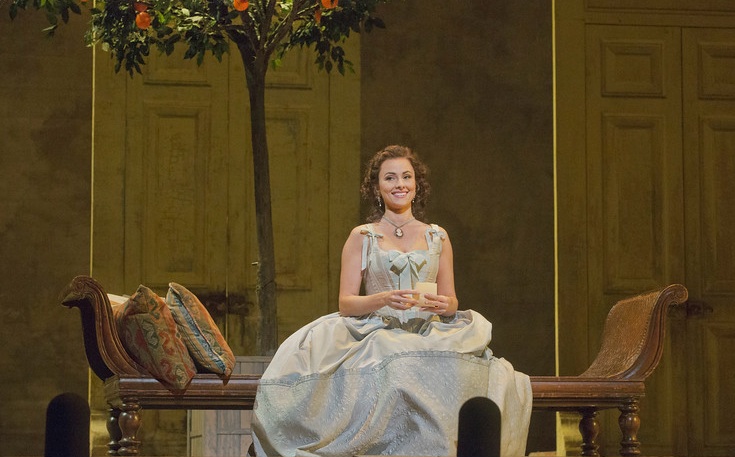
The lovers make their escape in Act II of the Barber.Photo by Andrea Kremperer
© 2009 Baden-Baden Festspiel/The Metropolitan Opera.
The Met's final 2010 performance of Il Barbiere di Siviglia was an occasion for sparkling vocal performances and robust comedy. In this kinetic staging by Bartlett Sher, the opera is re-imagined as Dr. Bartolo's fevered nightmare. The curtain rises during the overture, with Rosina's guardian asleep on the stage, accompanied by the mute Ambrogio (played to good slapstick effect by dancer Rob Besserer). Doors shift around mysteriously, explosions go off for no reason, and a gigantic anvil descends from the rafters, to destructive, if comic effect.

Trending on Superconductor

Translate

Share My Blog!

Share |

Critical Thinking in the Cheap Seats