Support independent arts journalism by joining our Patreon! Currently $5/month.

About Superconductor

Our motto: "Critical thinking in the cheap seats." Unbiased, honest classical music and opera opinions, occasional obituaries and classical news reporting, since 2007. All written content © 2019 by Paul J. Pelkonen. For more about Superconductor, visit this link. For advertising rates, click this link. Follow us on Facebook.
Showing posts with label classical. Show all posts

Sunday, September 30, 2018

Concert Review: Every Tuba Tells a Story

Jaap van Zweden conducts the Bruckner Eighth.
by Paul J. Pelkonen
Conductor Jaap van Zweden shows off the latest in controversial baton grips.
Photo by Chris Lee © 2017 for the New York Philharmonic.
When a new music director takes the helm of a major symphony orchestra, there are certain works that will be tests of his mettle and ability. These works provide the scribes that scribble accounts of their performances some clues as to how the multi-year multi-million dollar relationship between maestro and ensemble will play out. New York's critics got some useful information on that front this week, as Jaap van Zweden led the New York Philharmonic in Anton Bruckner's Symphony No. 8 in C minor. This is a big one: a ninety-minute work that stands as that Austrian composer's final completed composition.

Wednesday, August 9, 2017

Concert Review: Rolling Doubles

Joshua Bell and Steven Isserlis at Mostly Mozart.
Violinist Joshua Bell and cellist Steven Isserlis team up again at Mostly Mozart.
Photo courtesy Linfoln Center/Mostly Mozart.
Tuesday night's concert at Mostly Mozart, conducted by Andrew Mainze and featuring an all-star tandem of soloists featured a distinct absence of music by Mozart. Rather, the Festival Orchestra turned its talents to Brahms, Bach and Mendelssohn. The program was well chosen, bringing together three unusual and infrequently layer pieces together. Credit for this must go to the scholarly Mr. Mainze, whose cool-headed, cerebral approach to music-making has four him at the helm of the Academy of Ancient Music and the English Concert.

Friday, August 4, 2017

There is Water Under Ground

The importance of Remaining in Light.
by Paul J. Pelkonen
The Benin-born singer Angelique Kidjo performed Remain in Light
by the Talking Heads at Lincoln Center on Wednesday night.
The other night, as my concert companion and I walked out of Mostly Mozart, we started crossing Lincoln Center Plaza southward. As we approached the bandshell, we heard the extraordinary sound of...the Talking Heads. Now, I don't usually go to another concert right on top of the first one, and I'm reluctant to be in a crowd when processing a show. However, this was Angelique Kidjo and her band, and one of the events this summer that I had wanted to see (and had forgotten about) a complete performance of the classic 1980 Talking Heads album, Remain in Light presented by Lincoln Center Out of Doors.

Wednesday, June 22, 2016

Concert Review: The Individual Against the System

Yefim Bronfman closes his Prokofiev cycle at Zankel Hall.
by Paul J. Pelkonen
The hands. Yefim Bronfman.
Portrait photo by Dario Acosta from the artist's website.
The classical music schedule is a big, hectic thing with artists girdling the globe in their efforts to meet each year's long slate of concerts and professional obligations. Sometimes, though things get re-scheduled and pushed to the very end of the season. That's what happened Saturday at Zankel Hall, when pianist Yefim Bronfman finally played the much-delayed final concert in his ambitious concert project exploring Serge Prokofiev's set of nine sonatas for solo piano.

Monday, December 21, 2015

Concert Review: Keeping the Faith

The Philharmonic resurrects Handel's Messiah.
by Paul J. Pelkonen
Jane Glover.
Photo by Ken Howard for Chicago Music of the Baroque.
Ever since the twelve-year music directorship of the late Kurt Masur, the oratorio has resumed pride of place at the New York Philharmonic. That was confirmed last week when Jane Glover, the eminent British musicologist and conductor known to New Yorkers from her opera performances at Juilliard, made her debut with the orchestra conducting this year's run of Handel's Messiah.

Wednesday, December 16, 2015

Concert Review: The Power of the Collective

The Manhattan Chamber Players' Holiday Concert.
by Paul J. Pelkonen
Members of the Manhattan Chamber Players (with artistic director Luke Fleming
in the red tie) looking for a place to play. Photo by Sophie Zhai © 2015 Manhattan Chamber Players.

The arrival of a new chamber music ensemble in New York is an occasion for celebration, for virtuosity and for its members to show the concert-going music-loving public what they can do. That opportunity was presented on Tuesday night when the Manhattan Chamber Players gave their second concert...ever in the Recital Hall at Baruch College. (Their first was last week at Le Poisson Rouge.) A collective that formed earlier this year, the MCP is formed from members of other still extant ensembles: a large circle of friends and colleagues who convene for the purposes of playing pure music.


Tuesday, November 3, 2015

Concert Review: The 19-ton Orchestra

Christine Brewer and Paul Jacobs at Alice Tully Hall.
by Paul J. Pelkonen
In recital: soprano Christine Brewer sang at Alice Tully Hall on Sunday.
Photo courtesy Lincoln Center.
Of the keyboard instruments, the pipe organ is the one that can approximate not only the sound of a full symphony orchestra, but the unique tone of the human voice as well. On Sunday afternoon, dramatic soprano Christine Brewer and organist Paul Jacobs gave a concert in Lincoln Center's Alice Tully Hall. This performance, part of the 2015 White Light Festival, paired Ms. Brewer's big, potent instrument with the Alice Tully Hall Organ.

Thursday, October 8, 2015

Concert Review: This Used To Be Their Playground


The New York Philharmonic returns to Carnegie Hall for its 2015 gala.
by Paul J. Pelkonen
Evgeny Kissin played the opening gala of Carnegie Hall.
Photo by Bette Marshall for Sony Classics.
Opening night at Carnegie Hall is a festive occasion each year. This year, the famed venue turns 125 years old, and celebrated that birthday with a program that looked back upon golden moments in its venerated history. The guests though were from up the street: the New York Philharmonic. America's oldest orchestra called the Carnegie stage home for 70 years before upping roots to Lincoln Center.

Wednesday, August 5, 2015

Concert Review: It's Gotta Be the Shoes

Jean-Yves Thibaudet and the Emerson String Quartet at Mostly Mozart.
by Paul J. Pelkonen
Steve Madden Caviarr Rhinestone Slip-On. In Men's Sizes.
The annual visit to Mostly Mozart by the Emerson String Quartet is a joyous occasion, a cnahnce for New Yokrkers trapped in the sweltering and ever deepening canyons of  gotham to hear one of the best chamber music ensembles in the country without leaving the fortress of Manhattan. On Monday night at Alice Tully Hall, the eminent Emersons were joined by French pianist Jean-Yves Thibaudet for a program of Mozart, Beethoven and Fauré at Alice Tully Hall.

Wednesday, March 11, 2015

Concert Review: Rank Has Its Privileges

Sir András Schiff plays Carnegie Hall.
by Paul J. Pelkonen
Sir András Schiff. Photo by Steve Bowbrick
© 2012, icensed through Wikimedia Commons.
Sir András Schiff is one of the most revered figures in contemporary pianism, an international touring and recording artist with a vast CD catalogue and a reputation for cerebral programs that engage the mind and the ear at the same time. A former citizen of Hungary and later Austria, he is now a British subject, knighted by the Queen of England last year, in recognition of his longstanding service and expertise in a vast repertory from Bach to Bartók.

Monday, September 16, 2013

The Superconductor Fall Preview: The Metropolitan Opera

Breaking down the 2013-14 season by degree of difficulty.
by Paul J. Pelkonen
Nathan Gunn seeks advice in a scene from The Magic Flute.
Photo by Ken Howard © 2013 The Metropolitan Opera. Captions by the author.
Attending a performance--even a bad one--at the Metropolitan Opera is an amazing experience. But for a lot of first-timers, the idea of attending any opera at all is off-putting, intimidating, maybe even elitist. It takes  money to afford a night out at the Met--if the average $100 ticket prices don't get you, the tiny sandwiches ($13 last season, probably going up this year will.

Sunday, June 2, 2013

Concert Review: Jazz Odyssey, Part II

Gilbert's Playlist opens with Wynton Marsalis' Swing Symphony.
by Paul J. Pelkonen
Meeting of the minds: Wynton Marsalis (left) and Alan Gilbert share a moment.
Photo by Chris Lee for nyphil.tumblr.com © 2013 The New York Philharmonic
The New York Philharmonic are back for a month-long stand at Avery Fisher Hall. On Saturday night, the orchestra played the final concert in the first weekend of Gilbert's Playlist, the month-long festival centered around the contents of music director Alan Gilbert's hard drive. The concert explored the amorphous territory between jazz and 20th century classical music, and featured the first subscription performances of Wynton Marsalis' Symphony No. 3, dubbed the Swing Symphony by the trumpeter turned composer.

Monday, April 8, 2013

Concert Review: Moon Dreams and Street Players

The New York Philharmonic makes CONTACT!
by Paul J. Pelkonen
An astronaut footprint from the Apollo 11 mission, on the Sea of Tranquility.
The New York Philharmonic's biannual CONTACT! series allows Alan Gilbert and company to break free of their usual digs at Avery Fisher Hall to explore works by cutting-edge composers. On Friday night, the wood panels of Grace Rainey Rodgers Auditorium (tucked neatly between Arms and Armor and the Egyptian Wing of the Metropolitan Museum of Art) resounded to the sounds of the 21st century.

Thursday, January 31, 2013

Concert Review: The Man of Steel

Marc-André Hamelin at the 92nd Street Y.
by Paul J. Pelkonen
Marc-André Hamelin. Photo by Fran Kaufman © 2013 Marc-André Hamelin.com 
There's nothing conventional about Marc-André Hamelin. The Canadian-born pianist is an authentic virtuoso. His recitals combine fierce technical chops with in-depth explorations of the dark corners of the catalogue. For piano cognonscenti, they are nearly sacred events.

On Wednesday night at the 92nd St. Y's Kaufman Auditorium, Mr. Hamelin  started with the G Minor Organ Fantasia and Fugue of Johann Sebastian Bach. Playing a transcription by Theodor Szántó, Mr. Hamelin hammered out the chords, lending a thunderous weight to Bach's musical ideas. The fugue emerged from this turmoil, putting the work's ideas back in order before revealing the cosmic concepts written into Bach's figured bass.

The Sonatina Seconda by Ferruccio Busoni is that composer pushing the envelope with a leaden bump of pianistic complexity. Mr. Hamelin seemed to relish the bleak colors called forth in this music, grim, almost atonal fragments that coalesce into a dark, coherent whole. Playing with muscle and drive, he made the sound of the Steinway like a crack of thunder in the intimate space of Kaufmann Concert Hall.

Thursday, January 10, 2013

Concert Review: The Philosopher's Stone

Christoph Eschenbach conducts Bruch and Bruckner.
by Paul J. Pelkonen
Knowing the score: conductor Christoph Eschenbach.
This week's New York Philharmonic concerts bring together the Romantic violin flourishes of Max Bruch with the staid, cathedral-like sound of Anton Bruckner. At first look, the two composers have nothing in common except for the first four letters of their last names.

It was the task of conductor Christoph Eschenbach to bridge these two very different sound-worlds. He accomplished that by juxtaposing Bruch's Violin Concerto, a stirring, Romantic favorite with the Bruckner Sixth, the shortest and least performed of the Austrian composer's mature symphonies. On Wednesday night, the two works proved to have a potent one-two punch under Mr. Eschenbach, the pianist-turned-conductor who currently heads the National Symphony Orchestra in Washington D.C.

For the concerto, the orchestra was joined by Pinchas Zukerman. Mr. Zukerman played the solo part with rich low tones and a supple sound that swelled in volume as it rose in pitch.Mr. Eschenbach kept the concerto flowing smoothly forward from the Introduction to the central Adagio, supporting the soloist with rich color in the brass and woodwinds. The strings formed a lush support for the solo line in this slow movement, allowing Mr. Zukerman room to expand the central theme. The final Allegro dance allowed fresh opportunities for virtuoso flights and rhythmic drive as Mr. Eschenbach led the orchestra in Bruch's kinetic dance.

Friday, December 21, 2012

Your Daily Gingerbread II

Some more holiday cheer from Superconductor.
What every kid (and adult) really wants under their tree.
Image from Ren and Stimpy © John Kricfalusi/MTV Networks.
Bach's Christmas Oratorio. 


Tuesday, May 17, 2011

Rare Orchestra Announces Rare U.S. Tour

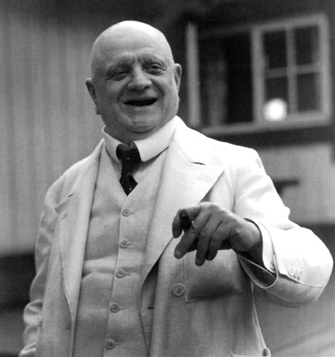
Jean Sibelius, surprised as anyone else
 that they've found the score of his Eighth Symphony.
Inspired by Daniel J. Wakin's excellent article in the New York Times on questionable orchestras and their planned tours of North America, Superconductor is pleased to announce its sponsorship of the first North American tour by the world-famous Olematon Akatemia Sinfoniaorkestri.

The group will be touring under the direction of its current music director, Lupää Johtaja. Mr. Johtaja has worked with the 120-piece touring ensemble since 1999, and originally joined the orchestra as a second triangle player.

The company's summer repertory includes Bruckner's Concerto for Two Wagner Tubas and String Orchestra, The Asteroids, a tone poem by Gustav Holst, Franz Liszt's Fourth Piano Concerto for the Left Pinkie and the Richard Strauss waltz Schlagobers. The orchestra will also be playing an abbreviated version of John Cage's 4'33" as its nightly encore.

Based in the world-class Kusta Lumi Concert Hall, newly built on the outskirts of Kemijärvi, Finland, this  ensemble is particularly revered for its performance of the recently discovered Eighth Symphony of Finnish national composer Jean Sibelius. The score, long thought destroyed, was found underneath a FinnBot pinball machine in a public house on the outskirts of Rovaniemi. A recording is forthcoming on Teldec Records.

Founded on February 30, 1973, the Olematon Akatemia Sinfoniaorkestri is an internationally accredited ensemble, which spent most of the 1970s and '80s on goodwill tours of the eastern end of the former Soviet bloc. Their first music director was the much-loved Sonni "Paska" Valehtelija. In addition to his chamber arrangement of Arnold Schoenberg's cantata Gurre-Lieder, Mr. Valehtelija was known for conducting concert versions of rare operas, including Richard Wagner's Wieland der Schmied, Giuseppe Verdi's Re Lear and Leos Janacek's The Cunning Little Agent, a dark comedy which is the flip side to the composer's The Makropolous Case.

Tour stops include Bodie, CA, Berlin, NV, Medicine Mound, TX, and Centralia, PA before returning to Europe to play a summer festival in Belchite, Spain. More information about this orchestra can be found at this site.


Sunday, March 20, 2011

Metropolitan Opera Preview: Capriccio

This is a preview of Capriccio, with a brief summary and CD recommendations. To read the Superconductor review of the March 28 performance, click here.
The final scene from Capriccio. That's Renée Fleming at center.
Photo by Ken Howard © 2008 The Metropolitan Opera.
"Frau Gräfin, das Souper ist serviert."
Renée Fleming sings the leading role of Countess Madeleine in this rare revival of Capriccio, the 15th (and final) opera by Richard Strauss.

Capriccio was labeled as a "conversation piece for music." The subject of that conversation is the art of opera itself. Set in a big house in 18th-century France (when the musical reforms of Christoph Willibald Gluck were sweeping Europe) the work takes the form of a day-long debate about the importance of words vs. music in the construction of opera. Eventually, the participants decide to write an opera based on the day's events. It's very "meta."


The debate is framed as a romantic comedy, where the Countess is torn between the passions of the poet Olivier (Russell Braun) and the advances of the composer Flamand, (Joseph Kaiser) two best friends who are playful rivals for their hand. Also present at the house are the impresario LaRoche, (Peter Rose) the actress Clairon, (Sarah Connolly) and the prompter, M. Taupe ("Mr. Mole") who lives under the stage.

While there is only one really memorable aria in Capriccio (and it comes at the very end!) the opera is two hours of beautiful music. It is written in Strauss' late, post-Mozartean style, combining complex harmonic techniques with the galant music of the 18th century. This is an intricate score that opens with a string sextet and retains that chamber-music characteristic all the way to its final bars.


Watch Renée Fleming sing the final scene of Capriccio.
And then go get tickets.


Recording Recommendations:
There are just three recordings of this opera in  the catalogue, with several more on video. But the best video of the opera, a film from Vienna starring Anna Tomowa-Sintow, has never been put out on VHS or DVD in the United States.


Philharmonia Orchestra cond. Wolfgang Sawallisch (EMI, 1957)
Countess Madeleine: Elizabeth Schwarzkopf
Flamand: Nicolai Gedda
Olivier: Dietrich Fischer-Dieskau
LaRoche: Hans Hotter
This was EMI producer Walter Legge's last-ditch effort to ignore the rise of stereo technology by producing opera recordings in monaural sound. Yes it's in mono. but this is a benchmark recording with a near-unbeatable cast of great opera singers in top form. Look for a young Christa Ludwig as Clairon, and the maestro himself making a rare appearance as the Servant in the final scene.

Bavarian Radio Symphony Orchestra cond. Karl Böhm (Deutsche Grammophon, 1972)
Countess Madeleine: Gundula Janowitz
Flamand: Peter Schreier
Olivier: Dietrich Fischer-Dieskau
LaRoche: Karl Ridderbusch
This is a comparable reading of the opera, with an excellent Countess in Gundula Janowitz and its own all-stars (Hermann Prey, Tatiana Troyanos) in smaller roles. Fischer-Dieskau reprises his performance as Olivier. The underappreciated Karl Ridderbusch is also featured as LaRoche. If I had to choose between the two, I'd take Böhm--I like his conducting, and it's in pristine DG analog stereo

Monday, January 31, 2011

The Superconductor Top Ten: A Schubertiade

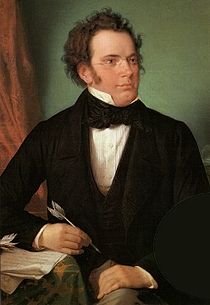
Franz Schubert. Portrait by Wilhelm August Rieder 
Today marks the 214th birthday of Franz Peter Schubert, songwriter, symphonist, and composer par excellence. So to celebrate, here's a list of ten really good pieces by this brilliant composer, who died at the age of 31. No particular order.

1) Symphony in B Minor ("Unfinished")
From its tremolo opening to the noble theme, sung forth in the cellos, this two-movement torso features everything that makes a Schubert work great: powerful, innovative use of modulation, and above all melodies that at first soothe and ultimately end on a disquieting, unfinished note. Schubert sketched a third movement, and may have planned a fourth, but the Unfinished stands as a masterpiece.


2) Der Doppelganger
Many of Schubert's best songs are horror stories in miniature. Schubert's second-to-last lied explores psychological horror: the idea of having to confront your own duplicate--and your own madness.

3) Erlkönig
With its difficult, galloping piano part, this song about a father trying to save his child from a demonic figure (the "Erl King") is one of Schubert's most popular Lieder. The singer has to play four parts: the narrator, father the terrified child, and the wheedling, seductive Erl King. All this in four minutes.

4) Der Wanderer
This soul-searching ballad is one of the most famous Schubert songs, from its introspective opening recitative, to the introduction of a lilting, almost gleeful 6/8 figure in the second half that brings the work to a climax. It also served as the launch-point for the later "Wanderer Fantasy", one of the composer's famous piano works.


5) String Quartet No. 12: Quartettsatz
Schubert spent much of his brief career pushing the boundaries of form in chamber music. (Often he would do so by simply not finishing works.) This is the first movement from the never-completed String Quartet No. 12. It stands on its own, especially with its warm, harmonized second subject. Premiered after the composer's death.

6) String Quintet in C Major D. 956
The best "gateway" to the music of Schubert is this exquisite, melancholy quintet that (unusually) replaces the traditional second viola with a second 'cello--allowing the two low instruments to interweave and comment on each other's basslines as the violins duel in the upper register. Genius.

7) Der Winterreise
The most famous song cycle ever written. The hero, rejected by his lover, begins a trek into white oblivion, slowly going mad in the freezing dead of winter over the course of 24 songs. Winterreise broke fresh ground when it premiered, and its narrative never fails to chill one to the marrow.

8) Piano Sonata No. 6 in E Minor
Like many Schubert works, this piano sonata shifts moods as it develops. An up-tempo opening gives way to the suffering brooding beneath the surface. Schubert wrote 21 sonatas. His work does not have storm and fire of Beethoven or the dazzling virtuososity of Liszt. But it has endured through the emotional, melodic nature of the music which speaks to listeners 200 years later.


9) Nachtgesang im Walde
Written for four horns and a male chorus, this short part-song is one of Schubert's fine examples of secular choral writing. The opening evokes the mystery of the woods at night, and the later pages shift to celebratory hunting music. The combination of chorus, nature images and mysterious minor chords points the way forward to Mahler.

10) Impromptu No. 2 in E Flat
This work opens rolling wave of arpeggiated notes displays Schubert the consumnate pianist. It requires fluid legato playing and a dexterous technique. Once the main theme arrives, the swift passage becomes expert accompaniment to the noble main theme. Played by the right pianist, the effect of this demanding piece is breathtaking.

Saturday, January 29, 2011

The Superconductor Top Ten: Mozart's Greatest Hits

Celebrating Mozart's birthday with Superconductor.
by Paul J. Pelkonen
Mozart as a child.
January 27th marked Wolfgang Amadeus Mozart's 255th birthday. To celebrate, here's a completely arbitrary list of essential Mozart compositions, and some recording recommendations to  back them up. No particular order--they're as I think of them.

1) Die Zauberflöte
Mozart's last German opera is a hybrid of Masonic rite and rollocking music hall comedy. Packed with memorable arias, duets and choruses, The Magic Flute presents the story of a young prince on a quest to attain enlightenment: helped by his buddy, a bird-catcher who only wants to eat, drink, and get married.
Recording: Berlin Philharmonic cond. Karl Böhm

2) Piano Sonata in C Major K. 545
All of the Mozart piano sonatas are masterpieces--full of rich tunes that delight the ear and astound the listener as to the composer's mastery of the keyboard and technical facility. This one made the "cut" because it's the most famous.
Recording: Carl Seeman, Piano

3) Piano Concerto No. 24 in C Minor K. 491
Mozart is one of the fathers of the piano concerto. This minor-key work points the way forward to the great concertos of Beethoven, Brahms and Tchaikovsky. So it makes the list.
Recording: English Chamber Orchestra cond. Jeffrey Tate; Mitsuko Uchida, Piano

4) Bassoon Concerto K. 191
This was Mozart's first wind concerto (he was 18) and one of the few written for this low-voiced instrument. It remains a standard work for bassoonists, and one of the most enjoyable Mozart concertos.
Recording: Vienna Philharmonic cond. Karl Böhm

5) Missa da Requiem
Mozart's last composition has become the stuff of legend. Commissioned by an under-handed nobleman who wanted to pass the work off as his own (an idea used in the last act of the film Amadeus) the incomplete Requiem is a potent, experimental setting of the Latin Mass for the Dead.
Recording: Atlanta Symphony Orchestra cond. Robert Shaw

6) Le Nozze di Figaro
One of the most important opera comedies ever written and still securely in the repertory over two centuries since its premiere. Packed with fine comic moments, great tunes, and class warfare--Figaro never disappoints.
Recording: Vienna Philharmonic cond. Erich Kleiber

7) Don Giovanni
The second collaboration between Mozart and Lorenzo da Ponte combines tragic elements with comedy. And the Don's defiance in the face of eternal damnation inspired a whole generation of Romantic writers and composers.
Recording: Chamber Orchestra of Europe cond. Claudio Abbado

8) Symphony No. 39 in G Minor
Mozart's third-to-last symphony explored the possibilities afforded by working in what was, at the time of its composition, an under-used minor key. With strong melodic ideas (including an instantly recognizable "hook") this is one of the composer's most enduring creations.
Recording: Berlin Philharmonic cond. Karl Böhm

9) Violin Sonata in E Flat K. 481
As with most categories of Mozart compositions, all of the sonatas for piano and violin are splendid. The E Flat Sonata breaks new ground with ith its theme-and-variations final movement.
Recording: Radu Lupu, Piano; Szymon Goldberg, Violin

10) Serenade: Eine Kleine Nachtmusik
This remains the most enduring and best-known melody written by this august composer. But what you may not know is that this four-part serenade was originally five movements. The Serenades were Mozart's laboratory for musical experimentation. More importantly, listening to them can just make you happy. Promise.
Recording: Orpheus Chamber Orchestra

Trending on Superconductor

Translate

Share My Blog!

Share |

Critical Thinking in the Cheap Seats