Support independent arts journalism by joining our Patreon! Currently $5/month.

About Superconductor

Our motto: "Critical thinking in the cheap seats." Unbiased, honest classical music and opera opinions, occasional obituaries and classical news reporting, since 2007. All written content © 2019 by Paul J. Pelkonen. For more about Superconductor, visit this link. For advertising rates, click this link. Follow us on Facebook.
Showing posts with label Franz Schubert. Show all posts

Friday, December 21, 2012

Concert Review: Lied, Down the Garden Path

Winterize brings Schubert outdoors.
by Paul J. Pelkonen
Christopher Dylan Herbert sings Schubert in Winterize.
Photo by the author.
Schubert's Winterreise is a harrowing descent into solitude, madness (and probably, hypothermia) told over 24 songs. Based on poems by Wilhelm Müller, this is the composer's crowning achievement in the field of lieder, a forbidding journey for any singer. Most performances take place in a concert or recital hall, with a formally attired singer and accompanist tracking the hapless protagonist's journey, a setting of relative comfort for audience and artists.

On Friday afternoon, New York baritone Christopher Dylan Herbert walked a different path, performing the song cycle at the Brooklyn Botanic Garden as part of a city-wide arts project, Make Music New York. This particular performance, dubbed Winterize, took place in the sere, leafless grounds of the Brooklyn Botanical Gardens on the first day of winter. Under a chilly, leaden sky, the songs of Schubert had new meaning and weight, especially as clouds rolled in over Prospect Heights and the wind picked up.

Although singing in the cold, Mr. Herbert proved to have a rich, theatrical baritone that had no difficulty being heard in this outdoor setting. He projected the emotions behind this descent into madness, capturing the irony of the cycle's more fantastical moments and the self-flagellating character of Schubert's protagonist. From the steady tramp of "Gute Nacht" through the manic determination of later songs like Mut, this was a consistent, and sometimes harrowing performance. He managed the wide spectrum of sounds, even floating a lovely "head voice" in the more difficult passages of Die Nebensonnen and the haunting despair of Der Leiermann.

Saturday, August 11, 2012

Concert Review: Remastering the Romantics

Pablo Heras-Casado conducts the Freiburg Baroque Orchestra.
by Paul J. Pelkonen
Pablo Heras-Casado demonstrates his ninja podium technique.
Photo by Jean-François Leclerq © 2011 PabloHerasCasado.com
Thursday night's concert at Mostly Mozart built a bridge between the instruments of the 18th century and the early Romanticism of the 19th. Under the baton of Pablo Heras-Casado, the Freiburg Baroque Orchestra offered a program of Schubert, Schumann and Mendelssohn--conventional composers given new life through the use of period instruments.

The Freiburg Baroque Orchestra is celebrating its silver anniversary this year. Founded by music students in this university town near the Black Forest, this group's choice of archaic instruments seems somehow in keeping with the medieval, cobbled streets of their home city. Wooden flutes, natural horns, and a crisp, refreshing approach to music by Schubert, Schumann and Mendelssohn made for an entertaining addition to the usual Mostly Mozart schedule.

The program opened with Schubert's light-hearted Third Symphony. The characteristic orchestrations and long melodic lines that characterize this composer sounded fresh and new played by the Freiburgers, as if thick coatings of linseed oil were suddenly scraped from a masterwork of art. The music sprang with robust, Romantic life, from the slow, thoughtful introduction to the forceful Allegro with its complex clarinet part.

Sunday, September 25, 2011

Re-stocking the Bare Shelves

A look at upcoming classical boxed sets.
"My cans. My precious, antique cans. Look what you've done to 'em."
Every Fall, the classical music industry releases a new flood of boxed sets and reissues into the warehouses of Amazon.com and its competitors. (This line used to read "into the record stores" but since there are very few left age their stock is limited, I decided to update it for this barren decade.)

In times of limited employment and deep economic strife, suggesting which classical/opera boxed sets to collect might be as futile as buying a subscription to the New York City Opera's 2011 fall season. But we're still going to do it anyway, because writing about good music is a light in dark days.

Here's some new and notable box sets. Some are recently released. Others are coming in the next few months:

Rafael Kubelik conducts Great Symphonies
Schumann Symphonies 1-4, Bruckner Symphony No. 3, 4, Mozart Nos. 35, 36, 38-41

Bavarian Radio Symphony Orchestra cond. Rafael Kubelik (RCA, 7 discs)
One of the great underrated conductors gets a reappraisal, thanks to the merger of Sony and RCA and a slew of accompanying reissues. Kubelik always had a unique take on major repertory, and he meshed perfectly with the Munich forces to produce gorgeous results. (Release Date: Sept. 6, 2011)


Schubert: Piano Sonatas and Impromptus, Andras Schiff, Piano (Decca, 9 discs)

This Hungarian pianist made these Schubert recordings in the 1990s. Crisp keyboard diction, beautiful digital sound and a sense of intimacy, especially in the beautifully played Impromptus. (Oct. 18, 2011)

Bruckner: Symphonies 0-9
Chicago Symphony Orchestra cond. Daniel Barenboim. (DG, 10 discs)

This set has been out of print for almost two decades, mostly because Daniel Barenboim decided to record a second Bruckner cycle with the Berlin Philharmonic. That set was released in the '90s on Teldec/Warner Brothers and is also currently available. This older, analog set made in the 1970s offers the conductor's fiery first take on these classic works and allows the listener to hear the early relationship between the young Barenboim and this great American orchestra. (Oct. 18, 2011)


EMI Sergiu Celibidache Edition Boxed Sets
Munich Philharmonic cond. Sergiu Celibidache (EMI Classics, Four boxed sets, 48 discs total.)

Four low-price boxed sets celebrate the "all-bootleg" recorded legacy of this idiosyncratic, but inspired Romanian conductor. Since Celibidache would not make studio recordings and openly disapproved of the process of making live recordings, he had to be recorded quietly, with everything released following his death.

The maverick Celibidache famously eschewed the recording studio, leading mystic, revelatory performances of major symphonic repertory. (Most of these recordings were made between 1982 and 1995, but not intended to be released.) Bruckner is the main attraction here, although this conductor applied his unique touch to Bach choral works, the Verdi Requiem and an astonishing range of repertory from Haydn and Mozart to Debussy, Bartok and Mussorgsky. (Oct. 25, 2011)


The Liszt Legacy: Benno Moisewitch, Alicia De Larrocha, Claudio Arrau, Raymond Lewenthal, Egon Petri, Piano (DG, 11 discs)
This year has seen a slew of Liszt boxed sets, from the scattershot anthologies of EMI and Sony to Hyperion's absolutely complete set of Leslie Howard's recordings, that weighs in at a hefty 99 discs. This ten-disc Liszt-a-thon celebrates the composer's bicentennial with rare and unreleased recordings of the composer's works from five great pianists. Many of these are previously unreleased.

The Chilean Claudio Arrau and the Spanish Alicia de Larrocha are the big names here, but the set is also notable for the inclusion of the underrated Benno Moisewitch as well as the more obscure Dutch-German pianist Egon Petri and the American-born Raymond Lewenthal.  (Nov. 15, 2011)

Monday, August 29, 2011

Concert Review: An Early Exit in a Hurricane's Path

Mostly Mozart ends with unfinished music.
The Mostly Mozart Festival Orchestra, led by conductor Louis Langrée.
Image courtesy Lincoln Center © 2010 Mostly Mozart/Lincoln Center.
The 2011 Mostly Mozart festival came to a premature end on Friday night. Due to the imminent arrival of Hurricane Irene this weekend, Saturday night's concert was cancelled. With the audiences from both nights combined at the last minute, a capacity crowd was on hand to hear the Mostly Mozart Festival Orchestra offer a program of Stravinsky, Schubert, and Mozart's last work, the Requiem. Louis Langrée conducted.

The packed house meant some unusual seating arrangements. My seat was on the stage, in one of the jury-box like arrangements that recall Wieland Wagner's 1961 production of Tannhäuser. Also, I could sight-read the double bass part over the musicians' shoulders during the Schubert "Unfinished" Symphony. For the Mozart Requiem I divided my attention between the choristers, the sheet music and conductor Louis Lortie.

The concert opened with Stravinsky's In Memoriam Dylan Thomas, a dirge-like setting of the poet's "Do Not Go Gently Into That Good Night." The work has an unusual chamber orchestration: four string players and four trombones. Tenor Joseph Kaisersang the complex vocal part (which belongs to Stravinsky's difficult, late style with fervent emotion and beauty of tone. As Hurricane Irene whirled slowly toward the city, the poem seemed an appropriate message for the assembled audience.

Schubert's Unfinished Symphony (his Eighth) remains a giant question mark in his career. Unlike Bruckner and Mahler (who also left incomplete symphonies) Schubert lived for several years after stopping work on this piece after only two movements. Those movements were played with sure beauty by the Festival Orchestra, coloring in the complicated woodwind parts and the rolling, eloquent main theme in the 'cellos. The second movement loped with easy grace, and the horns played with firm, ringing tone.

A great deal of myth swirls around Mozart's Requiem. Here's the truth: the work was commissioned by an eccentric nobleman: Count Franz Walsegg-Stupach who planned to pass it off as his own work.Mozart died having only completed the first movement. But he wrote out vocal sketches for the work up to the beginning of the Lacrimosa, the final section of the Dies Irae.. His widow Constanze hired composer Franz Xavier Süssmayer to finish the piece and meet the commission.

Unlike later Requiem masses by Berlioz and Verdi, Mozart eschews clock-you-on-the-head orchestration, relying on the power of the human voice to convey the message of the Latin text. This is most apparent in the Tuba mirum, where the Last Trumpet is announced by a ringing bass voice with brass accompaniment. Morris Robinson delivered this unearthly message with power and warmth. Soprano Julia Lezhneva, in her American debut, was impressive in the work's lyric passages, as was mezzo Kelley O'Connor.

The second half of the Requiem was written by Süssmayer. Strong choral contributions from the Concert Chorale of New York were prominent here, particularly in the Sanctus and Agnus Dei. The final passages of the work sound forth in a triumphal shout, quoting the very beginning of the mass. This might not be the most imaginative ending, but one can only imagine how Mozart would have done it.

Monday, January 31, 2011

The Superconductor Top Ten: A Schubertiade

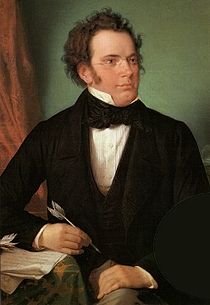
Franz Schubert. Portrait by Wilhelm August Rieder 
Today marks the 214th birthday of Franz Peter Schubert, songwriter, symphonist, and composer par excellence. So to celebrate, here's a list of ten really good pieces by this brilliant composer, who died at the age of 31. No particular order.

1) Symphony in B Minor ("Unfinished")
From its tremolo opening to the noble theme, sung forth in the cellos, this two-movement torso features everything that makes a Schubert work great: powerful, innovative use of modulation, and above all melodies that at first soothe and ultimately end on a disquieting, unfinished note. Schubert sketched a third movement, and may have planned a fourth, but the Unfinished stands as a masterpiece.


2) Der Doppelganger
Many of Schubert's best songs are horror stories in miniature. Schubert's second-to-last lied explores psychological horror: the idea of having to confront your own duplicate--and your own madness.

3) Erlkönig
With its difficult, galloping piano part, this song about a father trying to save his child from a demonic figure (the "Erl King") is one of Schubert's most popular Lieder. The singer has to play four parts: the narrator, father the terrified child, and the wheedling, seductive Erl King. All this in four minutes.

4) Der Wanderer
This soul-searching ballad is one of the most famous Schubert songs, from its introspective opening recitative, to the introduction of a lilting, almost gleeful 6/8 figure in the second half that brings the work to a climax. It also served as the launch-point for the later "Wanderer Fantasy", one of the composer's famous piano works.


5) String Quartet No. 12: Quartettsatz
Schubert spent much of his brief career pushing the boundaries of form in chamber music. (Often he would do so by simply not finishing works.) This is the first movement from the never-completed String Quartet No. 12. It stands on its own, especially with its warm, harmonized second subject. Premiered after the composer's death.

6) String Quintet in C Major D. 956
The best "gateway" to the music of Schubert is this exquisite, melancholy quintet that (unusually) replaces the traditional second viola with a second 'cello--allowing the two low instruments to interweave and comment on each other's basslines as the violins duel in the upper register. Genius.

7) Der Winterreise
The most famous song cycle ever written. The hero, rejected by his lover, begins a trek into white oblivion, slowly going mad in the freezing dead of winter over the course of 24 songs. Winterreise broke fresh ground when it premiered, and its narrative never fails to chill one to the marrow.

8) Piano Sonata No. 6 in E Minor
Like many Schubert works, this piano sonata shifts moods as it develops. An up-tempo opening gives way to the suffering brooding beneath the surface. Schubert wrote 21 sonatas. His work does not have storm and fire of Beethoven or the dazzling virtuososity of Liszt. But it has endured through the emotional, melodic nature of the music which speaks to listeners 200 years later.


9) Nachtgesang im Walde
Written for four horns and a male chorus, this short part-song is one of Schubert's fine examples of secular choral writing. The opening evokes the mystery of the woods at night, and the later pages shift to celebratory hunting music. The combination of chorus, nature images and mysterious minor chords points the way forward to Mahler.

10) Impromptu No. 2 in E Flat
This work opens rolling wave of arpeggiated notes displays Schubert the consumnate pianist. It requires fluid legato playing and a dexterous technique. Once the main theme arrives, the swift passage becomes expert accompaniment to the noble main theme. Played by the right pianist, the effect of this demanding piece is breathtaking.

Trending on Superconductor

Translate

Share My Blog!

Share |

Critical Thinking in the Cheap Seats