Support independent arts journalism by joining our Patreon! Currently $5/month.

About Superconductor

Our motto: "Critical thinking in the cheap seats." Unbiased, honest classical music and opera opinions, occasional obituaries and classical news reporting, since 2007. All written content © 2019 by Paul J. Pelkonen. For more about Superconductor, visit this link. For advertising rates, click this link. Follow us on Facebook.
Showing posts with label Renee Fleming. Show all posts

Wednesday, March 20, 2019

Concert Review: Call Her Madeleine

Renée Fleming returns to Strauss at Carnegie Hall.
by Paul J. Pelkonen
She's not done yet: soprano Renée Fleming. Photo by Andrew Eccles.
The soprano Renée Fleming remains a legitimate superstar. So it caused particular turmoil in the operatic world last year when she announced that the performances as the Marschallin in Richard Strauss' opera Der Rosenkavalier would be her last...in that role. Last night at Carnegie Hall, Ms. Fleming returned to Strauss as another heroine, the Countess Madeleine in the composer's final opera, Capriccio.

Thursday, October 4, 2018

Concert Review: Everybody Gets Ice Cream

The San Francisco Symphony opens Carnegie Hall.
by Paul J. Pelkonen
Broadway soprano Audra McDonald lit up opening night at Carnegie Hall.
Photo by Autumn de Wilde.
Opening night of Carnegie Hall is a little bit...different. Men's clothes are nattier. Women's necklines dip lower. The concert is shorter, minus the usual intermission. There's an  elegant rooftop dinner for heavy donors. And there's always an A-list special guest (or two), a star attraction that one wouldn't hear on the programs reserved for mere concert-going music enthusiasts.

Tuesday, November 15, 2016

Concert Review: An Unexpected Party

Renée Fleming premieres Letters from Georgia by Kevin Puts.
by Paul J. Pelkonen
Petunias by Georgia O'Keeffe © 1924 The Georgia O'Keeffe Museum.
Most concerts at Alice Tully Hall are pretty staid affairs. Refreshments are usually limited to the occasional output of the American Table Restaurant and a standard Lincoln Center refreshment bar offering hot coffee and maybe the occasional little sandwich. So it was a welcome surprise to this reviewer to show up for Monday night's concert featuring the Eastman Philharmonia and soprano Renée Fleming and to find the glass lobby on the corner of W. 65th and Broadway the site of an elegant and catered soirée.

Tuesday, May 24, 2016

Concert Review: The No-Bell Prize

The MET Orchestra goes all-Strauss at Carnegie Hall.
by Paul J. Pelkonen
The ever-glamorous Renée Fleming sang Strauss Sunday afternoon at Carnegie Hall.
Photo by Andrew Eccles for Decca/Universal Music Group.
The starry career of soprano Renée Fleming has been associated for the past two decades with the operas of Richard Strauss, and specifically roles like the Marschallin in Der Rosenkavalier, the title role in Arabella and the Countess Madeleine in Capriccio, all more or less a fit for her aristocratic stage presence and charm.

Thursday, February 6, 2014

Opera Review: Taking the Plunge

Renée Fleming returns as Rusalka.
by Paul J. Pelkonen
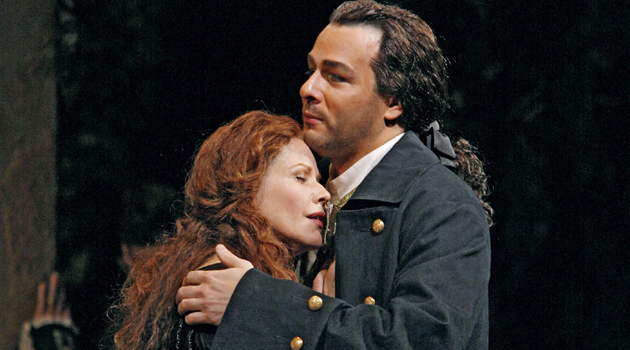
Her kisses can kill: Rusalka (Renée Fleming) woos the Prince (Piotr Beczala)
in Act III of Rusalka at the Metropolitan Opera.
Photo by Ken Howard © 2014 The Metropolitan Opera.
The title role of Rusalka, Antonín Dvořák's long-suffering aquatic sprite, has effectively belonged to soprano Renée Fleming for nearly two decades. From her first performances of the role at the Seattle Opera to the start of her reign in the Metropolitan Operas's handsome, elaborate staging, she has been inextricably linked with Dvořák's most successful opera.  Now, with the advent of the Metropolitan Opera's Live in HD broadcasts, Ms. Fleming has plunged once more into Rusalka, with the goal of preserving her interpretation for posterity and eventual release on home video.

Monday, February 3, 2014

The Super Bowl National Anthem

or, yes it's time to write about Renée Fleming.
by Paul J. Pelkonen
Renée Fleming at the Super Bowl.
Image © FOX Sports and the National Football League.
So, on Super Bowl Sunday, the partner and I trekked on the subway to Carnegie Hall to see the English Concert perform Handel's Theodora.. There's a review of that performance to follow later today but first, let's talk about the Super Bowl and Renée Fleming's performance of the National Anthem.

Friends of this blog and those of you who've seen me show up at Carnegie Hall in a warm Green Bay Packers jacket know that I'm not only a football fan, I'm a huge football fan. But because the Handel oratorio was four hours long we didn't make it home in time to see the start of the game. In fact, we watched the first quarter (in Spanish on Fox Deportes Español) at our local taqueria while demolishing delicious (and authentic) burritos.

Sunday, January 19, 2014

Metropolitan Opera Preview: Rusalka

Renée Fleming returns to the water as a love-struck mermaid.
by Paul J. Pelkonen
Fathoms below: Renée Fleming in the title role of Rusalka.
Photo by Ken Howard © 2009 The Metropolitan Opera.
The return of soprano Renée Fleming is always anticipated at the Metropolitan Opera. And here, she returns t the role that has become one of her signatures in the last 15 years: the title character in this revival of Antonin Dvořák's Rusalka.

Tuesday, November 19, 2013

Concert Review: An All-Star Team, Minus Two

The 2013 Richard Tucker Gala at Lincoln Center.
by Paul J. Pelkonen
This year's Richard Tucker Gala celebrates the singer's 100th birthday.
The annual Richard Tucker Gala is like opera's equivalent of the All-Star Game, a chance to hear today's foremost opera singers alongside the stars of tomorrow. Held to commemorate the Richard Tucker Foundation's annual awarding of the Tucker Prize to a promising young singer, this concert at Lincoln Center attracts affluent opera lovers and industry cognoscenti alike. This year's gala also celebrated the centennial of Richard Tucker's birth, and featured a new banner across the back of the stage with five portraits of the late tenor and New York native.

Sunday, April 28, 2013

Concert Review: Fountains, Poems and Pictures

The New York Philharmonic plays Carnegie Hall.
by Ellen Fishbein
Renée Fleming appeared with the New York Philharmonic on Friday night.
Photo © Decca Classics.
On Friday night, the New York Philharmonic made a rare appearance on the stage of Carnegie Hall, with a short program that was rich and engaging despite its brevity. Alan Gilbert conducted two orchestral favorites, framing the world premiere of Swedish composer Anders Hillborg's The Strand Settings. The new work featured soprano Renée Fleming in her only appearance with the orchestra this season.

Saturday, March 16, 2013

Opera Review: Next Stop, Carnegie Hall

André Previn’s Streetcar finally arrives in New York.
by Paul J. Pelkonen
Renée Fleming as Blanche DuBois in A Streetcar Named Desire,
Thursday night at Carnegie Hall. Photo by Richard Termine © Richard Termine,
courtesy Carnegie Hall Public Relations Department.
Sometimes public transportation can be slow to arrive. Take Andre Previn's first opera: A Streetcar Named Desire which rolled into New York last night, fifteen years after its premiere at the San Francisco Opera. Here, the score was played by the ever-reliable Orchestra of St. Luke’s under the baton of Ms. Fleming’s regular collaborator Patrick Summers. This was a "semi-staged" production, directed by Brad Dalton.

Tuesday, February 26, 2013

Metropolitan Opera Announces 2013-2014 Season

New Productions: 6. Wagner: 0.
by Paul J. Pelkonen
"What do you mean, no horned helmets?"
Ambrogio Maestri is Sir John  Falstaff in Robert Carsen's production
of the Verdi opera,  premiering at the Met Dec. 6, 2013.
Photo by Catherine Ashmore © 2012 The Royal Opera House in Covent Garden.
In continuation of its apparent determination to do things differently than every other arts organization in New York City, the Metropolitan Opera announced its 2013-2014 season schedule at 5pm tonight via the company's website.

It's an unusual schedule this year. Scratch that--it's downright weird. Some unloved productions from recent years return, including the Luc Bondy Tosca and Mary Zimmerman's controversial "rehearsal" version of La Sonnambula.  There are three operas by Bellini and three operas by Richard Strauss including the mighty Die Frau ohne Schatten. There are three Russian operas (two of them new productions) and one in Czech.

An article in the New York Times announced that ticket prices in the expensive seats will drop by 10%, with the burden being placed on Family Circle Balance seats--they go up 20%. Happily, the Rush Program will continue next year.

So what's missing? First of all, there is no Wagner on the schedule. Planned revivals of Tannhäuser and Parsifal were reportedly nixed in favor of Dvorak's Rusalka (starring Renée Fleming) and Berg's Wozzeck with Thomas Hampson and Deborah Voigt. And there's only two Verdi operas (Falstaff and a revival of the Vegas Rigoletto) after last year's slew of seven.

Also anticipated: the return of Shostakovich's The Nose, Sondra Radvanovsky and Angela Meade alternating in Norma and a much-needed revival of A Midsummer Night's Dream. But nothing is more eagerly anticipated than the return of music director James Levine to active duty after a long absence. He's scheduled to conduct a revival of Cosí fan tutte, the aforementioned Wozzeck and the new production of Falstaff.

That's one of six new productions. And here....they....are:

Monday, January 28, 2013

Concert Review: Cream and Sugar

Renée Fleming and Susan Graham at Carnegie Hall.
by Paul J. Pelkonen
Susan Graham and Renée Fleming. Susan is the tall one.
Photo by Melanie Buford © 2013 National Public Radio/WQXR.
On Sunday night, soprano Renée Fleming and mezzo Susan Graham gave a joint recital with pianist Bradley Moore. The concert, which opened Ms. Fleming's 2013 Perspectives series at Carnegie Hall, celebrated the long friendship and artistic partnership of these two fine singers with an emphasis on French chanson and operatic repertory.

Ms. Fleming and Ms. Graham don't always appear together, but their careers are inextricably linked. They made early recordings together, like Handel's Alcina. In 2000 and 2009, they melted earts at the Met in Richard Strauss' sentimental comedy Der Rosenkavalier (Ms. Graham takes the trouser part.) However, the opportunity to see these two divas in a concert collaboration is rare indeed.

The program opened with three songs by Camille Saint-Saëns. The black-gowned singers paused between numbers to explain that their intent was to recreate a salon atmosphere in the unlikely space of Stern Auditorium. Somehow, the interaction of their voices created that needed sense of intimacy as they soared through the long phrases of "Pastorale" and the rapid Spanish rhythms of "El desdichado."

Thursday, October 18, 2012

Opera Review: Unmoored

Otello at the Metropolitan Opera.
by Paul J. Pelkonen
He is nothing if not critical: Falk Struckmann as Iago in the Met's Otello.
Photo © 2012 The Metropolitan Opera.
The Metropolitan Opera's ambitious slate of Verdi operas continued this month with a revival of Verdi's Otello. The plan: to reunite tenor Johan Botha with soprano Renée Fleming, a pairing that proved potent in 2008. But on Tuesday night, Mr. Botha cancelled due to illness, leaving the challenging title role to Russian tenor August Amonov.

Wednesday, September 19, 2012

Carnegie Hall 2012-2013 Season Preview

Carnegie Hall's ambitious 2012-2013 slate.
The Dude abides: Gustavo Dudamel returns to Carnegie Hall with an ambitious
program of Latin American music. Photo © 2011 Rolex.
The Carnegie Hall season opens Oct 3. This year's intiatives include a Latin American music festival featuring conductor Gustavo Dudamel, composer Osvaldo Golijov, and the Simon Bolivar Youth Orchestra of Venezuela in a rare New York appearance.

Mr. Golijov is also the Hall's new composer-in-residence. And opera singer Renée Fleming takes the post of artist-in-residence with a four-concert Perspectives series featuring the New York stage premiere of André Previn's opera A Streetcar Named Desire.

Here are 12 quick highlights of the 2012-2013 season:

Monday, June 25, 2012

Today's Musical Postcard

comes from London.


Featuring a performance of Renée Fleming, singing Erich Wolfgang Korngold's Ich ging zu ihm from the opera Die Wunder das Heliane. And another Marillion parody, which has nothing to do with Korngold.

Parody of Marillion's Somewhere Else. Yes that's a Starbuck's.
Which is not where I am right now.

Tuesday, June 19, 2012

Even Better Than the Real Thing™

The Metropolitan Opera offers summer re-runs of its Live in HD series.
by Paul Pelkonen
Kathleen Kim in the Met's 2009 Les contes d'Hoffmann.
Photo by Ken Howard © 2009 The Metropolitan Opera.
Need to get out of the sunlight and into the opera house? Well the Met currently has the Chagalls curtained, but the company is advertising a series of Summer Encores of its Live in HD series.

Monday, January 16, 2012

Concert Review: She Wants Magic

Renée Fleming and the Met Orchestra at Carnegie Hall.
Renée Fleming. Photo © 2011 QPrime Management.
On Sunday afternoon, the Metropolitan Opera Orchestra came to play Carnegie Hall under the baton of Principal Conductor Fabio Luisi. The program was unusual: alternating two clarinet concertos (by Mozart and Aaron Copland) with short recitals from superstar soprano Renée Fleming.

The afternoon opened with Stephen Williamson playing Mozart's Clarinet Concerto. Mr. Williamson is a principal clarinetist of the MET Orchestra, currently playing with the Chicago Symphony Orchestra. This is the last woodwind concerto written by this composer and one of his final works completed before the (unfinished) Requiem.  He played Mozart's athletic solo lines and octave leaps with agility.

Despite generating a pleasing tone, Mr. Williamson kept pausing between movements. He disassembled his clarinet, examined the cork ends, and fiddled with the action on the keys. At the second pause, he wiped  out the inside of the barrel, and bit in a new reed. So in addition to appreciating Mozart, the Carnegie audience may have learned enough to open their own woodwind repair shops.

Ms. Fleming swept onstage (in a bright magenta gown) to sing Mahler' five Ruckert-Lieder. The soprano's voice sounded impressive in the dreamy heights of Ich atmet' einen linden Duft and the extreme depths of Mitternacht. But in each song, her middle register seemed to vanish. Also, Ms. Fleming is an experienced interpreter of Strauss, but she lent a strange inflection to this German text. That said, the final "Ich bin der Welt abhanden gekommen" was impressive. Mr. Luisi proved a sensitive accompanist.

The second half of the program featured Aaron Copland's concerto, originally written for Benny Goodman. Anthony McGill showed himself to be an outstanding soloist, playing with bright, vibrant tone and racing through Copland's jazz-inflected figures. Mr. Luisi drew some gorgeous sonorities from the Met orchestra, lovely shimmers of strings with Copland's signature tonalities that suggest wide American landscapes and urban bustle.


In the course of her long career, Ms. Fleming has shown commitment to 20th century opera, especially in bringing Carlisle Floyd's powerful Susannah to the Met stage and creating Blanche DuBois in A Streetcar Named Desire. Here, she presented three arias from modern American operas by Samuel Barber and Bernard Hermann.  Two of these arias appear on I Want Magic! the 1998 album which she recorded with the Met Orchestra and Mr. Levine.

She opened the short set with "Give Me Some Music" from Barber's Antony and Cleopatra, the opera that opened the new Met in 1967. Today it is chiefly remembered for director Franco Zeffirelli's extravagant pyramid set, which broke the opera house's brand-new turntable. Here, the soprano battled a sandstorm of orchestration, taxing her instrument to portray the Egyptian queen against the heavy brass and strings of Barber's score. She faced similar challenges in "Do Not Utter a Word" from Vanessa. But Mr. Luisi was more successful in managing the orchestra, creating a rich balance of sound. Ms. Fleming soared to some powerful heights in this frantic scena.

Bernard Herrmann is remembered for his film scores for Alfred Hitchcock: most notably Psycho. "I Have Dreamt" is from his opera Wuthering Heights, and featured Ms. Fleming as Emily Brontë's haunted heroine. Mr. Luisi drew rich tones from the Met orchestra, conveying Mr. Herrmann's rich, Korngold-like textures. But like Catherine's ghost, the middle voice seemed swaddled in the heavy orchestral fabric, and did not make a great case for future mountings of this Gothic opera.

Ms. Fleming offered one encore: "I can smell the sea air" from André Previn's Streetcar. This was a treat for New Yorkers, who have not yet seen this operatic version of the Tennessee Williams play onstage. Ms. Fleming did a powerful job of inhabiting Blanche Dubois's particular descent into madness, arching into Mr. Prévin's lush phrases with ease.

Wednesday, November 16, 2011

Opera Review: One for the Diva

The Met's goes for baroque, reviving Rodelinda.

Marital bliss: Rodelinda (Renée Fleming, left) is embraced by Bertarido (Andreas Scholl.)
Photo by Ken Howard © 2011 The Metropolitan Opera.
The Met's revival of Rodelinda is the company's latest effort on behalf of soprano Renée Fleming. In presenting this comparatively obscure Handel opera, the presumed goal is to preserve the superstar's interpretation of the title role, into the ongoing Met Live in HD series. But in catering to the diva, the company has revived a dull entertainment.


Rodelinda is Handel's 19th opera. The title character is based on a real person, a 6th century Lombard queen. At the opera's opening (this is one of those plots where you need to know what happened before the curtain rises, like Die Walküre or Il Trovatore, Rodelinda's husband has been usurped and presumed killed. Of course, he's not really dead, but we'll get to that in a moment.


At the Monday night opener, Ms. Fleming's biggest assets were her good-natured manner and a majestic presence. This quality was evident even in the opening scene, which found the singer chained to a bed in a bizarre echo of Rosenkavalier. (Octavian was not present.) In the later acts, Ms. Fleming's voice developed a slight, but audible flutter in the coloratura passages. A hard edge emerged when her instrument was put under pressure and brought above the stave. Most problematic, an Act III aria, with high notes that repeatedly sharp.


Far more impressive: mezzo Stephanie Blythe as Eduige, the courtier whose jealousy helps drive the opera's complex plot. Ms. Blythe is an old-school diva with a sturdy instrument and stage presence. She dominated the scenes she was in, especially the lengthy aria that opens Act II. With roles like this and Fricka in the new Ring Cycle, the robust mezzo is now a house favorite.

Handel creates some unusual ensembles for Rodelinda, with a cast that includes two countertenors. Andreas Scholl was strong as Rodelinda's husband Bertarido, although his voice slipped into its normal register at one point, he recovered. But why does Bertarido have to sing his final aria running from room to room as the sets slide across the stage? Countertenor Iestyn Davies made his Met debut in the smaller role of Unulfo. Mr. Davies sang with great agility and the promise of bigger roles to come.

Tenor Joseph Kaiser was a convincing bad guy as Grimoaldo. Out to to seize the throne of Lombardy and marry Rodelinda, Mr. Kaiser was passionate, dastardly and ultimately forgiven (by Ms. Blythe)He was undermined by a clumsy, almost laughable sword-fight with Mr. Scholl in Act III. Baritone Shenyang was a convincing heavy, with a smooth delivery and a pleasing, dark instrument. In the half-empty pit, Harry Bickett conducted the small orchestra with flair, playing the continuo parts himself from the harpsichord.

Stephen Wadsworth's production is an anomaly in Peter Gelb's Met, an example of the hyper-realistic style that characterized the previous administration. These huge sets might be recycled (perhaps incorporated Simon Boccanegra.) Scenery slides in and out, like subway trains arriving in a station. Unnecessary effects are common, like a gardener who spends all his time planting impatiens onstage, and a gratuitous use of the house mega-elevator for the prison scene.

Thursday, November 3, 2011

Metropolian Opera Preview: Rodelinda

Renée Fleming returns to the Met as Handel's sixth-century queen.
Renée Fleming in the title role of Rodelinda.
Photo by Ken Howard © 2004 The Metropolitan Opera.

The Met presents a revival of Stephen Wadsworth's production of Handel's opera seria. This is the second revival of Rodelinda, an opera which first arrived at the Met in 2004 with Ms. Fleming and countertenor David Daniels in the leading roles. Here, the star soprano is paired with mezzo Stephanie Blythe. Harry Bickett conducts.

Handel's opera retells the story of a Lombard queen whose husband Bertarido (countertenor Andreas Scholl) fakes his own death in order to achieve revenge and take back his throne. Since this isn't Verdi, everything ends on a note of forgiveness as Rodelinda and her husband are restored to the throne.

There is some reason to debate the merits of performing baroque opera in the vast spaces of the Met. But Ms. Fleming remains a magnetic stage presence, and this revival (which occasions a Met Live in HD broadcast) will preserve another of the singer's many roles for posterity.


Recording Recommendations:

Thanks to the revival of interest in baroque opera in the last two decades, Rodelinda has not been ignored on disc. There's even an older set with Joan Sutherland applying her formidable technique to the title role.

Il Complesso Barocco cond. Alan Curtis (DG Archiv, 2005)
Rodelinda: Simone Kermes
Bertarido: Marjana Mijanovic
Grimoaldo: Steve Davislim

This is a fine period performance ensemble under the experienced baton of Alan Curtis. The cast is solid and enthusiastic, with female singers taking the roles that are normally delegated to countertenors.
Return to the Metropolitan Opera Season Preview!

Tuesday, March 29, 2011

Opera Review: First the Words, then the Diva

Renée Fleming reigns as the Met revives Capriccio.
by Paul J. Pelkonen
"Hello?" "This is the prompter." Renée Fleming as Countess Madeleine in the Met's Capriccio.
Photo by Ken Howard © 2011 The Metropolitan Opera.
The first-ever revival of Capriccio at the Metropolitan Opera bowed on Monday night. This is a connoisseur's opera, heard only when a prima donna decides to tackle its length and difficult mix of witty dialogue and all-out soprano singing. Right now, Renée Fleming is that diva. On Monday night, she reigned supreme as the Countess Madeleine.

Trending on Superconductor

Translate

Share My Blog!

Share |

Critical Thinking in the Cheap Seats