A Playlist for the Apocalypse
10) Wagner: Götterdämmerung (the whole frickin' thing.)
We might as well start off this soundtrack to the apocalpyse with the final opera from Wagner's Ring cycle, which ends with a Germanic vision of the end of the world. Something about a cursed ring thrown into a river, a collapsing castle and 24 giant moving planks on a computer-controlled system just spells doomsday. The Solti recording from 1962 (made in Vienna with Birgit Nilsson and Wolfgang Windgassen) has been the benchmark for half a century.
9) Bruckner: Symphony No. 8 (Apocalyptic)
Anton Bruckner's final completed symphony consists of huge slab-like chords of brass and strings, piled in an ever-reaching stairway to heaven as the composer grapples with the infinite. He spent so much time grappling with the Eighth that he never finished the even more ambitious Ninth--a lesson for us all.
8) Berlioz: Requiem
Tremendous orchestral and choral forces are required for Hector Berlioz' setting of the Latin Mass of the Dead. The Tuba Mirum (Last Trumpet) is announced by four offstage brass bands and twelve thundering kettledrums-definitely the soundtrack to some kind of 19th century apocalypse. The message: "God is coming! Look busy!" Colin Davis made two recordings: the first one is the one on my shelf.
7) Beethoven: Symphony No. 3 "Eroica"
The best funeral march ever written stands at the center of Beethoven's first long-form symphony. There are two dozen recordings in the standard catalogue, and another twenty or so that have been deleted by record companies preparing for the end of the world, or their industry as they know it. I like Claudio Abbado's second live recording with the Berlin forces.
6) Verdi: Falstaff
I thought about the Requiem here but a) I already picked the Berlioz piece and b) we all need to lighten up already. Verdi's Shakespearean comedy (and last opera) ends with a gorgeous fugue on the words "All the world's a joke." Not a bad way to go out.
5) Mozart: Idomeneo
If you're looking for an apocalyptic scenario, the prospect of being destroyed by a gigantic sea monster must appeal. Japan's genre of kaiju movies might have been inspired by this Mozart opera seria, where a Greek king runs afoul of the god Neptune and nearly gets stomped on by a giant, unspecified aquatic beast. Music's good too. I like James Levine's recording with the Metropolitan Opera forces and Placido Domingo as the king in deep water.
4) Mahler: Symphony No. 2 Resurrection
Gustav Mahler added a soloist and a chorus to this five-movement opus, which starts with a funeral march and ends with the dead busting out of their graves. Not quite a zombie apocalypse. The second Bernstein recording featuring the New York Philharmonic is a classic.
3) Shostakovich: Symphony No. 14
Part symphony and part song cycle, Shostakovich's penultimate symphony is a setting of 11 poems about death, written for two singers, a chamber orchestra and an unusual percussion section. Try Bernard Haitink's recording with the Royal Concertgebouw Orchestra.
2) Messiaen: L'ascension
Just as the Rapture might send people running through the streets, Messiaen's music with its bird-songs and apocalyptic chords can send listeners running from the concert hall. "The Ascension", a 27-minute piece in four movements meditating on the resurrection of Jesus, is one of his more accomodating compositions. Also worthy: the Quartet For the End of Time, written in the chaos of World War II when the composer was held in the German Stalag-VIII-A prison camp.
1) Strauss: Tod und Verklärung
When Richard Strauss finally died, he commented that the experience was exactly as he had written it in this 22-minute tone poem, composed in his early period. (The title means Death and Transfiguration.) Herbert von Karajan's excellent recording with the Berlin Philharmonic is recommended as your guide to the world beyond.
About Superconductor
Our motto: "Critical thinking in the cheap seats." Unbiased, honest classical music and opera opinions, occasional obituaries and classical news reporting, since 2007. All written content © 2019 by Paul J. Pelkonen. For more about Superconductor, visit this link. For advertising rates, click this link. Follow us on Facebook.
Showing posts with label top ten. Show all posts
Friday, May 20, 2011
Friday, April 8, 2011
The "Road Warrior" Ring
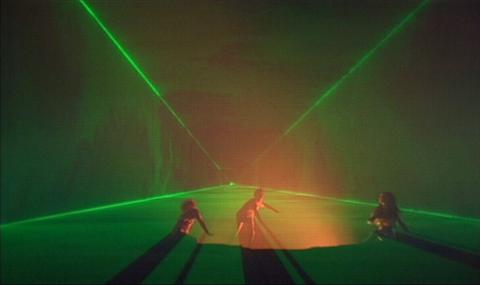
| The Rhinemaidens and their gold...and those awesome lasers. |
This Ring Cycle was recorded and filmed at the Bayreuth Festspielhaus in 1992, in a series of filmed rehearsals. The production itself dates from the late '80s, and is set in a bleak, post-apocalyptic world that might make viewers think of Mad Max
So here's our affectionate, (if not totally reverent)
Ten Reasons to Love the Barenboim Ring or
"How I Learned to Stop Worrying and Love the Dwarf."
| Trenchcoat Mafia: Anne Evans (prone) and John Tomlinson as Wotan in Die Walküre. |
From Hagen (Philip Kang's) sharp leather number to Brunnhilde's shiny PVC armor, the cycle looks like it was costumed by Morty Seinfeld. But the best is Wotan's--with a fur-lined collar that goes nicely with his cowboy hat and aviators. Makes John Tomlinson look all bad-ass.
9) The singers get good exercise.
Harry Kupfer's stage directions are interesting at times. Siegfried (Siegfried Jerusalem) uses Mime's cave like a jungle gym, and then gets a real workout fighting Fafner's giant mechanical tentacles. Plus, characters have a tendency to fall down at odd times, and getting up again is good for the leg muscles.
![]() |
| Mime's cave is a broken missile silo on its side. Those green things are nuclear fuel for his forge. That's Siegfried Jerusalem hanging on the side as Siegfried. Graham Clarke (top) is Mime. |
The king of the Gods is traditionally absent from the final opera in the Ring. Here he drops in at his grandson's funeral. In Siegfried. Wotan controls the Forest Bird, a mechanical wind-up bird that dances on the end of his spear. Not to be outdone, Alberich (Gunther von Kannen) appears unexpectedly in Act I of Siegfried and in the last scene of Götterdämmerung, staring numbly at the conflagration.
7) The Giants are Really Big (and scary!)
In fact, Fasolt (Matthias Holle) and Fafner (Philip Kang) appear on giant rolling platforms twenty feet high with floppy arms, and a perspective trick that makes these dim-witted laborers look microcephalic. Fafner also appears in Siegfried, operating giant mechanical tentacles that make him look like Doctor Octopus from the Spider-Man comics.
6) Das Ende Will Be Televised.
If the world were to end tomorrow (or sometime in 2012), we'd all be glued to our tubes getting the news from some network or other. At least until the power, the Internet and the cellular networks went down. This production captures that moment, featuring Gibichungs huddled and numbly watching the final apocalypse on a number of television sets.
| Anne Evans as Brunnhilde (right) and Philip Kang looking all bad-ass as Hagen |
In Act I of Die Walküre, Siegmund (Poul Elming) and Hunding (Matthias Holle) express their mutual dislike and distrust of each other by tearing up chunks of baguette, while sitting at either end of a long table and glaring. (Maybe Sieglinde (Nadine Secunde) was going to stuff a turkey?) It's an unintentionally funny moment in an otherwise fine Walküre.
4) The Rhine Journey is actually staged.
Most productions of the Ring drop the curtain during the orchestral interlude that separates the prologue and first act of Götterdämmerung. Not here. Brunnhilde's rock descends majestically into the stage, revealing Siegfried and a mdel horse, travelling up a river-bed of green lasers.
3) The Singing Is Good--If Unusual.
John Tomlinson's bass is a bit rough and heavy for Wotan. Anne Evans' silvered instrument is best suited to the friendly confines of the Festspielhause. But these are important, unusual interpretations of these key roles, and should be heard by any Wagner enthusiast. Siegfried Jerusalem is at his best, playing his namesake. Graham Clarke's high-wire performance as Mime must be seen.
2) What's Happening Under the Stage?
Daniel Barenboim is at a personal peak here, leading the Ring with style, flair, and a full-throated roar of sound from the Bayreuth pit. Although tempos are a little eccentric, his style recalls his idol (and teacher) Wilhelm Furtwängler. There is no higher compliment.
1) Lasers Are Cool!
(Well, they are!) This Ring features the cunning use of lasers and smoke to represent the watery depths of the Rhine and the magic fire surrounding Brünnhilde's rock (which appears as a giant, glowing "burglar alarm." Wagner is already awesome. Lasers are awesome.
Lasers + Wagner = Double Awesome.
All images © 1992 Warner Brothers Classics
Wednesday, February 2, 2011
The Punxsatawney Playlist: Music For Eternity
"OK, campers. Rise and shine! And don't forget your booties 'cause it's cooooold out there today!"--Groundhog Day
For some, February 2nd is the longest day of the year.
In the film Groundhog Day the day Bill Murray found himself trapped in Punxsatawney, PA for what (literally) seemed like an eternity. (According to director Harold Ramis, it was actually about ten years.) Over the course of the film, he experiences Feb. 2, 1993 over and over, spending his days as a romantic lover, a bank robber, and eventually, a decent human being...
...who can play the piano real good.
Part of the fictional Phil Connors' path to redemption is an infinite series of daily piano lessons with a local instructor. By the time the movie ends, he has progressed to playing a jazzy improvisation on the Eighteenth Variation from Sergei Rachmaninoff's Rhapsody on a Theme by Paganini.
So with Mr. Connors in mind, here's a list of musical works I wouldn't mind spending eternity with. No particular order.
1) Bach: The Well-Tempered Clavier Book I & II.
These 48 preludes and fugues in all the major and minor keys are the touchstone of modern keyboard playing, be it on the piano, harpsichord, or (possibly) calliope. Bach's work is immortal, and endlessly rewarding to the listener. (If I had to choose: piano, please.)
2) Wagner: Parsifal
Yeah, I know. You'd expect The Ring to be in this spot. But Parsifal offers an endless contemplation of the very meaning of time and space in the course of three acts. Not to mention, it's about why living forever may not be the best deal.
3) Schubert: String Quintet in C Major
My favorite piece of chamber music. I wrote about this yesterday in the Schubertiade piece. It deserves to make the list twice.
4) Beethoven: 32 Piano Sonatas
OK, I'm cheating. But this is eternity we're talking about. If I have to pick just one I'll take the mighty Hammerklavier, a work that like many music lovers, I'm still trying to wrap my brain around 200 years after its publication.
5) Richard Strauss: Eine Alpensinfonie
This symphony/tone poem depicts (in 22 movements and 45 minutes) man's struggle for existence. The fun part: all that philosophy is disguised as a travelogue--the story of a journey up and down an Alpine peak, with a thunderstorm wetting the descent.
6) Liszt/Beethoven: Piano Transcriptions of the Nine Symphonies
The beauty and power of Beethoven's symphonies, redesigned to be played by only ten fingers. After contemplating the brilliance of Beethoven's invention, you can spend the rest of eternity trying to figure out how the hell Liszt managed it.
7) Mozart: Le Nozze di Figaro
It's still my favorite Mozart opera, filled with endless melodic invention--and it sounds fresh every time you hear it. Figaro is a score full of small miracles. As it's eternity, a recording that includes the Barbarina and Basilio arias in Act IV is preferred.
8) Verdi: Requiem
Some writers joke that this setting of the Latin death mass is in fact, Verdi's best opera. Elevating the composer's art from the stage to the church, the Requiem throbs with power and musical invention.
9) Brahms: Piano Concerto No 1
Brahms' profound first concerto carries all the weight and power of a great Beethoven work, redolent with the thick musical textures that characterize this composer's music. The challenging piano part is endlessly rewarding, particularly in the long, singing Adagio.
10) Wagner: Der Ring des Nibelungen.
OK. I give. I'm a Wagnerite. And I couldn't imagine eternity without the political machinations of Das Rheingold, the passion of Die Walküre, the optimism of Siegfried or the complex profundity of Götterdämmerung. Not to mention Hagen's dirty jokes in the second act.
![]() |
| A scene from Groundhog Day, with Bill Murray playing Rachmaninoff. © 1993 Columbia Pictures/Sony Entertainment |
In the film Groundhog Day the day Bill Murray found himself trapped in Punxsatawney, PA for what (literally) seemed like an eternity. (According to director Harold Ramis, it was actually about ten years.) Over the course of the film, he experiences Feb. 2, 1993 over and over, spending his days as a romantic lover, a bank robber, and eventually, a decent human being...
...who can play the piano real good.
Part of the fictional Phil Connors' path to redemption is an infinite series of daily piano lessons with a local instructor. By the time the movie ends, he has progressed to playing a jazzy improvisation on the Eighteenth Variation from Sergei Rachmaninoff's Rhapsody on a Theme by Paganini.
So with Mr. Connors in mind, here's a list of musical works I wouldn't mind spending eternity with. No particular order.
1) Bach: The Well-Tempered Clavier Book I & II.
These 48 preludes and fugues in all the major and minor keys are the touchstone of modern keyboard playing, be it on the piano, harpsichord, or (possibly) calliope. Bach's work is immortal, and endlessly rewarding to the listener. (If I had to choose: piano, please.)
2) Wagner: Parsifal
Yeah, I know. You'd expect The Ring to be in this spot. But Parsifal offers an endless contemplation of the very meaning of time and space in the course of three acts. Not to mention, it's about why living forever may not be the best deal.
3) Schubert: String Quintet in C Major
My favorite piece of chamber music. I wrote about this yesterday in the Schubertiade piece. It deserves to make the list twice.
4) Beethoven: 32 Piano Sonatas
OK, I'm cheating. But this is eternity we're talking about. If I have to pick just one I'll take the mighty Hammerklavier, a work that like many music lovers, I'm still trying to wrap my brain around 200 years after its publication.
5) Richard Strauss: Eine Alpensinfonie
This symphony/tone poem depicts (in 22 movements and 45 minutes) man's struggle for existence. The fun part: all that philosophy is disguised as a travelogue--the story of a journey up and down an Alpine peak, with a thunderstorm wetting the descent.
6) Liszt/Beethoven: Piano Transcriptions of the Nine Symphonies
The beauty and power of Beethoven's symphonies, redesigned to be played by only ten fingers. After contemplating the brilliance of Beethoven's invention, you can spend the rest of eternity trying to figure out how the hell Liszt managed it.
7) Mozart: Le Nozze di Figaro
It's still my favorite Mozart opera, filled with endless melodic invention--and it sounds fresh every time you hear it. Figaro is a score full of small miracles. As it's eternity, a recording that includes the Barbarina and Basilio arias in Act IV is preferred.
8) Verdi: Requiem
Some writers joke that this setting of the Latin death mass is in fact, Verdi's best opera. Elevating the composer's art from the stage to the church, the Requiem throbs with power and musical invention.
9) Brahms: Piano Concerto No 1
Brahms' profound first concerto carries all the weight and power of a great Beethoven work, redolent with the thick musical textures that characterize this composer's music. The challenging piano part is endlessly rewarding, particularly in the long, singing Adagio.
10) Wagner: Der Ring des Nibelungen.
OK. I give. I'm a Wagnerite. And I couldn't imagine eternity without the political machinations of Das Rheingold, the passion of Die Walküre, the optimism of Siegfried or the complex profundity of Götterdämmerung. Not to mention Hagen's dirty jokes in the second act.
As you contemplate eternity, watch Phil's piano solo!
Monday, January 31, 2011
The Superconductor Top Ten: A Schubertiade
![]() |
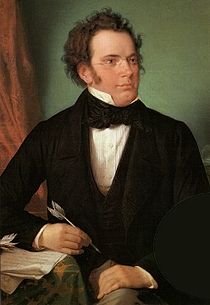
| Franz Schubert. Portrait by Wilhelm August Rieder |
1) Symphony in B Minor ("Unfinished")
From its tremolo opening to the noble theme, sung forth in the cellos, this two-movement torso features everything that makes a Schubert work great: powerful, innovative use of modulation, and above all melodies that at first soothe and ultimately end on a disquieting, unfinished note. Schubert sketched a third movement, and may have planned a fourth, but the Unfinished stands as a masterpiece.
2) Der Doppelganger
Many of Schubert's best songs are horror stories in miniature. Schubert's second-to-last lied explores psychological horror: the idea of having to confront your own duplicate--and your own madness.
3) Erlkönig
With its difficult, galloping piano part, this song about a father trying to save his child from a demonic figure (the "Erl King") is one of Schubert's most popular Lieder. The singer has to play four parts: the narrator, father the terrified child, and the wheedling, seductive Erl King. All this in four minutes.
4) Der Wanderer
This soul-searching ballad is one of the most famous Schubert songs, from its introspective opening recitative, to the introduction of a lilting, almost gleeful 6/8 figure in the second half that brings the work to a climax. It also served as the launch-point for the later "Wanderer Fantasy", one of the composer's famous piano works.
5) String Quartet No. 12: Quartettsatz
Schubert spent much of his brief career pushing the boundaries of form in chamber music. (Often he would do so by simply not finishing works.) This is the first movement from the never-completed String Quartet No. 12. It stands on its own, especially with its warm, harmonized second subject. Premiered after the composer's death.
6) String Quintet in C Major D. 956
The best "gateway" to the music of Schubert is this exquisite, melancholy quintet that (unusually) replaces the traditional second viola with a second 'cello--allowing the two low instruments to interweave and comment on each other's basslines as the violins duel in the upper register. Genius.
7) Der Winterreise
The most famous song cycle ever written. The hero, rejected by his lover, begins a trek into white oblivion, slowly going mad in the freezing dead of winter over the course of 24 songs. Winterreise broke fresh ground when it premiered, and its narrative never fails to chill one to the marrow.
8) Piano Sonata No. 6 in E Minor
Like many Schubert works, this piano sonata shifts moods as it develops. An up-tempo opening gives way to the suffering brooding beneath the surface. Schubert wrote 21 sonatas. His work does not have storm and fire of Beethoven or the dazzling virtuososity of Liszt. But it has endured through the emotional, melodic nature of the music which speaks to listeners 200 years later.
9) Nachtgesang im Walde
Written for four horns and a male chorus, this short part-song is one of Schubert's fine examples of secular choral writing. The opening evokes the mystery of the woods at night, and the later pages shift to celebratory hunting music. The combination of chorus, nature images and mysterious minor chords points the way forward to Mahler.
10) Impromptu No. 2 in E Flat
This work opens rolling wave of arpeggiated notes displays Schubert the consumnate pianist. It requires fluid legato playing and a dexterous technique. Once the main theme arrives, the swift passage becomes expert accompaniment to the noble main theme. Played by the right pianist, the effect of this demanding piece is breathtaking.
Subscribe to:
Posts (Atom)
Trending on Superconductor
-
The helicopter attack from Apocalypse Now. © 1979 American Zoetrope Studio/Lions Gate Pictures In the 20th century, the surging string...
-
Semyon Bychkov conducts Mahler's Sixth . by Paul J. Pelkonen The Mahler Sixth meets its maker at the New York Philharmonic. L.-R. K...
-
The Cleveland Orchestra sails into Carnegie Hall. by Paul J. Pelkonen White tie and tails: Franz Welser-Möst. Photo by Michael Pöhn fo...