Support independent arts journalism by joining our Patreon! Currently $5/month.

About Superconductor

Our motto: "Critical thinking in the cheap seats." Unbiased, honest classical music and opera opinions, occasional obituaries and classical news reporting, since 2007. All written content © 2019 by Paul J. Pelkonen. For more about Superconductor, visit this link. For advertising rates, click this link. Follow us on Facebook.
Showing posts with label oratorio. Show all posts

Sunday, January 27, 2019

Concert Review: No Exits, No Escapes

The New York Philharmonic unveils Fire in my mouth.
by Paul J. Pelkonen
The premiere of Fire in my mouth with the Young People's Chorus of New York (left and right)
the singers of The Crossing (center) and the New York Philharmonic under the baton of Jaap van Zweden.
Photo © 2019 The New York Philharmonic.
Although the efforts of the New York Philharmonic to commission and perform new works by contemporary composers are sometimes met with chagrin by its audience, new music remains one of the most important priorities for the orchestra. This weekend marked the first performances of Fire in my mouth, a new oratorio by Julia Wolfe.

Friday, December 7, 2018

Concert Review: Salvation on Fifth Avenue

The St. Thomas Men and Boys Choir presents Handel's Messiah.
by Paul J. Pelkonen
The St. Thomas Chois of Men and Boys, earlier this season performing Israel in Egypt.
Photo from St. Thomas Episcopal Church.
There are any number of ways for a chorus and orchestra to come together to perform Messiah, the 1741 oratorio that remains Handel's most popular contribution to the canon of Western classical music. For New Yorkers, one of the most satisfying and traditional Messiah experiences to be had is held each year at St. Thomas' Episcopal Church, which is home to one of the few choral schools still operating in the United States.

Thursday, January 25, 2018

Concert Review: Welcome to FarmVille

The Cleveland Orchestra turns Haydn's The Seasons.
by Paul J. Pelkonen
Franz Welser-Möst and the Cleveland Orchestra.
Photo by Roger Mastroianni © 2017 The Cleveland Orchestra.
You don't hear the Haydn oratorios much.

The father of the symphony and the string quartet wrote two late ones for his London audiences following the success of his cycle of late symphonies. Of the two, it is the first The Creation that shows up on the occasional choral program. On Wednesday night, Franz Welser-Möst and the Cleveland Orchestra made their case for The Seasons (German title: Die Jahrezeiten) with a concert performance of the piece on the big stage at Carnegie Hall.

Sunday, December 24, 2017

The St. Roger's Passion: A Pink Floyd Oratorio

An oratorio scenario inspired by Pink Floyd.
by Paul J. Pelkonen 
(with apologies to Roger Waters, David Gilmour and Nick Mason)
Lo there is no dark side of the moon. Art by Paul Klee, Hipgnosis and Gerald Scarfe.
Dark Side of the Moon symbol © 1973 EMI Records
So today I was talking to a friend who is singing at the Kennedy Center tonight. She referred to it as singing "at the KC". I said, "Oh, you're singing King Crimson?" because I'm a smartass.

She said, "no the Kennedy Center. I'm singing about sheep."

It is to her I'd like to dedicate this little holiday offering, a completely made up outline for

Saturday, December 9, 2017

Concert Review: The Boys' Club

The St. Thomas Choir celebrates Handel's Messiah.
by Paul J. Pelkonen
The Enraged Musician. Engraving by William Hogarth from 1741,
the year of the premiere of Handel's Messiah.
Handel's Messiah is a ubiquitous event for New York music lovers, with as many as thirty different choruses and ensembles offering performances of this oratorio. On Tuesday night, New York Baroque Incorporated and the St. Thomas Choir of Men and Boys kicked off the Advent season  with the first of two performance this week at St. Thomas Church. Using period instruments, four soloists and an all-male chorus, this modest Messiah was as Handel himself might have heard it.

Saturday, May 13, 2017

Concert Review: The Power and the Passion

Leon Botstein wrestles Elgar's The Apostles.
by Paul J. Pelkonen
Leon Botstein. Photo by Kallaher for Bard College.
It is never a good idea to follow in the footsteps of Richard Wagner. That truism could easily be applied to Edward Elgar's long-neglected oratorio The Apostles. Elgar conceived The Apostles as the first part of a planned trilogy of stage works based on the New Testament, following a visit to Bayreuth in 1902. However, this piece, played at Carnegie Hall on Friday night by Leon Botstein and the American Symphony Orchestra, is problematic at best.


Wednesday, February 8, 2017

Concert Review: Her Terrible, Swift Sword

Juditha Triumphans triumphs at Carnegie Hall.
by Paul J. Pelkonen
Judith and Holofernes by Valentin de Bolougne. 
National Museum of Fine Arts, Valletta, Malta
The music of Antonio Vivaldi was forgotten for centuries. When he was rediscovered in the 20th century, he rapidly emerged as one of the greatest composers of Renaissance Venice. The father of the multi-movement violin concerto, he was also a teacher of music, the creator of 94 operas and (at least) four oratorios. On Tuesday night, Carnegie Hall resounded with its first performance of his lone surviving oratorio, Juditha Triumphans.

Friday, December 16, 2016

2016 Gift Guide: Big Box Sets For the Music Collector

There's nothing like Mozart  for the holidays.
by Paul J. Pelkonen

The business model of the music business has changed. Classical labels still do tons of reissues but usually in the form of huge boxed sets that attempt to show an overview of artist's life, an orchestra's journey or a conductor's approach to his work. Thanks to their tireless efforts, there are still a lot of options if you want to leave a doorstop-sized boxed set under a loved one's tree. Here are the best box sets to come out in 2016.

Monday, December 21, 2015

Concert Review: Keeping the Faith

The Philharmonic resurrects Handel's Messiah.
by Paul J. Pelkonen
Jane Glover.
Photo by Ken Howard for Chicago Music of the Baroque.
Ever since the twelve-year music directorship of the late Kurt Masur, the oratorio has resumed pride of place at the New York Philharmonic. That was confirmed last week when Jane Glover, the eminent British musicologist and conductor known to New Yorkers from her opera performances at Juilliard, made her debut with the orchestra conducting this year's run of Handel's Messiah.

Saturday, December 5, 2015

Concert Review: Making Tracks in Brooklyn

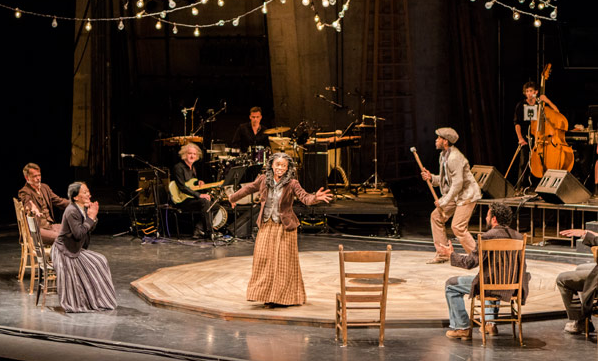
Julia Wolfe's Steel Hammer rolls into BAM.
by Paul J. Pelkonen
The Bang on A Can All Stars and the SITI Ensemble perform Steel Hammer. 
Eric Berryman (standing, right, with hammer) is John Henry.
Photo © 2015 the Krannert Center and courtesy Brooklyn Academy of Music.
The composer Julia Wolfe is one of the most important voices in American music. Winner of the Pulitzer Prize for Music for her oratorio Anthracite Fields she combines Appalachian folk music, minimalist techniques and the power of the human voice to create a unique American sound, rock-ribbed, raw-boned and bursting with vitality. On Wednesday night, the Bang On A Can All-Stars and the SITI Company brought the New York premiere of the fully staged version of her first oratorio Steel Hammer to the BAM Harvey Theater in the waning days of this year's NextWave Festival.

Thursday, August 27, 2015

Concert Review: The Shaper of Worlds

Mostly Mozart ends with Haydn's Creation.
by Paul J. Pelkonen
And lo he said, let there be light: Mostly Mozart music director Louis Langrée.
Photo © 2015 Mostly Mozart/Lincoln Center for the Performing Arts.
The 2015 Mostly Mozart Festival ended last week with two performances of Haydn's The Creation, that highly stylized oratorio built around the early events of the Book of Genesis. Haydn's work is one of beginnings and creation from the void, and was an apt choice to end a successful run by the oldest Lincoln Center event, one that has largely succeeded in reinventing itself and its image in the face of a challenging musical environment.

Friday, May 8, 2015

Concert Review: Prophets and Losses

The Collegiate Chorale travels The Road of Promise.
by Paul J. Pelkonen
Wholly Moses: Mark Delevan in The Road of Promise at Carnegie Hall.
Photo by Erin Baiano © 2015 The Collegiate Chorale.
The Nazi persecution of Jewish composers and musicians remains a permanent blood-stain on the history of 20th century art music. On Thursday night, the Collegiate Chorale presented Kurt Weill's The Road of Promise to close out their season at Carnegie Hall. This is a new condensed concert version of Weill's little heard magnum opus Der Weg der Verbeissing (presented originally as The Eternal Road), a massive opera-oratorio written as a vehement protest against the encroaching darkness of Hitler's Germany.

Saturday, December 20, 2014

Concert Review: Salvation Found Together

The Trinity Choir presents Messiah (again.)
by Paul J. Pelkonen
Singers of the Trinity Choir.
Photo by Leah Reddy for Trinity Church.
Handel's Messiah remains his blockbuster. It has remained in the repertory for 261 years, moving from a work performed to raise money for hospitals at Easter to an annual New York tradition in celebration of Christmas. Each year, its most traditional visitation comes at Trinity Church, which gave the work's New York premiere when it was considered "new music." That premiere was echoed by Wednesday night's performance, which also kicked off a month-long celebration of baroque music at this historic locale.

Tuesday, November 4, 2014

Concert Review: The Genesis Effect

The Oratorio Society of New York plays Haydn's Creation.
by Paul J. Pelkonen
Conductor Kent Tritle leading the Oratorio Society of New York at Carnegie Hall.
Photo by Tim Dwight © 2014 The Oratorio Society of New York. 
Franz Joseph Haydn is a pivotal figure in music. The father of the symphony and the string quartet, Haydn is too often pigeon-holed as a doddering relic, a composer who churned out similar works to keep a rich patron happy and whose music remains irrelevant today. With their season-opening performance of The Creation ("Die Schöpfung") on Monday night at Carnegie Hall, Kent Tritle and the Oratorio Society of New York showed that the truth about Haydn is something very different.

Wednesday, May 21, 2014

Concert Review: An Act of Faith

The Oratorio Society of New York presents the St. Matthew Passion.
by Paul J. Pelkonen
The stained glass Bach window in the Thomaskirche, Leipzig, Germany,
Photo from Wikimedia Commons.
Johann Sebastian Bach’s St. Matthew Passion is the composer’s mightiest creation, an unflinching account of the arrest, trial,and execution of Jesus as laid down in the first Gospel of the New Testament. First performed for Good Friday service in St. Thomas’ Church in Leipzig, it retains all of its emotional impact in the concert hall. A strong performance of this work is a declaration of faith, not necessarily in Christianity but in the perfect musical design that Bach uses throughout this sprawling work.

Friday, March 28, 2014

Concert Review: He Supposes, Erroneously

The American Symphony Orchestra exhumes Max Bruch's Moses.
by Paul J. Pelkonen
Sssh: American Symphony Orchestra music director Leon Botstein
Photo by Jito Lee © 2011 The Melos Ethos Festival.
Since assuming the directorship of the American Symphony Orchestra in 1991, Dr. Leon Botstein has made it his mission to expose audiences to long-forgotten works of the 19th and 20th centuries. His latest discovery is Moses, a two-hour oratorio by Max Bruch, written in 1895 when the Romantic tradition was breathing its last. On Thursday night, Dr. Botstein led the ASO in this work, joined by the Collegiate Chorale and a trio of up-and-coming opera singers at Carnegie Hall.

Friday, August 23, 2013

Concert Review: The Departed and the Heroic

The Orchestra of the Age of Enlightenment pays tribute to Lorraine Hunt Lieberson. 
by Paul J. Pelkonen
Lorraine Hunt Lieberson in Peter Sellars' production of Theodora at Glyndebourne.
Photo by Mike Hoban © 1996 Glyndebourne Festival.
On Thursday night, the Mostly Mozart Festival welcomed the Orchestra of the Age of Enlightenment for a special concert of Handel arias and orchestral works, specifically dedicated to the memory of Lorraine Hunt Lieberson. (who succumbed to breast cancer in 2006) was one of the premiere mezzo-sopranos of the modern age, a key member of a generation of singers responsible for renewing the public's interest in the operas of Handel and baroque repertory in general.

Friday, March 29, 2013

Concert Review: The Passion, California Style

John Adams' The Gospel According to the Other Mary with the L.A. Philharmonic.
by Paul J. Pelkonen
The cast of The Gospel According to the Other Mary with conductor Gustavo Dudamel (left).
Photo by Richard Termine © 2013 Richard Termine Courtesy Lincoln Center.
Gustavo Dudamel and the Los Angeles Philharmonic are back in New York. On Wednesday night, the fiery Venezuelan conductor led the New York premiere of The Gospel According to the Other Mary, a massive, nearly three-hour oratorio by composer John Adams. Other Mary (as it is called in the program) is a follow-up to Mr. Adams' 2000 composition El Niño. It recounts the late works, death, and resurrection  of Jesus from a distinctly feminist perspective.

Tuesday, December 11, 2012

The Hallelujah Alternative

A look at upcoming holiday concerts in New York.
Image from the film Hallelujah © 1929 MGM Pictures.
I know it's been a while since we've done a calendar post on this blog--the work that went into them was not equalling the amount of page views and clicks every month. However, as the holidays approach we would like to take a look around our fair city and offer up some alternatives to holiday merriment in various local music merriment. 

Do not fear, New Yorkers: there are plenty of performances of Handel's Messiah scheduled in the two-week run-up to Christmas.

The famed oratorio returns to the New York Philharmonic this season with a strong cast of singers and the New York Choral Artists. 
Dec. 18-22 at Avery Fisher Hall

It will also be heard at St. Thomas' Church (Dec. 11, 13) Avery Fisher Hall (Dec. 12 with the Trinity Choir, Dec. 17 with the National Choral Council Messiah Sing-In) Carnegie Hall (Dec. 20, with two performances Dec. 23 at 2pm and 7:30pm) and elsewhere. 

But this year, we're moving beyond Messiah to explore some alternative holiday concerts that offer other composers' equally profound takes on the reason for the season. 

Monday, November 21, 2011

Concert Review: The Martyr Complex

Jeanne d'Arc au Bûcher at Carnegie Hall.
by Paul Pelkonen.
Joan of Arc's Death at the Stake
by Hermann Stilke.
Image from Wikimedia Commons.
Saturday night at Carnegie Hall featured a  New York appearance from the Baltimore Symphony Orchestra, performing Arthur Honegger's equally rare Jeanne d'Arc au Bûcher, a 1935 dramatic oratorio depicting the martyrization of Joan of Arc. Marin Alsop conducted.

This  unconventional oratorio requires vast resources, superbly commanded here by Ms. Alsop. Honegger wrote for a giant orchestra, a three-part chorus, and the ondes Martenot, an early electronic instrument whose eerie, swooping sound represents both the barking of dogs around Joan's stake and the onslaught of divine intervention.

Honegger is chiefly remembered today for his membership in Les Six, the handful of France-based composers who modernized music in the first half of the 20th century. His work is tonal, rising from the minor-key darkness of the prologue (added when the work was revised in 1946.

The music veers into a satiric, jazz-inflected voice in the description of Joan's trial (her prosecutor is a pig, the judge depicted as a sheep) and the "game of cards" where Kings and Queens shuffle and cut for the right to kill the innocent Joan. Ms. Alsop kept taut control over the tricky rhythms and the shifts in mood, with characterful contributions from the large cast of singers and actors.

The work achieves an ecstatic height in its last sections, starting with the passage where Brother Dominic (Ronald Guttman) grills Joan about the discovery of her sword. At this point, the music shifts heavenward, with overwhelming, rising passages that depict the religious fervor of Joan and influence of a higher power on her short life. 

Right before the burning, a medieval folk-dance, Tirazo is added to the orchestral fabric. Like the Turkish march in Beethoven's Ninth Symphony, the dance drives the work to a higher energy level, for the difficult, emotionally wrenching depiction of the burning itself. This final sequence rises to an extraordinary height, with the orchestra thundering, the chorus providing support and the soprano voice of the Virgin welcoming Joan to Heaven. 

Jeanne d'Arc requires a large cast. Soprano Tamara Wilson was potent as the voice of the Virgin Mary, although she fought to get over the huge orchestra in the last pages. Tenor Timothy Fallon was squally and bleating, appropriate to the part of the porcine prosecutor. Bass Morris Robinson made a strong impression in his short passages. 

The part of Joan is spoken. Actress Caroline Dhavernas was a powerful, dramatic force. Her hair bound up and her dress plain (historically accurate, as Joan was tried wearing men's clothing), Ms. Dhavernas became a simple figure of faith standing up for injustice. The contemporary, political resonance of this image only added to the overwhelming strength of this performance.

Contact the author: E-mail Superconductor editor Paul Pelkonen.

Trending on Superconductor

Translate

Share My Blog!

Share |

Critical Thinking in the Cheap Seats