Support independent arts journalism by joining our Patreon! Currently $5/month.

About Superconductor

Our motto: "Critical thinking in the cheap seats." Unbiased, honest classical music and opera opinions, occasional obituaries and classical news reporting, since 2007. All written content © 2019 by Paul J. Pelkonen. For more about Superconductor, visit this link. For advertising rates, click this link. Follow us on Facebook.
Showing posts with label Ivan Fischer. Show all posts

Friday, November 9, 2018

Concert Review: It Wouldn't Be in Summer

Iván Fischer conducts the New York Philharmonic.
by Paul J. Pelkonen
Conductor Iván Fischer returned to the podium of David Geffen Hall on Wednesday night.
Photo by Chris Lee © 2017 The New York Philharmonic.
Wednesday night's concert at the New York Philharmonic felt more like Mostly Mozart.

It wasn't just the program: a brief but satisfying blend of Beethoven and Schubert. It was the presence of frequent MM guest Iván Fischer, who, for a number of seasons has enlivened that summer festival by bringing his orchestra charges: the Budapest Festival Orchestra (an ensemble he founded and still currently leads) to play symphonies and operas at Lincoln Center. Here, Mr. Fischer found himself at the helm of the New York Philharmonic, but wasted no time in ensuring that this was a very different kind of concert.

Friday, November 25, 2016

Concert Review: A Game of Chairs

Iván Fischer leads (and reseats) the New York Philharmonic.
by Paul J. Pelkonen
Conductor Iván Fischer leads the New York Philharmonic this week.
Photo courtesy the New York Philharmonic © 2014 The Budapest Festival Orchestra.
The seating of an orchestra is usually at the discretion of the conductor. On Wednesday night, visitors to David Geffen Hall for the first of three concerts featuring Hungarian conductor Ivan Fischer and the New York Philharmonic were confronted with a radical rearrangement of the orchestra. The stage risers, almost never seen at a Philharmonic concert, were in use, putting the musicians in tiers with the basses at the top, dead center and directly opposite the conductor's podium.

Monday, February 22, 2016

Concert Review: Business As Unusual

The Budapest Festival Orchestra returns to Carnegie Hall.
by Paul J. Pelkonen
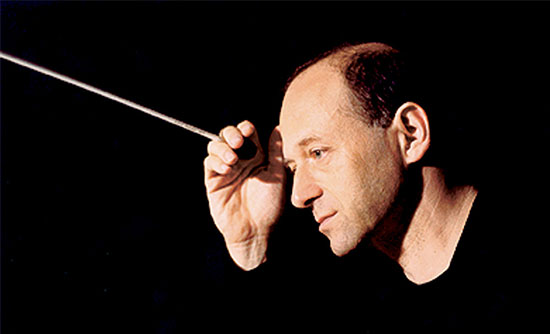
Man and baton: Budapest Festival Orchestra music director Iván Fischer
in a pensive moment. Photo © 2015 Budapest Festival Orchestra/Channel Classics.

Founded in 1983, the Budapest Festival Orchestra is a relatively recent addition to the ranks of central Europe's great ensembles. Under the direction of Iván Fischer, these Hungarian players always offer something fresh, from Lincoln Center stagings of the great Mozart operas to powerhouse readings of the great works of the 19th and 20th century. On Thursday night, the Hungarian band returned to Carnegie Hall for a conventional concert program (overture, concerto, symphony) that proved, in its execution to be anything but ordinary.

Wednesday, June 4, 2014

Concert Review: Unbowed But Undefeated

The Budapest Festival Orchestra plays Dvořák. 
by Paul J. Pelkonen
Iván Fischer. Photo © 2014 by Dan Porges.
When the Budapest Festival Orchestra arrived in at Newark Airport, they received an unwelcome surprise. The orchestra's violinists had their bows (which were shipped separately to J.F.K.) seized by U.S. Customs at the Kennedy Airport due to suspicion that these vintage implements might contain ivory. On Monday night, with substitute bows (loaned by generous local string players) in hand, this Hungarian orchestra presented the second of two concerts focusing entirely on the music of Antonín Dvořák.

Wednesday, August 14, 2013

Opera Review: Off the Rack

The Budapest Festival Orchestra presents Le Nozze di Figaro.
by Paul J. Pelkonen
Iván Fischer (lower right) supervises the good-natured insanity in Act II of
Le Nozze di Figaro at Lincoln Center's Mostly Mozart Festival.
Photo by Richard Termine © 2013 Richard Termine.
One of the most eagerly anticipated events of this year's Mostly Mozart Festival is the return of conductor-director Iván Fischer and the Budapest Festival Orchestra. Mr. Fischer, who mounted a superb Don Giovanni two years ago) have returned to Lincoln Center with a new production of Mozart's Le Nozze di Figaro, seen Tuesday night at the Rose Theater.

Monday, December 26, 2011

The Year in Reviews: Concerts and Recitals in 2011

The year of the "new jack" maestro.
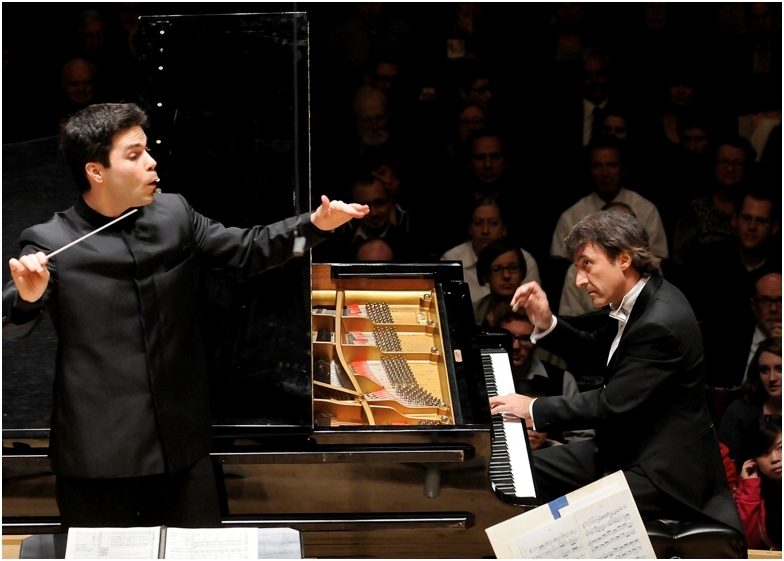
Life saver: Sean Newhouse (left) stepped in for James Levine.
Here, he conducts Prokofiev with pianist Jean-Efflam Bavouzet.
Photo by Stu Rosner © 2011 Boston Symphony Orchestra.
With disasters striking down a number of prominent conductors this year (Seiji Ozawa's battle with cancer, Riccardo Muti's fall and injury, and a whole stack of misfortunes for James Levine), 2011 was the year that young conductors stepped up to the podium and took charge. From Sean Newhouse in Boston to Yannick Nézet-Séguin in Philadelphia, this was the year of a continued youth movement on North American podiums.

It was also a busy season for your favorite classical music blog. 94 concerts in four different cities. And seeing one more this week to make it 95. On to 2012!


Budapest Festival Orchestra: The Rite of Spring (Jan. 27)
"Under Iván Fischer's direction, the taut polyrhythms and blasts of brass acquired a fearsome, battering force, hammering at the senses in a frenzied dance. A reprieve came with the second section of the ballet, but it was not to last."

Boston Symphony Orchestra: Sean Newhouse's Boston debut (Feb. 27)
"Mr. Newhouse proved himself up to the task on Saturday night, leading a vigorous performance that balanced the extremes of this long, difficult work. The young conductor did more than just beat time--he offered his own interpretation of the work, making Mahler's last completed symphony a profound and deeply humanistic statement."

Louis Lortie plays Liszt (March 11)
"The pianist took his audience on a detailed tour of Liszt's travels in Switzerland. He drove the piano, playing from his shoulders, crossing hands for the most difficult passages and ranging across his instrument as Liszt traversed the Alps."

Leif Ove Andsnes at Carnegie Hall (April 9) 
"Mr. Andsnes brought a fiery approach to the first movement, conjuring up the stormy figures and near-fugal textures common to late Beethoven. The second movement was far more lyrical. The slow Arietta was played with quiet, poetic restraint."


Cleveland Orchestra: Bruckner Eighth. (July 17)
"Mr. Welser-Möst took a surprising, fast tempo for the opening movement, creating driving figures in the strings that moved the work forward and opened vast sonic vistas for the listener. This enabled the full 18-piece Cleveland brass section to cut loose with massive, block chords, voiced in stately, organ-like tones by horns, trombones and Wagner tubas."

New York Philharmonic: A Concert for New York (Sept. 11)
"The heavy, stentorian opening blared out with emphatic force. Mr. Gilbert drew inspired music-making from the veteran winds and strings, playing the uplifting main themes with emotion missing with some other conductors."

Cleveland Orchestra: Stravinsky and Tchaikovsky (Oct. 9)
Mr. Welser-Möst brought maximum clarity to this work, which had not been heard at Severance Hall in nearly four decades. The orchestra responded brilliantly, as the knotty musical lines untangled themselves and the work coalesced. The brass, asked to make difficult contributions in this work, responded admirably, as did the superb woodwind section.


Yuja Wang's Debut at Carnegie Hall (Oct. 21)
"Ms. Wang dived into the opening theme (a representation of Mephistopheles) and brought the wild energy of Faust's ill-fated adventures out in the early pages. The plunge into the abyss was chilling, ending in grim, matter-of-fact low notes."

London Symphony Orchestra And Chorus: War Requiem (Oct. 24)
"The London Symphony Chorus was a force unto itself, declaiming the Latin text of the mass with the authority of the Metatron. The fiery incantations of the Dies Irae blazed forth with power. They were also key contributors to the success of the later movements, especially the slow-moving setting of the Agnus Dei."

Atlanta Symphony Orchestra, Garrick Ohlsson: Rachmaninoff Three (Nov. 7)
"The first movement's complicated cadenza held the audience breathless. The slow Intermezzo sang a sad Russian song. And the pell-mell finale, calling for the greatest degree of virtuosity from the pianist proved a thrilling experience."

Baltimore Symphony Orchestra: Jeanne d'Arc au Bûcher (Nov. 21)
"Actress Caroline Dhavernas was a powerful, dramatic force. Her hair bound up and her dress plain (historically accurate, as Joan was tried wearing men's clothing), Ms. Dhavernas became a simple figure of faith standing up for injustice."


Visit the rest of the 2011 Year in Reviews, our account of the year that went to "'11".


Sunday, October 30, 2011

Concert Review: The Rising Force

The Budapest Festival Orchestra takes Carnegie Hall.
Budapest Festival Orchestra conductor Iván Fischer.
This year the Budapest Festival Orchestra has built a strong reputation with New York audiences. Last spring, Iván Fischer's band roared through The Rite of Spring.  Last summer, they offered a compelling, fully-staged Don Giovanni at Mostly Mozart. Saturday night's concert at Carnegie Hall, featuring the music of Bartók and Schubert only added to that legacy.

Mr. Fischer chose an unusual seating arrangement for his players. Woodwinds were placed at the front, with the principal oboe in front of the concertmaster. All the bassists used five-string instruments. They were dead center, behind the brass. Other players moved around depending on which piece was being played.

The program opened with a Bartók rarity: settings of Hungarian Peasant Songs. These works were played with firm brass tones (especially from the trombones) and delicate, playful work from the oboe and clarinet. The tuba, moved to the front for these pieces enjoyed great prominence. Following what seems to be a trend among orchestras this year, Mr. Fischer had his violins and violas play these songs standing up.

The orchestra was joined by soloist András Schiff for Bartók's Second Piano Concerto. Mr. Schiff remains a sublime pianist, bringing out the lyric beauty in Bartok's high-speed, staccato keyboard figures and displaying a smooth legato. The solo part seemed to spill from his fingers in the slow second movement, accompanied by Mr. Fischer with a delicate, pointillist beauty. It's not surprising that these two Hungarian musicians work in a smooth tandem--they recorded all three Bartók concertos together for Teldec. Moreover, they were at school together.

Mr. Schiff held the Hall rapt in the last movement. His hands fluttered and dove over the keyboard, at one point bouncing out the melody in the high register with his right as his left raced up the lower regions. It was stunning playing, met with an enthusiastic reception. The soloist obliged the adulation with a pair of encores: a Schubert Impromptu and Liszt's lyrical Hungarian Rhapsody No. 5.

Schubert's Ninth Symphony sat in a drawer at the Gesellschaft der Musikfreunde in Vienna for a decade. In 1838, ten years after Schubert's death, it was shown to composer/critic Robert Schumann. Dubbed the "Great" Symphony, the Ninth has since become an orchestra standard, the most popular Schubert symphony besides the "Unfinished."

Mr. Fischer's interpretation did much to blow the dust from this well-traveled score. Schubert's innovative combination of wind, horns and trombone stands at the core of this work, and Mr. Fischer's choice to move the winds forward led to a superbly balanced sound. 

A noble, searching horn theme started the first movement, taken here at a slightly fast pace. Mr. Fischer maintained this momentum through the work, letting the eloquence of Schubert's echoing conversation between winds and strings speak for itself. The climax of the opening movement surged with joy and power that belied the composer's dire last years. 

The two dance movements, a fleet-footed Andante and joyful Scherzo also featured expert playing from the Budapest winds. Mr. Fischer drew extra reserves of power for the final Allegro, bringing the argument of this long symphony to a giddy climax. The last phrases, with staccato trumpets and stomping tuba sounded like a happy round dance, a rustic celebration in the tradition of Beethoven's Sixth.

The orchestra ended with what Mr. Fischer announced as their traditional encore: a cheerful and very Hungarian dance. It was a strong end to a solid program, another feather in the cap for this excellent, innovative and rapidly rising European orchestra.

Thursday, August 11, 2011

Concert Review: Between Sacred Songs, a Secular Symphony

At Mostly Mozart, Ivan Fischer puts the Jupiter in context.
Ivan Fischer demonstrates a new baton technique.
Photo courtesy the Orchestra of the Age of Enlightenment
Tuesday night at Mostly Mozart featured an innovative program of that composer's music under the baton of Hungarian maestro Iván Fischer. At its heart stood Mozart's 41st and final symphony, the Jupiter.

This is one of Mozart's most well-known and popular symphonies. But instead of using its grand pre-Romantic gestures to ring down the curtain on the evening, Mr. Fischer placed it second, between the choral motet Ave verum corpus and the Vesperae solennes de confessore, a setting of five Psalms and the Magnificat written at the end of Mozart's Salzburg years.

Mr. Fischer led this concert with the same technique as in the excellent Don Giovanni performances of last week. He balanced the orchestral forces, driving them forward while allowing the melodies room to blossom and breathe. Ave verum corpus was sung with delicacy and simple faith. It led into a brief organ melody from Kent Tritle. As the chorus members filed out (as if they were leaving church,) Mr. Fischer lauched into Jupiter.


The opening movement was played with jubilance and strength. Mr. Fischer created a narrative flow that led into the Andante with its lyric subject. The rhythms of the minuet, were firm and precise. The complex finale, with its fugal sections and difficult wind parts was taken a mite slower than some conductors, allowing fresh details to emerge with the color and vibrancy of a restored painting.

It was refreshing to hear the instrumental Jupiter contrasted with liturgical music. This illuminated the influences that went into writing this great work. (Not everything in this boisterous symphony is sacred however--the last movement alludes to a certain vulgar choral round, also written by Mozart. It's K. 231. Look it up.)

Whether working with his own Budapest Festival Orchestra or the Mostly Mozart band, Mr. Fischer has proven himself able to make listeners hear familiar music with new ears. But he also made the less familiar Vesperae shine forth with clarity and beauty. The opening "Dixit Dominus" was a rock-like statement of faith, with deep power and commitment. The fourth movement, "Laudate pueri" had a Bach-like precision. Soprano Lucy Crowe soared through "Laudate Dominum", a gorgeous aria worthy of one of Mozart's operas. The final Magnificat was played with exultation, a gorgeous affirmation of Mozart's genius and the abilities of this remarkable conductor.

Wednesday, January 26, 2011

Concert Review: Budapest Festival Orchestra Straddles Two Centuries

The 18th and 20th centuries clashed at last night's concert by the Budapest Festival Orchestra--with sexy results.
Iván Fischer
On Tuesday night, the orchestra explored the dichotomy between the genteel "classical" works of Franz Josef Haydn and the rough-and-tumble modernism of Igor Stravinsky. Iván Fischer, the kinetic Hungarian maestro who founded the orchestra 27 years ago, conducted.


The Haydn works found the orchestra in period instrument mode. The brass section used slide trumpets and natural horns, complete with replaceable crooks. Timpanist Dénes Roland sat at a small pair of period kettledrums, playing with wooden sticks. The Haydn Symphony No. 102 sprang to life, a work filled with genteel, yet earthy good humor. Crisp rhythms, warm strings and a bright contribution from the winds made this a distinguished performance.

The Piano Concerto No. 11 was written for an 18th century pianoforte. However, this performance pitted a modern Steinway (played by Alexei Lubimov) on a modern Steinway against the period band. Mr. Lubimov made the case for this anachronistic arrangement with fleet-fingered legato playing, and elegant turns of phrase. The final, rondo had an almost manic energy, as the orchestra supported Mr. Lubimov through every twist and turn of the work.


The full orchestra filled the stage for a raucous reading of The Rite of Spring. Stravinsky's 1913 ballet is one of the cultural touchstones of the 20th century, a thundering, violent work that depicts the barbaric pagan rites of ancient Russia. Under Mr. Fischer's direction, the taut polyrhythms and blasts of brass acquired a fearsome, battering force, hammering at the senses in a frenzied dance.

A reprieve came with the second section of the ballet, but it was not to last. The quieter moments, featuring the elegaic horns (now playing modern instruments), lengthy bassoon solos and muttered honks on the bass clarinets. These gave way to the final, sacrificial dance, driven to an earth-shattering conclusion as Mr. Fischer exhorted his musicians to new heights of aural savagery.

To close the concert, Mr. Fischer returned and led his band in a work from the 19th century: the 21st (and last) of Brahms' Hungarian Dances. Shot through with rhythms of their homeland, the Brahms work served as a pleasant, high-energy palate cleanser after the controlled brutality of the Stravinsky: a fitting way to end this New York appearance by this excellent, underrated orchestra.

Trending on Superconductor

Translate

Share My Blog!

Share |

Critical Thinking in the Cheap Seats