Support independent arts journalism by joining our Patreon! Currently $5/month.

About Superconductor

Our motto: "Critical thinking in the cheap seats." Unbiased, honest classical music and opera opinions, occasional obituaries and classical news reporting, since 2007. All written content © 2019 by Paul J. Pelkonen. For more about Superconductor, visit this link. For advertising rates, click this link. Follow us on Facebook.
Showing posts with label piano. Show all posts

Friday, September 28, 2018

2018-19 Season Preview: A Matter of Taste

The venerable Carnegie Hall has a different flavor this season.
by Paul J. Pelkonen
The muses dance in an early program book for Carnegie Hall.
Image from the Carnegie Hall Archives.
The announcement of Carnegie Hall's mammoth season schedule is always an occasion for celebration. This year's press conference, held upstairs in the Resnick Education Wing introduced an unorthodox slate for next year. The new schedule has programming from familiar orchestras and ensembles but one gets the sense that, like '16-'17, that this is an experimental season trying to push the venue in some bold new directions.

Monday, June 18, 2018

Great Recitals and Concerts: Spring 2018

Superconductor breaks down the best recitals, performances and even a play.
by Paul J. Pelkonen

It's not all symphonies and operas. Here at Superconductor we also try to cover smaller and more intimate performances where you find see and hear some of the best music on offer in and around New York City. Here are the best of the spring season of 2018.

Thursday, February 8, 2018

Concert Review: The Pointillist Procedure

Pianist Ian Hobson continues his Debussy and Ravel series at SubCulture.
by Paul J. Pelkonen
The pianist Ian Hobson is giving a six recital series at SubCulture this season.
Photo from the artist's website, courtesy Hemsing Associates.
The pianist and academic Ian Hobson may not be as well known as the flashy virtuosos who pack the schedule of major concert venues. However, sometimes the best recitals are those that are on a more intimate scale. On Wednesday night, Mr. Hobson, a veteran soloist and conductor and recording artist who also teaches music at Florida State came back to New York for the third of six recitals this season at SubCulture. Tucked downstairs on Bleecker Street, this funky downtown performance space is currently in a struggle to reclaim its spot at the front of the cutting edge of Gotham performance venues.

Thursday, December 8, 2016

Concert Review: A Farewell to Childhood

Daniil Trifonov returns to Carnegie Hall.
by Paul J. Pelkonen
Daniil Trifonov in performance at the Verbier Festival.
Photo by Nicolas Brodard © 2016 The Verbier Festival.
To track the evolution of an artist is an extraordinary thing. For the Russian pianist Daniil Trifonov. Mr. Trifonov made his Carnegie Hall debut at 22. On Wednesday night he returned to that famous venue with a blazing recital that indicates his evolution from boy virtuoso to an extraordinary, adult artist. Adding to the sense of the occasion were cameras from medici.tv, making the performance available for viewing by an international audience (for free through March 7, 2017.)

Thursday, December 1, 2016

Concert Review: First Cake, Then Ice Cream

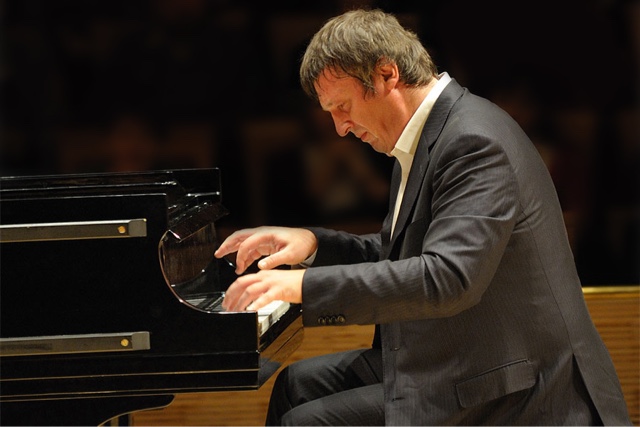
The pianist Boris Berezovsky returns to New York.
by Paul J. Pelkonen
The pianist Boris Berezovsky onstage at the Mariinsky Theater..
Photo copyright 1996 mariinsky.ru.
When the Russian virtuoso pianist Boris Berezovsky last gave a recital in New York City, Bill Clinton was president and Zankel Hall didn't evenexist. So Tuesday night marked the pianists debut at Carnegie’s modern subterranean venture, billed with a finger-busting program of piano études by Bartók, Ligeti and Liszt.

Friday, April 29, 2016

Concert Review: The Mechanics of the Heart

Emanuel Ax plays Beethoven at Carnegie Hall.
by Paul J. Pelkonen
Emanuel Ax and friend. Photo by Lisa Marie Mazzucco for Sony Classical.
There is something beatific about Emanuel Ax. He is a familiar figure on the concert stages of New York, gray haired, bespectacled and often beaming at his applauding audience.  And yet, behind that façade is a fiery artist, capable of great interpretations of standard repertory, offering insight on well-loved works. On Wednesday night, Mr. Ax offered a program of works by Ludwig van Beethoven at Carnegie Hall.

Wednesday, November 25, 2015

Concert Review: The Mountain of Madness

Daniil Trifonov closes out Rachmaninoff at the Philharmonic.
by Paul J. Pelkonen
The young gun: Daniil Trifonov is set to take over the world
...and just joined the board of the New York Philharmonic.
Photo © 2015 Deutsche Grammophon/Universal Music Group.
It's been a good month for piano aficionados at the New York Philharmonic, where newly minted board member Daniil Trifonov is wrapping up a three-week overview of the career of Sergei Rachmaninoff, the tall, dour Russian virtuoso whose piano music combines lyricism and technical challenges in a way that makes his four concertos the equivalent of an expedition to conquer the Himalayas.


Friday, November 29, 2013

Concert Review: The Leftovers

The Boston Symphony Orchestra serves up Beethoven and Brahms.
by Paul J. Pelkonen
Door busters: Rafael Frühbeck de Burgos (left) and Peter Serkin serve up Beethoven and Brahms.
Photo by Sam Brewer © 2013 Boston Symphony Orchestra.
Black Friday is a weird tradition. Since the 1960s, American consumers gathered at the malls and "big box" stores on the day after Thanksgiving for so-called "door-buster" deals. All this consumerism an have injurious, or even fatal consequences. But for the Boston Symphony Orchestra and its audience, today was just another Friday matinee at Symphony Hall, a civilized pause for high culture in the middle of all the holiday hype.

The program for this week's concert featured a crowd-pleasing pairing of Brahms (the Piano Concerto No. 2 with soloist Peter Serkin) and the Beethoven Seventh Symphony. With the sturdy conductor Rafael Frühbeck de Burgos on the podium, this looked to be safe serving of holiday fare, sure to please the musically conservative audiences that attend the BSO's Friday concerts.

Friday, May 17, 2013

Concert Review: The Return of the Dazzler

Yuja Wang in recital at Carnegie Hall.
by Paul J. Pelkonen
Yuja Wang. Photo by Xavier Antoinet.
Image © 2013 YujaWang.com.
In the course of this young decade, the pianist Yuja Wang has emerged as one of the most galvanizing artists of the keyboard appearing on concert stages. Her rock-solid virtuosity, brave repertory decisions and habit of playing recitals in a minimal black dress and a dazzling pair of heels have made her a piano celebrity, the kind that comes along once in a generation.

Thursday, May 2, 2013

Concert Review: The Limits of Control

Richard Goode plays the last three Beethoven sonatas.
by Paul J. Pelkonen
Ignore the hat: the pianist Richard Goode.
Photograph by Michael Wilson.
When a concert program is abstract in nature and of the utmost seriousness, writing a competent review becomes a challenge. Take, for example, Tuesday night's recital at Carnegie Hall, with pianist Richard Goode playing the last three sonatas of Ludwig van Beethoven. Mr. Goode's ability in this repertory is well known and his technique is universally respected. So what is the news quality, the element that separates this fine New York-bred soloist from all the other virtuosos treading the boards of our fair city's concert halls?

Friday, April 19, 2013

Concert Review: There Still Ain't Nothing Like a Dame

Mitsuko Uchida returns to Carnegie Hall.
by Paul J. Pelkonen
Mitsuko Uchida. Photo © Decca Classics/Universal Music Group.

It's almost unfair to write a "review" of a pianist like Mitsuko Uchida. The Japanese-born, Vienna-educated Dame Commander of the British Empire brings a unique expertise and musical understanding of whatever material she programs, combining a bold musical imagination with a bold technique and a smooth, slightly dry legato that has made her an international superstar.

Monday, December 10, 2012

Obituary: Charles Rosen (1927-2012)

Pianist, educator, author was 85.
by Paul J. Pelkonen
The pianist and author Charles Rosen from the cover of his book
 Music and Sentiment. Image © 2010 Yale University Press. 

Photo from the Lebrecht Archive at  www.lebrecht.co.uk
Charles Rosen, the pianist, author and educator whose written works included The Classical Style and The Romantic Generation has died in New York. He was 85.

Dr. Rosen started his study of the piano at the age of four. He was an accomplished performer whose teachers included Moriz Rosenthal (1862-1946) a pupil of Franz Liszt. However, the pianist Józef Hoffmann was his most important influence.

In a 2007 interview with BBC Music Magazine, Dr. Rosen recounted a story from when he was 7. Young Charles was asked to play for the pianist and composer Leopold Godowsky, himself a superstar of the keyboard. When asked by the older man what he wanted to be when he grew up, the youth said: "A pianist just like Józef Hoffmann."

Wednesday, November 7, 2012

Concert Review: Have Piano, Will Travel

Murray Perahia in recital at Car...er...Avery Fisher Hall.
by Paul J. Pelkonen
Hometown hero: the pianist Murray Perahia. Photo provided by Sony Classical.
A recital in New York by Murray Perahia is always a major event. The pianist's preference for traditional repertory makes him a favorite among more conservative music lovers, and his Bronx birth makes him a hometown hero. In a city clobbered by Hurricane Sandy, that kind of heroism is what was needed as patrons gathered for a concert that was supposed to happen three nights before.

You see, this Sunday night recital was originally scheduled for Friday night at Carnegie Hall. This change was necessitated by the aftermath of Hurricane Sandy, which left enormous, damaged construction crane dangling over W. 57th St. across the street from that historic venue, shutting down the venue, its attendant subway stops and all the local businesses for a two block radius.

The program selected by Mr. Perahia for this recital may have had therapeutic qualities for his traumatized audience. It opened with the solemn, sylvan dances of Haydn's D Major Sonata, which went through a series of stormy passages before emerging in an optimistic conclusion. Mr. Perahia displayed a lightness of touch, making a coherent argument that this composer's superb, underrated piano music needs to be heard more frequently.

Tuesday, August 28, 2012

Concert Review: Point-Counterpoint

Taka Kigawa plays Bach at Le Poisson Rouge.
by Paul J. Pelkonen
Pianist Taka Kigawa is a regular at Le Poisson Rouge.
Photo from the artist's website.
There's something to be said for attending a concert with just your ears.

That was the case at a crowded Le Poisson Rouge on Monday night. The event: pianist Taka Kigawa was the featured artist playing all of Johann Sebastian Bach's The Art of the Fugue. In a crowded club, it wasn't always possible to watch the artist play, which led to one's ability to concentrate on and enjoy this final Bach masterpiece.

Before the review: some explanation:

The Art of the Fugue is one of Bach's last creations. Starting with a simple theme:
the composer embarks on a thorough exploration of counterpoint and thematic development. In the course of the fourteen movements, this theme is subject to the following techniques:
  • augmented: note values lengthened.
  • diminished: note values shortened.
  • inverted: (a low melody trades places with a high one)
  • imitated: (a theme is repeated on lower or higher voices)
  • stretto: ("narrowed") where themes are repeated in an overlapping structure.
Bach's work contains double, triple and quadruple fugues, where the artist is responsible for maintaining many contrasting voices all overlapping. There are also so-called mirror fugues (where the whole piece is played, inverted and then repeated) and the four canons that divide the 14 movements and provide a stylistic calm at the center of a storm of counterpoint.

Wednesday, August 15, 2012

The Superconductor Interview: David Greilsammer

The fiery pianist talks about recitals, Mozart and his new disc Baroque Conversations.
by Paul J. Pelkonen
Firebrand: The pianist David Greilsammer. Photo © Sony Classical.
It's not every day that a pianist shakes up the very idea of the piano recital, the 150-year old institution established by Franz Liszt as a means of bringing music for that instrument before the general public. But David Greilsammer, the Israel-born soloist who made his Mostly Mozart debut on Tuesday night, does just that on his new Sony Classical disc Baroque Conversations. 

"I do believe that in the 21st century, a recital program should have a greater purpose," he says in a telephone interview. "Historically, the recital program has come to a end. It is important to visit the great masterpieces in a new way--one that is not necessarily a new interpretation but bringing together music from different worlds. Having them say wha they have to say is magic--there is always conversation and dialogue being created."

The dialogues on Baroque Conversations bring together some unlikely combinations. The arch elegance and perfect structure of Jean-Philippe Rameau rubs shoulders with the burly minimalism of Morton Feldman. Familiar baroque composers like Couperin and Handel flank Whaam!" a bold, jazzy creation by Matan Porat inspired by the pop art of Roy Lichtenstein. Yet the disc maintains a convincing narrative flow, 64 minutes of dialogue that spans the centuries.

Friday, June 1, 2012

Concert Review: The Return of the Flash

Lang Lang at Carnegie Hall.
Lang Lang. Photo by Felix Broede for Deutsche Grammophon. © 2011 Universal Classics.
The pianist Lang Lang is a formidable talent. At Tuesday night's recital at Carnegie Hall, the last major subscription concert of the 2012 season, Mr. Lang gave a performance that favored style over musical substance.

Mr. Lang has made no secret of his idolization of Franz Liszt, even releasing a Sony collection called My Piano Hero. His playing is not just Lisztian in its prodigious technical ability--he also incorporates a free-form, Romantic approach to tempo and structure. Here, he offered works Bach, Schubert and Chopin. While the written notes were always played, this concert seemed to err, if it can be said, on the side of virtuosity.

Monday, May 14, 2012

Concert Review: Beethoven for Conversation

Steven Isserlis and Robert Levin play the Cello Sonatas
by Paul Pelkonen
Beethoven at his fortepiano. Note the lack of pedals.

Within the vast catalogue of works written by Ludwig van Beethoven, the five Sonatas for Cello and Piano are relatively obscure: chamber pieces written for salon performances and various musicians and patrons the composer encountered in his career.

On Saturday night at the 92nd Street Y, cellist Steven Isserlis and pianist Robert Levin shone light on these lesser-known works. Contributing to the unique nature of these performances was Mr. Levin's choice to play fortepiano, an older style of keyboard instrumet with a shallower wooden frame and no pedals. The instrument, built by Paul McNulty, is modeled after an 1805 fortepiano, a spindly creation that looks more suited to a furniture museum than the concert stage.

The concert opened with a set of variations based on "Bei Mannern," the Act I duet from Mozart's Die Zauberflöte. These were played with engaging warmth as the softer sounds of the fortepiano intersected perfectly with the cello's imitation of the human voice. The variations range from light and playful to slow and serious. Beethoven's interest in the humanist message of the text allowed him to alternate between the solemnity of a humanist message and the playful first interaction between Pamina and Papageno.

Tuesday, April 10, 2012

The Superconductor Interview: On the Roof with Alexandre Tharaud

The French pianist plays, then talks to Superconductor.
by Paul Pelkonen
A man and his keys Alexandre Tharaud
The words "piano recital" conjure images of the big stage, a jet-black Steinway grand  under a bright spotlight. For pianist Alexandre Tharaud, his April 9 recital at Le Poisson Rouge had a very different atmosphere. Mr. Tharaud took the stage with a lean, casual grace, casting spells with longkh fingers on the (baby) grand in the underground Greenwich Village club.

Monday, March 26, 2012

Concert Review: The Keeper of the Keys

Murray Perahia in recital at Lincoln Center
by Paul Pelkonen
Piano man: Murray Perahia. Photo © 2010 courtesy Sony Classical.
In the course of a long concert season, some recitals and concerts are akin to a religious ceremony. Such a one was Sunday's afternoon concert at Avery Fisher Hall, featuring Bronx-born pianist Murray Perahia. The lights of this great hall were down very low, creating an atmosphere of religious contemplation. A celestial beam lit the stage, as New York's own high priest of solo piano music strode to his instrument.

As a hometown hero with impeccable taste and technique, Mr. Perahia is beloved by New York concert-goers. Yet he has earned their frustration as well, with a series of cancellations and health problems stemming from a 1995 operation to remove a bone spur from his right hand. This forced him to retire from performance for three years. Those physical problems, coupled with the artist's ongoing residency in Berlin have conspired to make a recital by this artist a special event.

The repertory for this recital was conservative, with the three "B's" (J. S. Bach, Beethoven, Brahms) in the first half and Chopin and Schubert in the second. Mr. Perahia began with No. 5 of Bach's French Suites, his hands performing a complex terpsichore on the keys through the seven dance movements. The closing Loure and Gigue were lyric and uplifting, a strong argument for performing this music on the modern instrument.


Beethoven wrote his piano sonatas for the wood-framed fortepiano of his day, destroying a few in the process. The 27th Sonata in E minor is one of his most unconventional. Consisting of just two movements, its tense opening and cheerful Rondo are testaments to the composer's volatile personality. Mr. Perahia's playing was conservative, focusing on the deep humanism of the writing and the composer's gift of phrase.

The first half of the program ended with Brahms' late Klavierstücke--four piano miniatures from the composer's late period. Mr. Perahia announced Brahms' solemn presence through the cascade of heavy chords that open the first Intermezzo. From there he turned to warm, glowing melodies, leading a gorgeous waltz in the middle section of the second piece.

Mr. Perahia's recent releases have included a disc of Brahms works, and his affinity for the composer's complex scheme and variations showed in the third Intermezzo, a kind of scherzo based on just four notes. Finally it was time for the vast, cinematic sweep of the Rhapsody in E Flat Major, which ends the set with a noble theme borrowed six years later by Brahms' friend Jean Sibelius for his tone poem Finlandia.

The second half opened with Schubert's Sonata No. 19 in A, a work of sunny optimism with none of the obsession with death that plagued this young composer in his later years. Mr. Perahia made the sunlight of Schubert's Vienna shine into the dark cavern of Avery Fisher Hall, playing the three movements with lyric grace. The Andante flowed smoothly from his fingers, and the final movement had a fierce, determined joy.

That ferocity and determination extended to the four Chopin works chosen by Mr. Perahia to end the concert. This ws not the simpering, soft Chopin of the salon, but music of a brusque, business-like determination. The C# minor Polonaise had a heroic swagger, its dance rhythms etched by the soloist in bold strokes. The murderously difficult Prelude No. 8 in F# minor followed. A tiny two-minute beast among the composer's 24, its nickname is "Desparation." Mr. Perahia kept a cool head and executed the tricky right-hand figures with his customary skill.

The Mazurka No. 4 is just three minutes in length. Mr. Perahia showed that this brief work is packed with musical ideas and expressive possibilities. The little tetralogy ended with the muscular Scherzo No. 4, the last of the set. Mr. Perahia returned to Chopin's heroic mode here. The brash opening theme gave way to a slow, sad minor. The work ended with a mighty struggle to return to the major key. Mr. Perahia injected a note of triumph and achievement into the resonant final chords.

Wednesday, March 21, 2012

The Rosalyn Tureck Confession

What a missing CD cover taught me about Bach.
by Paul Pelkonen
The missing Rosalyn Tureck album cover. I still don't have it!
Today is the 327th birthday of Johann Sebastian Bach. To celebrate, it's time to take a look at some of the recordings of Rosalyn Tureck.

Born in Chicago in 1914, Dr. Tureck was a pianist who devoted extraordinary keyboard gifts to the interpretation of Bach. Her recordings of the Goldberg Variations, Keyboard Partitas and the two books of The Well-Tempered Clavier are touchstones, revered by collectors and by pianists like Glenn Gould. She died in New York at the age of 88.

I first encountered Ms. Tureck's playing in 1999, when Deutsche Grammophon sent me the 4-disc set of her recordings of the complete Well-Tempered Clavier. I well remember putting the first disc into the drive of my office tower computer, putting on the big noise-blocking headphones...and hating it.

The familiar C Major Prelude of Book I was taken at a maddening, slow pace, the notes seeming to sleep-walk out of the speakers in hissy mono sound. The whole piece was a minute slower than other recordings, like Chinese water torture.

I kept listening. Some of the later Preludes and Fugues were still slow to me. My inner Bach metronome was used to the "Gould" approach to tempo. I didn't really appreciate the beauty of her approach to this music. After writing a mumbling, middling review for the website I was working for, I put the recordings aside, going back to Glenn Gould and Andràs Schiff, another pianist who remains a favorite today.

Later, I wanted to get rid of that set, to send it out into the world of used CDs where music journalists often trade in their acquisitions for a bit of ready cash. But I didn't, mostly because the producer at that website had lost the front-cover label insert, making the set worthless to a dealer.

Reluctantly, I kept it. The set sat on my shelf for years, wedged between the big Sony Glenn Gould "Original Jackets" box and Mr. Schiff's orange box of Bach for Decca. It stayed silent in its case for over a decade. When I did "Project Upload" (moving many recordings of mine into hard drives and iPods) it was left out.

With the Bach birthday this week, I took out that Tureck boxed set, as well as recordings of the Partitas and Goldberg Variations that I'd acquired as part of the Great Pianists of the 20th Century series.

I uploaded all eight discs of Ms. Tureck's recordings that I had. I transferred them into my iPhone. Now, her approach to these short pieces not only felt right, but were extraordinary in their beauty. The piano works seemed thoughtful, beautifully paced and carefully measured. Ms. Tureck's playing hadn't changed.

I had grown up.

Trending on Superconductor

Translate

Share My Blog!

Share |

Critical Thinking in the Cheap Seats