Support independent arts journalism by joining our Patreon! Currently $5/month.

About Superconductor

Our motto: "Critical thinking in the cheap seats." Unbiased, honest classical music and opera opinions, occasional obituaries and classical news reporting, since 2007. All written content © 2019 by Paul J. Pelkonen. For more about Superconductor, visit this link. For advertising rates, click this link. Follow us on Facebook.
Showing posts with label sacred music. Show all posts

Tuesday, August 14, 2018

The Verdi Project: Messa di Requiem

Verdi takes on the cosmos and the Church.
by Paul J. Pelkonen
It could be argued that the Verdi Requiem is his most...monumental achievement.
Photo from Wikimedia Commons
Following the triumphant reception of Aida,, Giuseppe Verdi had no more worlds to conquer. Aida marked the culmination of a long ambition to create a successful fusion between his own style and the grand spectacles that dominated the stage at theaters like the Paris Opera. Aida, with its blend of private anguish and public spectacle, fulfilled all of those requirements.

Friday, October 13, 2017

Concert Review: Where Science Has Lease

The Orchestra of St. Luke's opens its season at Carnegie Hall.
Pablo Heras-Casado.
Photo from the conductor's official website.
All entities must evolve to survive, and the Orchestra of St. Lukes has undergone some changes in recent years. The ensemble, which originated playing chamber music at the Church of St. Lukes in the Fields in Greenwich Village has had, since 2011,  a permanent address: the Dimenna Center on Manhattan's West Side. They are also about to change music directors again, with period performance expert Bernard Labardie slotted to replace Pablo Heras-Casado next season.

Saturday, May 13, 2017

Concert Review: The Power and the Passion

Leon Botstein wrestles Elgar's The Apostles.
by Paul J. Pelkonen
Leon Botstein. Photo by Kallaher for Bard College.
It is never a good idea to follow in the footsteps of Richard Wagner. That truism could easily be applied to Edward Elgar's long-neglected oratorio The Apostles. Elgar conceived The Apostles as the first part of a planned trilogy of stage works based on the New Testament, following a visit to Bayreuth in 1902. However, this piece, played at Carnegie Hall on Friday night by Leon Botstein and the American Symphony Orchestra, is problematic at best.


Friday, October 24, 2014

Concert Review: It's All in the Context

The Mozart Great Mass in C Minor at St. Ignatius Loyola.
by Paul J. Pelkonen
The St. Ignatius Loyola Choir and Orchestra.
Photo by Rachel Papo © 2014 Sacred Music in a Sacred Space.
Does the power and majesty of a sacred choral work need to be performed in a church? That's the question posed by Sacred Music in a Sacred Space, the series of concerts held annually at St. Ignatius Loyola on Park Avenue. Featuring the church's own chorus and orchestra under the baton of music director K. Scott Warren, this series opened its 26th season Wednesday night with Mozart's Great Mass in C minor and Haydn's Symphony No. 97.

Wednesday, May 21, 2014

Concert Review: An Act of Faith

The Oratorio Society of New York presents the St. Matthew Passion.
by Paul J. Pelkonen
The stained glass Bach window in the Thomaskirche, Leipzig, Germany,
Photo from Wikimedia Commons.
Johann Sebastian Bach’s St. Matthew Passion is the composer’s mightiest creation, an unflinching account of the arrest, trial,and execution of Jesus as laid down in the first Gospel of the New Testament. First performed for Good Friday service in St. Thomas’ Church in Leipzig, it retains all of its emotional impact in the concert hall. A strong performance of this work is a declaration of faith, not necessarily in Christianity but in the perfect musical design that Bach uses throughout this sprawling work.

Friday, March 28, 2014

Concert Review: He Supposes, Erroneously

The American Symphony Orchestra exhumes Max Bruch's Moses.
by Paul J. Pelkonen
Sssh: American Symphony Orchestra music director Leon Botstein
Photo by Jito Lee © 2011 The Melos Ethos Festival.
Since assuming the directorship of the American Symphony Orchestra in 1991, Dr. Leon Botstein has made it his mission to expose audiences to long-forgotten works of the 19th and 20th centuries. His latest discovery is Moses, a two-hour oratorio by Max Bruch, written in 1895 when the Romantic tradition was breathing its last. On Thursday night, Dr. Botstein led the ASO in this work, joined by the Collegiate Chorale and a trio of up-and-coming opera singers at Carnegie Hall.

Saturday, August 4, 2012

Concert Review: Trouble is his Business

Yannick Nézet-Séguin conducts Beethoven and Haydn at Mostly Mozart
by Paul J. Pelkonen
Trouble shooter: Yannick Nézet-Séguin.
Photo by Marco Borggreve © 2012 YannickNézet-Séguin.com
Fresh off his Thursday night triumph with the Chamber Orchestra of Europe, conductor Yannick Nézet-Séguin turned to the Mostly Mozart Festival Orchestra to lead Haydn's "Nelson" Mass and another Beethoven symphony--in this case the Second.

Although Haydn an Beethoven knew each other and follow each other in the historical procession of great Vienna-based composers, these two works could be tied together by their common origin in a Europe beset by crisis and war. Beethoven's Symphony No. 2 (written in 1801) is filled with revolutionary spirit, an optimistic, yet dramatic pinnacle of Beethoven's early style. The Mass is much darker, the sound of Austro-Hungarian aristocracy fretting in the midst of the Napoleonic Wars.

Working with the larger Festival Orchestra, Mr. Nézet-Séguin led a Second Symphony that bristled with energy and good humor. After an appropriately slow, dramatic buildup, the rapid-fire main theme of the opening movement leapt out of the starting gate, driven hard by the young conductor. The slower second movement went at a fairly brisk pace, with lovely textures from the bassoons and horns.

Sunday, October 9, 2011

Concert Review: Sunday Mass at Severance Hall

The Cleveland Orchestra plays Mozart and Strauss
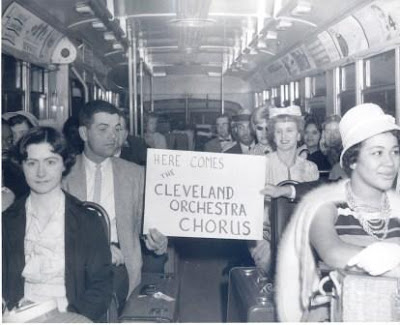
The men and women of the Cleveland Orchestra Chorus get ready to hit the road.
(This doesn't have much to do with this concert, but it's an awesome photograph!)
© 1962 The Cleveland Orchestra/Cleveland Orchestra Chorus.
In the course of Franz Welser-Möst's decade at the helm of the Cleveland Orchestra, he has pioneered the concept of residencies in other cities as a means of promoting the orchestra and raising much-needed revenues by having concerts outside of Severance Hall.

On Sunday afternoon, the orchestra offered the same program it will take to Vienna's historic Musikverein as part of a two-night residency in the capital of the conductor's home country. The program pairs Richard Strauss' mournful Metamorphosen with the Great Mass in c minor, a lesser-known, unfinished work by Wolfgang Amadeus Mozart.

 Metamorphosen is one of Richard Strauss' last works, a funereal piece written in 1944 for 23 solo strings. In the course of a 25-minute-span, Strauss looks back on the glories of Western music and realizes he is standing at the end of his art form. The music quotes and references 200 years of German music, from Mozart and Beethoven to Strauss himself. The subject matter: the death of German musical culture under the Nazi boot, and the destruction of famous music venues in Dresden and Vienna under the Allied assault in World War II.

Despite the serious nature of the subject matter, Metamorphosen ebbs and flows with Strauss' characteristic, long melodic lines. The Cleveland string players captured the autumnal glow that illuminates the score, the blend of small ensembles and solo melodic lines that weave together to create a dense, and ultimately soothing blanket of sound.

Part of the legend surrounding Mozart includes his Requiem, unfinished at the time of his death. No such drama surrounds the Great Mass--Mozart simply didn't finish the piece. But in this performing edition, assembled by musicologist H. Robbins Landon, Mr. Welser-Möst made a good case for this lesser-known work.

 He was reinforced by an able cast of singers, led by sopranos Malin Hartelius and Julia Lezhneva--the latter heard recently at this summer's Mostly Mozart Festival. Joined by tenor Martin MutterRutzner and bass Ruben Drole. the singers delivered the sacred text with warmth and devotion to Mozart's melodic lines.

The glory of this performance was the Cleveland Orchestra Chorus, under the direction of Robert Porco. The choristers made each movement of the Grosse Messe a powerful declaration of faith, not just in the religious subject matter but in the power of Mozart's music. Even in its torso state, this Mass is a raw gem. Here, it was polished with smooth precision under Mr. Welser-Möst's expert direction.

Thursday, August 11, 2011

Concert Review: Between Sacred Songs, a Secular Symphony

At Mostly Mozart, Ivan Fischer puts the Jupiter in context.
Ivan Fischer demonstrates a new baton technique.
Photo courtesy the Orchestra of the Age of Enlightenment
Tuesday night at Mostly Mozart featured an innovative program of that composer's music under the baton of Hungarian maestro Iván Fischer. At its heart stood Mozart's 41st and final symphony, the Jupiter.

This is one of Mozart's most well-known and popular symphonies. But instead of using its grand pre-Romantic gestures to ring down the curtain on the evening, Mr. Fischer placed it second, between the choral motet Ave verum corpus and the Vesperae solennes de confessore, a setting of five Psalms and the Magnificat written at the end of Mozart's Salzburg years.

Mr. Fischer led this concert with the same technique as in the excellent Don Giovanni performances of last week. He balanced the orchestral forces, driving them forward while allowing the melodies room to blossom and breathe. Ave verum corpus was sung with delicacy and simple faith. It led into a brief organ melody from Kent Tritle. As the chorus members filed out (as if they were leaving church,) Mr. Fischer lauched into Jupiter.


The opening movement was played with jubilance and strength. Mr. Fischer created a narrative flow that led into the Andante with its lyric subject. The rhythms of the minuet, were firm and precise. The complex finale, with its fugal sections and difficult wind parts was taken a mite slower than some conductors, allowing fresh details to emerge with the color and vibrancy of a restored painting.

It was refreshing to hear the instrumental Jupiter contrasted with liturgical music. This illuminated the influences that went into writing this great work. (Not everything in this boisterous symphony is sacred however--the last movement alludes to a certain vulgar choral round, also written by Mozart. It's K. 231. Look it up.)

Whether working with his own Budapest Festival Orchestra or the Mostly Mozart band, Mr. Fischer has proven himself able to make listeners hear familiar music with new ears. But he also made the less familiar Vesperae shine forth with clarity and beauty. The opening "Dixit Dominus" was a rock-like statement of faith, with deep power and commitment. The fourth movement, "Laudate pueri" had a Bach-like precision. Soprano Lucy Crowe soared through "Laudate Dominum", a gorgeous aria worthy of one of Mozart's operas. The final Magnificat was played with exultation, a gorgeous affirmation of Mozart's genius and the abilities of this remarkable conductor.

Trending on Superconductor

Translate

Share My Blog!

Share |

Critical Thinking in the Cheap Seats