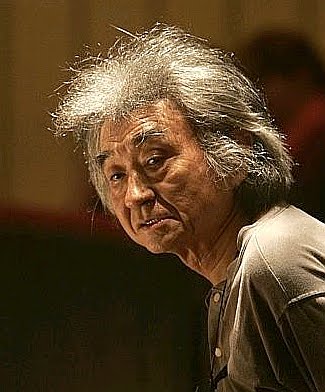
The year of the "new jack" maestro.
With disasters striking down a number of prominent conductors this year (Seiji Ozawa's battle with cancer, Riccardo Muti's fall and injury, and a whole stack of misfortunes for James Levine), 2011 was the year that young conductors stepped up to the podium and took charge. From Sean Newhouse in Boston to Yannick Nézet-Séguin in Philadelphia, this was the year of a continued youth movement on North American podiums.
It was also a busy season for your favorite classical music blog. 94 concerts in four different cities. And seeing one more this week to make it 95. On to 2012!
Budapest Festival Orchestra: The Rite of Spring (Jan. 27)
"Under Iván Fischer's direction, the taut polyrhythms and blasts of brass acquired a fearsome, battering force, hammering at the senses in a frenzied dance. A reprieve came with the second section of the ballet, but it was not to last."
Boston Symphony Orchestra: Sean Newhouse's Boston debut (Feb. 27)
"Mr. Newhouse proved himself up to the task on Saturday night, leading a vigorous performance that balanced the extremes of this long, difficult work. The young conductor did more than just beat time--he offered his own interpretation of the work, making Mahler's last completed symphony a profound and deeply humanistic statement."
Louis Lortie plays Liszt (March 11)
"The pianist took his audience on a detailed tour of Liszt's travels in Switzerland. He drove the piano, playing from his shoulders, crossing hands for the most difficult passages and ranging across his instrument as Liszt traversed the Alps."
Leif Ove Andsnes at Carnegie Hall (April 9)
"Mr. Andsnes brought a fiery approach to the first movement, conjuring up the stormy figures and near-fugal textures common to late Beethoven. The second movement was far more lyrical. The slow Arietta was played with quiet, poetic restraint."
Cleveland Orchestra: Bruckner Eighth. (July 17)
"Mr. Welser-Möst took a surprising, fast tempo for the opening movement, creating driving figures in the strings that moved the work forward and opened vast sonic vistas for the listener. This enabled the full 18-piece Cleveland brass section to cut loose with massive, block chords, voiced in stately, organ-like tones by horns, trombones and Wagner tubas."
New York Philharmonic: A Concert for New York (Sept. 11)
"The heavy, stentorian opening blared out with emphatic force. Mr. Gilbert drew inspired music-making from the veteran winds and strings, playing the uplifting main themes with emotion missing with some other conductors."
Cleveland Orchestra: Stravinsky and Tchaikovsky (Oct. 9)
Mr. Welser-Möst brought maximum clarity to this work, which had not been heard at Severance Hall in nearly four decades. The orchestra responded brilliantly, as the knotty musical lines untangled themselves and the work coalesced. The brass, asked to make difficult contributions in this work, responded admirably, as did the superb woodwind section.
Yuja Wang's Debut at Carnegie Hall (Oct. 21)
"Ms. Wang dived into the opening theme (a representation of Mephistopheles) and brought the wild energy of Faust's ill-fated adventures out in the early pages. The plunge into the abyss was chilling, ending in grim, matter-of-fact low notes."
London Symphony Orchestra And Chorus: War Requiem (Oct. 24)
"The London Symphony Chorus was a force unto itself, declaiming the Latin text of the mass with the authority of the Metatron. The fiery incantations of the Dies Irae blazed forth with power. They were also key contributors to the success of the later movements, especially the slow-moving setting of the Agnus Dei."
Atlanta Symphony Orchestra, Garrick Ohlsson: Rachmaninoff Three (Nov. 7)
"The first movement's complicated cadenza held the audience breathless. The slow Intermezzo sang a sad Russian song. And the pell-mell finale, calling for the greatest degree of virtuosity from the pianist proved a thrilling experience."
Baltimore Symphony Orchestra: Jeanne d'Arc au Bûcher (Nov. 21)
"Actress Caroline Dhavernas was a powerful, dramatic force. Her hair bound up and her dress plain (historically accurate, as Joan was tried wearing men's clothing), Ms. Dhavernas became a simple figure of faith standing up for injustice."
Visit the rest of the 2011 Year in Reviews, our account of the year that went to "'11".
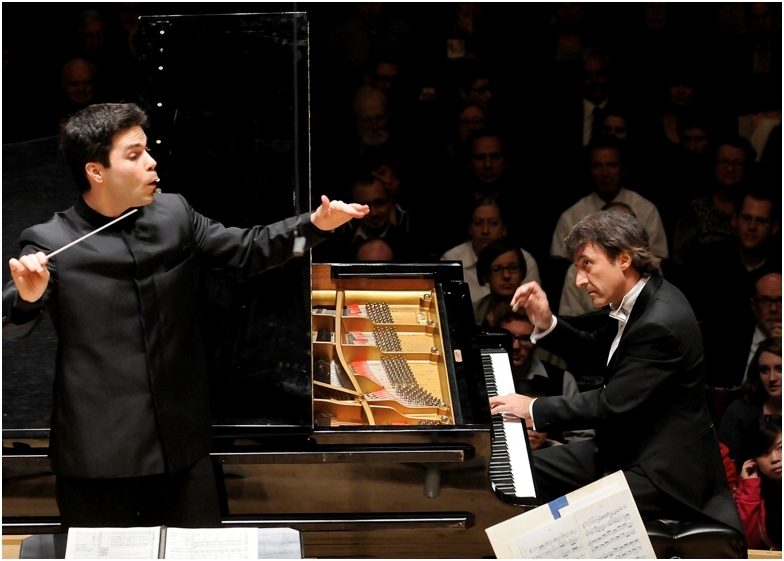 |
| Life saver: Sean Newhouse (left) stepped in for James Levine. Here, he conducts Prokofiev with pianist Jean-Efflam Bavouzet. Photo by Stu Rosner © 2011 Boston Symphony Orchestra. |
It was also a busy season for your favorite classical music blog. 94 concerts in four different cities. And seeing one more this week to make it 95. On to 2012!
Budapest Festival Orchestra: The Rite of Spring (Jan. 27)
"Under Iván Fischer's direction, the taut polyrhythms and blasts of brass acquired a fearsome, battering force, hammering at the senses in a frenzied dance. A reprieve came with the second section of the ballet, but it was not to last."
Boston Symphony Orchestra: Sean Newhouse's Boston debut (Feb. 27)
"Mr. Newhouse proved himself up to the task on Saturday night, leading a vigorous performance that balanced the extremes of this long, difficult work. The young conductor did more than just beat time--he offered his own interpretation of the work, making Mahler's last completed symphony a profound and deeply humanistic statement."
Louis Lortie plays Liszt (March 11)
"The pianist took his audience on a detailed tour of Liszt's travels in Switzerland. He drove the piano, playing from his shoulders, crossing hands for the most difficult passages and ranging across his instrument as Liszt traversed the Alps."
Leif Ove Andsnes at Carnegie Hall (April 9)
"Mr. Andsnes brought a fiery approach to the first movement, conjuring up the stormy figures and near-fugal textures common to late Beethoven. The second movement was far more lyrical. The slow Arietta was played with quiet, poetic restraint."
Cleveland Orchestra: Bruckner Eighth. (July 17)
"Mr. Welser-Möst took a surprising, fast tempo for the opening movement, creating driving figures in the strings that moved the work forward and opened vast sonic vistas for the listener. This enabled the full 18-piece Cleveland brass section to cut loose with massive, block chords, voiced in stately, organ-like tones by horns, trombones and Wagner tubas."
New York Philharmonic: A Concert for New York (Sept. 11)
"The heavy, stentorian opening blared out with emphatic force. Mr. Gilbert drew inspired music-making from the veteran winds and strings, playing the uplifting main themes with emotion missing with some other conductors."
Cleveland Orchestra: Stravinsky and Tchaikovsky (Oct. 9)
Mr. Welser-Möst brought maximum clarity to this work, which had not been heard at Severance Hall in nearly four decades. The orchestra responded brilliantly, as the knotty musical lines untangled themselves and the work coalesced. The brass, asked to make difficult contributions in this work, responded admirably, as did the superb woodwind section.
Yuja Wang's Debut at Carnegie Hall (Oct. 21)
"Ms. Wang dived into the opening theme (a representation of Mephistopheles) and brought the wild energy of Faust's ill-fated adventures out in the early pages. The plunge into the abyss was chilling, ending in grim, matter-of-fact low notes."
London Symphony Orchestra And Chorus: War Requiem (Oct. 24)
"The London Symphony Chorus was a force unto itself, declaiming the Latin text of the mass with the authority of the Metatron. The fiery incantations of the Dies Irae blazed forth with power. They were also key contributors to the success of the later movements, especially the slow-moving setting of the Agnus Dei."
Atlanta Symphony Orchestra, Garrick Ohlsson: Rachmaninoff Three (Nov. 7)
"The first movement's complicated cadenza held the audience breathless. The slow Intermezzo sang a sad Russian song. And the pell-mell finale, calling for the greatest degree of virtuosity from the pianist proved a thrilling experience."
Baltimore Symphony Orchestra: Jeanne d'Arc au Bûcher (Nov. 21)
"Actress Caroline Dhavernas was a powerful, dramatic force. Her hair bound up and her dress plain (historically accurate, as Joan was tried wearing men's clothing), Ms. Dhavernas became a simple figure of faith standing up for injustice."
Visit the rest of the 2011 Year in Reviews, our account of the year that went to "'11".