Support independent arts journalism by joining our Patreon! Currently $5/month.

About Superconductor

Our motto: "Critical thinking in the cheap seats." Unbiased, honest classical music and opera opinions, occasional obituaries and classical news reporting, since 2007. All written content © 2019 by Paul J. Pelkonen. For more about Superconductor, visit this link. For advertising rates, click this link. Follow us on Facebook.
Showing posts with label 20th century music. Show all posts

Monday, July 27, 2015

Opera Review: Love on the Rocks

Ethyl Smyth's The Wreckers rises from the vasty deep.
by Paul J. Pelkonen
(This article is presented in collaboration with our friends at OperaPulse.)
Wrecking crew: (L-r) Katharine Goeldner, Sky Ingram, Michael Mayes, Neal Cooper and Kendra Broom 
in rehearsal for Dame Ethel Smyth’s The Wreckers.
Photo by Stephanie Berger © 2015 Bard SummerScape.
Each summer, it is the business of the Bard SummerScape Festival to present an opera that for whatever reason has fallen far from the fringes of the standard repertory. On Friday night, artistic director and Bard College president) Leon Botstein led the first fully staged performance of The Wreckers the 1907 opera by Dame Ethyl Smyth. (The work was first performed in the U.S. by the American Symphony Orchestra under Dr. Botstein at Carnegie Hall in 2007.) This was the first of five scheduled performances this month at the Fisher Center, the Frank Gehry-designed concert hall on the Bard campus that is SummerScape's headquarters.

Tuesday, August 12, 2014

Your Cure For a Bad Day in Three Minutes

An appreciation of Gassenhauer by Carl Orff.
by Paul J. Pelkonen
The composer Carl Orff (right) in the classroom.
If, like me, you spend time in between interactions with this particular blog by watching too many movies, you may have at some point run across this short piece of music:


Friday, March 7, 2014

Opera Review: The Ringer Cycle

Matthias Goerne's surprise Wozzeck at the Met.
by Paul J. Pelkonen
He knows where his towel is: Matthias Goerne in the title role of Wozzeck.
Photo by Marty Sohl © 2014 The Metropolitan Opera.
At 2:10 yesterday afternoon, the Metropolitan Opera announced that Thomas Hampson had withdrawn from Wozzeck. Mr. Hampson's substitute would not be the scheduled (and already contracted) cover, but baritone Matthias Goerne. Mr. Goerne, who has sung the title role to acclaim at other houses, was in New York to sing a lieder recital at Carnegie Hall on Wednesday night. Smoke signals went up on the Internet, and a hastily written press release was slipped into thousands of copies of Playbill.

Saturday, March 1, 2014

Metropolitan Opera Preview: Wozzeck

Berg's blood-soaked psychodrama returns to the Met.
by Paul J. Pelkonen
Deborah Voigt and Thomas Hampson make their role debuts in Wozzeck March 6.
Photo by Cory Weaver © 2014 The Metropolitan Opera.
Thomas Hampson makes his first appearance in the title role of Wozzeck, the story of a soldier whose lowly life is nothing but suffering. Deborah Voigt appears as Marie, his perpetually unfaithful common-law wife. (Neither artist has sung these difficult roles before.) James Levine is scheduled to conduct these performances.

Wednesday, October 16, 2013

Opera Review: Goodfellows

The Met reawakens A Midsummer Night's Dream.
by Paul J. Pelkonen
Bottom at bay: Tytania (Kathleen Kim) charms a translated Nick Bottom
(Matthew Rose, with ass's head) in A Midsummer Night's Dream.
Photo by Marty Sohl © 2013 The Metropolitan Opera.
The spirit of William Shakespeare was definitely evident in the Metropolitan Opera's current revival of its  Benjamin Britten's A Midsummer Night's Dream, seen Tuesday night at Lincoln Center. This is the first presentation of the company's 1996 production (by Tim Albery and designer Antony MacDonald) in ten years. The occasion? The composer's 100th birthday, which falls on Nov. 22 of this year.

Tuesday, September 3, 2013

Some Words on Electronic Music

Cos sometimes it ain't all Mozart.
by Paul J. Pelkonen
The brothers Phil and Paul Hartnoll, better known as Orbital.
Longtime readers of this blog may know that my interest in music extends beyond the concert stage and the opera house. And in this two week period before the launch of the 2013 season (with the first New York performances of the opera Anna Nicole) I'd like to write about some different genres far outside the "normal" parade of Mozart, Mahler and modernism that makes up the bulk of Superconductor content.

Today, let's talk about electronica.

Friday, February 15, 2013

Concert Review: Size Does Matter

Mariss Jansons conducts Bartók and Mahler.
by Paul J. Pelkonen
Pushing the boundaries: Mariss Jansons conducted the Royal Concertgebouw Orchestra
at Carnegie Hall on Wednesday night. Photo © Royal Concertgebouw Orchestra.
Every concert season, the Carnegie Hall Corporation arranges for a wide selection of world-class orchestras to come to New York. Wednesday evening at Isaac Stern Auditorium saw the welcome return of Amsterdam's finest band, the Royal Concertgebouw Orchestra, under the baton of their music director Mariss Janssons. The program offered a pair of 20th century classics.

The first work on the program was Béla Bartók's Violin Concerto No. 2 with Leonidas Kavakos. The harps set up a gentle pulse. Then, the Greek soloist bit into the meaty texture of this complicated concerto, built from the seed of its opening bars. Mr. Jansons and the orchestra provided expert architectural support in the long opening, allowing Mr. Kavakos room to express Bartok's folksong rhythms, jagged intervals and extended lyric lines.

The second movement was played with the utmost tenderness, with the solo violin's lament coming eerily close to the quality of the human voice. The finale was played with energy and bravura fire, as Mr. Kavakos leaped into the fray of this complicated finale. Soloist and orchestra battled for the spotlight, working against each other until the coda with its final ascent into a blaze of brass. The tender phrases of the final bars recalled the contemplative opening, bringing the piece full circle.

Friday, July 13, 2012

Concert Review: Three-Sided Cage

The Flux Quartet's John Cage celebration continues.
Sinister footwear: Merce Cunningham's "John Cage shoes."
by Paul Pelkonen

On Wednesday night at Bargemusic, the Flux Quartet continued their celebration of the tricksome legacy of John Cage, composer, iconoclast and maverick of modernity whose works continue to baffle listeners (and sometimes, players) today.) The first part of the program held an early, familiar work. The second and third explored difficult, gnarled sounds: what the casual listener thinks of when they hear the name "John Cage."

And sometimes they run away.

The String Quartet in Four Parts is a refreshing surprise to anyone expecting nothing but noise terror from this particular composer. Here, the writing is more conventional, almost dreamy. Its sounds are stretched, pulled apart and then knotted back together as the composer strove toward a new way of making music.

The Flux players created a performance of grace and great beauty here, paying fitting tribute to the composer's early period.


And it's rather pretty.

Wednesday, June 13, 2012

Recordngs Review: The Water is Fine

Daniele Gatti conducts Debussy.
by Paul J. Pelkonen
Is this a baton I see before me? Conductor Daniele Gatti.
Photo © 2011 Sony Classical.
This new recording from Sony Classical consists of familiar repertory by Claude Debussy, played by the Orchestre National de France under the baton of their music director, Daniele Gatti.

Debussy's major orchestral works are practically required in the catalogue of any conductor aspiring to the major leagues. That means that there are a lot of bad recordings about. Mr. Gatti's effort is a rewarding one, crisply played by an orchestra that sounds very comfortable in the studio environment. 

This recording has a blossoming, blooming low end, with the deep Tristan-esque throbs of cellos and basses The atmospheric, wide-ranging acoustic centers firmly on the ONF cellos, with occasional comments from warm, rich brass and finely detailed woodwinds. The clarinet playing is a simple pleasure.

Saturday, June 2, 2012

Concert Review: Middle Ages, Spread

The Philharmonic takes on Carmina Burana.
The caption reads: "Virtue lies defeated."
(Note the wheel in the background.)
From El Club Dumas by Arturo Pérez-Réverte,
© 1993 Random House.
by Paul J. Pelkonen
The performance of choral music is not the primary mission of the New York Philharmonic. In its long history, the orchestra has taken advantage of skilled choral ensembles and music directors (Leonard Bernstein, Kurt Masur) with a penchant for choral repertory.

On Thursday night, the Philharmonic presented the first of three concerts led by Rafael Frühbeck de Burgos, a veteran conductor acclaimed for his interpretations of choral and dramatic music. The program paired Atlantide, the final, unfinished cantata by Manuel de Falla, with Carl Orff's mighty Carmina Burana, an audience favorite. This was the orchestra's first performance of the Orff work since 1995.

In the interests of time and authenticity, Mr. Frühbeck chose to present Falla's completed, performable sketches instead of the whole three-act work. Atlantide requires two pianos and lush orchestration for its rich portrait of ocean exploration and the journeys of Christopher Columbus. Juilliard-trained soprano Emalie Savoy sang the pivotal Queen Elizabeth with rage and inner magnetism. However, despite the conductor's best efforts, the disconnected segments of the cantata failed to jell into a dramatic whole.

Sunday, October 23, 2011

Metropolitan Opera Preview: Satyagraha

Philip Glass' opera retells the life of Gandhi...in Sanskrit.
Soul man: Richard Croft as Mahatma Gandhi in Satyagraha.
Photo by Ken Howard © 2008 The Metropolitan Opera.
Richard Croft reprises the role of Mohandis K. Gandhi in this first revival of the company's 2008 production of Satyagraha: Philip Glass' operatic treatment of an early incident in the life of the Mahatma. The title refers to Mr. Gandhi's practice of passive resistance.

Satyagraha depicts Mr. Gandhi's early efforts fighting for civil rights in British-controlled South Africa, specifically the "Black Act" that restricted the rights of immigrants from India and elsewhere in that country. But the opera does not have a conventional libretto. Mr. Glass adapted the 700 verses of the Bhagavad-Gita for his story, having singers act out the story even as they sing the sacred texts.


The followup to Einstein on the Beach is a much more conventional opera, with an actual plot and tighter musical structure. This is classic early Glass-work, where small tight musical structures are repeated and built upon by the orchestra. These aural building blocks are used to build vast structures, a sonic temple of meditation that invites the listener in.

Did we mention? The work is in Sanskrit. The last time the Met performed Satyagraha (in 2008), the opera was offered with the house's multi-million-dollar Met Titles system turned off. Expect the same for this revival.

Recording Recommendation:
There's only one. Luckily it was reissued last year.

New York City Opera Orchestra and Chorus cond. Christopher Keene
Back in the glory days of the 1970s and 80s, City Opera was instrumental in getting Philip Glass' operas performed and explored. The company hosted the first New York performances of Satyagraha and its sequel, Akhnaten, turning the former New York State Theater into Lincoln Center's own Glass cathedral. The late Christopher Keene, who also served as a general manager of the NYCO, conducts.
Return to the Metropolitan Opera Season Preview!

Thursday, August 4, 2011

Into "The Gates of Delerium"....and Back.

Or: Another blog post about Yes.
Roger Dean's artwork for the Yes album Relayer, minus the logo.
© 1974 by the artist/Yes/Rhino Records


On September 8, 2001, my ex-partner and I went to Radio City Music Hall to see Yes, who were touring their album Magnification. Due to the band's umpteenth personnel change, Russian keyboardist Igor Koroshev had been booted from the band, replaced with a full symphony orchestra on the record. This was an experiment the band had tried before, on their sophomore effort Time And A Word.

Little could we know that three days later, the towers of the World Trade Center would be destroyed, and the world would go to hell for a decade.

Ironically, the highlight of the show was a live performance of "The Gates of Delerium", a 22-minute epic from the band's 1974 Relayer album. "Gates" contains some of the band's most challenging music, with lyrics that tell of a terrifying plunge into war and the dust settling afterwards over the battlefield. The performance was everything it promised to be, and the symphony orchestra only added to the grandeur of the work.

"Gates" opens with a shimmering, descending figure that sounds like it's right out of Strauss' Die Frau Ohne Schatten--the scene where the Nurse shows untold riches to the Dyer's Wife. This gives way to acoustic guitar and Jon Anderson's voice, singing of the preparation for battle.

As the piece moves forward, the whole band moves in and the lyrics become more aggressive, detailing a society readying itself for battle, marching forth, interrogating spies, and killing civilians.

The music ultimately erupts into the central battle sequence, which features some of the band's most advanced playing. The music careens and lurches, building up, stopping and starting again like a Bruckner symphony stuck in overdrive. Driven relentlessly by drummer Alan White and the searching bass-line of Chris Squire, the song rapidly shifts time changes over Steve Howe's jabbing guitar.

If all that wasn't enough, the band added found objects to the song, car brakes, hubcaps, and other junk that they rattled, banged on and crashed. Add to that Patrick Moraz' whooping "electric slinky" keyboard effect that sounds like black wings moaning over the battlefield, and the total effect is terrifying. And at the section's close, Alan White simply toppled the whole rack over. The crash is audible.

But that is just preparation for the final section, popularly known to Yes-heads as "Soon." A new theme is stated in the steel guitar, and is joined by Jon's high, keening voice in a resigned plea for peace. The effect is not unlike the final scene of Aida. The acoustic comes back, supported by bass, drums and a wash of keyboards. The final words belong to Steve Howe's steel guitar, which resolves all this chaos in an eloquent, final solo.

I still love it. Relayer has been my favorite Yes album since I bought my first copy (on cassette, from the Sears in the Rockaway Townsquare Mall, NJ, on the same day I bought Led Zeppelin III. (I think it was the fourth or fifth one I bought.) I wore that cassette out, and still listen to the song once a week. Playing it now as I write this, I only hope that this decade of senseless, hate-fuelled war will come to an end, and the world can somehow attempt to get back to what used to be normal.

Saturday, June 11, 2011

Concert Review: A Valkyrie, Lost in the Woods

Erwartung at the New York Philharmonic with Deborah Voigt
Original stage set design for Erwartung. Crayon, pastel and watercolor by Arnold Schoenberg.
From the composer's collection at the Arnold Schoenberg Center.
This week's concert by the New York Philharmonic exhibited different aspects of early 20th century art, contrasting the surreal, exuberant humor of Shostakovich, the potent symbolism of Rachmaninoff and the sharp-edged expressionism of Schoenberg. David Robertson conducted.

Dmitri Shostakovich wrote his First Symphony as his graduation piece for the Leningrad Conservatory, when he was just 19 years old. It is a powerful, fully mature symphony that is too often dismissed as a work of juvinalia. Although not as dark as the works of Shostakovich's maturity and redolent with the influence of Prokofiev, this is a compelling work that should be performed more frequently.

Mr. Robertson led an engaging performance of the work, with its memorable themes and elegaic little solos for oboe, violin, 'cello and horn. The jaunty, almost nautical theme of the first movement (cribbed by Disney for "Hi diddley-hi" and the elegaic lento movement engaged the audience. The final Allegro, with its long working out of the "fate" theme from Wagner's Die Walküre brought the work to a muscular finish.
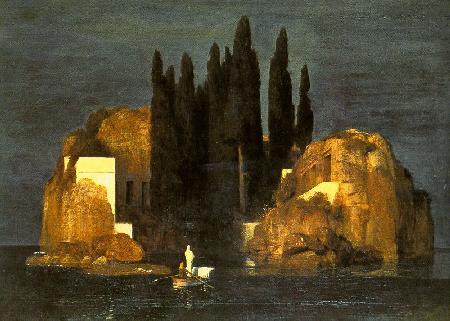
The Isle of the Dead by Arnold Böcklin.
Collection of the Kunstmuseum in Basel, Switzerland.
Sergei Rachmaninoff's The Isle of the Dead is a much darker affair. Rachmaninoff's tone poem was inspired by Arnold Böcklin's symbolist painting, a symbolist work that depicts a possible vision of the afterlife. Under Mr. Robertson, the Philharmonic built a slow but mighty crescendo, from the opening figures that depict the oars of Charon's boat leading one to the afterlife to the majestic final bars.

Erwartung is one of Schoenberg's thorniest creations, a 30-minue psychodrama that stretches the ideas of atonality and chromaticism to their absolute limit. The Woman, as she is known, was played by Deborah Voigt, who is currently between Brünnhilde in the Met's Ring Cycle and the title role in Irving Berlin's Annie Get Your Gun at this summer's Glimmerglass Festival. 

Ms. Voigt used her deep experience of the long vocal lines of Richard Strauss' operas in order to make a magnificent impression. She brought vocal warmth and vulnerability to put the listener at the center of the Woman's plight. Lost in the woods and terrified of the dark forest, she caressed the words with her voice and evoked the happiness that was once hers.

When her lover's corpse was found, the soprano tapped into the reserves of power she has been building since she decided to transition into the heaviest roles of Wagner and Puccini. On the bright side of Avery Fisher Hall, the soprano cast a cone of shadow, imbuing Schoenberg' psychodrama with touching vulnerability. The opera was expertly played by the Philharmonic under Mr. Robertson's sure baton in a performance that met the high expectations that New York currently has for the Met's Brunnhilde of the moment.

Sunday, June 5, 2011

Opera Review: A Modern German Take on Greek Myth

Henze's Phaedra Premieres in Philadelphia.

Cage match: A scene from Act Two of Phaedra. 
Photo by Katherine Elliot, © 2011 Opera Company of Philadelphia
This weekend at the Kimmel Center, the Opera Company of Philadelphia concluded its 35th season with Hans Werner Henze's 2007 opera Phaedra, a knotty work steeped in German serialism and Greek myth. The performances, conducted by Corrado Rivaris, mark the work's United States premiere.

The story is based on Euripides' treatment of the Phaedra myth. Phaedra is the wife of Theseus, the Athenian hero best known for slaying the Minotaur in the Labyrinth of Knossos. The opera opens with the death of the beast. Things take a sharply personal turn as Phaedra falls in love with her step-son Hippolyte, an illicit affair that results in disaster and the latter's death.


Henze originally stopped there, but real life led to the creation of a second act. In 2005, the composer was struck with a mysterious illness and fell into a coma for two months. Upon reviving, he worked with librettist Christian Lehnert to provide a second act and create a scenario in which Hippolyte is resurrected and crowned as king of the forests by the goddess Artemis. The final result was a 75-minute opera in two acts, performed here without an intermission.

The score of Phaedra owes much to Richard Strauss' late style and the 12-tone writing of Alban Berg. Henze makes use of a powerful brass and wind sectin in his score, supporting them with an elaborate percussion section and minimal strings. Tuned keyboard instruments are featured alongside "found" sounds, including the recording of a buzz-saw and what might be the first cellular phone ever used in an opera. Unusual amplification of instruments like the harp provide dense, otherworldly textures, a fitting background to the fantastical plot.

This work proved potent in performance. Mezzo-soprano Tamara Mumford (Flosshilde in the Met's new Das Rheingold) brought physical and vocal athleticism to the title role. Heroic tenor William Burden was compelling as the dead-then-resurrected Hippolyte, the object of his step-mom's obsession. The hunt goddess Artemis was subject to some gender-bending, with countertenor Anthony Roth Costanzo singing the part. Mr. Costanzo's performance combined impressive vocal gyrations with a fierce dramatic heart. Finally, Elizabeth Reiter was impressive in the small role of Aphrodite, singing her duet with Phaedra to Hippolyte as he was trapped in a cage.

If Phaedra sounds like heady, pretentious stuff, it is. But it also the latest in a long operatic tradition of putting fresh spins on familiar mythology, one that stretches from Monteverdi's Orfeo, through the operas of Handel, Haydn and Mozart to the late stage works of Richard Strauss (Daphne and Das Liebe der Danaë.) At this late state in his career, the octegenarian Henze makes his case as an important composer of opera, a visionary whose work can still compel and thrill the adventurous listener.

Thursday, May 5, 2011

Concert Review: Finding Their Marbles

The Philadelphia Orchestra brings Stravinsky to Carnegie Hall.
The Philadelphia Orchestra's chief conductor: Charles Dutoit

The Philadelphia Orchestra has been in the headlines lately, not for the band's musical prowess, but for their board's decision to file for Chapter 11 bankruptcy. The Philadelphians are the first major American orchestra to declare bankruptcy, a decision that has sent rumblings of doom throughout the classical music industry.

Those rumblings were silenced at the Orchestra's Tuesday night appearance at Carnegie Hall under the baton of chief conductor Charles Dutoit. The Swiss maestro brought a contrasting program of works by Igor Stravinsky: the sunny ballet score Apollo and the opera-oratorio Oedipus Rex. The result was an effective contrast of light and dark, exploring two aspects of Stravinsky's neo-classical period.

The  succulent, dark tone of the Philadelphia strings have been a trademark of this orchestra since the heady days when Leopold Stokowski stood upon the podium. This performance of Apollo, a work written just for the strings, featured this rich, thick carpet of sound, with soaring solos from the principal players in each section. Apollo marks a very different Stravinsky from the tribal thunder of the Rite of Spring: a work of neo-classical elegance that recalls the music of Haydn.


The jarring, heavy chords that mark the opening bars of Oedipus Rex have the opposite effect. Oedipus uses huge, rough blocks of brass and percussion, combined with an all-male Latin chorus to evoke the marble and masks of Greek tragedy. The Latin setting of Sophocles (by Jean Cocteau) features no onstage action, and all the events of Oedipus' downfall are described by an omniscient narrative before they happen.

In other words, this is the perfect opera to do in a concert setting.

Tenor Paul Groves was a strong Oedipus, exuding confidence in the first act that slowly degenerated into panic. Baritone Robert Gierlach doubled the roles of Creon and the Messenger. While he has a fine voice, he had trouble being heard over the orchestra at full blast. Petra Lang made an impressive vocal entrance as Jocasta, but sounded unusually harsh of tone in the latter half of her scene with Oedipus. Then again, it could have been her character's panic at realizing who her husband really was.

Mr. Dutoit moved the blocks of sound around with the ease of an Athenian work crew, although the heavy orchestra occasionally overwhelmed the soloists. The orchestra played with precision, with rich trombone tones and deadly, precise percussion. The men of the Philadelphia Singers Chorale made the strongest impression as the citizenry of plague-struck Thebes, by turns terrified, enraged, and horrified at the fate of their king. Philadelphia-based Shakespearean actor David Howey was strong and sympathetic as the Narrator.

Friday, April 29, 2011

Concert Review: The Cost of Modernism

Debussy, Messiaen and Mahler at the New York Philharmonic
Alan Gilbert takes aim.
Photo by Chris Lee © 2011 The New York Philharmonic
Friday's afternoon performance at the New York Philharmonic reunited the orchestra with pianist Emanuel Ax for a program exploring the links between three seminal composers of the 20th century: Claude Debussy, Olivier Messiaen and Gustav Mahler. The concert featured pianist Emanuel Ax. On the night before, Mr. Ax celebrated his 100th concert appearance with the New York Philharmonic.


"Pagodas", the first of Estampes, Debussy's "picture postcards" for piano, opened the concert. Mr. Ax played with flair, drawing out the delicate textures and smoky, Oriental flavor in this music. He then dived into the difficult Couleurs de la cité céleste  "Colors of the Celestial City", Olivier Messiaen's composition for piano, brass, winds and percussion.

Messiaen's music is generally not to the taste of the Philharmonic's über-conservative Friday afternoon audience. (One had the sense that these music-lovers would stream for the exit had there been a break in the program.) Mr. Gilbert led a vigorous performance with rich textures of heavy brass, gongs, and virtuoso clarinet playing. Through the contrasting sections of this piece, (which is meant to evoke a heavenly cityscape) Mr. Gilbert produced Messiaen's unusual clusters of sound: combining brass chords, bird-song and layers of tuned percussion with a deft flick of his baton.


Before the performance, Mr. Gilbert and Mr. Ax addressed their audience explaining the valid musical connection between Debussy and Messiaen, along with brief examples of the latter's work. This mystic French composer is one of the most important musical voices of the 20th century, having influenced everyone from Pierre Boulez to the film music of John Williams. But despite Mr. Gilbert's diplomatic efforts, his subscribers were having none of it.

They were far happier with the second half of the program, the thunderous (and more importantly, familiar) Fifth Symphony by Gustav Mahler. The solo trumpet kicked off the opening funeral dirge, answered by eructations of sound from the fully assembled Philharmonic and low ominous growls from tuba player Alan Baer. Then, Mr. Gilbert let his small army of musicians slide into the three-four lockstep, playing the demented death-waltz that makes up the second subject of the movement.

The second movement was played with thrust and power, the sound of a lumbering giant at play. The third is a Mahler scherzo, which means that it contains some of this composer's boldest, edgiest music. Its opening three-note drop serves a trapdoor, plunging the listener into a deep exploration of the dark corners of the psyche. Its soaring horn solo, played here by the great Philip Myers, was a highlight of the entire performance.

Those in the audience who spent the intermission complaining about Messiaen were probably only there to hear the fourth movement of the Mahler Fifth: the famous Adagietto. Mr. Gilbert conducted Mahler's "greatest hit" with grace and charm. He then proceeded to make the finale fly like a well-swung wrecking ball. What emerged from the rubble was a triumph: not just for the composer conquering his demons but for Mr. Gilbert conquering his audience. After all, a hundred years ago, concert-goers sneered at Mahler, too.

Thursday, April 7, 2011

Opera Review: The Bloody Return of James Levine

Wozzeck at the Metropolitan Opera
The Doctor (Walter Fink, standing) reminds Wozzeck (Alan Held) to eat his beans.
Photo by Ken Howard © 2005 The Metropolitan Opera
A revival of Wozzeck is always cause for anticipation and dread: anticipation for those who love the knotty, disturbing opera, and dread for those putting it on who hope that people will come see it. Berg's only completed opera is a work of the highest genius, but it is rarely big box office.

This revival of Mark Lamos' stark, claustrophobic production featured bass-baritone Alan Held in the title role: the hapless soldier driven to murder his common-law wife by jealousy, madness, and forces beyond his control. Mr. Held staked his claim to the role in the opening scene, defending himself from the sarcasm and abuse of his Captain (Gerhard Siegel) even as he held a straight razor to his superior's throat. The scene made effective use of lighting design, as Wozzeck's shadow towered above the pompous officer, a harbinger of the bloodshed to come.

Waltraud Meier's searing interpretation of Marie was long overdue at the Met. You can see from her performance that she too is trapped in this life, caught between Wozzeck's growing madness and the advances, bribes and threats of the Drum Major (Stuart Skelton), Ms. Meier portrayed Marie with full emotional investment, singing with fearless leaps into the complex texture of Berg's sprechstimme. She was particularly moving in the Act III prayer, which serves as a calm prelude to her murder at Wozzeck's hands.

Mr. Held sang with dark nobility in the opening act of the opera, creating a defensive barrier around the character that was slowly torn down by the Captain, his Doctor (the excellent Walter Fink) and his rapidly deteriorating relationship with Marie. Things shattered completely when he was cuckolded in the second act, and then beaten brutally by the Drum Major. In the final act, he brought whoops of despair and madness into his performance, making his final drowning a poignant, pathetic spectacle.


Mr. Held and Ms. Meier were well matched, and supported by committed performances from Gerhard Siegel as the Captain and Walter Fink as the Doctor. House favorite Wendy White made the most of the brief role of Margret, and tenor Stuart Skelton made a compelling company debut as the Drum Major, the pompous bullying ass who thinks that he's the hero of the opera.

Last night, the Metropolitan Opera House was (just about) full, with opera-goers who gave an enthusiastic welcome to the return of music director James Levine after a two-month absence. Mr. Levine didn't disappoint, leading the 113-piece Met orchestra in a Wozzeck that shrieked, snarled and hummed for 90 minutes. It was a performance of great clarity, accelerating in the right places, and slowing for the work's few poignant moments. As the conductor on this train-ride through hell, there is no better.

Tuesday, March 29, 2011

Opera Review: First the Words, then the Diva

Renée Fleming reigns as the Met revives Capriccio.
by Paul J. Pelkonen
"Hello?" "This is the prompter." Renée Fleming as Countess Madeleine in the Met's Capriccio.
Photo by Ken Howard © 2011 The Metropolitan Opera.
The first-ever revival of Capriccio at the Metropolitan Opera bowed on Monday night. This is a connoisseur's opera, heard only when a prima donna decides to tackle its length and difficult mix of witty dialogue and all-out soprano singing. Right now, Renée Fleming is that diva. On Monday night, she reigned supreme as the Countess Madeleine.

Saturday, March 26, 2011

Opera Review: Three Faces of the Void

City Opera experiments with Monodramas.
by Paul J. Pelkonen
Soprano Anu Komsi in La Machine d'etre.
Photo by Carol Rosegg ©2011 New York City Opera
On Friday night, the City Opera unveiled Monodramas, a triptych of modern operas, each with a single female protagonist. Though two of the works lacked anything resembling a plot, it was a fascinating evening of experimental opera--a bold gesture from a company that nearly went dark two years ago.

La Machine d'etre, ("The Machine of Existence") led off, the first opera by downtown jazz-rebel John Zorn. This was the world premiere of Mr. Zorn's piece, and served as the City Opera debut of soprano Anu Komsi. She was slowly unwrapped, appearing like a Wagner heroine to sing wordless melismas against Mr. Zorn's jagged rhythms and shifting tonal palette.

The plotless work, inspired by the drawings of Antonin Artaud, opened with a memorable image: the City Opera company concealed and rendered genderless by gray burkhas. The performance featured Mr. Artaud's illustrations, animated above the stage on two "flying" cartoon word-balloons. Beneath them, Ms. Komsi displayed an impressive vocal technique. It would be pleasing to learn how this Finnish soprano sounds when she has words to sing.
Kara Shay Thomson, lost in the woods in Erwartung.
Photo by Carol Rosegg © 2011 New York City Opera
Arnold Schoenberg's Erwartung is the only familiar opera on this program. Written in 1909, it is the story of a nameless woman (Kara Shay Thomson, in her company debut) lost in a forest at night. Veering on the edge of madness, she encounters the dead body of her lover. Schoenberg's expressionist score captures the madness and torment of the woman. Ms. Thomson's performance was that of a promising dramatic soprano, navigating her big voice through the tricky, and often exposed passages of the half-hour work.

George Manahan emphasized the rich, melodic content of Schoenberg's score, and the City Opera orchestra was in top form. As with the first work, Ms. Thomson was slowly revealed from beneath her burkha. She was surrounded by a small group of silent, female doppelgangers, all wearing identical white dresses, a memorable image. The most mind-blowing moment of Erwartung arrived in the closing bars: an imaginative, superbly executed time-reversal effect that stopped the opera in its tracks.
Cynthia Sieden (left) and the mirrored boxes of neither.
Photo by Carol Rosegg © 2011 New York City Opera
neither is an apt title for the final work on the program, a lengthy excursion into form and function by American minimalist Morton Feldman. Feldman is an expert at writing stretched-out textures on an enormous canvas. (His String Quartet No. 2 lasts six hours if you play all the repeats.) neither is a setting of a text by Samuel Beckett, and true to this composer's style, each word is stretched out to its breaking point over a series of repeated figures in the orchestra.

Cynthia Sieden did a commendable job of singing the work, a formidable task since she had to hit the same pitch again and again for the first half with absolutely no melodic or harmonic development. The words are stretched distorted to the point where not even the supertitles help with comprehension.

The stage action featured skilled physical movement, at a glacial pace that recalled the productions of Robert Wilson. The action, such as it was, took place inside an iridescent, shimmering cube, adorned with colored lights and 66 (I counted) mysterious mirrored boxes that raised and lowered slowly from the ceiling, hanging in mid-air like miniature avatars of the 2001 monolith. It looked really cool. And it was all very mysterious.

Saturday, March 19, 2011

Concert Review: The Doors of Perception

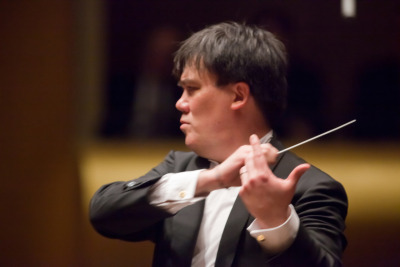
Esa-Pekka Salonen conducts Bluebeard's Castle
Esa-Pekka Salonen. Photo by Nicho Södling.
If Friday night's concert at Avery Fisher Hall is any indication, the three-week marriage of the New York Philharmonic and Finnish maestro Esa-Pekka Salonen is proving to be an effective match. Friday evening featured Béla Bartók's one-act opera Bluebeard's Castle, which presents a French fairy-tale marriage in stark, 20th century terms.

Under the baton of Esa-Pekka Salonen, the New York Philharmonic gave its audience a thrilling performance of this one-act, symbolist opera. As the tension built, the audience was perched on the edge of their seats, held in the grip of the drama of Bluebeard and his latest wife, Judith, and her exploration of the dark reaches of his castle. With help from a strong cast and an effective light show, Mr. Salonen made the opera not a horror story, but an exploration of the complexities of marriage and the dark depths of the male and female psyches.

Bartók started work on Bluebeard's Castle in 1911, but the work took a decade to find its way to the stage. His sole opera combines heavy, Wagnerian orchestration with clever use of woodwinds and unique textures that can only be described as "Bartókian." The libretto is based on the 1901 play Ariane et Barbe-bleu by Maurice Maeterlinck, which was  first set as an opera in 1907 by the composer Paul Dukas.


Mr. Salonen was blessed with a strong cast, considering that there are just two characters and a narrator (played by film actor Richard Easton.) Judith was sung by mezzo-soprano Michelle DeYoung. She rose to the occasion, pulling off the climactic high C that Judith hits at the midway point of the opera, and gave a convincing portrayal of fear and dread despite the formal evening wear and the concert setting.

As Bluebeard, bass Gábor Bretz displayed fine Hungarian diction throught. But he sounded slightly overmatched in the early pages of the opera, battling huge, dissonant chords as the doors of his keep are opened to reveal a torture chamber, armaments, and a garden. Mr. Bretz found his voice at the opening of the fifth door, singing with noble tone through the final pages of the opera. He was firm and resonant in Bluebeard's final peroration to his wife, and chilling in the final bars.

Mr. Salonen drew out the beauty in Bartók's score, making the work's most dissonant pages sound appealing. He conducted the work with an ear for detail and a sweeping, late-Wagnerian style that let the complex music bloom in the lush language of the full orchestra.

The Philharmonic players had their share of heroic moments. These included the titanic, hall-shaking brass fortissimo at the opening of the fifth door, and the eerie, mind-bending chords that accompany the opening of the sixth and the revelation of Bluebeard's lake of tears. Colored lights, electronic effects, and one memorable use of the house lights on full blast added to the complex presentation, pulling the Philharmonic audience into the drama.


The opera performance was part of Mr. Salonen's Hungarian Echoes festival, which matches Bartok's music with the 18th century symphonies of Haydn and the modern works of Györgi Ligeti. The evening opened with the latter's Concert Românesc, a playful composition in four movements. The 12-minute concerto featured a bravura violin part played by concertmaster Glenn Dicterow, and a pair of echoing horns in the slow movement, meant to echo the sound of alphorns.

The Ligeti piece was paired with the Seventh Symphony by Franz Joseph Haydn. Nicknamed Le Midi, ("Noon") the work forms the central part of Haydn's "Times of the Day" triptych, which is being programmed throughout the festival by Mr. Salonen. Like the Ligeti work, Le Midi featured a thrilling series of violin solos, adroitly played by Mr. Dicterow. One could stretch the idea that these three symphonies echoed Bluebeard's wives--one for each time of the day, but otherwise it was difficult to see how Le Midi fit into this adventurous program.

Trending on Superconductor

Translate

Share My Blog!

Share |

Critical Thinking in the Cheap Seats