Support independent arts journalism by joining our Patreon! Currently $5/month.

About Superconductor

Our motto: "Critical thinking in the cheap seats." Unbiased, honest classical music and opera opinions, occasional obituaries and classical news reporting, since 2007. All written content © 2019 by Paul J. Pelkonen. For more about Superconductor, visit this link. For advertising rates, click this link. Follow us on Facebook.
Showing posts with label sergei rachmaninoff. Show all posts

Monday, November 7, 2011

Concert Review: Taking on the Titans

The Atlanta Symphony Orchestra at Carnegie Hall
Mr. Congenial: Garrick Ohlsson returned to Carnegie Hall
as soloist with the Atlanta Symphony Orchestra.
Robert Spano brought the Atlanta Symphony Orchestra to Carnegie Hall on Saturday night with a challenging program featuring new music from composer/conductor Esa-Pekka Salonen, followed by two works by Scriabin and Rachmaninoff. These late Russian Romantics, while very different musically, were classmates at the same conservatory.

The concert opened with the New York premiere of Nyx a large-scale orchestral work. Mr. Salonen wove a complex, yet clear fabric from gleaming melodic threads. The clarinet and horns tossed the main theme back and forth over a roil of sound. The music became menacing and monolithic, with bold brass writing and innovative percussion making a rich sonic experience. Predictably, it was met with polite applause. 

Although Scriabin's Poem of Ecstasy premiered in New York in 1908, it remains an obscure example of late Russian romanticism. Scriabin used an unusual harmonic language in this late piece. By choosing to substitute the dissonant interval of a harmonic fourth for the usual, more tonal fifth, he created a dissonant sound-world, very much his own.

This challenging score was presented with playing of the highest caliber. Concertmaster David Coucheron unleashed the shimmering first theme, answered by a clarion call in the expanded brass section. The eight horns formed a phalanx in the orchestra, leading the charge up the score's dizzying heights. Robert Spano drove the work home, bringing in the tuba and organ to anchor an orgiastic swirl of sound. The meaning of the work may have died with Scriabin, but its impact was deeply felt.

The audience seemed happier about the second half of the program: Rachmaninoff's familiar, though fearsomely difficult Piano Concerto No. 3, featuring soloist Garrick Ohlsson. Its three movements are like that old Atari game "Pitfall!"--one wrong move and the soloist will never be heard from again.
Pitfall Harry (on rope, right) may well have understood the dangers of playing Rachmaninoff.
Image from the video game Pitfall! © 1982 Activision.
It's true that Rachmaninoff wrote the concerto for himself to play on tour and was possessed with freakishly big hands that (legend has it) could stretch a twelfth (that's an octave and a half) on the keyboard. But what makes this concerto so difficult is the interwoven nature of its writing. The conductor does more than just accompany a pretty melody--he and the orchestra get into a complicated dialogue with the soloist that sometimes verges on argument. It also calls for fearsome precision among all those trills, keyboard runs and hand-crossings, pointillist playing at full forte.

Mr. Ohlsson and Mr. Spano made a congenial team, solving the concerto's problems as they unfolded its secrets. The first movement's complicated cadenzas (where the pianist takes on the role of both orchestra and soloist, an idea first developed by the composer Alkan) held the audience breathless. The slow Intermezzo sang a sad Russian song. And the pell-mell finale, calling for the greatest degree of virtuosity from the pianist proved a thrilling experience.

After a tumultuous reception from the audience, Mr. Ohlsson returned to the keyboard. Turning to the house, he announced: "This is too famous for an introduction." Then he played a slow, loving Clair de Lune from Debussy's Suite Bergamesque. It was the perfect contrast to the Rachmaninoff, and an ideal way to end the evening.

Saturday, June 11, 2011

Concert Review: A Valkyrie, Lost in the Woods

Erwartung at the New York Philharmonic with Deborah Voigt
Original stage set design for Erwartung. Crayon, pastel and watercolor by Arnold Schoenberg.
From the composer's collection at the Arnold Schoenberg Center.
This week's concert by the New York Philharmonic exhibited different aspects of early 20th century art, contrasting the surreal, exuberant humor of Shostakovich, the potent symbolism of Rachmaninoff and the sharp-edged expressionism of Schoenberg. David Robertson conducted.

Dmitri Shostakovich wrote his First Symphony as his graduation piece for the Leningrad Conservatory, when he was just 19 years old. It is a powerful, fully mature symphony that is too often dismissed as a work of juvinalia. Although not as dark as the works of Shostakovich's maturity and redolent with the influence of Prokofiev, this is a compelling work that should be performed more frequently.

Mr. Robertson led an engaging performance of the work, with its memorable themes and elegaic little solos for oboe, violin, 'cello and horn. The jaunty, almost nautical theme of the first movement (cribbed by Disney for "Hi diddley-hi" and the elegaic lento movement engaged the audience. The final Allegro, with its long working out of the "fate" theme from Wagner's Die Walküre brought the work to a muscular finish.
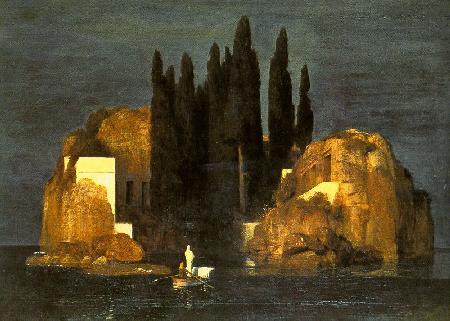
The Isle of the Dead by Arnold Böcklin.
Collection of the Kunstmuseum in Basel, Switzerland.
Sergei Rachmaninoff's The Isle of the Dead is a much darker affair. Rachmaninoff's tone poem was inspired by Arnold Böcklin's symbolist painting, a symbolist work that depicts a possible vision of the afterlife. Under Mr. Robertson, the Philharmonic built a slow but mighty crescendo, from the opening figures that depict the oars of Charon's boat leading one to the afterlife to the majestic final bars.

Erwartung is one of Schoenberg's thorniest creations, a 30-minue psychodrama that stretches the ideas of atonality and chromaticism to their absolute limit. The Woman, as she is known, was played by Deborah Voigt, who is currently between Brünnhilde in the Met's Ring Cycle and the title role in Irving Berlin's Annie Get Your Gun at this summer's Glimmerglass Festival. 

Ms. Voigt used her deep experience of the long vocal lines of Richard Strauss' operas in order to make a magnificent impression. She brought vocal warmth and vulnerability to put the listener at the center of the Woman's plight. Lost in the woods and terrified of the dark forest, she caressed the words with her voice and evoked the happiness that was once hers.

When her lover's corpse was found, the soprano tapped into the reserves of power she has been building since she decided to transition into the heaviest roles of Wagner and Puccini. On the bright side of Avery Fisher Hall, the soprano cast a cone of shadow, imbuing Schoenberg' psychodrama with touching vulnerability. The opera was expertly played by the Philharmonic under Mr. Robertson's sure baton in a performance that met the high expectations that New York currently has for the Met's Brunnhilde of the moment.

Trending on Superconductor

Translate

Share My Blog!

Share |

Critical Thinking in the Cheap Seats