Support independent arts journalism by joining our Patreon! Currently $5/month.

About Superconductor

Our motto: "Critical thinking in the cheap seats." Unbiased, honest classical music and opera opinions, occasional obituaries and classical news reporting, since 2007. All written content © 2019 by Paul J. Pelkonen. For more about Superconductor, visit this link. For advertising rates, click this link. Follow us on Facebook.
Showing posts with label New York. Show all posts

Tuesday, May 21, 2019

Concert Review: Slip-Slidin' Away

Valery Gergiev and Daniil Trifonov return to Carnegie Hall.
by Paul J. Pelkonen
And carry a small stick: Valery Gergiev.
Photo © 2017 Munich Philharmonic Orchestra.
Six years and some months ago, the pianist Daniil Trifonov made his debut at Carnegie Hall. On Saturday night, Mr. Trifonov re-teamed with Valery Gergiev, now at the helm of the MET Orchestra. Mr. Gergiev spent many years as a principal guest conductor at the Metropolitan Opera, and one assumes that the players remain familiar with his eccentric conducting style. This was the first of three scheduled spring concerts by New York's greatest opera orchestra, an annual tradition at this venue following the end of the opera season.

Wednesday, July 11, 2018

We Are Experiencing Technical Difficulties

The state of Superconductor, July 2018.
by Paul J. Pelkonen
Art from The Simpsons episode "Marge on the Lam" © 1993 Gracie Films
Hi all. Paul here. Some of you may have noticed that posts on this usually stalwart blog have gotten spotty of late, with a couple of posts a week instead of the usual steady stream of words about the classical music and opera scene in and around New York in elsewhere. We’re not pleased about this either and I thought I should lay down here what’s going on.

Monday, June 11, 2018

Concert Review: All Within Her Hands

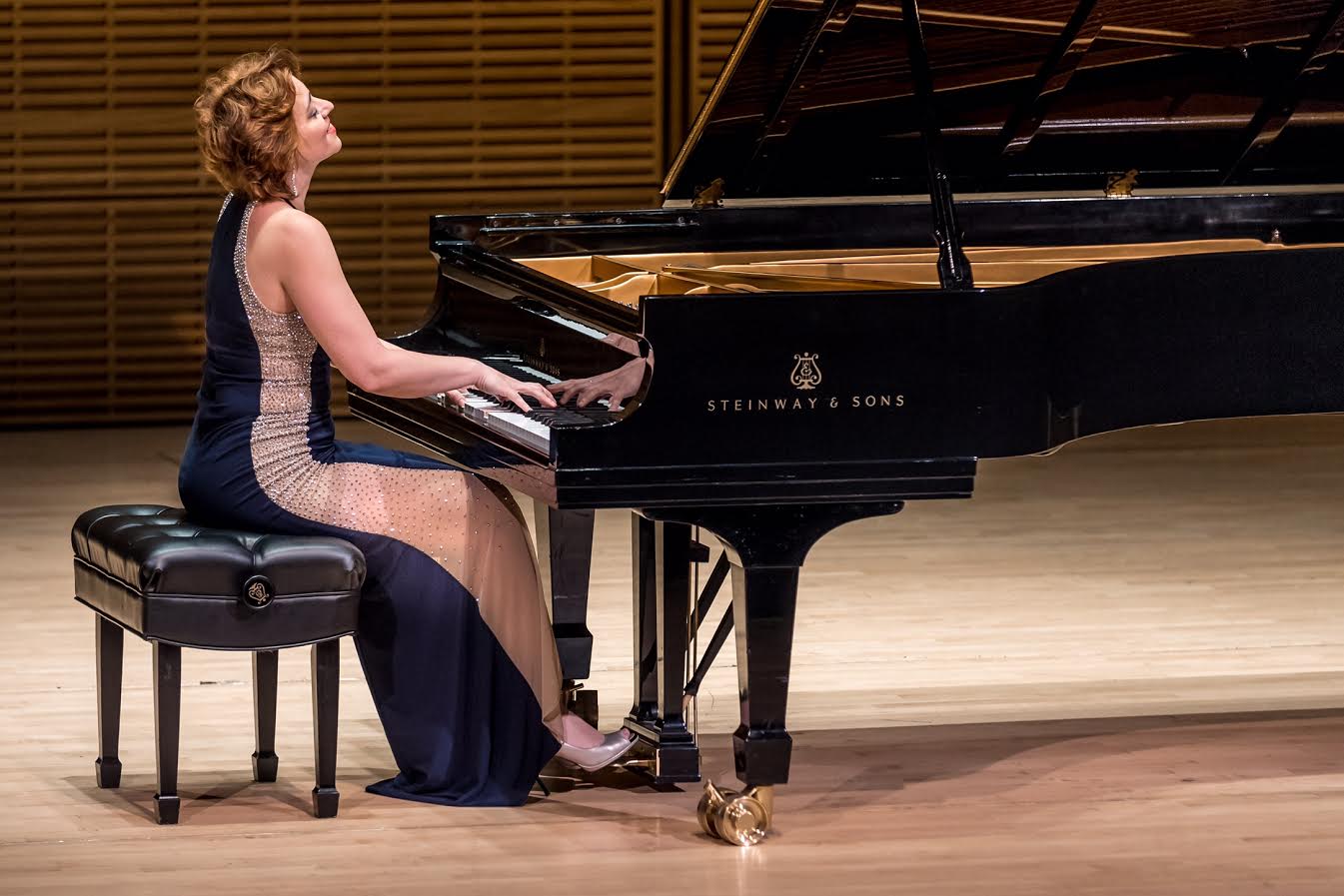
Kariné Poghosyan plays damned difficult stuff at Zankel Hall.
by Paul J. Pelkonen
Kariné Poghosyan in concert at Zankel Hall. Photo by Jonathan Levin. 
The season is winding down but there are still some extraordinary artists to be heard (and covered) in the pages of Superconductor. On Thursday night, it was the New York-based Armenian-born pianist Kariné Poghosyan, playing her first recital at Zankel Hall, the subterranean concert venue that sits underneath Carnegie Hall.

Friday, January 19, 2018

Concert Review: Coming Down to Earth

The Royal Concertgebouw plays Bruch and Mahler. 
by Paul J. Pelkonen
Violinist Janine Jansen played the Bruch Concerto No. 1 at Carnegie Hall
on Thursday night. Photo courtesy Decca/UMG.
The second night of the Royal Concertgebouw's 2018 stand at Carnegie Hall did not scale the same dizzying heights as its first. This performance, led by music director Daniele Gatti featured the Dutch ensemble setting aside the cosmic considerations of Bruckner for the earthier world of a composer that has proved even more popular: Gustav Mahler.

Sunday, January 7, 2018

Concert Review: Who's for Trifle?

A light program at the Philharmonic with Jeffrey Kahane.
by Paul J. Pelkonen 
Cellist Alisa Weilerstein guested (briefly) with the New York Philharmonic this week.
Photo by Harald Hoffmann, © 2018 Decca Classics.
New Yorkers (and I am one by birth) are a hardy bunch. Not even the purported bomb cyclone and sub-freezing windchill could keep them away from this week's concerts at the New York Philharmonic, the first of the new year on the stage of David Geffen HallHowever, given the short length and relative light weight of this program, it may be a matter of some debate if the concert was worth braving the elements.

Tuesday, October 31, 2017

On Crossing Barriers and Finding Escapes

Reflecting on ten years of Superconductor.
by Paul J. Pelkonen
The office.
Tonight, Monday night. I was walking across Lincoln Center Plaza on route to the Metropolitan Opera to go see second performance of The Exterminating Angel, the new opera by Thomas Àdes.
This is the story of a group of wealthy individuals who find themselves trapped in a particular living space after a very strange dinner party. It got me thinking about the original purpose of this blog and how Superconductor started at now however ten years into existence where the blog maybe going.

Sunday, December 20, 2015

Concert Review: No Country for Forgotten Men

The ASO explores Russia's lost Jewish composers.
by Paul J. Pelkonen
Big stick: the composer Anton Rubinstein on the podium. His work was played
Thursday night by the American Symphony Orchestra.
Painting by Ilya Repin.
The concert hall music of Russia has a shorter history than most, as no major composers emerged in that land until the 19th century. And yet, there are as many forgotten and neglected composers from Russia as there are trees in its vast taiga forests. On Thursday night, Leon Botstein chose four Jewish composers from Russia as the focus of a Carnegie Hall concert by the American Symphony Orchestra: Aleksandr Krein, Anton Rubinstein, Mikhail Gnesin and Maximillian Steinberg.

Friday, March 20, 2015

Concert Review: He's Your Native Son

Alan Gilbert returns to the New York Philharmonic.
by Paul J. Pelkonen
Back in black: Alan Gilbert leads the New York Philharmonic.
Photo by Chris Lee © 2015 The New York Philharmonic
New York Philharmonic music director Alan Gilbert has been making headlines this year, not so much for his feats on the podium of Avery Fisher Hall but for the fact that he has announced that he will vacate his position in 2017. Still, the conductor, (who is the first New York-born musician to hold this post and the son of two former members of the orchestra) was all business at Friday's 11am matinée. Looking fit and trim (and conducting in an open-necked shirt without the benefit of his usual baton, he led a complex program featuring classics by Richard Strauss, Claude Debussy and Maurice Ravel, along with a recent composition by next year's composer-in-residence, Esa-Pekka Salonen.

Thursday, February 19, 2015

Concert Review: He's Ready for the World

Behzod Abduraimov at Weill Recital Hall.
by Paul J. Pelkonen
Bezhod Abduraimov.
Photo by Ben Ealavega © 2015 Decca Classics.
The first Carnegie Hall recital by a promising young pianist is an important occasion. When that artist is Behzod Abduraimov, the young powerhouse playing a musically conservative (but pianistically ambitious) program of Chopin, Schubert and Ravel, that occasion becomes a hot ticket, especially when that recital is held in the cozy (268 seats) elegance of Weill Recital Hall, located upstairs from the more famous Hall that Music Built.

Friday, August 9, 2013

Obituary: Regina Resnik, 1922-2013

From Bronx baby to international opera star.
by Paul J. Pelkonen
A gypsy from the Bronx: Regina Resnik.
Regina Resnik, the opera singer who went from soprano roles to mezzo to a Tony-nominated career on Broadway, died today. She was 90.

Born in 1922 in the Bronx, Ms. Resnik studied drama and music at Hunter College. She vaulted to stardom on December 6, 1944, when she debuted at the Met. On just 24 hours notice, she stepped in for Zinka Milanov in Verdi's Il Trovatore. This launched a ten-year career playing opera heroines in works by Mozart Beethovem Wagner, Veri and uccini. She was the first singer to play Ellen Orford in Peter Grimes at the Met, and she created the role of Delilah in Bernard Rogers' now-forgotten opera The Warrior.

Sunday, November 4, 2012

Awareness: Beethoven and Sandy

Some music for the storm recovery.
Ludwig Was Here.
Last night at the New York Philharmonic concert, I got a little card in my Playbill, helpfully reminding me that November in New York City is Beethoven Awareness Month. As far as I am um...aware, this is the second year in a row that our city has celebrated the music of the great man. 

In light of recent events, I wanted to share the following clip, from Beethoven's only opera Fidelio, which ranks as my favorite piece that the composer ever wrote. It is a quartet in canon form, from the first act of the opera, and can hopefully serve as some kind of psychological balm in these chaotic days that have followed the arrival of Hurricane Sandy. 


Things are (slowly) getting back to normal here at the Superconductor desk, but that doesn't mean they are for the rest of the city. Whole sections of Brooklyn, Queens, and Staten Island remain devastated, with enormous, unrepairable damage to lives, homes and property. So I urge you, after listening to this (or even before, to join the effort to help people in New York, New Jersey and elsewhere recover from the hurricane's impact. Here's a list of ways you can help:

The American Red Cross fund for Hurricane Relief. They need money. And if you can, visit a Red Cross blood drive and donate some of what flows in your veins.

Occupy Sandy Our friends at the movement for social change have set up kitchens and distribution of relief centers in Brooklyn. They have a list of donation requirements.

AmeriCares has set up its own disaster relief fund.

The Salvation Army is also doing disaster relief. I don't agree with this organization's policies on sexual discrimination but will post this if you want to help their relief efforts.

The Knights of Columbus, another organization I don't agree with but they are also out there organizing and donating.

New York's food trucks are working to provide food for people displaced. 
Food Bank New York is trying to feed the people who are out of their homes.

Finally, you can donate to the Mayor's Fund in four easy ways:

1. Online – visit www.nyc.gov/fund.
2. Mail – checks can be made payable to Mayor’s Fund to Advance New York City, with “hurricane relief” in the memo line, and sent to:
Mayor’s Fund to Advance New York City,
253 Broadway, 8th Floor, New York, NY 10007. 
3. Call – donations can be made over the phone at 212-788-7794.
4. Text – text NYCFUND to 50555 to donate $10 to the Mayor’s Fund to support hurricane relief. (Message and data rates may apply.)

100 percent of donations are being dispersed to relief efforts and organizations to meet the short- and long-term needs of New York City and its residents. This includes immediate aid such as the supply and transport of water, food, toiletries, baby supplies, blankets and cleaning materials to distribution sites, as well as longer term restoration and recovery efforts.

To volunteer or for in-kind donations, visit www.nycservice.org.


Tuesday, September 25, 2012

Opera Review: The Conservative Ticket

L'Elisir d'Amore opens the Metropolitan Opera's 2012-2013 Season.
by Paul J. Pelkonen
Opening night in Times Square. Photo by the author.
Original images by Nick Heavican (top) and Ken Howard (bottom)
© 2012 The Metropolitan Opera.

The Metropolitan Opera opened last night with the company's first performance of a new production of Donizetti's L'Elisir d'Amore starring Anna Netrebko. Ms. Netrebko was reunited with her tag-team partners from a successful 2010 revival of Don Pasquale, tenor Matthew Polenzani and baritone Mariusz Kwiecień.

It's true that the Met was due for a new Elisir. John Copley's shopworn 1991 production had soured with audiences, despite an energetic run of the opera last spring. The choice also allowed the Met marketing department to keep Ms. Netrebko's flashing, dark eyes at the heart of its city-wide campaign. However, this was an uninspired choice to kick off the season at a time when opera needs to make itself relevant.

Bart Sher's new production is conservative, lacking the distinct directorial mannerisms and surreal humor that prevailed in his three previous outings for the Met. The sets (by Michael Yeargan) are realistic and picturesque. Catherine Zuber provided elaborate costumes and rich fabrics that ground the opera firmly in the reality of the 19th century. The only oddity is a preference for high black hats: indeed everyone except Mr. Polenzani gets to sport one at one time or another.

Friday, June 8, 2012

A Superconductive Summer

A quick note to our loyal readers.
Well, a bunch of notes.
Hi folks,

As it's now June, you might have noticed that offerings on Superconductor have gotten thinner this month. Carnegie Hall is closed for the summer, as is the Metropolitan Opera. 

As summer marches in, there's much to be happy about. The New York Philharmonic is still going strong, with an exciting slate of concerts this month, culminating in Philharmonic 360, a concert at the Park Avenue Armory celebrating the unlikely confluence of Mozart and Stockhausen. Smaller opera companies are staging...well, smaller opera productions. 

 The summer festival season is almost on us.

Monday, May 7, 2012

Coiled Anticipation: Spring For Music 2012

The festival returns to Carnegie Hall for its second season.
by Paul Pelkonen
Spring for Music. This is not the logo or anything.
Starting Monday night, Carnegie Hall opens its venerated doors to the Spring For Music Festival, six concerts with lesser-known North American orchestras playing a combination of 20th and 21st-century repertory from deep corners of the repertory. 

Sounds exciting?

Did we mention that all tickets for these concerts are dirt cheap at $25?.

Thursday, April 5, 2012

Spooky Nights at the Museum

DJ Spooky, new administration promise an innovative year at the MET.
It's the climate--or maybe the pants. Paul "DJ Spooky" Miller in Antarctica.
He's the Metropolitan Museum of Art's new Artist-in-Residence.
The Metropolitan Museum of Art is one of the greatest arts exhibits in New York City. For next season, the museum is shaking off its staid image and rebranding its annual concerts and lectures offering as Met Museum Presents

The Museum has a new Director for its concerts and lectures: Limor Tomer, whose resume includes work at WQXR and the Whitney. To revitalize this program (which was under the aegis of the now-retired Hildje Limondjian for 41 years), Ms. Tomer has in turn enlisted Paul Miller, the decidedly "downtown" musician better known as DJ Spooky, That Subliminal Kid. Mr. Miller is the museum's first-ever Artist-in-Residence.

The programming for next season has its share of exciting intiatives, designed to bring concerts and performances out of the cavernous Grace Rainey Rodgers Auditorium and into the museum's actual exhibit spaces. The program offerings include: 

The Peony Pavilion:
 The so-called "Ming Ring" (blame the Lincoln Center press department for that one) gets a new score from Chinese composer Tan Dun, and a new stage in the Museum's Astor Court Chinese Scholar Garden. Although only 50 people will be able to attend each performance, a live simulcast to the Rodgers Auditorium will expand the opera's on-site audience.

The Met Reframed:
DJ Spooky's initiative this year seeks to combine turntablism, chamber music, and mixed media (including iPads and GPS) for an exciting series of concerts. Works on the schedule include The Nauru Elegies (examining the plight of that much-harvested South Pacific Island), Of Water and Ice which draws inspiration from the rapidly shrinking ice-cap of Antarctica, and an iPad Mixing Project to take place in the Museum's Great Hall.

The Endellion String Quartet:
Another cycle of the Beethoven String Quartets (following the 2011 appearances by the Pacifica Quartet) does not necessarily qualify as "innovative", but this young European ensemble should make these immortal works interesting. Six concerts over two weekends will encompass the entire cycle of quartets.

The Salomé Chamber Orchestra
This exciting young orchestra will offer a series of performances featuring Bach's Brandenburg concertos, a concert pairing the Four Seasons by Vivaldi with similar concertos from Astor Piazzola. All of these concerts will feature instruments from the Sau Wing Lam collection, which will promptly return to their display cases.

Additionally, the Museum will continue its partnership with the New York Philharmonic hosting new music concerts in the CONTACT! series. Other concerts include an appearance by jazz saxophonist Charles Lloyd, a Valentine's Day concert by Judy Collins, and a Mozart concert by the Salzburg Chamber Soloists.

Monday, March 26, 2012

Concert Review: The Keeper of the Keys

Murray Perahia in recital at Lincoln Center
by Paul Pelkonen
Piano man: Murray Perahia. Photo © 2010 courtesy Sony Classical.
In the course of a long concert season, some recitals and concerts are akin to a religious ceremony. Such a one was Sunday's afternoon concert at Avery Fisher Hall, featuring Bronx-born pianist Murray Perahia. The lights of this great hall were down very low, creating an atmosphere of religious contemplation. A celestial beam lit the stage, as New York's own high priest of solo piano music strode to his instrument.

As a hometown hero with impeccable taste and technique, Mr. Perahia is beloved by New York concert-goers. Yet he has earned their frustration as well, with a series of cancellations and health problems stemming from a 1995 operation to remove a bone spur from his right hand. This forced him to retire from performance for three years. Those physical problems, coupled with the artist's ongoing residency in Berlin have conspired to make a recital by this artist a special event.

The repertory for this recital was conservative, with the three "B's" (J. S. Bach, Beethoven, Brahms) in the first half and Chopin and Schubert in the second. Mr. Perahia began with No. 5 of Bach's French Suites, his hands performing a complex terpsichore on the keys through the seven dance movements. The closing Loure and Gigue were lyric and uplifting, a strong argument for performing this music on the modern instrument.


Beethoven wrote his piano sonatas for the wood-framed fortepiano of his day, destroying a few in the process. The 27th Sonata in E minor is one of his most unconventional. Consisting of just two movements, its tense opening and cheerful Rondo are testaments to the composer's volatile personality. Mr. Perahia's playing was conservative, focusing on the deep humanism of the writing and the composer's gift of phrase.

The first half of the program ended with Brahms' late Klavierstücke--four piano miniatures from the composer's late period. Mr. Perahia announced Brahms' solemn presence through the cascade of heavy chords that open the first Intermezzo. From there he turned to warm, glowing melodies, leading a gorgeous waltz in the middle section of the second piece.

Mr. Perahia's recent releases have included a disc of Brahms works, and his affinity for the composer's complex scheme and variations showed in the third Intermezzo, a kind of scherzo based on just four notes. Finally it was time for the vast, cinematic sweep of the Rhapsody in E Flat Major, which ends the set with a noble theme borrowed six years later by Brahms' friend Jean Sibelius for his tone poem Finlandia.

The second half opened with Schubert's Sonata No. 19 in A, a work of sunny optimism with none of the obsession with death that plagued this young composer in his later years. Mr. Perahia made the sunlight of Schubert's Vienna shine into the dark cavern of Avery Fisher Hall, playing the three movements with lyric grace. The Andante flowed smoothly from his fingers, and the final movement had a fierce, determined joy.

That ferocity and determination extended to the four Chopin works chosen by Mr. Perahia to end the concert. This ws not the simpering, soft Chopin of the salon, but music of a brusque, business-like determination. The C# minor Polonaise had a heroic swagger, its dance rhythms etched by the soloist in bold strokes. The murderously difficult Prelude No. 8 in F# minor followed. A tiny two-minute beast among the composer's 24, its nickname is "Desparation." Mr. Perahia kept a cool head and executed the tricky right-hand figures with his customary skill.

The Mazurka No. 4 is just three minutes in length. Mr. Perahia showed that this brief work is packed with musical ideas and expressive possibilities. The little tetralogy ended with the muscular Scherzo No. 4, the last of the set. Mr. Perahia returned to Chopin's heroic mode here. The brash opening theme gave way to a slow, sad minor. The work ended with a mighty struggle to return to the major key. Mr. Perahia injected a note of triumph and achievement into the resonant final chords.

Sunday, March 25, 2012

Concert Review: Flash of the Titans

Yefim Bronfman in recital at Carnegie Hall.
by Paul J. Pelkonen
Determination: Yefim Bronfman in concert. 
When the pianist Yefim Bronfman made his entrance at Carnegie Hall on Friday night, it was the start of a heroic confrontation between the burly Russian-born artist and the black Steinway: his vehicle to play sonatas by Haydn, Brahms and Prokofiev.

Saturday, January 14, 2012

Concert Review: How Zubin Got His Groove Back

Or: Bruckner 8, Cell Phones 0.
Cosmic traveler: former New York Philharmonic music director Zubin Mehta.
Playing the final completed composition of a great symphonist can be a daunting task. The job is harder when the composer is Anton Bruckner. All Bruckner symphonies are big, but none is more massive than the mighty Eighth. Its orchestral requirements are huge, and the four movements can last almost an hour and a half.

These performances of the Eighth at the New York Philharmonic feature the return of Zubin Mehta, the orchestra's former music director. (He stepped down in 1991.) This year, Mr. Mehta's younger brother Zarin is due to step down too (as orchestra President) in 2012. Zarin was in attendance at Friday night's concert, in a second tier box alongside current music director Alan Gilbert and acting Artistic Administrator Ed Yim.

Maybe it was the heavy brass upstairs, but the brass-heavy mystic sound-world of this symphony took some time to come into focus on Friday night. The first  theme in the cellos was played forcefully, paving the way for the brass' entrance. With a full complement of eight horns, Wagner tubas, heavy trombones and tuba, this is a lot of music to coordinate. The stentorian thematic statement of the motto theme didn't quite come off as it should, but conductor and orchestra settled in to deliver a potent first movement.


Once the development was reached, Mr. Mehta finally showed the touch with this orchestra that he had displayed early in his 13-year career on the podium of Avery Fisher Hall.  Working without a score, Mr. Mehta clarified and emphasized the drama of this abstract music, with audible references to Wagner's Nibelungs and Valkyries underlined in this interpretation. (All that experience conducting the Ring had clearly paid off.) The first movement rose to a mighty climax and then cut off, building again and leaving the audience breathless.

The second movement more consistent, with Mr. Mehta taking a heavy, broad approach to the trademark three-two ländler rhythm that dominates this scherzo. The theme rose and fell like giants or very large gods at play. The trio had a lovely, Viennese grace to it that is heard in the later Bruckner symphonies, as if the peasant composer with a love of church music had finally gained a little urban sophistication.

The "Bruckner rhythm" expands to an enormous scale in the third movement, one of the composer's most majestic Adagios. Here, the Philharmonic's augmented brass section moved to the fore, seeming to open a sonic gateway into the cosmic mysteries that so obsessed this composer. Unusually, the climax of the Adagio at its exact midpoint, with a simple, unforgettable canon in the horns that is stated once. That horn figure seems to be the long-sought truth at the heart of this questing movement. It is then varied and interwoven into the huge structure, but never repeated.

The potent opening of the finale with pounding timpani and driving strings served as the central building block for a mighty summation of everything that had come before. As the opening statement returned (this time played with firmness and conviction) the Philharmonic rose to a triumphant height. Once more, the Austrian peasant with a simple, unlikely talent for writing big music, had conquered.

Tuesday, November 15, 2011

A Soundtrack for Zuccotti Park

Today was going to feature the review of Handel's opera Rodelinda, with Renée Fleming in the title role. But when we came home late last night, it was to a Twitter stream of violence and flagrant violations of Americans' First Amendment rights to peaceably assemble. In fact, it was war in the streets of Manhattan, with Kevlar-vested weapon-wielding thugs (the NYPD) enforcing the will of New York Mayor Michael "I can pay to stay in office as long as I want" Bloomberg.
I'll write the review tonight and it will probably be up tomorrow. In the meantime, I decided to write about heavy metal protest music. Hey, it's my blog, and WNYC already did classical protest music. So...

Top Ten Heavy Metal Protest Songs
People in this business are often surprised when they learn I'm a metal fan in addition to having an ear for classical music and opera. I got into Metallica because I thought "One" sounded like chamber music albeit played really loud. Still do. Anyway here are some songs for Zuccotti, Occupy Wall Street and for the righteous anger of the 99%.
10) "Clenching the Fists of Dissent" by Machine Head.
This ten-minute track kicks off the San Francisco group's The Blackening. Title pretty much says it all along with Robb Flynn's roared vocals and razor-sharp guitar.
"Didn't say I want to lead, I just might let you down."
9) "Broken, Beat and Scarred" by Metallica.
From 2008's comeback bid Death Magnetic, a song about persevering in the face of adversity. Metallica have written a lot of protest songs but this is the most recent.
"What don't kill ya, make ya more strong."
8) "Two Minutes to Midnight" by Iron Maiden.
One of the best anti-war protest songs from the '80s. The lyrics are really about nuclear war, but Maiden were playing this a lot onstage when the war in Iraq broke out.
"We oil the jaws of the war machine and feed it with our babies."
7) "Resistance" by Queensrÿche.
"Protests in New York, listen to the call of the wild! Brothers, sisters carrying signs."
That's the first line of this classic track featuring Geoff Tate's giant tenor voice. The song is 20 years old, folks. It hasn't aged. Nor has our country grown up.
6) "Open Letter (To a Landlord)" by Living Coloür.
Especially poignant for New Yorkers, a tale of inner-city survival against greedy land developers and landlords who don't care about the human beings living in their buildings.
"This is my neighborhood. This is where I come from."
5) "Fucking Hostile" by Pantera.
From the group's aptly named Vulgar Display of Power. Philip Anselmo breaks down relations of the ordinary man to parents, police, the clergy and other authority figures. Late, great guitarist "Dimebag" Darrell Abbott plays the kamikaze solo over a gallop.
"If you crossed me, I'd shake your hand like a man, not a god."
4) "Peace Sells" by Megadeth.
There have been a lot of rage-fuelled Megadeth protest songs from the pen of Dave Mustaine. This was one of the first, and one of the best. Its opening bassline used to announce MTV News and it's still relevant today. From Peace Sells (But Who's Buying?)
"Can you put a price on peace?"
3) "United" by Judas Priest.
From what is arguably Priest's most successful album, the legendary British Steel. Rob Halford was really singing about gay rights here, but this cut (with its memorable chorus) is an underrated anthem.
"Look around, they're moving in.
Hold your ground, when they begin."
2) "War Pigs" by Black Sabbath
From Paranoid. It doesn't get more old-school than Ozzy's howl over Tony Iommi's heavy chords, Terence "Geezer" Butler's agile bass and Bill Ward's powerhouse drumming. And they're back together as of last Friday! "Oz-zy! Oz-zy!" (though Geezer wrote the lyrics.)
"Politicians hide themselves away. They only started the war.
 Why should they go out to fight? They leave that role to the poor ."
1) "Killing in the Name" by Rage Against the Machine.
Tom Morello and Zack de la Rocha pretty much said it all in this cut from their first pipe-bomb of an album.
"Fuck you, I won't do what you tell me."

Got a suggestion for this list? Leave it in the comments below.
Better yet, donate to Occupy Wall Street and support your local occupation today!

Friday, November 4, 2011

Concert Review: The Devil Went Down to Wall Street

Occupy Stravinsky performs at Zuccotti Park.
The Devil is a blonde: Elizabeth Stanley (center) tempts Nick Choksi (left) as Erik Liberman (right) looks on.
Photo taken at Occupy Wall Street, Nov. 3, 2011, © the author.
 
"Mic check!"

"Mic check!" 

"We are...Occupy Stravinksy!"

"We are...OCCUPY STRAVINSKY!"

Trending on Superconductor

Translate

Share My Blog!

Share |

Critical Thinking in the Cheap Seats