Support independent arts journalism by joining our Patreon! Currently $5/month.

About Superconductor

Our motto: "Critical thinking in the cheap seats." Unbiased, honest classical music and opera opinions, occasional obituaries and classical news reporting, since 2007. All written content © 2019 by Paul J. Pelkonen. For more about Superconductor, visit this link. For advertising rates, click this link. Follow us on Facebook.
Showing posts with label Grieg. Show all posts

Thursday, December 1, 2016

Concert Review: First Cake, Then Ice Cream

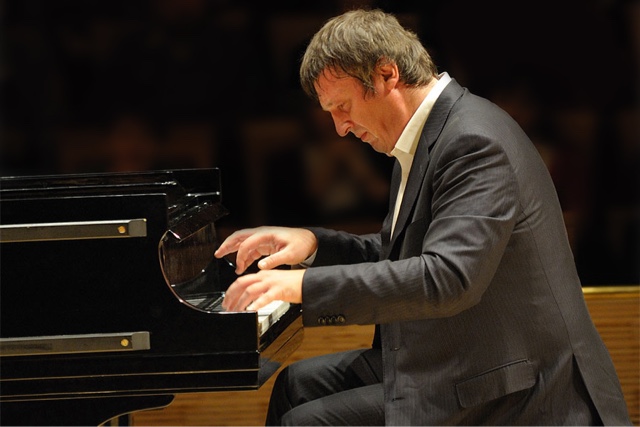
The pianist Boris Berezovsky returns to New York.
by Paul J. Pelkonen
The pianist Boris Berezovsky onstage at the Mariinsky Theater..
Photo copyright 1996 mariinsky.ru.
When the Russian virtuoso pianist Boris Berezovsky last gave a recital in New York City, Bill Clinton was president and Zankel Hall didn't evenexist. So Tuesday night marked the pianists debut at Carnegie’s modern subterranean venture, billed with a finger-busting program of piano études by Bartók, Ligeti and Liszt.

Saturday, October 8, 2016

Concert Review: Smashing Glass

Gemma New sparkles at the New Jersey Symphony Orchestra.
by Paul J. Pelkonen
Meet the New boss: Gemma New conducted at NJPAC on Thursday.
Photo by Fred Stucker © 2016 IMG Artists.
For centuries, the podium in front of a symphony orchestra has been a place reserved for men. However, this year the New Jersey Symphony Orchestra turned the role of music director over to a woman for the first time, appointing Xien Zhang to the post. On Thursday afternoon at NJPAC, the orchestra was led by yet another female conductor: New Zealand-born Gemma New. The one-time associate for Ms. Zhang's predecessor Jacques Lacombe, she currently leads the Hamilton Philharmonic Orchestra and is resident conductor at the St. Louis Symphony. She is at the vanguard of female conductors eager to step out of the shadows and onto a podium.

Thursday, October 15, 2015

Concert Review: Of Trolls, Swans and Indeterminate Obstacles

The Philadelphia Orchestra returns to Carnegie Hall.
by Paul J. Pelkonen
That's right! Yannick Nézet-Séguin.
Photo © 2015 by Chris Lee.
This was a concert that almost didn't happen.

On Monday night, the Philadelphia Orchestra agreed to a new one-year contract for its musicians, just one night before they were scheduled to play their first concert of the 2015 season at Carnegie Hall. With a 3% pay raise on the books and light at the end of a decade marked by bankruptcy and labor disputes, the ensemble arrived at Carnegie Hall on Tuesday, to offer a refreshing if old-fashioned program of Grieg, Bartók and Sibelius under music director Yannick Nézet-Séguin.

Friday, January 4, 2013

Concert Review: A New Conductor for a New Year

Manfred Honeck debuts with the New York Philharmonic.
by Paul J. Pelkonen
Conductor Manfred Honeck made his New York Philharmonic
debut on Thursday night with Braunfels, Beethoven and Grieg.
Image framegrabbed from a Medici.tv webcast. 
The New York Philharmonic got 2013 off to a brisk start with a Jan. 3 concert led by Pittsburgh Symphony Orchestra music director Manfred Honeck. This marked the Austrian conductor's debut with the orchestra. He came armed with a work the Philharmonic had never played before: his Suite from Walter Braunfels' Fantastic Apparitions on a Theme by Hector Berlioz. The program also featured two well-traveled favorites: Edvard Grieg's Piano Concerto (with pianist Jean-Yves Thibaudet) and Beethoven's Symphony No. 7.

Walter Braunfels (1882-1954) was an underrated German composer whose large body of work has been virtually ignored since he fell out of favor with the Nazi regime. He wrote a number of operas and orchestral works, the best known being the comic Aristophanes-inspired Die Vogel. This composition, finished in 1917)  is built on Mephistopheles' "Song of the Flea" from Berlioz' La damnation de Faust. The whole work is roughly fifty minutes. Mr. Honeck's version includes the Introduction and three variations and lasts just ten.

Braunfels' work re-imagines the Devil's aria as a series of increasingly complex orchestral variations. The original Berlioz melody played on the cornet before yielding way to a languorous tone poem for the whole orchestra, overlaid on a lush carpet of strings that would make Richard Strauss proud. (That composer's influence is also audible in the harmonies, which echo some of the more sensual pages of Der Rosenkavalier.) The final variation brings back the original theme, charging forward with vigor and renewed purpose. This movement recalled Berlioz' own anarchic spirit, and made one curious to hear the entire piece.

Trending on Superconductor

Translate

Share My Blog!

Share |

Critical Thinking in the Cheap Seats