Support independent arts journalism by joining our Patreon! Currently $5/month.

About Superconductor

Our motto: "Critical thinking in the cheap seats." Unbiased, honest classical music and opera opinions, occasional obituaries and classical news reporting, since 2007. All written content © 2019 by Paul J. Pelkonen. For more about Superconductor, visit this link. For advertising rates, click this link. Follow us on Facebook.
Showing posts with label diva. Show all posts

Monday, June 10, 2013

Concert Review: A Genuine Crossover

Erykah Badu and the Brooklyn Philharmonic.
by Paul J. Pelkonen
Soul diva Erykah Badu emotes as Alan Pierson conducts the Brooklyn Philharmonic.
Photo by Alvina Lai © 2013 The Brooklyn Philharmonic.
The classical crossover, combining a traditional symphony orchestra with popular music can be a difficult proposition. Do it wrong and you're accused of trivializing the skills of the players. Hit the wrong pitch and critics will say you're pandering to the masses. On Saturday night, the Alan Pierson and the Brooklyn Philharmonic did neither in the first of two concerts at the Brooklyn Academy of Music, with neo-soul diva (and this year's artist-in-residence) Erykah Badu.

There was a lot of publicity leading up to Saturday night's concert. And there were some important questions:

  •  Would the leggy singer's brew of jazz, funk, soul and rap mesh or clash with the orchestra? 
  • Would the complex messages of her songs (drawn from the album New Amerykah Pt. 1: Fourth World War) get lost in a soup of orchestration? 
  • Finally, what would Ms. Badu (known for head wraps and exotic Afro-centric fashion statements) be wearing?

Wednesday, November 28, 2012

The Superconductor Interview: Angela Meade

A conversation with the next queen of bel canto.
by Paul J. Pelkonen
"I don't read blogs." Soprano Angela Meade in Ernani.
Photo by Marty Sohl, © 2012 The Metropolitan Opera.
"The essence of a great bel canto opera is beautifully written melodies that seem extremely organic." Soprano Angela Meade should know. In the last five years, Ms. Meade has taken the spotlight as a bel canto specialist, reviving this lost operatic form (the phrase is Italian for "beautiful song") for a new generation of opera lovers.

Wednesday, April 6, 2011

The Diva is Money!

"She is very easy to work with. You put money in, and a beautiful sound comes out."
--Former Metropolitan Opera general manager Sir Rudolf Bing, on Birgit Nilsson.
Birgit Nilsson, as Lady Macbeth.
Photo from Wikimedia Commons.

We here at the First International Bank of Superconductor (FIBS) have learned that Swedish diva Birgit Nilsson, one of the greatest sopranos of the 20th century, will be honored by having her picture placed on the Bank of Sweden's 500-krona note.

And no, this is not an April Fools' post.

Birgit Nilsson (1918-2005) was one of the most famous dramatic sopranos of the post-war era, appearing h around the world in the major roles of Wagner, Strauss and Puccini. (She referred to Puccini's Turandot as her "vacation" part.)

Ms. Nilsson was known for her fierce Valkyrie attitude and a silver sword of a voice that could cut easily through a thick Wagner orchestra. She also had a great sense of humor and no fear of powerful conductors. Confronting Herbert von Karajan about his dark-lit sets for Die Walküre, she showed up onstage in a miner's helmet--with Valkyrie wings attached.

Although she retired from singing in 1984, she taught young singers in her native Sweden and would still make the occasional appearance at the Met. Memorably, she "dropped in" at James Levine's 25th anniversary gala concert in 1996. La Nilsson toasted the maestro with a few short words and let out a keening "Ho-jo-to-ho!"

And for a moment it was as if she had never retired.
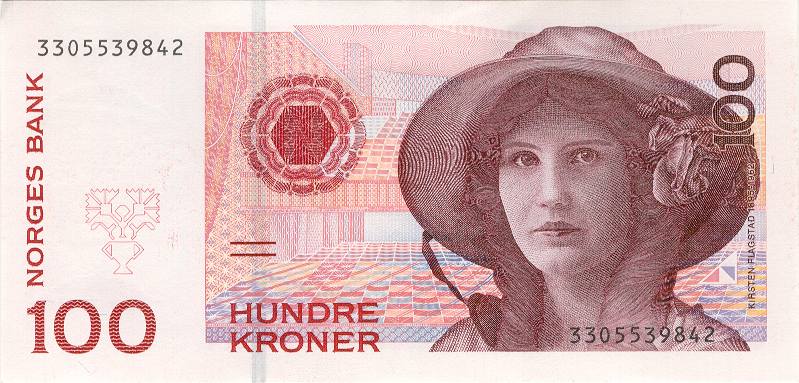
The Norwegian 100-kroner note, with Ms. Flagstad
Ms. Nilsson's honor follows that of Norwegian diva Kirsten Flagstad, who was granted a similar honor on that country's 100-kroner note.

The Nilsson bills will be issued by the Bank of Sweden in 2014.

Monday, March 7, 2011

Angela Ankles Faust

Marina Poplavskaya to sing Marguerite in new Met production.
Angela Gheorghiu,
in between cancellations.

Angela Gheorghiu is out of the Metropolitan Opera's current run of Gounod's Roméo et Juliette, but the dark-eyed Romanian diva continues to make headlines. The latest: she has dropped the bomb on her commitment to sing Marguerite in the Met's new production of Gounod's Faust. The cause was cited as that old stand-by: "artistic differences."

The cancellation is the latest by Ms. Gheorghiu, a soprano who rose to international fame after she was cast (by Sir Georg Solti) in a 1994 Covent Garden production of La Traviata. The string started in 1998, when she and her husband, tenor Roberto Alagna, attempted to inflate their fees to appear in Franco Zeffirelli's second Met production of that same opera. They were replaced by soprano Patricia Racette and Argentinean tenor Marcelo Álvarez, and the show went on anyway.

More recently, Ms. Gheorghiu pulled out of the Dec. 31 2009 prima of the Met's new David McVicar staging of Bizet's Carmen. An early 2010 run in La Traviata (that same Zeffirelli production) featured the singer, although conductor Leonard Slatkin was fired withdrew for personal reasons after the prima.

The Roméo cancellation is the most recent. Ms. Gheorghiu pulled out of all seven performances of the opera this season, citing what was reported to be a month-long case of the flu. Her replacement is the experienced Korean soprano Hei-Kyung Hong, who was initially engaged to "cover" these performances.
A gilded cage: a scene from the ENO Faust.
Photo by Catherine Ashmore © 2010 English National Opera.
Faust was one opera that Ms. Gheorghiu actually sang at the Met recently, taking the role of Marguerite in the company's laughably bad 2005 staging of the opera, the one that featured a cadre of choristers waving tricolor French flags and René Pape attempting to look "menacing" in a rubber devil suit. It has never been repeated.

Its replacement is this new staging by Canadian director Des MacAnuff. Mr. McAnuff updates the opera to the 20th century and makes Goethe's medieval mystic into a mad scientist working to finish the atomic bomb, is bound to be some improvement. It is a collaboration between the Met and the English National Opera, and has already run in London to generally positive reviews.

Ms. Gheorghiu will be replaced in Faust by Russian diva-on-the-rise Marina Poplavskaya, who made an excellent impression at the Met this season in new productions of Verdi's Don Carlo as well as the lead role in La Traviata. Hopefully, Ms. Poplavskaya will be able to sing in French as well as she does in Italian.

For more about the Met's 2011-2012 plans, check out this preview of the upcoming season.

Tuesday, February 1, 2011

Happy Birthday, Mimi!

Vissi d'arte: Renata Tebaldi as Floria Tosca
© 1959 Decca/Universal Music Group.
The Met's current revival of La Bohème coincides with the 115th anniversary of Puccini's opera, which premiered on February 1, 1896. Today is also the birthday of Renata Tebaldi, the creamy-voiced Italian soprano who was one of the great voices of the 20th century.

After a long career on the stages of Europe and America, Tebaldi retired from singing opera performances. Fortunately she was a prolific artist at the height of the LP and stereo boom, recording many operas. Some of them were core repertory (Tosca (1959), Don Carlos (1965).) But she also recorded a variety of verismo operas (La Wally, (1968) Adriana Lecouvrer (1961) that are rarely seen today.

Here's a quick guide to five great recordings featuring Tebaldi.

1) La bohème (Decca, 1959)
This is one of the better recordings of Bohème in the catalogue, and definitely belongs in the top three. La Tebaldi's second recording of the opera features her as a sweet, smooth Mimi, her voice well matched with an all-star cast of Bohemians. (Where else but this recording would you find Carlo Bergonzi (Rodolfo), Ettore Bastianini (Marcello) and Cesare Siepi (Colline) sharing an apartment?

2) La Gioconda (Decca, 1967)
Almacore Ponchielli's classic potboiler is well-served on this sweeping set, the best studio recording of this underperformed operas. This Gioconda features the familiar pairing of Tebaldi with Carlo Bergonzi. Her "Suicidio!" in Act IV is everything that aria should be. Lamberto Gardelli conducts, showing his expertise in Italian repertory.

3) Turandot (RCA Living Stereo, 1959)
Tebaldi never recorded the role of Puccini's ice princess, but she was a heart-warming, melting Lìu on two different recordings. The better one is the Erich Leinsdorf set from RCA, which features the "Battle of Sweden" matchup of Jussi Björling and Birgit Nilsson in the Riddle Scene. But the best moment is Tebaldi's heart-rending "Signor, ascolta," complete with theatrical sobs that do not sound fake or forced.

4) Otello (Decca, 1960)
Herbert von Karajan's first studio recording of Verdi's Shakespearean opera is the recording to test your stereo on (or to leave on "repeat" if you can't stand your neighbors.) Thanks to John Culshaw's engineering, this classic Vienna recording of the opera features fine sound effects and the "aural theater" that was a Decca hallmark. Tebaldi is paired with Mario del Monaco (for the second time) as the murderous Moor. This is an essential set.

5) Aida (Decca, 1959)
Another pairing of Tebaldi and Bergonzi, with von Karajan conducting and John Culshaw manning the controls. This Aida is 52 years old, and it remains a benchmark recording of Verdi's Egyptian opera. Tebaldi's big voice is up to the challenge of "Ritorna vincitar!" and "O, patria mia," but it is the experience of the Vienna players slamming through the Triumphal March that you'll never forget.


Footage of Renata Tebaldi and Jussi Björling as Mimi and Rodolfo in Act I of La bohème.

Trending on Superconductor

Translate

Share My Blog!

Share |

Critical Thinking in the Cheap Seats