Support independent arts journalism by joining our Patreon! Currently $5/month.

About Superconductor

Our motto: "Critical thinking in the cheap seats." Unbiased, honest classical music and opera opinions, occasional obituaries and classical news reporting, since 2007. All written content © 2019 by Paul J. Pelkonen. For more about Superconductor, visit this link. For advertising rates, click this link. Follow us on Facebook.
Showing posts with label opera singers. Show all posts

Tuesday, August 14, 2012

Brass Tacks: Baritones

The "middle" of the male voice.
by Paul J. Pelkonen
Verdi's Falstaff is a pinnacle of the baritone repertory. Here, Ambrogio Maestri has a pint.
Photo © 2011 Bayerische Staatsoper.
We're in the home-stretch of our Brass Tacks survey of the different types of opera singers. Today, we're talking about baritones: the "middle" of the male voice.

Although the baritone is one of the most versatile vocal types, composers did not begin creatingimportant works for it until the end of the baroque era. Mozart and Rossini led the innovation, bringing Beaumarchais' Figaro plays to the operatic stage in Le Nozze di Figaro and Il Barbiere di Siviglia.

Baritones are important to operas both as soloists...

Simon Keenlyside as Papageno in Die Zauberflöte.
Footage © 2003 Royal Opera House of Covent Garden

And in support of higher voices in duets and larger ensembles:


Dwayne Croft and Rolando Villazon in a scene from Don Carlo. 
Footage  © 2007 The Netherlands Opera


In 1850, Verdi's Rigoletto elevated the game yet again, making Victor Hugo's hunchbacked jester into a figure of towering dramatic stature. Later operas like Il Trovatore, Simon Boccanegra and Un Ballo in Maschera featured baritone villains that are as memorable as the tenor parts.

The 19th century also saw the evolution of the "bass-baritone." These singers are featured in most of the operas of Wagner. They can either be a baritone who can extend his range downward,  or more frequently a high bass with an exceptional lyric range.
The typical range for a baritone is from a low A below "low C" to a G# above middle C. A bass-baritone may be able to extend their range down to a low D, but voices vary.

Monday, September 5, 2011

Obituary: Salvatore Licitra, 1968-2011

Salvatore Licitra in La Forza del Destino.
Photo by Marty Sohl © 2006 The Metropolitan Opera.
Tenor Salvatore Licitra, who was severely injured on Aug. 27 while riding his Vespa motorcycle in Ragusa, Sicily, has died. He was 43.

The singer was riding on his scooter when he suffered a cerebral hemorrhage and crashed into a brick wall. He was not wearing a helmet. He was was rushed to Garibaldi Hospital and moved into the intensive care unit with serious injuries to his head and chest.

Mr. Licitra lay in a coma for nine days. He never regained consciousness.

Born in Bern, Switzerland, Mr. Licitra fell into opera singing after a brief career as a graphic designer. A student at Carlo Bergonzi's voice academy in Bussetto, Italy, he made his debut there in 1998 in Un Ballo en Maschera. Later, he was hired by Riccardo Muti for a production of La Forza del Destino at La Scala and his rise to fame was complete.

Mr. Licitra rose to fame in New York when he substituted for Luciano Pavarotti in a 2002 performance of Tosca. Mr. Pavarotti had cancelled his appearance two hours before curtain. The charismatic tenor made a strong impression as Mario Cavaradossi, and the press started referring to him as a logical heir to Mr. Pavarotti's crown.


The singer made a specialty of Verdi heroes: Radames in Aida, Don Alvaro in La Forza del Destino, and King Gustavo in Un Ballo in Maschera. Armed with a sturdy instrument and dynamic stage presence, the singer also appeared in new productions of Puccini's Il Trittico and Tosca. He was then hired  to sing Turiddu in the traditional pairing of Cavalleria Rusticana and Pagliacci. 

When another tenor cancelled, Mr. Licitra added the role of Canio in the later opera, singing both tenor roles in the famous pair. Earlier this year, Mr. Licitra was booked to sing the title role in the company's revival of Ernani next February. He pulled out of those performances in July. Marcello Giordani will sing the part, splitting the six performances with fellow tenor Roberto Lo Blasio.

Mr. Licitra is survived by his parents, his brother, and his girlfriend, who was riding on the scooter when it crashed. She was wearing a helmet.

Wednesday, August 24, 2011

How To Dismantle An Atomic Bomb?

Tenor Cancels Japan Tour for Medical Check.

UPDATE: Tenor Jonas Kaufmann has cancelled his commitment to sing in an upcoming tour of Japan with the Bavarian State Opera, but will meet New York commitments including Faust and Die Walküre.
Jonas Kaufmann as Siegmund.
Photo by Ken Howard.
© 2010 The Metropolitan Opera.

In a statement, the tenor wrote:

I need to have an operation to remove a node in my thoracic area. I do not wish anyone to become alarmed reading this, but my physicians have ordered me to have the surgery as soon as possible. This will take place after my appearance in Stockholm on September 2. I am pretty sure that the results of the histological examination will come up "benign" but as I said, this procedure could not be further delayed.


Mr. Kaufmann was scheduled to sing the role of Don José, and the title role in Lohengrin. He will be replaced in the latter by South African tenor Johan Botha.

Mr. Kaufmann is scheduled to sing the title role in the Metropolitan Opera's new staging of Faust, which premieres on Nov. 29. This new staging is by Jersey Boys director Dez McAnuff and was first presented at the English National Opera.

 Mr. McAnuff updates Gounod's opera to the 20th century and the birth of the atomic bomb. already seen one cancellation: Angela Gheorghiu nixed her commitment to it earlier this year, citing "artistic differences."

The tenor burned up the stage in 2011 in the role of Siegmund in the company's new production of Die Walküre. Mr. Kaufmann is currently signed to reprise the role of Siegmund in three performances of Walküre, part of the company's complete staging of Wagner's Der Ring des Nibelungen.

We here at Superconductor would like to wish Mr. Kaufmann a speedy recovery, and we hope that his prognosis is good.

Tuesday, May 31, 2011

Anna Netrebko Cancels Japan Jaunt

Diva withdraws from Met tour, citing Chernobyl concerns.
She'll take her candle and go home. Anna Netrebko in a publicity photo for Anna Bolena.
Photo © 2011 The Metropolitan Opera.
The Metropolitan Opera is on its way to Japan, but Anna Netrebko is not.

The Russian diva, scheduled to sing Mimi in the company's touring production of La bohéme has announced her 11th-hour withdrawal from the tour. The decision was announced last night in a New York Times article by Daniel J. Wakin. The article included the following statement from the Met press office: "Ms. Netrebko changed her mind having lived through the tragedy of Chernobyl." You can read the full article here.

The decision of Metropolitan Opera general manager Peter Gelb to carry on the Japan tour despite the danger of leaked radiation from the damaged nuclear reactors at Fukushima has been an unpopular one at the world's most famous opera company. The company arrived in Japan last night.

Ms. Netrebko is the fifth major artist to cancel on the Met's ill-starred tour of the Orient. So far, casualties include tenors Jonas Kaufman and Joseph Calleja, who both cited concerns about radiation leakage from the damaged nuclear reactors at Fukushima. Olga Borodina cancelled, citing a need to rest her voice. Conductor James Levine, who is taking a five-month sabbatical for health reasons.


But the soprano, whose face adorns the Met's current marketing campaign and season ticket drive, is currently the biggest star at the Met. The diva is scheduled to open the season with a new production of Donizetti's Anna Bolena, a Metropolitan Opera premiere. In March, she will sing the title role in a new staging of Manon. Both performances will be included in the Met's schedule of Live in HD broadcasts for next year.

The Met's tour includes presentations of La bohéme, Lucia di Lammermoor and the company's new staging of Don Carlo. The cancellations have required some role shuffling. Barbara Frittoli, scheduled to sing Elisabeth in Don Carlo, will switch over to Bohéme. Russian soprano Marina Poplavskaya, who created the role of Elisabeth in this production, will step in to sing the role. She cancelled a Moscow concert appearance to join the Met in Japan.

The touring company includes 350 Met stage hands, extras, and musicians. The roster of and an impressive roster of singers: Mariusz Kwiecen, John Relyea, Rene Pape, Dmitri Hvorostovsky and Diana Damrau. Tenors Marcelo Álvarez and Rolando Villazon, returning after a lengthy hiatus due to voice problems, will add firepower to the three productions. Met principal guest conductor Fabio Luisi will take James Levine's place on the podium. Gianandrea Noseda will also conduct.

The Met's two-week tour will conclude on June 14 with a concert in Tokyo. The program of that concert is listed as "TBA."

Wednesday, April 6, 2011

The Diva is Money!

"She is very easy to work with. You put money in, and a beautiful sound comes out."
--Former Metropolitan Opera general manager Sir Rudolf Bing, on Birgit Nilsson.
Birgit Nilsson, as Lady Macbeth.
Photo from Wikimedia Commons.

We here at the First International Bank of Superconductor (FIBS) have learned that Swedish diva Birgit Nilsson, one of the greatest sopranos of the 20th century, will be honored by having her picture placed on the Bank of Sweden's 500-krona note.

And no, this is not an April Fools' post.

Birgit Nilsson (1918-2005) was one of the most famous dramatic sopranos of the post-war era, appearing h around the world in the major roles of Wagner, Strauss and Puccini. (She referred to Puccini's Turandot as her "vacation" part.)

Ms. Nilsson was known for her fierce Valkyrie attitude and a silver sword of a voice that could cut easily through a thick Wagner orchestra. She also had a great sense of humor and no fear of powerful conductors. Confronting Herbert von Karajan about his dark-lit sets for Die Walküre, she showed up onstage in a miner's helmet--with Valkyrie wings attached.

Although she retired from singing in 1984, she taught young singers in her native Sweden and would still make the occasional appearance at the Met. Memorably, she "dropped in" at James Levine's 25th anniversary gala concert in 1996. La Nilsson toasted the maestro with a few short words and let out a keening "Ho-jo-to-ho!"

And for a moment it was as if she had never retired.
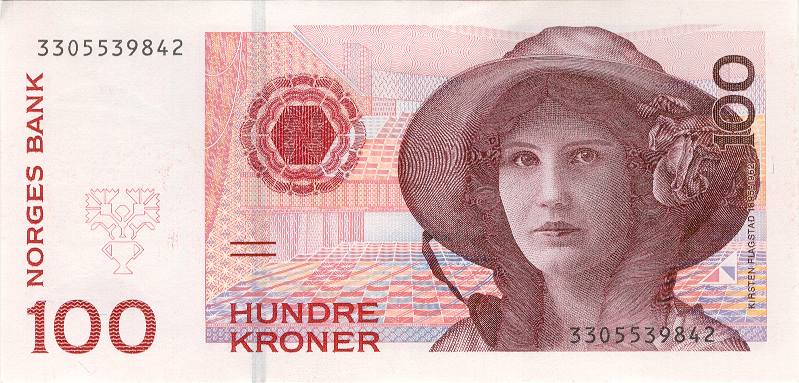
The Norwegian 100-kroner note, with Ms. Flagstad
Ms. Nilsson's honor follows that of Norwegian diva Kirsten Flagstad, who was granted a similar honor on that country's 100-kroner note.

The Nilsson bills will be issued by the Bank of Sweden in 2014.

Trending on Superconductor

Translate

Share My Blog!

Share |

Critical Thinking in the Cheap Seats