Support independent arts journalism by joining our Patreon! Currently $5/month.

About Superconductor

Our motto: "Critical thinking in the cheap seats." Unbiased, honest classical music and opera opinions, occasional obituaries and classical news reporting, since 2007. All written content © 2019 by Paul J. Pelkonen. For more about Superconductor, visit this link. For advertising rates, click this link. Follow us on Facebook.
Showing posts with label Birgit Nilsson. Show all posts

Tuesday, March 27, 2018

The Strauss Project: Die Frau ohne Schatten

Mysticism, marriage and a fish dinner: Strauss' wildest opera explored.
by Paul J. Pelkonen
Fish for dinner: Christine Goerke as the Dyer's Wife in the current Metropolitan Opera
production of Die Frau ohne Schatten. Photo by Ken Howard © 2012 The Metropolitan Opera.
Of the fifteen operas written by Richard Strauss none are more complicated, more esoteric or more demanding than Die Frau ohne Schatten. Written during the First World War and premiered in Vienna in 1916, this was the composer’s sixth opera, and his third collaboration with librettist Hugo von Hoffmannsthal. Frau or “Fr-o-sch” as the composer affectionately nicknamed it (the German word for "frog") is a fairy tale for grown-ups, told on a scale that would make Richard Wagner envious.

Thursday, July 23, 2015

Six Minutes in the Temple of Heaven

Birgit Nilsson and Franco Corelli in Turandot.
by Paul J. Pelkonen
Birgit Nilsson as Turandot.
I was working on this year's edition of the Metropolitan Opera Preview and came across an example of Birgit Nilsson and Franco Corelli squaring off in Act II of the Puccini opera Turandot. This aria and following duet is some of the most punishing music in the Italian repertory but La Nilsson makes it look effortless. Clips are after the break.

Wednesday, April 6, 2011

The Diva is Money!

"She is very easy to work with. You put money in, and a beautiful sound comes out."
--Former Metropolitan Opera general manager Sir Rudolf Bing, on Birgit Nilsson.
Birgit Nilsson, as Lady Macbeth.
Photo from Wikimedia Commons.

We here at the First International Bank of Superconductor (FIBS) have learned that Swedish diva Birgit Nilsson, one of the greatest sopranos of the 20th century, will be honored by having her picture placed on the Bank of Sweden's 500-krona note.

And no, this is not an April Fools' post.

Birgit Nilsson (1918-2005) was one of the most famous dramatic sopranos of the post-war era, appearing h around the world in the major roles of Wagner, Strauss and Puccini. (She referred to Puccini's Turandot as her "vacation" part.)

Ms. Nilsson was known for her fierce Valkyrie attitude and a silver sword of a voice that could cut easily through a thick Wagner orchestra. She also had a great sense of humor and no fear of powerful conductors. Confronting Herbert von Karajan about his dark-lit sets for Die Walküre, she showed up onstage in a miner's helmet--with Valkyrie wings attached.

Although she retired from singing in 1984, she taught young singers in her native Sweden and would still make the occasional appearance at the Met. Memorably, she "dropped in" at James Levine's 25th anniversary gala concert in 1996. La Nilsson toasted the maestro with a few short words and let out a keening "Ho-jo-to-ho!"

And for a moment it was as if she had never retired.
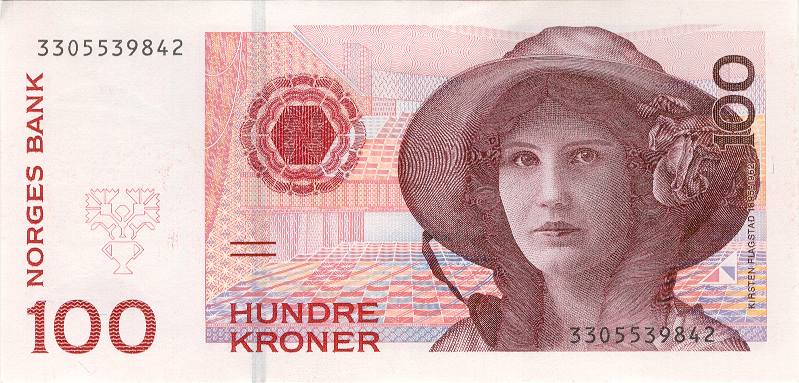
The Norwegian 100-kroner note, with Ms. Flagstad
Ms. Nilsson's honor follows that of Norwegian diva Kirsten Flagstad, who was granted a similar honor on that country's 100-kroner note.

The Nilsson bills will be issued by the Bank of Sweden in 2014.

Friday, January 14, 2011

Recording Recommendations: Wagner's Der Ring des Nibelungen

"What's the best recording of the Ring cycle?"
by Paul Pelkonen
Birgit Nilsson as Brünnhilde in Der Ring des Nibelungen.
Photo by Siegfried Lauterwasser © 1970 Bayreuth Festspiele
Richard Wagner's four-opera cycle (Das Rheingold, Die Walküre, Siegfried, Götterdämmerung) re-tells the story of the Norse gods and heroes. The four operas (Walküre remains the most popular) have entertained listeners since 1876. Starting in 1927 at Bayreuth, the Ring has provided a challenge for recording engineers. The first attempt at a "complete" cycle was made on 78s. The result: a "potted" version of the cycle that left out some of the music and switched singers and conductors from opera to opera.

Monday, January 19, 2009

Recordings Review: The Return of the Big Wagner Box

All Bayreuth, all the time.
by Paul J. Pelkonen

Back in the '90s (I seem to be starting a lot of articles with that sentence these days) the then-record-company Philips released a gigantic 18" long 32-CD box set called the "Richard Wagner Edition", consisting of live recordings of all ten of the major Wagner operas. (Höllander, Tannhaüser, Lohengrin, Tristan, Meistersinger, the whole Ring and Parsifal.

Trending on Superconductor

Translate

Share My Blog!

Share |

Critical Thinking in the Cheap Seats