Support independent arts journalism by joining our Patreon! Currently $5/month.

About Superconductor

Our motto: "Critical thinking in the cheap seats." Unbiased, honest classical music and opera opinions, occasional obituaries and classical news reporting, since 2007. All written content © 2019 by Paul J. Pelkonen. For more about Superconductor, visit this link. For advertising rates, click this link. Follow us on Facebook.
Showing posts with label pianism. Show all posts

Tuesday, March 10, 2015

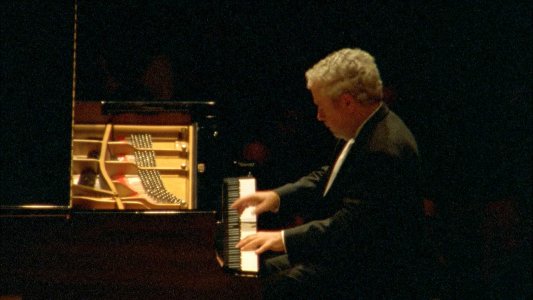
Concert Review: A Blizzard of Notes

Kirill Gerstein in recital at Zankel Hall.
by Paul J. Pelkonen
Kirill Gerstein and his hammered friend.
Photo by Marco Borggreve. 
The ability to navigate difficult passages on the piano with aplomb is a key to the life of a concert pianist. On Monday night, Kirill Gerstein visited Carnegie Hall's downstairs Zankel Hall with a program of works that stretched his technique to the limit. Mr. Gerstein is a competition-winning Russian-born artist, who has dedicated himself in recent years to the classroom. A recital from Mr. Gerstein is thus a rare event, and the pianist chose a program loaded with technical challenges.

Thursday, June 19, 2014

The Superconductor Interview: Melvin Stecher and Norman Horowitz

The founders of the New York International Piano Competition.
by Paul J. Pelkonen
Melvin Stecher and Norman Horowitz (left).
Photo from the Stecher Horowitz Foundation.
Melvin Stecher and Norman Horowitz know a good pianist when they hear one.

New York-based and partners in pianism for over six decades, (they met at the age of 17) they are the creators of the New York International Piano Competition, which starts June 23 at the Manhattan School of Music. In a telephone interview with Superconductor these two pianists (now 81) discussed their piano competition with energy and eagerness, occasionally interlocuting for each other with the ease of long musical partnership.

Tuesday, January 28, 2014

Concert Review: The Keys to the Kingdom

Marc-André Hamelin returns to Zankel Hall.
by Paul J. Pelkonen
Marc-André Hamelin. Photo by Sim Canetty Clark for Colbert Artists Management.
Any recital by Marc-André Hamelin in New York City is greeted with eager, one would say even fevered anticipation by piano aficionados. Mr. Hamelin may not have the international fame of Yevgeni Kissin or Lang Lang. He has been invited (yet) to join Metallica onstage. But this artist has something more than virtuosity. He has musicianship--and a willingness to explore the difficult corners of the piano catalogue where other artists so often fear to tread.

Sunday, August 21, 2011

Concert Review: Grief, Joy, but no Mozart

New world elegance: pianist Nelson Freire.
The composer whose name adorns the festival was absent from Mostly Mozart on Friday night, as the Festival Orchestra offered a program pairing Stravinsky's Symphony in C with Beethoven's Fourth Piano Concerto. Nelson Freire made his Festival debut as the featured soloist in the latter work.

Igor Stravinsky's neo-classical period saw the composer turn away from programmatic ballets in an effort to write pure music. But the wartime Symphony in C has autobiographical elements, with its relentless opening and melancholy writing for the wind section. Small wonder: Stravinsky had begun his wartime exile from Europe.

The mournful Larghetto may reference the deaths of his wife and daughter from tuberculosis. Mr. Langree led an eloquent reading of this underperformed work, with superb playing from the bassoons, oboe and English horn. The grim Largo that ends the work in a series of hushed, mysterious chords that never quite climax, created a spellbinding effect.

The Brazilian pianist Nelson Freire played Beethoven's Fourth piano concerto with Old World elegance. Subtly accompanied by Mr. Langree, Mr. Freire played the arpeggiated runs and figures with a sweet, almost joyful tone, offering an almost pastoral tour through the opening movement. This was pianism of a high order, gracious but with a restrained power underneath.

The slow movement of this concerto bears some resemblance to the composer's Waldstein sonata, in that it serves as a lead-up to a dazzling finale. Again, Mr. Freire spoke with his fingers, winding out the lazy melodies with ease. But there was nothing languid about the finale, a joyful storm up and down the keyboard with Mr. Freire's sure technique leading the charge.

Mr. Freire added to the work's challenges by playing the cadenzas of composer/pianist Ferrucio Busoni. Busoni, one of the most underperformed and challenging composers of the early 20th century, elaborated and expanded Beethoven's original work as part of his own concert repertory. The cadenzas are challenging: of such complexity that they amount to works in themselves.

The short concert was followed by an enthusiastic reception. Mr. Freire's first encore was a transcription from Gluck's opera Orfeo et Euridice, played with elegance and warmth. The second piece, a searching work that fell between impressionism and modal jazz, was from the 20th century and probably penned in Mr. Freire's native Brazil. It might have been by Villa-Lobos.

Monday, April 11, 2011

Of Pianos, Laptops and Aluminum Vibrations


Those of you who read this blog on a regular basis know that I'm hopelessly addicted to my IPod, using the little silver guy (current model, a 160-gig Classic, cute little David Horvath sticker on the back) to manage and play music. I know it's not the same sound quality as LPs or CDs, but for my purposes, I often settle for running my Pod off a dock attached to the stereo.

So my laptop has an awful lot of music in its hard drive--six months' worth if you count all the genres packed in and sorted into various and sundry libraries.

Most of the time, I peruse this vast library with the help of my trusty stereo, or my headphones for most listening when the significant other is about. But for writing about piano music, I take a special pleasure in the two, humble speakers built into the work-surface of my MacBookPro.

Saturday, April 9, 2011

Concert Review: Beethoven's Heirs

Leif Ove Andsnes at Carnegie Hall
A fearless artist: Leif Ove Andsnes confronts the flood. Photo © EMI Classics.
The Norwegian pianist Leif Ove Andsnes took Carnegie Hall by storm this week, in a Thursday night recital that explored the relationship between Beethoven, Brahms and Schoenberg. The concert featured Mr. Andsnes signature style, a bold attack with the left hand and agile figurations with the right, combined with liberal use of the pedal to make the Steinway sing.

The concert opened with a charging "Waldstein" sonata, its opening ostinato taken at a rapid clip by Mr. Andsnes. He leant on the pedal for the legato runs up and down the keyboard, presenting a kaleidoscope of emotions for the listener to process. Suddenly, the movement would stop, and the second, soft singing theme would emerge, quietly at first and then with more confidence.

The hesitating introduction to the finale led into a rich, singing final movement with the famous, expansive theme proudly stated in the upper register. Mr. Andsnes balanced this famous movement expertly, racing along the keyboard as he drove the work into its final chords.

The four Ballades by Johannes Brahms followed. Mr. Andsnes showed how these early Brahms works, played together, form a sort of symphony for solo piano: four movements of a cohesive whole. He found the Romantic coloration in this music, whether in the first Ballade or the lyrical passages in the later movements of this "symphony."

Schoenberg's Six Little Piano Pieces last only seven minutes, but mere mention of this innovative 20th century composer is enough to scare concert-goers. Mr. Andsnes played with lyricism and a jazzy flair, bringing out the inner beauty of these little gems.

The concert climaxed with Beethoven's 32nd, and final piano sonata. Op. 111 is a challenging work. Like the Brahms ballades, this two-movement sonata packs enough musical ideas for an entire symphony. In fact, the works bears some points of similarity to Beethoven's Fifth in that genre, as the composer revisits the tonal conflict between the keys of C minor and C Major.

Mr. Andsnes brought a fiery approach to the first movement, conjuring up the stormy figures and near-fugal textures common to late Beethoven. The second movement was far more lyrical. The slow Arietta was played with quiet, poetic restraint. The transition to the Bach-like central section was handled smoothly. Mr. Andsnes saved his finest playing for the last third of the final movement, a series of descending figures: the sound of Beethoven at play. The last bars died away softly--the sound of transcendence and a kind of cosmic bliss.

Three encores followed. A welcome exploration of György Kurtág's "Scraps of a Colinda Melody--Faintly Recollected" featured a gossamer-like series of short, lifted keystrokes to make the two ends of the instrument talk to each other in easy dialogue. A rugged, cheerful performance of Chopin's a-flat waltz was next. The trio of treats concluded with Schumann's second Romance, played with deep profundity and understanding. Beethoven would have been proud.

Tuesday, March 29, 2011

Dudley Moore Plays the Colonel Bogey March


Footage from the 1964 BBC2 Beyond The Fringe special, with the late, great Dudley Moore playing a Diabelli Variations-style take on the Colonel Bogey March by F.J. Ricketts. (That's the theme that was used in The Bridge on the River Kwai.)

This is essential viewing if you're a fan of stellar pianism--or P.D.Q. Bach-type humor.


Enjoy.

Friday, March 11, 2011

Concert Review: A Journey Into Mystery

Louis Lortie Plays Liszt
Louis Lortie and friend.
The three books of Franz Liszt's Anneés de la pèlerinage constitute a musical autobiography, chronicling the composer's busy life as a travelling virtuoso. Played together, the three volumes (or "years") comprise two hours and 45 minutes of difficult, virtuso pianism. Playing them all in the course one evening was an unheard-of feat, even in Liszt's day when programs could run for four hours.

On Thursday night, as part of Lincoln Center's TullyScope Festival, (designed to demonstrate the versatility of the newly refurbished Alice Tully Hall) French-Canadian virtuoso Louis Lortie did just that. Mr. Lortie has enjoyed a long steady climb into the elite echelon of virtuoso touring pianists, a profession created by Liszt himself.

Liszt's so-called "recitals" (he invented the term) were the rage during the composer's career as a touring virtuoso. His playing inspired women to throw undergarments, jewels, and even house keys as part of the peculiar syndrome that became known as "Liszt-o-mania." Everywhere he went, Liszt was the first rock star, a reputation that remained secure as he retired (at 35) to teach a whole new generation of pianists his secrets.


In this modern age, playing like Mr. Lortie's might inspire both genders to engage in such behavior. While no objects (intimate or otherwise) were flung on Thursday night, Mr. Lortie played at a very high level indeed. His performance, in two acts with a 30-minute break, was a fearsome show of prodigious memory and manual dexterity.

From the opening bars of the La chapelle de Guillaume Tell, the pianist took his audience on a detailed tour of Liszt's travels in Switzerland, the focus of the first Année. Mr. Lortie played with careful amounts of rubato, stretching and elongating the notes. He drove the piano, playing from his shoulders, crossing hands for the most difficult passages and ranging across his instrument as Liszt traversed the Alps, stopping at mountain lakes, weathering a fierce storm and celebrating the bells of Geneva at night.

The next stop was a visit to Liszt's last years, depicted in the third volume of the Années. Published in 1883 near the end of Liszt's life, these works are far more experimental in character and reflect the black depressions that afflicted the composer in his old age. By splitting the program in this way, Mr. Lortie was able to conclude the first half of his recital with the shimmering, rippling Les jeux d'eaux a la Villa d'Este, a composition in which Liszt practically invented musical impressionism, inspiring both Debussy and Ravel.

Mr. Lortie's visit to Italy in the Deuxième annéee seemed to fly by. He led off with a sweetly phrased, intimate account of Sposializio, inspired by a Raphael painting. The three Petrarch Sonnets, (re-workings of earlier songs) impressed. But the real gem was the crowd-pleasing Dante Sonata, played by Mr. Lortie with hell-fire in his fingers and delicate use of pedal. There was a definite whiff of sulphur coming from the Steinway.

The travels of Liszt did not exhaust the enthusiastic, piano-loving audience. They clapped hard for an encore, and Mr. Lortie obliged with a shimmering, rippling account of Die Forelle ("The Trout"), Liszt's piano-only version of the Schubert lied. The concert was followed by an engaging onstage dialogue between Mr. Lortie and Dr. Alan Walker, the Liszt scholar and author of the definitive three-volume biography of the composer-pianist.

Friday, February 11, 2011

Concert Review: Rebels With A Cause

Beethoven and Shostakovich at the New York Philharmonic
Jonathan Biss, at the Steinway. Photo © 2009 EMI Classics
Friday morning's New York Philharmonic concert featured a pairing of two composers who spent their lives struggling against the systems that spawned them: Beethoven and Shostakovich. Latvian conductor Andris Nelsons led the stylish pairing of the former's Third Piano Concerto, (featuring soloist Jonathan Biss) with the latter's Fifth Symphony.


After the lengthy orchestral introuction, Mr. Biss played the piano solo part with elegance and Mozartean grace. His limpid playing emphasized the melodicism in Beethoven's solo part, contrasting with the thoughtful commentary from the orchestra. This was especially true in the second movement, played with a smooth-flowing legato and a very gentle attack.

The final rondo took the piece to new, playful heights, as Mr. Biss engaged in a game of chase-and-tag with the orchestra, racing higher and higher on the keyboard and then soaring back down in a rush of arpeggiated notes. As the soloist played his final round of repetitions, Mr. Nelsons and his orchestral forces raced to catch up, with band and pianist finishing together in an exuberant outpouring of song.

Shostakovich wrote his Fifth Symphony as a response to Joseph Stalin's series of devastating artistic purges in 1936, that were themselves a response to the dictator's (over)reaction to his opera Lady Macbeth of the Mtsensk District. Shostakovich quietly locked his just-completed Fourth Symphony in a drawer and began working on the Fifth, which he referred to as "A Soviet Artist's Response to Just Criticism."


Politics and history aside, the Fifth has grown to be the most popular of the 15 Shostakovich symphonies, a big-shouldered four-movement bruiser that requires heroic brass playing and a conductor with tight control over the orchestra's balance. This performance had the former, but the strings were repeatedly drowned out by the brass and percussion. Perhaps that was Shostakovich's message: the little guys can't win.

The epic first movement, with its four-note theme in search of a final resolution took the shape as a proletarian struggle between the strings and brass for supremacy. (The strings lost.) The Allegretto, with its marching theme for low basses and plaintive dance for woodwinds seemed to symbolize the composer's private struggles with the censors and the Soviet state.

The Largo is one of Shostakovich's best-known movements, a sweeping theme for winds that builds to a thunder of brass. The trumpets and timpani hijacked the orchestra in the slamming fourth movement, an orchestral showpiece that was performed with an admirable lack of restraint. This was Philharmonic music-making at its most exciting: a big sonic steamroller that flattened everything in its path, including the enthusiastic audience.

Thursday, February 10, 2011

CD Review: Transcendental Attitude

Alice Sara Ott plays Liszt
A girl on her piano: Alice Sara Ott. Photo © 2010 Deutsche Grammophon
22-year-old German-Japanese pianist Alice Sara Ott has staked her claim as a virtuoso with this crystalline recording of Franz Liszt's Op. 139, the Transcendental Etudes. Now 22 years old, Ms. Ott plays these works with finesse and fearlessness, leaving listeners with a bravura performance that improves with each listen.

Franz Liszt was the greatest piano virtuoso of the 19th century. These works started as piano exercises and instructional tools. But their 1826 version was considered too difficult to play. Liszt revised the works in 1837 (as the Douze Grandes Etudes) and again in 1852. For these, Liszt removed all passages requiring a hand-stretch of ten notes, making the works more accessible to the most talented amateurs. This is the most commonly heard (and recorded) version of the works.


Etudes are piano studies, designed to instruct the listener and the player in various aspects of the instrument and piano techniques. For Liszt, these works were another opportunity to show his worth as a composer while giving his slew of students at Weimar a living, breathing textbook from which to improve themselves. The pieces range from three-minute reflections to ten-minute keyboard bacchanals. Along the way, Liszt incorporates everything he knew. As a composer, he thinks orchestrally on the piano, using ten fingers to create the illusion of multiple instruments playing in counterpoint.

Ms. Ott plays these formidable pieces with a liquid, singing tone, flying up and down the keyboard as she tackles Liszt's wide octave leaps, arpeggios, trills, and other demands upon the hands. From the opening Prelude, (No. 1) she plays this music with a combination of technical finesse and wild abandon, keeping sight of Liszt's overall architecture as she rides her piano into the dizzying heights of his imagination.

It's all here in these twelve works: the hand-crossing gallop of Mazeppa (No. 4), tolling pre-Wagnerian funeral bells of Vision (No. 6), the insistent rhythms of The Wild Hunt (No. 8). Ms. Ott unleashes her Romantic soul on the melancholy meanderings of Ricordanza (No. 9), playing the trills and arpeggios with a liquid ease and plenty of legato. Harmonies de Soir (No. 11) seems to melt into nothingness at its close.

The final Etude, Chasse Niege (No. 12) features a cascade of notes at each end of the keyboard, oceanic swells of arpeggiated chords with the main theme singing majestically, somewhere in the middle. Here, Liszt is using the "third hand" trick, playing the main theme with the thumbs as the hands roam the keyboard. In the hands of Ms. Ott, what might be a cheap effect becomes a study in virtuosity, played with the utmost in musicanship and consummate taste.

Tuesday, January 18, 2011

Liszt at 200: Nine Symphonies...for Ten Fingers

Cyprien Katsaris at the piano.
Photo © Carole Hellaiche, from his website.
It was one of those purchases you don't forget.

I was in a used CD store in Boston. (Might have been Cambridge). And there it was: an ugly teal-and-navy striped slipcase with a blue-tinted black and white photo of an intent-looking pianist sitting in profile at a long, black concert grand.

"Beethoven/Liszt: Symphonies Nos. 1-9",
the text said.
"Cyprien Katsaris, Piano."

Now, I was a young grad student with a love of classical music and a habit of spending his off hours in the rush tickets line for the Boston Symphony Orchestra. And I had heard of some of the great pianists. But not Katsaris. I asked my friend who worked at Tower Records about it, and looked up the recordings in the store copy of the Penguin Guide. They seemed legit.

I held off purchase at first, but eventually brought some trade-in items to the store to get credit towards my new purchase. And I took the box--two double jewel cases holding six discs--home with me.

I loved those recordings. And I still do. Mr. Katsaris opened a whole new way of listening to Beethoven. Using the spare notes of the piano instead of a massed orchestra, I learned how to hear musical architecture--the way a theme, a phrase, a counter-melody was introduced by that wily old German composer (and the clever Hungarian who transcribed the works for piano.)


Liszt was just 11 years old when he met Beethoven in Vienna. The date was April 13, 1822. (Stories vary, he might have been 12 and it might have been a year later.) According to a story Liszt told, the young virtuoso was brought to an arranged meeting at the composer's home.  He played several works for Beethoven, including a Bach fugue and a movement from the elder composer's own concertos. According to Liszt, Beethoven watched his fingers and listened with his hand on the piano. He was impressed.

In 1838, Liszt received a request from his publishers to transcribe Beethoven's Fifth, Sixth and Seventh Symphonies. He played them alongside his own compositions and opera transcriptions. The Hungarian virtuoso was instrumental in getting Beethoven's music heard--even in towns that didn't have symphony orchestras. In 1863, it was suggested that the pianist transcribe the remainder of the Nine. He completed the set in 1865.

These recordings are astonishing performances, and remain an under-valued jewel of the catalogue. They're great listening if you are a Beethoven aficionado, hearing how Liszt translates Beethoven's orchestral effects to be played by ten dexterous fingers. The best of the set are the Eroica (which sounds even more powerful on the piano), the Pastorale (dreamy and lyrical, almost impressionistic in the Scene By the Brook) and the jaw-dropping Ninth--the last to be completed.

Cyprien Katsaris was the first pianist to record that Everest of transcriptions: the Beethoven Ninth for two hands. Liszt originally transcribed Beethoven's final symphony for two players--four hands. At his publisher's request, Liszt completed a two-handed version. The movements are difficult and astonishingly long (each is the size of a piano sonata) and Mr. Katsaris' athletic, and yes, emotional performance of the final "Ode to Joy" belongs in any self-respecting record collection.

The Incredible Life of Franz Liszt

French caricature of Franz Liszt at the piano, circa 1845
Ed. Note: This article marks the first in an ongoing Liszt at 200 series, celebrating the bicentennial birthday of Franz Liszt in the year 2011.

Oct. 22, 2011 marks the 200th birthday of Franz Ferenc Liszt, the Hungarian composer, pianist, and showman whose prestidigitative playing marked the dawn of a new era in piano music. Liszt's meteoric career signalled the rise of the piano virtuoso as a public figure equivalent with kings, generals, and minor gods.

Franz Liszt was the greatest pianist of the 19th century, a formidable performer who could play anything, from all nine Beethoven symphonies (re-arranged for solo piano) to the operatic works of Verdi, Wagner, and Johann Strauss. But his own music came first.

Famous Liszt piano compositions include the Annéés de la pèlerinage (Years of Pilgramage), the Hungarian Rhapsodies and the Transcendental Etudes, finger-busting works inspired by the violinist (and fellow showman) Niccolò Paganini. He even experimented with atonality in late works, setting the stage for the Second Viennese School of Schoenberg, Webern and Berg.


Liszt's concerts (he popularized the concept of the "piano recital") caused women to scream and throw clothes in a precursor of Beatlemania. They were his primary source of income. But he found time to compose orchestral works. Deciding that symphonic form was too restrictive, he created the "symphonic poem." (This may have been the idea of Belgian composer Cesar Franck.) The popularity of Liszt's tone poems (which include the Faust Symphony, the Dante Symphony and Les Preludes) showed the way for later composers like Richard Strauss.

Liszt only wrote one opera: Don Sanche. It premiered when he was 14 and quickly dropped from sight. However, he remained heavily involved in that genre. During Wagner's Swiss exile, Liszt conducted the world premiere of Lohengrin. Still later, he became Wagner's father-in-law and most prominent musical advocate. Liszt's transcriptions of the Liebestod from Tristan und Isolde and the Pilgrim's Chorus from Tannhäuser led to this "music of the future" being played outside the opera house in the century before recordings existed.

This bicentennial year promises a great deal of exciting Liszt music. There are concerts scheduled, (Jean-Yves Thibaudet at Carnegie Hall on Feb. 2, Evgeny Kissin in March), and of course, new recordings on their way. The most prominent of these is from the acclaimed British label Hyperion: Leslie Howard's 99-disc Complete Piano Works of Liszt. It comes out on February 8.

Wednesday, June 23, 2010

The Piano In the Park

The piano in City Hall Park. Photo by Becca Dorstek


Any New Yorker can become a sidewalk musician for the next month, thanks to Play Me, I'm Yours. The art project by Luke Jerram is a collaboration with Sing for Hope, a charitable organization, and the New York City Parks Department. Sixty pianos, strategically scattered across the five boroughs are available for playing from 9am until 10 at night, by anyone who walks up and sits down.

The pianos, donated for the project have been colorfully painted and decorated by a roster of local artists. Each comes equipped with:
  • a small Ikea stool.
  • Some sheet music
  • A clear set of rules.
  • A plastic tarp in case of inclement weather.
There is a ten-minute limit per performer if there is a line.


I got to play one of them tonight, as dusk settled over City Hall Park. It was a colorful, rainbow-bedecked old upright painted in a swirl of psychedelic yellow and orange. Sheet music was provided: in this case Irving Berlin's "I Love a Piano" and Beethoven's Für Elise.

Not being much of a sight-reader, (I read music but lack the coordination to play at sight) I opted for the one thing I do know how to play. That's the Ode to Joy theme from Beethoven's Ninth Symphony, which I picked out on my first electronic keyboard when I was maybe 10 years old. As I figured out the notes in a couple of keys (OK, C and F Major), I added some simple left-hand chords so it wouldn't sound too thin.

As I played, I felt what Mr. Jerram may have intended: a deep sense of personal satisfaction in my own poor ability. Not to mention that I had something to write about other than vuvuzelas.

The piano project will remain on the streets of New York until july 5th, 2010, when the instruments will be donated.

Sunday, February 24, 2008

Piano Pleasures: John Ogdon and the Busoni Concerto

Ferruccio Busoni. From the Library of Congress,
Prints and Photographs Division, George Grantham Bain Collection
Ferruccio Busoni (1866-1924) was a titan of the early 20th century. He stands at a crossroads: the end of Romanticism and the start of modern neo-Classicism. Italian-born but German-trained, Busoni was a virtuoso composer/pianist, armed with a colossal technique forged in the fiery furnaces of Bach, Beethoven and Chopin. His music is often complex to the point of obtusity, necessitating repeated listens to assimilate everything this Faustian artist was trying to say.


There are some big piano concertos in the concert repertory. But the Busoni work, like its creator, was a real original-- a five-movement megatherium lasting an hour and ten minutes. Busoni required a huge orchestra, a nimble soloist, and even a male chorus, in the final movement. This last had never been done in a piano concerto. When Busoni fell out of fashion following his death, the concerto went with him. It was long seen as a white elephant, a work whose very complexity defied performance. Worst of all, its solo part is hellishly difficult, but not flashy, Virtuoso players still avoid it today.

John Ogdon (1937-1989) was a titan among pianists. Throughout his erratic career, this ebullient virtuoso specialized in "unplayable" composers like Scriabin, Sorabji, Alkan and of course, Busoni. He played with a mix of delicate filigree and elemental power, and was ideally suited to champion the composer's lone piano concerto. Ogdon recorded this work at Abbey Road Studios in June of 1967 studios. It was an exciting session. Pink Floyd occupied one recording studio, working on The Piper at the Gates of Dawn. Ogdon and the Royal Philharmonic Orchestra had to face a series of musical challenges. Not the least was having the session's conductor, Daniell Revenaugh, "temporarily borrowed" by Paul McCartney to complete orchestral parts on Sgt. Pepper's Lonely Hearts Club Band.

John Ogdon recording at Abbey Road Studios, 1967.
© 2007 The John Ogdon Foundation
In the middle of all this psychedelic activity, Ogdon, Revenaugh and the Royal Philharmonic Orchestra worked their own kind of magic. Ogdon skates through the first four movements with jaw-dropping ease. He plays with power and restraint, working with and not against the orchestra, blending into the thick contrapuntal textures before soaring above the orchestra in a burst of virtuoso fireworks. Revenaugh (who made no other major commercial recordings as a conductor) leads the huge score in a stirring, confident performance. The wordless choral finale (sung by the male voices of the John Alldis Choir) is a stunning final effect.

Happily, this recording is still in the EMI catalogue. It is available as a stand-alone piece on a single budget disc. Better yet, the Ogden recording was reissued in 1998 as part of a two-CD set, Vol. 72 in the Great Pianists of the 20th Century . (This is a series of 100 two-disc DigiPaks celebrating the importance of piano music. Mostly, it's pretty good.) Here, the Busoni Concerto is accompanied by the Variations and Fugue on Chopin's Prelude in c minor, a playful, yet technically challenging work. Recorded in 1960, its inclusion here proves to be an entertaining prelude to the Concerto itself. The set also includes an interesting performance of the Alkan Concerto pour piano seul along with works by Scriabin and Rachmaninoff.

Trending on Superconductor

Translate

Share My Blog!

Share |

Critical Thinking in the Cheap Seats