Support independent arts journalism by joining our Patreon! Currently $5/month.

About Superconductor

Our motto: "Critical thinking in the cheap seats." Unbiased, honest classical music and opera opinions, occasional obituaries and classical news reporting, since 2007. All written content © 2019 by Paul J. Pelkonen. For more about Superconductor, visit this link. For advertising rates, click this link. Follow us on Facebook.
Showing posts with label TullyScope Festival. Show all posts

Thursday, March 17, 2011

Concert Review: Child Is Father...to the Symphony

The Orchestra of the Age of Enlightenment at TullyScope.
Sir Roger Norrington.
Johann Sebastian Bach had twenty children, if you don't count P.D.Q. Bach. Ten of them survived into adulthood. Of them, four of his sons grew up to be famous composers. Wednesday evening's concert at Alice Tully Hall offered argument for the reappraisal of Carl Philip Emmanuel Bach, whose work serves as an important bridge between the music of his father and the classical style as developed by Haydn and Mozart in the latter half of the 18th century.

The Orchestra of the Age of Enlightenment is an acclaimed period performance ensemble from the United Kingdom, under the direction of Sir Roger Norrington. Sir Roger is now 77, and has had a long career leading period performance ensembles. Although he has met with wide criticism for his dry-toned, unromantic accounts of Beethoven, Wagner and even Mahler, these four symphonies and two concertos were ideally suited to his plain-spoken approach. They were played by the small orchestra (about two dozen, all told) with melodic drive and energy throughout.

The highlight of the performance was the C Major harpsichord concerto. It is difficult to play with lyricism on the harpsichord, but soloist Steven Devine overcame the limitations of that instrument. His cadenzas were played with beauty and skill, an impressive blend of dexterity and phrasing as he made the harpsichord sing.

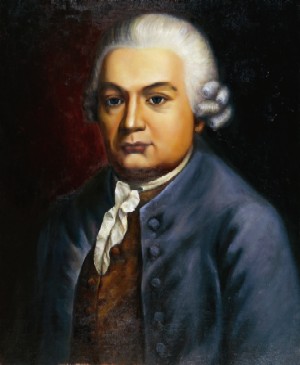
C.P.E. Bach. Image © Naxos.
The same could not be said for the A Major cello concerto, with Richard Lester playing the solo part. Mr. Lester played with passion but hit some number of wrong notes in the first movement. Although he settled in and played the next two movements with singing tone and skilled bow-work, the errant opening undermined the whole performance.

When Haydn referred to Bach as the "father of us all", he was referring not to Johann Sebastianm but to C.P.E. Bach. This was proved by the four string symphonies on this program, which were written for a patron (Baron Gottfired von Swieten) who wanted Bach to push the envelope of instrumental writing farther than it had ever been pushed before. Using only strings and harpsichord, the younger Bach creates a riot of emotional color in the course of three movements each. Impressive, since each symphony is an average of just ten minutes in length.

Sunday, March 13, 2011

Opera Review: No Bunnies, Just Talent

Les Arts Florissants at Alice Tully Hall.
by Paul J. Pelkonen
Less is more: Les Arts Florissants music director William Christie.

As part of their 2010 BAM appearance, Les Arts Florissants staged Henry Purcell's The Fairy Queen with elaborate costumes, sets, and bunny suits. For 2011, the French period ensemble offered two performances at Alice Tully Hall, as part of the TullyScope Festival designed to highlight the versatility of Lincoln Center's mid-sized concert hall.

Friday, March 11, 2011

Concert Review: A Journey Into Mystery

Louis Lortie Plays Liszt
Louis Lortie and friend.
The three books of Franz Liszt's Anneés de la pèlerinage constitute a musical autobiography, chronicling the composer's busy life as a travelling virtuoso. Played together, the three volumes (or "years") comprise two hours and 45 minutes of difficult, virtuso pianism. Playing them all in the course one evening was an unheard-of feat, even in Liszt's day when programs could run for four hours.

On Thursday night, as part of Lincoln Center's TullyScope Festival, (designed to demonstrate the versatility of the newly refurbished Alice Tully Hall) French-Canadian virtuoso Louis Lortie did just that. Mr. Lortie has enjoyed a long steady climb into the elite echelon of virtuoso touring pianists, a profession created by Liszt himself.

Liszt's so-called "recitals" (he invented the term) were the rage during the composer's career as a touring virtuoso. His playing inspired women to throw undergarments, jewels, and even house keys as part of the peculiar syndrome that became known as "Liszt-o-mania." Everywhere he went, Liszt was the first rock star, a reputation that remained secure as he retired (at 35) to teach a whole new generation of pianists his secrets.


In this modern age, playing like Mr. Lortie's might inspire both genders to engage in such behavior. While no objects (intimate or otherwise) were flung on Thursday night, Mr. Lortie played at a very high level indeed. His performance, in two acts with a 30-minute break, was a fearsome show of prodigious memory and manual dexterity.

From the opening bars of the La chapelle de Guillaume Tell, the pianist took his audience on a detailed tour of Liszt's travels in Switzerland, the focus of the first Année. Mr. Lortie played with careful amounts of rubato, stretching and elongating the notes. He drove the piano, playing from his shoulders, crossing hands for the most difficult passages and ranging across his instrument as Liszt traversed the Alps, stopping at mountain lakes, weathering a fierce storm and celebrating the bells of Geneva at night.

The next stop was a visit to Liszt's last years, depicted in the third volume of the Années. Published in 1883 near the end of Liszt's life, these works are far more experimental in character and reflect the black depressions that afflicted the composer in his old age. By splitting the program in this way, Mr. Lortie was able to conclude the first half of his recital with the shimmering, rippling Les jeux d'eaux a la Villa d'Este, a composition in which Liszt practically invented musical impressionism, inspiring both Debussy and Ravel.

Mr. Lortie's visit to Italy in the Deuxième annéee seemed to fly by. He led off with a sweetly phrased, intimate account of Sposializio, inspired by a Raphael painting. The three Petrarch Sonnets, (re-workings of earlier songs) impressed. But the real gem was the crowd-pleasing Dante Sonata, played by Mr. Lortie with hell-fire in his fingers and delicate use of pedal. There was a definite whiff of sulphur coming from the Steinway.

The travels of Liszt did not exhaust the enthusiastic, piano-loving audience. They clapped hard for an encore, and Mr. Lortie obliged with a shimmering, rippling account of Die Forelle ("The Trout"), Liszt's piano-only version of the Schubert lied. The concert was followed by an engaging onstage dialogue between Mr. Lortie and Dr. Alan Walker, the Liszt scholar and author of the definitive three-volume biography of the composer-pianist.

Trending on Superconductor

Translate

Share My Blog!

Share |

Critical Thinking in the Cheap Seats