Support independent arts journalism by joining our Patreon! Currently $5/month.

About Superconductor

Our motto: "Critical thinking in the cheap seats." Unbiased, honest classical music and opera opinions, occasional obituaries and classical news reporting, since 2007. All written content © 2019 by Paul J. Pelkonen. For more about Superconductor, visit this link. For advertising rates, click this link. Follow us on Facebook.
Showing posts with label karita mattila. Show all posts

Saturday, April 27, 2019

Metropolitan Opera Preview: Dialogues des Carmélites

Francis Poulenc's dark opera combines religion, politics and history to devastating effect.
by Paul J. Pelkonen
Isabel Leonard is Sister Blanche de la Force in Dialogues des Carmélites.
Photo by Ken Howard © 2019 The Metropolitan Opera. 
The Met ends its season with this grim and brilliant 20th century opera, in its justifiably famous staging by John Dexter. Three performances only.

Wednesday, November 2, 2016

Opera Review: Country Discomfort

The Met revives Leoš Janáček's Jenůfa. 
by Paul J. Pelkonen
Karita Mattila (standing) holds Oksana Dyka in a key scene from Act II of Jenůfa.
Photo by Ken Howard © 2016 The Metropolitan Opera.
This latest Met revival of Jenůfa, the third opera by Czech composer Leoš Janáček is one of the most important productions of the current season. It allows a new generation of opera-goers to discover one of the most powerful dramas of the 20th century, thanks to the presence of a near-ideal cast. On Monday night, soprano Oksana Dyka was incandescent in the title role, a peasant girl whose suffering makes her one of the great operatic heroines. She's pregnant by a man that does not love her. She is attacked and mutilated by his love-struck brother. And then the baby is drowned.

Wednesday, August 31, 2016

Metropolitan Opera Preview: Jenůfa

Leoš Janáček's harrowing drama of Czech village life returns.
by Paul J. Pelkonen
Oksana Dyka in the title role of Jenůfa, opening at the Met on Oct. 28.
Photo by Ken Howard © 2016 The Metropolitan Opera.
The last time the Met staged its production of Jenůfa, Karita Mattila shone in the title role. Now, the Finnish diva graduates to the role of the Kostelnicka, the original operatic stepmother from hell. t
his bucolic tragedy is one of Janáček's masterpieces and the opera tht made the Czech composer a sensation late in life.

Sunday, April 13, 2014

Concert Review: The Substitute of Choice

Fabio Luisi conducts the Munich Philharmonic.
by Paul J. Pelkonen
Stepping in: Fabio Luisi was a late replacement at Saturday's Carnegie Hall concert.
Photo by Koich Miura © 2011 The Metropolitan Opera.
On Saturday night at Carnegie Hall, the Munich Philharmonic Orchestra played the second of two concert programs featuring the music of its hometown hero Richard Strauss. Strauss hits the milestone 150th birthday this year, motivating touring orchestras to program his orchestral extravaganzas.  With the current Munich chief conductor Lorin Maazel sidelined due to illness, Fabio Luisi was called in as a replacement.

Tuesday, April 8, 2014

The Three Strauss-keteers

Fabio Luisi and Valery Gergiev step in with the Munich Philharmonic.
by Paul J. Pelkonen
Juggling batons: With Lorin Maazel (left) ill,Valery Gergiev (center) and Fabio Luisi (right) will step in to
conduct major Strauss tone poems with the Munich Philharmonic at Carnegie Hall.
Photo of Mr. Maazel from his website. Photo of Mr. Luisi © 2014 Opernhaus Zurich.
Photo of Mr. Gergiev by Laura Luostarinen © 2006 the Polar Music Awards. Photo alteration by the author.

New Yorkers have lost their chance to hear Lorin Maazel conduct major works by Richard Strauss this weekend.

Wednesday, May 2, 2012

Opera Review: Formula One

Karita Mattila burns up The Makropulos Case.
Absolutely fabulous: Karita Mattila in The Makropulos Case.
Photo by Ken Howard © 2012 The Metropolitan Opera.
by Paul Pelkonen
Even as the Metropolitan Opera season winds down, there is still room on the schedule between all those performances of the Ring for interesting revivals. Such a one is Elijah Moshinsky's ill-starred 1996 production of Leoš Janáček's The Makropulos Case.

Ms. Mattila brings a unique sensuality and world-weariness to Emilia Marty, the central character of this drama. A deeply philosophical drama wrapped in a mystery wrapped in a legal procedural, this is one of Janáček's most memorable and moving operas. As the 337-year old opera star burnt out from having near-immortality, the Finnish singer was a captivating presence, exercising a mysterious fascination over every character in the opera.

The thorniest moment of Tuesday night's performance (the second of this run) had nothing to do with singing. In Act II, Ms. Mattila was mounting the wooden Sphinx statue that dominates this act (which takes place after-hours on the stage of an opera house.) In high heels and a long poison-green gown, the singer stumbled on the steps. She regained her balance, and  sprawled herself across the Sphinx's lap, nonchalantly taking off her heels and tossing them aside. The rest of the act was (like her Dance of the Seven Veils in Salome) performed barefoot.

Friday, April 20, 2012

Metropolitan Opera Preview: The Makropulos Case

Karita Mattila makes her bid for immortality.


The immortal diva: Karita Mattila.
Publicity photo for the Met's production of Tosca
by Brigitte Lacombe © 2006 The Metropolitan Opera.
by Paul Pelkonen
To an operatic novice, Leoš Janáček's The Makropulos Case may seem as remote and unapproachable as its enigmatic title character. However, this opera, which centers around a centuries-old lawsuit and humanity's obsession with eternal life, is one of the Czech composer's most satisfying creations. Jirí Behlolávek conducts.

The complex plot of The Makropulos Case (Věc Makropulos is the Czech title) delves into the art of opera itself. The central figure is the mysterious Emilia Marty (Karita Mattila), a world-famous opera singer who interjects herself into a long-lasting legal procedure stemming from a lawsuit: Gregor v. Prus. Her object: to obtain a copy of the chemical formula that her father invented, a formula that will extend her life another 300 years.

Science fiction? Maybe. Janáček based his libretto on the play of the same name by fellow Czech Karel Capek, the writer best remembered for coining the word "robot" in his play R.U.R.. The opera shifts through the composer's frequently visited sonic world: minor-key chords interjected with delicate fabrics of wind and strings. The voices are always to the fore, as maximum clarity is essential to Janáček's style.


Ms. Mattila is just the third singer to take on the difficult title role at the Met. The opera was first performed at the Met (in English) in 1996, with soprano Jessye Norman in her last role at the opera house.

The production's premiere was scheduled for Jan. 5, 1996. On that night, tenor Richard Versaille, playing the role of Vitek died onstage after singing his first line ("You only live so long.") While up on a ladder, Mr. Versaille suffered a heart attack and died, plummeting to the stage.

The curtain fell swiftly, and the performance was cancelled.

The next show was scheduled for January 8, and was cancelled because of a blizzard. The opera finally premiered on January 11, 1996. Further revivals of Makropoulos in 1998 and 2001, were sung in Czech and featured Catherine Malfitano as Emilia Marty.

Recording Recommendation:
There are a few recordings of this opera. Most are in the catalogue under the title Věc Makropulos. If you don't speak Czech, the English-language set (also conducted by Sir Charles Mackerras) is an excellent choice.

Vienna Philharmonic cond. Sir Charles Mackerras (Decca, 1978)
Emilia Marty: Elizabeth Söderström


Emilia Marty was the great Elizabeth Söderström's favorite role. She is marvelous here in the midst of an almost all-Czech cast, carefully conducted by Janáček expert Sir Charles Mackerras. This is part of the English conductor's cycle of major operas by this composer, and an essential. It is also available as part of a budget box set of the operas that also includes The Cunning Little Vixen, Jenufa and Kat'a Kabanova.

English National Opera cond. Sir Charles Mackerras (Chandos, 2008)
Emilia Marty: Cheryl Barker

For the listener not fluent in Czech, this English language version (made at the English National Opera) provides a valuable gateway into understanding  Janáček's complex masterpiece. Cheryl Barker hits some astonishing high notes as Emilia, and draws real pathos in the Tristan-like finale. A live recording with minimal audience noise and a fine supporting cast.

Return to the Metropolitan Opera Season Preview!

Monday, March 12, 2012

Concert Review: The Phoenix Force

The St. Louis Symphony returns to Carnegie Hall. 
by Paul Pelkonen
The "Phoenix Force" from Classic X-Men No. 8. 
Art by John Bolton© 1988 Marvel Comics. 
Licensed through Wikipedia.
Founded in 1880, the  St. Louis Symphony is the second-oldest major American orchestra. But in today's classical music world, the accolades and exposure enjoyed by the "Big Five" continues to elude the ensemble from the Gateway City. 

On Saturday night, the orchestra made its annual visit to Carnegie Hall, under the baton of current music director David Robertson. The program featured early works by Claude Debussy and Igor Stravinsky, and the New York premiere of Quatre Instants, (Four Instances) a song cycle by current Carnegie Hall composer-in-residence Kaija Saariaho. 

The concert opened with Printemps, an early example of Debussy's innovative approach to tonality. This 15-minute tone poem (originally created for the piano) finds the young composer trying to shrug off the effect of the flowery perfumes of Wagner's Parsifal. With mysterious, minor-key ninth chords and a solo flute that presages the latter adventures of a certain faun, the composer succeeded. 

Ms. Saariaho's song cycle uses French texts (instead of her native Finnish) to paint four images of the different stages of a relationship. The songs, with words by Amin Maalouf, were sung to thrilling effect by Karita Mattila, the Finnish soprano whose searing delivery and magnetic stage presence made each chanson a probing, psychological journey. Attente used water imagery to project the coming instability. Doleur was a picture of self-castigation. And Parfum de l'instant had a smoky, atmospheric texture of need and regret.

The sparse orchestral textures and innovative accompaniment built to a climax with Résonances, the last of the four songs. Here, soprano, poet and composer brought back themes from the three previous songs, creating a tragic portrait of a shattered heart. Mr. Robertson proved an expert collaborator, working closely with the singer to deliver the maximum emotional impact of each piece.

The second half of the concert featured a full performance of The Firebird, the ballet score that made Igor Stravinsky a household name. Mr. Robertson led a slow, atmospheric account of the score, letting the instrumental textures shimmer and the woodwinds pop out for the occasional solo. This was Stravinsky's music at its most romantic, with the influence of his teacher Rimsky-Korsakov clearly heard.

With its fortissimo sections--particularly the two frenzied dances of Katschei the Immortal--this Firebird spread its wings and burst into full flame. The dances were played with rude, primal energy. Offstage brass (placed in the lower balcony) added to the enveloping wall of sonic power. The bright acoustic of Carnegie Hall seemed to surround and engulf the listener.

The famous final section, where Stravinsky resolves plot and tonality with a simple, descending figure for French horn, swelled with redemptive power. Mr. Robertson brought in the strings, creating an upswelling of emotion. As the final chords crashed down, the audience rose in a ten-minute standing ovation. This superb orchestra had earned it.

Saturday, February 5, 2011

DVD Review: The Finnish Flash

Salome from the Met with Karita Mattila.
by Paul Pelkonen
Femme fatale: Karita Mattila as Salome.
Photo by Ken Howard © 2008 The Metropolitan Opera
The Metropolitan Opera has released this fine 2008 performance of Richard Strauss' Salome as part of a Sony series of Met Live in HD broadcasts, now available on DVD and Blu-Ray. Karita Mattila is the title role--the princess of Judea who does the most famous strip-tease in history in exchange for the head of Jokaanan (John the Baptist.)

The Finnish soprano is a slinky, blonde force of nature in this production, soaring to Strauss' glittering vocal peaks and meeting all the physical challenges of the role. Playful at first, monstrous at the end, her Salome is a little girl gone very wrong. And yes, she does the Dance of the Seven Veils herself, although the camera cuts away (to a thrilled Herod) at the moment when she bares all.

The object of her desire is fellow Finn Juha Uusitalo. This is a voice and star in development. His rich, dark bass has resonance and power, and much potential. However, his Jokaanan sounds better when echoing out of the cistern. He produces a vibrato which grows more pronounced as the role goes on, and is most noticeable when Jokaanan curses Salome. Kim Begley is a reliable, experienced Herod in the late stages of his career. Ildikó Komlóski is a large-voiced, if unsteady Herodias. Joseph Kaiser displays a fine, light tenor as Narraboth.


Ms. Mattila's finest moments come after the Veils, when she floats her first "den kopf des Jokaanan" with a pianissimo high note, then plunging into the depths for the sprechstimme phrases where she demands the head. She turns on the power in the final scene, singing to the severed head with warmth and passion, scaling those forbidding high notes in a fearless performance.

Jürgen Flimm's production re-imagines the work as a cocktail party at the end of the world, against a backdrop of 20th century doo-wop archictecture. A scaffold and mine-shaft splits the middle of the stage. From this, a rusted, metal dumb-waiter arises, revealing the bound, blindfolded, and later, beheaded Jokaanan--without his body. This is an effective moment.

This was an early Live in HD effort, and the opportunity to see this particular opera close-up (very close up) lends the drama a whole new dimension. It appears that the recording team was still learning where to put the microphones, and the singers' breathing is audible. (This is particularly disturbing when Ms. Mattila has kissed the bloody head.) The Metropolitan Opera Orchestra is in exceptional form, led by Patrick Summers in a bravura performance.

Wednesday, February 2, 2011

Concert Review: Nordic Combined at the Philharmonic

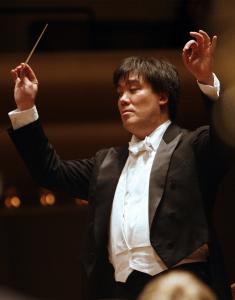
Alan Gilbert. Photo by Chris Lee
At the last concert before the New York Philharmonic unveils their 2011-2012 season, Alan Gilbert led a vital, intriguing combination of Beethoven, Sibelius, and Carl Nielsen. The concert featured two guest appearances from soprano Karita Mattila, who sang works by Beethoven and Sibelius while wearing two different gowns.

Beethoven's Eighth Symphony is one of his shortest and least-played. This cheerful little piece with its far-ranging opening theme allowed Mr. Gilbert to show his considerable skill in classical repertory. As the second theme entered, the Philharmonic's music director played Beethoven's little game of "hide-the-theme" with great glee. The second movement, with its repeating, metronomic rhythm was played with precision. The Minuet moved with the courtly precision of another century and the bucolic Rondo allowed the orchestra's winds and strings a chance to stretch.

Ms. Mattila then joined the orchestra for "Ah! Perfido!", a Beethoven stand-alone concert aria. Beethoven was a master pianist and orchestrator, but less skilled at writing for the voice. Ms. Mattila produced hearty tones, singing the aria's climactic passage with a full forte that overpowered the orchestra.

She and Mr. Gilbert sounded far more balanced in the three songs by Sibelius that opened the second half of the concert. These works, set to texts in the Finnish composer's preferred language of Swedish, were sang with great care and naturalism by the soprano, expertly accompanied. She ended her appearance with a brief encore, an a capella rendition of a traditional Finnish folk song. It was sung with great charm and emotion.

Carl Nielsen (1865-1931) a tonal symphonist from Denmark whose six quirky works in that genre provide symphony lovers with a great deal of enjoyment. Although Feb. 1 was the anniversary of Nielsen's Symphony No. 4, (The Inextinguishable) Mr. Gilbert programmed the Second instead. Entitled The Four Tempraments, its movements explore four different aspects of the human personality in accordance with the archaic medical belief that the body is ruled by four "humors": choleric, phlegmatic, melancholic and sanguine.


Those are the subtitles of the four movements of this brassy, engaging work which was led with great flair by Mr. Gilbert. The Philharmonic's famous brass section, led by Joseph Alessi and Philip Myers, had a field day with Nielsen's muscular choleric movement, charging pell-mell over a rich texture of strings. Mr. Gilbert conducted the phlegmatic movement with great lethargy, showing that he got the composer's joke. The melancholic adagio produced some of the evening's most beautiful playing. The sanguine finale roared forth, presenting the extroverted, raging side of the personality with a full-blooded performance.

This concert marks the start of a Nielsen initiative by Mr. Gilbert, who intends to revive interest in the composer by programming all six of his symphonies in coming seasons. If Tuesday night's performance is any indication, this bold move will provide Philharmonic audiences with something to look forward to in the seasons to come.

Wednesday, September 24, 2008

Opera Buff: The Met Revives Salome

Karita Mattila as Salome. Photo by Ken Howard © 2004 The Metropolitan Opera
The Metropolitan Opera opened its regular season on Tuesday night with a dazzling revival of Salome starring Karita Mattila. The Finnish soprano rose admirably to the many challenges of the title role, navigating the dizzying heights and gut-churning low notes with ease. Her star turn was ably supported by a solid supporting cast and virtuso performances from the orchestra pit.

When this opera premiered, Strauss commented that the work called for a "16-year old princess with the voice of an Isolde". Both of those qualities are present in Ms. Mattila's performance. Hers is a confused, oversexed adolescent, a fascinating mix of kittenish need, raw sexual energy and outright female domination. For 100 minutes, she was the focus of attention from her first entry, tossing off high notes to the moon, pulling the audience along on the journey from teasing temptress to depraved necrophiliac.

From the opening clarinet glissando, Strauss' opera is a mass of contradictions. It starts almost innocently, flirtatiously, with this production (by Jürgen Flimm) portraying Herod's court as a 1950's Hollywood cocktail party. The only sour note at the soiree is the presence of that pesky prophet John the Baptist (newcomer Juha Uusitalo) imprisoned by Herod (Kim Begley) in a cistern.

Salome, Herod's stepdaughter becomes sexually fascinated with Jokaanan. She descends into dangerous obsession when he rejects her advances. She agrees to perform the Dance of the Seven Veils, and demands the holy man's head as payment. Horrified, Herod orders her killed as the curtain crashes down.

In his Metropolitan opera debut, Juha Uusitalo wass a fine, resonant Jokaanan, stoic in his interactions with the princess. Character tenor Kim Begley was a twitchy, neurotic Herod, shrill and panicked in the opera's most atonal passages, singing all of the difficult nuances of Strauss' score. His counterpart, Ildiko Komlosi, was an impressive, piercing Herodias, whose approval of her daughter quickly vanished into a drunken haze of disgust at the opera's end. Joseph Kaiser was a fine resonant Narraboth, giving lie to the old saying that Strauss didn't write good parts for tenors. Patrick Summers led the enormous pit forces wilth lyricism and taste, conducting the opera (as Strauss himself directed) "like Fairy Music."

As for the famous Dance, it was staged here as a gender-bending exercise in tease and denial with multiple male victims dancing support roles to Ms. Mattila. Doug Varone's choreography combined elements of ballet, lap-dancing and sheer bump-and-grind. And yes, curious opera-goers, Ms. Mattila goes the full monty in this performance, leaving her audience stunned. What was even more amazing was that after receiving the severed head, Mattila then let the life and sexual anima drain from her performance, becoming nothing more than a depraved necrophage with a severed head of her very own.

Trending on Superconductor

Translate

Share My Blog!

Share |

Critical Thinking in the Cheap Seats