Support independent arts journalism by joining our Patreon! Currently $5/month.

About Superconductor

Our motto: "Critical thinking in the cheap seats." Unbiased, honest classical music and opera opinions, occasional obituaries and classical news reporting, since 2007. All written content © 2019 by Paul J. Pelkonen. For more about Superconductor, visit this link. For advertising rates, click this link. Follow us on Facebook.
Showing posts with label Czech Opera. Show all posts

Thursday, August 24, 2017

Opera Review: Fox Does Politics

Dell’Arte Opera Ensemble flushes The Cunning Little Vixen.
by Paul J. Pelkonen
Into the woods: the Fox (left) and the Vixen (Rachel Hall) meet cute in Janáček's opera.
Photo by Brian Long © 2017 Dell'Arte Opera Ensemble
In the remarkable string of operas that the Czech composer Leoš Janáček crafted in the last years of his life, it is Příhody lišky Bystroušky (usually represented in English as "The Cunning Little Vixen" that stands apart. Based on a Czech newspaper cartoon that was popular in Janáček's hometown of Brno, it is the only one of his operas that has any appeal to a younger audience. And yet, as shown in an intriguing new production by Dell'Arte Opera Ensemble. the Vixen is a deeply relevant opera whose sunny libretto masks some strong political subtext.

Monday, July 31, 2017

Opera Review: Tsarface

The Time of Troubles comes to Bard College with Dimitrij.
by Paul J. Pelkonen
Family snapshot: the false tsar Dimitrij (Clay Hilley, center)
flanked by Marfa (Nora Sourouzian) and Marina, his wife (Melissa Citro).
Photo courtesy Bard College and Bard SummerScape.

The operas of Antonín Dvorak are central to the repertory in that composer’s native land, but apart from Rusalka, remain neglected here in the United States. That may change after this weekend, when Bard SummerScape offered the first fully staged U.S. Performances of Dimitrij. Planned to be Dvorak's breakthrough international success, this opera is his most ambitious stage work: an absorbing, turbulent drama chronicling the start of the Time of Troubles, the most turbulent period in Russian history,

Thursday, July 27, 2017

Opera Preview: Dimitrij

Superconductor delves into "The Time of Troubles" and Dvořák's opera.
by Paul J. Pelkonen
The incident that started it all: Ivan the Terrible (top) holds his dying son Ivanovich.
Painting by Vadim Repin. 
The biggest opera premiere of the summer is this Friday evening, when Bard SummerScape unveils the rarely performed Dmitrij by Antonín Dvořák. Dmitrij is a Czech opera that delves into a bloody and to historians, fascinating period: the Time of Troubles. With the premiere scheduled for Friday night, I thought it would be a good idea to delve into the history of Dmitrij, and its more famous "prequel": Mussorgsky's Boris Godunov.

Wednesday, April 26, 2017

Opera Review: A Volga Display of Power

Juillard Opera mounts Kat'a Kabanova.
by Paul J. Pelkonen
Bad romance: Boris (Gerard Schneider, left) woos the heroine (Felicia Moore) in Juilliard's Kát'a Kabanova.Photo by Hiroyuki Ito for the Juilliard School. 
In retrospect, it is a pity that the Czech composer Leos Janacek did not find fame and fortune as an opera composer until the 1916 premiere of the revised version of Jenůfa, when the composer was 62. Káťa Kabanová, based on a Russian play, was written five years later. On Tuesday night, at the third of three performances at Peter Jay Sharp Theater, the Juilliard Opera showed that this rarely performed tragedy remains one of the composer's most potent creations.

Friday, March 31, 2017

Opera Review: Nature Red in Tooth (and claw)

Manhattan School of Music presents a cunning little Vixen.
by Paul J. Pelkonen
Right before the feathers fly: the Vixen Sharp-Ears (Shantal Martin, foreground)
gets ready to ravage a chorus of chickens. Photo courtesty Manhattan School of Music.
Adaptations of cartoons and comics as popular entertainment are now commonplace in popular culture. A hundred years ago, that form of entertainment was opera, and it was Moravian composer Leoš Janáček who had the idea of taking a popular children's comic strip from a Brno paper and making it into an opera. Příhody lišky Bystroušky (literally "The Adventures of Vixen Sharp-Ears", also known as "The Cunning Little Vixen" was way ahead of its time. On Thursday night, the Senior Opera Theater of Manhattan School of Music unveiled a new bare-bones staging of this challenging three-act opera (sung in English) with a cast of young singers applying themselves to recreating the woodland fantasy of this vivid, vital opera.

Tuesday, February 7, 2017

Opera Review: Fishing in the Dark

The Metropolitan Opera hooks a new Rusalka.
by Paul J. Pelkonen
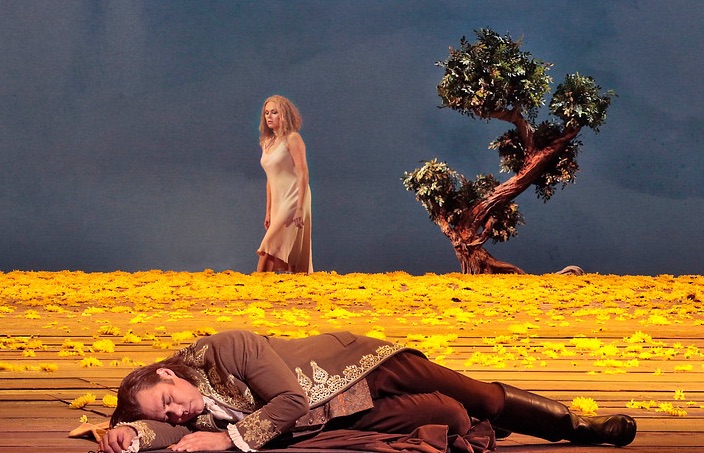
All dried out: Kristin Opolais (top) is the mermaid and Brandon Jovanovich is the Prince in the Met's new Rusalka.
Photo by Ken Howard © 2017 The Metropolitan Opera.

The Metropolitan Opera has a new production of Rusalka, adding the Dvořák fairy-tale opera to the long list of repertory works receiving new productions under the stewardship of general manager Peter Gelb. This new production is the fourth by director Mary Zimmerman, whose past stagings have ranged from innovative (Lucia di Lammermoor) to unwatchable claptrap (Armida). The show is centered around Kristine Opolais, inheriting the swim fins of Renée Fleming in the title role: a mermaid whose love for a handsome prince leads her to become fully human.

Friday, January 27, 2017

Metropolitan Opera Preview: Rusalka

It's like The Little Mermaid but with more death.
by Paul J. Pelkonen
The sleeper must awaken: Kristin Opolais (rear) and Brandon Jovanovich (foreground) in Rusalka.
Photo by Ken Howard © 2017 The Metropolitan Opera.
The Met plunges into a new production of Dvořák's Rusalka, a Czech fairy tale with gorgeous music and a dark but oh-so-Romantic ending. Kristine Opolais sings the title role, which has become one of her signature parts in recent years.

Wednesday, November 2, 2016

Opera Review: Country Discomfort

The Met revives Leoš Janáček's Jenůfa. 
by Paul J. Pelkonen
Karita Mattila (standing) holds Oksana Dyka in a key scene from Act II of Jenůfa.
Photo by Ken Howard © 2016 The Metropolitan Opera.
This latest Met revival of Jenůfa, the third opera by Czech composer Leoš Janáček is one of the most important productions of the current season. It allows a new generation of opera-goers to discover one of the most powerful dramas of the 20th century, thanks to the presence of a near-ideal cast. On Monday night, soprano Oksana Dyka was incandescent in the title role, a peasant girl whose suffering makes her one of the great operatic heroines. She's pregnant by a man that does not love her. She is attacked and mutilated by his love-struck brother. And then the baby is drowned.

Wednesday, August 31, 2016

Metropolitan Opera Preview: Jenůfa

Leoš Janáček's harrowing drama of Czech village life returns.
by Paul J. Pelkonen
Oksana Dyka in the title role of Jenůfa, opening at the Met on Oct. 28.
Photo by Ken Howard © 2016 The Metropolitan Opera.
The last time the Met staged its production of Jenůfa, Karita Mattila shone in the title role. Now, the Finnish diva graduates to the role of the Kostelnicka, the original operatic stepmother from hell. t
his bucolic tragedy is one of Janáček's masterpieces and the opera tht made the Czech composer a sensation late in life.

Wednesday, October 15, 2014

Opera Review: A Beard Too Far

Gotham Chamber Opera opens with a double bill by Martinů.
by Paul J. Pelkonen
Me and my shadow: Jarett Ott (left) and Joseph Beutel (right) flank Jenna Seladie in Alexandre Bis.
Photo © 2014 Richard Termine, courtesy Gotham Chamber Opera.
On Tuesday night, the maverick Gotham Chamber Opera opened its fourteenth season at the Gerald Lynch Theater. The program: a pair of operas by Czech composer Bohuslav Martinů. Alexandre Bis (1937) and Comedy on the Bridge (1935) were written in those turbulent years before Nazi Germany marched troops into the relatively new nation of Czechoslovakia, an event which would force Martinů himself to escape, first to France and then to America in 1941. These one-act comedies burn with a nervous comic energy, reacting to the insanity of the 1930s with bursts of absurd humor. Under Neal Goren's baton, Martinů's excellent qualities as a composer came to the fore, giving New Yorkers a new appreciation of this composer.

Thursday, February 6, 2014

Opera Review: Taking the Plunge

Renée Fleming returns as Rusalka.
by Paul J. Pelkonen
Her kisses can kill: Rusalka (Renée Fleming) woos the Prince (Piotr Beczala)
in Act III of Rusalka at the Metropolitan Opera.
Photo by Ken Howard © 2014 The Metropolitan Opera.
The title role of Rusalka, Antonín Dvořák's long-suffering aquatic sprite, has effectively belonged to soprano Renée Fleming for nearly two decades. From her first performances of the role at the Seattle Opera to the start of her reign in the Metropolitan Operas's handsome, elaborate staging, she has been inextricably linked with Dvořák's most successful opera.  Now, with the advent of the Metropolitan Opera's Live in HD broadcasts, Ms. Fleming has plunged once more into Rusalka, with the goal of preserving her interpretation for posterity and eventual release on home video.

Sunday, January 19, 2014

Metropolitan Opera Preview: Rusalka

Renée Fleming returns to the water as a love-struck mermaid.
by Paul J. Pelkonen
Fathoms below: Renée Fleming in the title role of Rusalka.
Photo by Ken Howard © 2009 The Metropolitan Opera.
The return of soprano Renée Fleming is always anticipated at the Metropolitan Opera. And here, she returns t the role that has become one of her signatures in the last 15 years: the title character in this revival of Antonin Dvořák's Rusalka.

Saturday, August 31, 2013

Opera Rewind: Foxy, Foxy

New York City Opera's classic The Cunning Little Vixen.
by Paul J. Pelkonen
Frame grab of The Cunning Little Vixen with Gianna Rolandi in the title role of "Sharp-Ears."
Image © 1983 Live From Lincoln Center/New York City Opera.
Presented purely here for the dual purpose of nostalgia and education, this is a video of the New York City Opera's classic Maurice Sendak production of Leos Janacek's magical opera The Cunning Little Vixen. (Which will never be seen again as the sets and props were dumped at the company's auction over the winter.)

Wednesday, May 2, 2012

Opera Review: Formula One

Karita Mattila burns up The Makropulos Case.
Absolutely fabulous: Karita Mattila in The Makropulos Case.
Photo by Ken Howard © 2012 The Metropolitan Opera.
by Paul Pelkonen
Even as the Metropolitan Opera season winds down, there is still room on the schedule between all those performances of the Ring for interesting revivals. Such a one is Elijah Moshinsky's ill-starred 1996 production of Leoš Janáček's The Makropulos Case.

Ms. Mattila brings a unique sensuality and world-weariness to Emilia Marty, the central character of this drama. A deeply philosophical drama wrapped in a mystery wrapped in a legal procedural, this is one of Janáček's most memorable and moving operas. As the 337-year old opera star burnt out from having near-immortality, the Finnish singer was a captivating presence, exercising a mysterious fascination over every character in the opera.

The thorniest moment of Tuesday night's performance (the second of this run) had nothing to do with singing. In Act II, Ms. Mattila was mounting the wooden Sphinx statue that dominates this act (which takes place after-hours on the stage of an opera house.) In high heels and a long poison-green gown, the singer stumbled on the steps. She regained her balance, and  sprawled herself across the Sphinx's lap, nonchalantly taking off her heels and tossing them aside. The rest of the act was (like her Dance of the Seven Veils in Salome) performed barefoot.

Friday, April 20, 2012

Metropolitan Opera Preview: The Makropulos Case

Karita Mattila makes her bid for immortality.


The immortal diva: Karita Mattila.
Publicity photo for the Met's production of Tosca
by Brigitte Lacombe © 2006 The Metropolitan Opera.
by Paul Pelkonen
To an operatic novice, Leoš Janáček's The Makropulos Case may seem as remote and unapproachable as its enigmatic title character. However, this opera, which centers around a centuries-old lawsuit and humanity's obsession with eternal life, is one of the Czech composer's most satisfying creations. Jirí Behlolávek conducts.

The complex plot of The Makropulos Case (Věc Makropulos is the Czech title) delves into the art of opera itself. The central figure is the mysterious Emilia Marty (Karita Mattila), a world-famous opera singer who interjects herself into a long-lasting legal procedure stemming from a lawsuit: Gregor v. Prus. Her object: to obtain a copy of the chemical formula that her father invented, a formula that will extend her life another 300 years.

Science fiction? Maybe. Janáček based his libretto on the play of the same name by fellow Czech Karel Capek, the writer best remembered for coining the word "robot" in his play R.U.R.. The opera shifts through the composer's frequently visited sonic world: minor-key chords interjected with delicate fabrics of wind and strings. The voices are always to the fore, as maximum clarity is essential to Janáček's style.


Ms. Mattila is just the third singer to take on the difficult title role at the Met. The opera was first performed at the Met (in English) in 1996, with soprano Jessye Norman in her last role at the opera house.

The production's premiere was scheduled for Jan. 5, 1996. On that night, tenor Richard Versaille, playing the role of Vitek died onstage after singing his first line ("You only live so long.") While up on a ladder, Mr. Versaille suffered a heart attack and died, plummeting to the stage.

The curtain fell swiftly, and the performance was cancelled.

The next show was scheduled for January 8, and was cancelled because of a blizzard. The opera finally premiered on January 11, 1996. Further revivals of Makropoulos in 1998 and 2001, were sung in Czech and featured Catherine Malfitano as Emilia Marty.

Recording Recommendation:
There are a few recordings of this opera. Most are in the catalogue under the title Věc Makropulos. If you don't speak Czech, the English-language set (also conducted by Sir Charles Mackerras) is an excellent choice.

Vienna Philharmonic cond. Sir Charles Mackerras (Decca, 1978)
Emilia Marty: Elizabeth Söderström


Emilia Marty was the great Elizabeth Söderström's favorite role. She is marvelous here in the midst of an almost all-Czech cast, carefully conducted by Janáček expert Sir Charles Mackerras. This is part of the English conductor's cycle of major operas by this composer, and an essential. It is also available as part of a budget box set of the operas that also includes The Cunning Little Vixen, Jenufa and Kat'a Kabanova.

English National Opera cond. Sir Charles Mackerras (Chandos, 2008)
Emilia Marty: Cheryl Barker

For the listener not fluent in Czech, this English language version (made at the English National Opera) provides a valuable gateway into understanding  Janáček's complex masterpiece. Cheryl Barker hits some astonishing high notes as Emilia, and draws real pathos in the Tristan-like finale. A live recording with minimal audience noise and a fine supporting cast.

Return to the Metropolitan Opera Season Preview!

Friday, June 24, 2011

Opera Review: Fox on the Runway

The Cunning Little Vixen at the New York Philharmonic
Isabel Bayrakdarian makes her escape in
The Cunning Little Vixen. Photo by Chris Lee.
© 2011The New York Philharmonic

This week, the New York Philharmonic ended their marathon 2011 season with Leoš Janáček's The Cunning Little Vixen, an opera that pits mankind against the animal kingdom as represented within a Czech forest. Thursday night's performance, under the baton of music director Alan Gilbert, offered a sumptuous reading of the score, with the orchestra supporting a first-class cast.


That cast was led by soprano Isabel Bayrakdarian, making her Philharmonic debut in the title role of the vixen Sharp-Ears. Ms. Bayrakdarian displayed an agile soprano instrument with a pleasing tone and the right amounts of light and shade. She also manipulated the complex costume (including a nearly prehinsile fox-tail) easily, coping with the challenging choreography on the somewhat limited stage.

She was well matched by the veteran British baritone Alan Opie as The Forester, the game warden who serves as antagonist, captor and foil to the Vixen. Mr. Opie was joined by Joshua Bloom in the brief role of Harasta, character tenor Keith Jameson as the Schoolmaster and bass Wilbur Pauley in the mirroring roles of the Badger and the Parson. The animal cast also features mezzo Marie Lenormand as Sharp-Ears' vulpine love interest, and members of the Metropolitan Opera Children's Chorus as a menagerie of bugs, butterflies, and beetles.
They gave good sunflower: Alan Gilbert conducts The Cunning Little Vixen.
Photo by Chris Lee © 2011 The New York Philharmonic

The costumes, also designed by Mr. Fitch, combined animal and insect characteristics with everyday items: cargo pants for the Vixen and her mate. Latex skull-caps with scarlet punk-rock mohawks for the Rooster and Chickens. Backpacks for all the insects (presumably to hold their folded wings) and appropriate peasant gear for the Forester, the poacher Harasta, and the denizens of the little tavern that represents the world of man in this opera.


The Vixen is the second collaboration between Mr. Gilbert and director Doug Fitch, who paired on last year's successful staging of Ligeti's Le Grand Macabre. The team took a lighter approach with the Janacek piece. Mr. Fitch's design turned the vast stage of Avery Fisher Hall into a giant patch of sunflowers, with cleverly placed cloth scrims and Vari-Lites providing a suitable forest atmosphere. The aisles of the concert hall and a black, tongue-like extension expanded the acting surface into the house, giving the large cast of insects, animals and humans enough room to cavort.

The effect of dappled light and raw natural beauty were also present in Mr. Gilbert's sensitive reading of this brief, but treacherous score. Whether playing the folk melodies generated by the Cricket and the Butterfly, or accompanying the soaring voices of the Vixen and the Fox in their love duet, Mr. Gilbert spent most of the night conducting in a comfortable pocket.

He was bold with the score, speeding tempos when necessary, producing a marvelous kinetic energy in the Act II wedding. The final scene featured impressive playing from the Philharmonic horns, depicting offstage hunting parties with authority and noble, firm tone.

Wednesday, June 22, 2011

A Sunflower Grows in Brooklyn

More about The Cunning Little Vixen.
Stage Model for The Cunning Little Vixen by Doug Fitch
Image © 2011 Giants Are Small. Courtesy New York Philharmonic.
Tonight is the opening of The Cunning Little Vixen at the New York Philharmonic. Your reporter was at yesterday's Open Rehearsal. Alan Gilbert led the musicians, perfecting small bits of Acts I and II of the opera. He worked with Alan Opie (The Forester) perfecting the scene where the Vixen gets captured. If the two acts played at the rehearsal are any indication, the actual performances should be marvelous. (My tickets are for Thursday night.)

The rehearsal was also an opportunity to experience Doug Fitch's extraordinary set, which transforms the Lincoln Center concert hall into a wonderous metaphorest, dominated by 33 ginormous sunflowers, constructed (according to recent New York Times article, from cardboard, plastic, and (of all things) bright yellow "CAUTION" tape.

According to the article (written by Steve Smith), director Doug Fitch's workshop is somewhere in my own neighborhood of Sunset Park, Brooklyn. The thought of giant sunflowers growing on my home turf reminds me of Star Trek, specifically This Side of Paradise.. That's the one with the flowers and the soporofic spores that make the whole Enterprise crew resign their commissions and go gamboling across the countryside.
The spores from Star Trek. Don't get too close. Image © Paramount/Desilu.
There will be a full review of Vixen on the blog in the next couple of days. Meanwhile, please enjoy this New York Philharmonic time-lapse video, chronicling the construction of the set.


Tickets for The Cunning Little Vixen are available at NYPhil.org.

Friday, June 10, 2011

New York Philharmonic Opera Preview: The Cunning Little Vixen

Costume design for the Vixen by Doug Fitch.
Image courtesy Giants Are Small/New York Philharmonic.
© 2011 Giants Are Small.
The New York Philharmonic closes the 2010-2011 season with four complete performances of Leoš Janáček's Příhody Lišky Bystroušky, better known as The Cunning Little Vixen.
The semi-staged production reunites Philharmonic music director Alan Gilbert with director Doug Fitch, the same team that created last season's staging of Ligeti's Le Grand Macabre. The performances will be sung in English.

The composer wrote his own libretto (based on a Czech comic strip). In his hands, the adventures of a girl fox named Sharp-Ears is the window through which to explore the animal world and man's relationship with nature. The score is filled with rich melodies and lush textures that temper
the composer's singular, angular style. And despite a plot which includes sex, politics, bondage, murder and premarital sex, this is the closest that Janáček ever came to writing a children's opera.

Oh yeah, and it's funny.
The story follows the Vixen through childhood, captivity, courtship, parenting, and ultimately death. Janacek uses the barnyard and forest to satirize women's liberation, worker's rights and the battle of the sexes, as presented in the Vixen's relationship with her eventual mate. The humans are also drawn fully, from the local parson and love-struck schoolmaster to the deeply soulful Forester whose relationship to the Vixen and her natural world is at the crux of the work.


Recording recommendations:
For an opera that is popular with audiences, there are only a few (four) recordings of Vixen in the catalogue. These are the two that I own. The first is in Czech. The second is in English. Both are highly recommended.

Vienna Philharmonic cond. Sir Charles Mackerras (Decca, 1985)
Forester: Dalibor Jedlicka
The Vixen, Sharp-Ears: Lucia Popp
The Fox: Eva Randova


Royal Opera House of Covent Garden cond. Sir Simon Rattle (EMI, 1991, reissued by Chandos)
Forester: Thomas Allen
The Vixen, Sharp-Ears: Lillian Watson
The Fox: Diana Montague

Watch the first scene from Geoff Dunbar's enchanting animated version of The Cunning Little Vixen, made for the BBC in 2003.

Monday, April 11, 2011

DVD Review: Barn Dance of Death

Jenůfa from the Teatro de Liceu

Tenor Jorma Silvasti as Laca in Act I of the Olivier Tambosi production of Jenůfa.
Photo by Robert Millard © 2007 Los Angeles Opera.
This live DVD (filmed in 2005 at the Teatro de Liceu) of Leos Janaček's rustic tragedy Jenůfa brings together two generations of fine dramatic sopranos: Nina Stemme in the title role and Eva Marton in the key role of the Kostelnička. And yes, Met-goers, this DVD preserves the same production that graced the stage of that house in 2007.


Jenůfa premiered in 1904, and was the opera that "broke" Janaček, elevating him to the realm of the most important opera composers to come from what was then Bohemia, and is now the Czech Republic. Based on a play by Gabriella Pressiová, it is a searing tale of love, jealousy and mayhem in a Moravian village: an Eastern European answer to Cavalleria Rusticana

Janaček's opera is about surviving and withstanding tragedy. The power of love overcomes seemingly insurmountable obstacles, achieving, if not happiness, at least a kind of stability. This sturdy production (by Olivier Tambosi) keeps things simple with a triangular acting surface, symbolizing the complex relationships at the heart of the opera. The outer acts take place in a rustic barn structure, evoking the world of the Moravian peasants. The dark central act is staged in the dark, with a large stone inexplicably dropped in the middle of the stage.


The titular Jenůfa is a young girl with a complex family relationship. A series of tragic events ensues. Her face is slashed by a jealous lover. Her stepmother, the Kostelnička, takes it upon herself to drown Jenůfa's illegitimate baby. In the third act, the corpse is discovered. Jenůfa is nearly killed by a mob of villagers, until the Kostelnička steps forward and takes the blame for the tragedy.

Nina Stemme tracks Jenůfa's journey with a soaring performance, that takes her from a shallow, romantically obsessed girl, to victim, to a transcendent figure capable of forgiving the Kostelnička. Ms. Stemme displays a powerful soprano voice, rising to the occasion for the final duet with Laca that ends the opera.

As the Kostelnička, Eva Marton shows that there is life after Brunnhilde. Her voice still has the power that enabled her to sing Brunnhilde and Turandot. However she has acquired a powerful vibrato that flirts with wobble but never goes over the edge. She is also a fine actress, bringing weight and dignity to the character despite her horrific deed.

Finnish tenor Jorma Silvasti is simply terrific as Laca, the frustrated suitor who attacks Jenůfa, only to wind up with her at the end of the opera. Mr. Silvasti has good command of Czech and a fine, dramatic tenor. Baritone Pär Lindskog gives a strong performance as Steva, the callow stud whose rejection of Jenůfa sets the plot in motion. Peter Schneider conducts a rchly textured performance that makes the most of Janaček's unique tonaltites and folk rhythms.

Friday, February 18, 2011

Opera Review: Cashing the Czech

The Bartered Bride Marries Met and Juilliard.
by Paul J. Pelkonen
Layla Claire and Alexander Lewis in Act II of The Bartered Bride.
Photo © 2011 The Juilliard School/Metropolitan Opera
The Metropolitan Opera's new collaboration with the Juilliard School got off to a winning start with Stephen Wadsworth's production of The Bartered Bride, seen Thursday night at the Peter Jay Sharp Theater. The Czech opera was performed in a new English translation by J. D. McClatchy, and incorporated 20th century references into the libretto.

Bedrich Smetana's comedy of small-town romance and arranged marriages has been away from New York stages for the last 15 years. This thrilling performance, conducted by James Levine made this writer wonder why we've had to wait so long. Maestro Levine led an enthusiastic reading that brought out the charm, laughter and joy in this underrated score. And he was a little caught up in it: the Met's music director was heard merrily singing along with the score.


He was helped by a fine young cast, led by soprano Layla Claire as Marenka, the bride-to-be who finds herself at the eye of a romantic hurricane when her planned marriage to Jenik is thrown over in favor of an arranged match with the son of Mischa, a rich farmer to whom her father owes money.

This is a complex, multi-dimensional role with a high tessitura and a number of rapid-fire emotional changes that can challenge any singing actress. Ms. Claire mined the rich comic vein of the score but also generated pathos, particularly in the heartbreaking spotlight aria that serves as the (serious) climax to the final act.

Marenka is deeply in love with Jenik, (tenor Paul Appleby), who manipulates events throughout the opera to produce a happy result. Mr. Appleby brought a brash attitude to the part and a pleasing tenor with light baritonal coloring. His performance took wing in his rapid-fire "contract duet" with the marriage broker Kecal, played with great comic gusto by bass Jordan Bisch.

Jenik's competition is Vacal, the most challenging part in this opera. Smetana was a fearless innovator, and he created what might be the only tenor role to be hampered by a musical stutter. As played by Alexander Lewis, Vacal's handicap became a source of charm, and the opera's most uplifting moment comes when the singer overcomes his alalia syllabaris and sings out. When he starts dancing in the third act, it is a moment of real joy.

Mr. Wadsworth's staging moved the action to a chic Czech café, sometime in the 20th century. The choristers slowly change from street garb to traditional kroje costumes. When a "real Czechoslovakian" circus hits the sleepy little town in the third act, the whole production takes a welcome turn for the surreal, complete with dancing bears, a bearded lady (dancer Miles Mykkanen, on point, like a ballerina) and a remarkable contortionist (Jacob Stainback).

This thrilling revival of one of the greatest operatic comedies of the 19th century plays for only one more performancer, but fear not, opera lovers, it's slated for the Met--sometime in 2014.

Trending on Superconductor

Translate

Share My Blog!

Share |

Critical Thinking in the Cheap Seats