Support independent arts journalism by joining our Patreon! Currently $5/month.

About Superconductor

Our motto: "Critical thinking in the cheap seats." Unbiased, honest classical music and opera opinions, occasional obituaries and classical news reporting, since 2007. All written content © 2019 by Paul J. Pelkonen. For more about Superconductor, visit this link. For advertising rates, click this link. Follow us on Facebook.
Showing posts with label Stephanie Blythe. Show all posts

Wednesday, April 4, 2018

Metropolitan Opera Preview: Cendrillon

Joyce DiDonato stars in the Massenet version of Cinderella.
by Paul J. Pelkonen
Joyce DiDonato goes to the ball in the Laurent Pelly production of Cendrillon.
Photo © 2018 The Metropolitan Opera.
The Metropolitan Opera has spent the last decade enthusiastically trawling through the vast operatic catalogue of Jules Massenet, the Parisian composer who represents the last gasp of French Romanticism before the dawn of the 20th century. Here they present the company's first performances of Cendrillon Joyce DiDonato sings the title role.

Tuesday, December 10, 2013

Opera Review: The Real Housewives of Windsor

The Met unveils Robert Carsen's Falstaff.
by Paul J. Pelkonen
Hampered: Falstaff (Ambrogio Maestri, center) seeks an exit in Act II of Verdi's comedy.
Helping him are Meg Page (Jennifer Jonson Cano, l.) and Mistress Quickly (Stephanie Blythe.)
Photo by Ken Howard © 2013 The Metropolitan Opera.
Falstaff is unique. Verdi's last opera (and his lone successful comedy) arrived when the composer was 79 and still in full command of his powers. Yet despite its tunefulness, the score lacks the "big numbers" of Rigoletto, Aida and Otello, choosing to present the comedy as a complex dialogue between singers and orchestra. As a result, Falstaff, though a respected opera is considered an opera for connoisseurs, and appears only occasionally on the operatic stage.

Tuesday, November 19, 2013

Concert Review: An All-Star Team, Minus Two

The 2013 Richard Tucker Gala at Lincoln Center.
by Paul J. Pelkonen
This year's Richard Tucker Gala celebrates the singer's 100th birthday.
The annual Richard Tucker Gala is like opera's equivalent of the All-Star Game, a chance to hear today's foremost opera singers alongside the stars of tomorrow. Held to commemorate the Richard Tucker Foundation's annual awarding of the Tucker Prize to a promising young singer, this concert at Lincoln Center attracts affluent opera lovers and industry cognoscenti alike. This year's gala also celebrated the centennial of Richard Tucker's birth, and featured a new banner across the back of the stage with five portraits of the late tenor and New York native.

Sunday, November 10, 2013

Concert Review: Famous Last Words, Revised

The New York Philharmonic offers a new version of Mozart's Requiem.
by Paul J. Pelkonen
Conductor Bernard Labadie. Photo by David Cannon© 2013 Les Violins du Roy.
In March of this year, the New York Philharmonic offered The Bach Variations, an an entire month celebrating the music of Johann Sebastian Bach. Not only did this festival remind concert-goers of this ensemble's skill with baroque music, it also provided opportunity for some lesser-known conductors to appear with the orchestra. One of them was Bernard Labadie, music director of Les Violons du Roy and a specialist in music from the baroque era. On Friday night, he conducted with a brisk, efficient energy, moving lightly on his feet and drawing dulcet tones from singers and ensemble.

Saturday, January 19, 2013

Opera Review: A Voice to Die For

Angela Meade sings Il Trovatore at the Met.
by Paul J. Pelkonen
Die hard: Angela Meade as Leonora, having just drunk poison in Act IV of Il Trovatore.
Photo by Marty Sohl © 2013 The Metropolitan Opera.
Wednesday, Jan. 16. 

That date was circled on the calendar for many New York opera lovers as the one night that soprano Angela Meade would sing Leonora in this year's revival of Verdi's Il Trovatore. In fact, it was the only night that the Met had scheduled for this talented soprano, in the middle of January. At the Met, January is where unloved revivals and obscure operas (La Rondine, Le Comte Ory) are sentenced to play before half-empty theaters. (Luckily, opera lovers know this, and plan accordingly!) While this performance turned out to be Ms. Meade's second Leonora of the season (she substituted for an ill Patricia Racette in the Saturday night broadcast) the Washington State-born soprano did not disappoint.

Monday, February 27, 2012

Egyptian Plague Strikes Soprano

Sondra Radvanovsky, Latonia Moore to platoon in Aida at the Met.
by Paul Pelkonen.
She's in the Egyptian business: Sondra Radvanovsky.
The winter flu bug has struck Egypt--and the Metropolitan Opera.

The Metropolitan Opera press office announced earlier this week that Violeta Urmana, scheduled to sing Aida at the Met this week, was ill.

Her replacement on Tuesday night was soprano Sondra Radvanovsky. Saturday's matinee broadcast will be sung by Latonia Moore.

Ms. Radvanovsky rose to stardom at the Met with the company's 2009 production of Il Trovatore. She has sung Aida before, but in the much smaller role of the (offstage) Priestess in Act I.

Her last appearances at the Met were in the spring of 2011, where she sang the title role in Tosca and reprised the role of Leonora in Trovatore. Next season, she will sing the role of Elisabetta de Valois in Don Carlo.

Latonia Moore is a recipient of the 2005 Richard Tucker Foundation grant. She has sung the role at the Hamburg State Opera in 2009 and at the Royal Opera House in Covent Garden in 2011. This performance is her Metropolitan Opera debut.

In other news, tenor Marcelo Giordani will sing Radames, taking over for Marcelo Àlvarez. Stephanie Blythe, who has drawn strong reviews for her fiery portrayal of the Egyptian princess Amneris, will sing as scheduled.

For a full review of the Met's Aida starring Ms. Urmana and Ms. Blythe, visit this page on Superconductor.
Contact the author: E-mail Superconductor editor Paul Pelkonen

Tuesday, February 14, 2012

Opera Review: Don't Mess With the Princess!

The Metropolitan Opera Revives Aida...again.
Stephanie Blythe as Amneris.
Photo by Marty Sohl,
© 2012 The Metropolitan Opera.

Monday night at the Met featured the company's second performance of Aida this season, with a cast featuring Violeta Urmana in the title role, Stephanie Blythe as Amneris and tenor Marcelo Àlvarez as Radames.

This was a pretty good outing for Mr. Àlvarez, the Argentine tenor who has been a regular at the Met in the last decade. His voice remains two sizes too small for Radames, but he sang with musical intelligence, navigating the score's pitfalls like a careful explorer inside a pyramid.

Stephanie Blythe is likely to be this company's Amneris for a long time. And that is a good thing. The New York-bred mezzo diva is a formidable stage presence, with an instrument that can lay the smack-down on both Wagnerian Gods (James Morris, the Met's ex-Wotan was the priest Ramfis) and callow Egyptian generals. And she doesn't look totally ridiculous wearing a blue turkey on her head.

Ms. Blythe's big, flexible voice rides low, but is capable of navigating Amneris' mercurial temperament. She was potent in the early ensembles, and supremely bitchy in the Act II confrontaton scene. This was not a princess to mess with. The voice is powerful, and sometimes rides over  the orchestra and surrounding ensembles. 

Wednesday, November 30, 2011

Concert Review: The Chosen Carols

The New York Festival of Song presents A Goyishe Christmas To You.
Lauren Worsham, Stephanie Blythe,
Judy Kaye, Joshua Breitzer,
John Brancy, Joshua Jeremiah,
Alan Kay, Steven Blier.
Image © 2011 Kaufman Center.

Tuesday night's concert by the New York Festival of Song featured the second year of A Goyishe Christmas To You, Steven Blier's program of holiday favorites, written by Jewish composers. This was the program's first appearance at the Merkin Concert Hall, the NYFOS' regular home. The show combines well-known Christmas chestnuts by Jewish composers with 20th century rarities and a new song, submitted in an e-mail from composer Howard Levitsky. 

Mr. Levitsky's song, "Candle in the Window (God Bless the Christmas Jews)"opened the program, setting an appropriate, light-hearted tone for the concert. The lyrics examine the disparity of being Jewish and celebrating Christmas anyway, even adding a few extradimensional words from God, admonishing his worshipers not to "think too much." It was engagingly performed by baritone Joshua Jeremiah and soprano Judy Kaye in a breezy, Broadway style.

The program then moved through an astonishing variety of music, from the familiar ("Santa Baby", vamped by nascent diva Lauren Worsham) to obscure nuggets from little-known musicals and old television specials. The best of these: "What Makes Santa Run?" a comic psychoanalysis of St. Nicholas, with Mr. Jeremiah taking the role of Dr. Sigmund Freud.

The biggest name in the little cast of singers was Stephanie Blythe, the potent mezzo-soprano who has become a current fixture at the Met. It was more than thrilling to hear her Wagner-sized voice sing "Let it Snow" and "The Christmas Song," with jazz-inflected piano accompaniment from Mr. Blier. She gave these popular songs full, rich tone and a seductive warmth. 

In addition to rarities and favorites, Mr. Blier presented some bold reworkings of familiar songs. "Winter Wonderland" was presented as an ode to gay bliss, with John Brancy and Mr. Jeremiah singing it as a baritonal duet. In a state where gay marriage is at long last legal, the line about Parson Brown and matrimony received hearty approval. "Rudolph the Red-Nosed Reindeer", was reworked in Yiddish. The Johnny Marks classic was sung by tenor Joshua Breitzer in a red yarmulke, accompanied by stepped-up piano and klezmer-style clarinet playing from soloist Alan Kay.

More traditional was "O Holy Night", the soaring carol from French composer Adolphe Adam. (Mr. Blier declared that Mr. Adam was "actually Jewish for one holy night" in his liner notes.) This was sung with emotive power by Mr. Brancy, who clearly relished the chance to open up his instrument and show its full power and range. He sang it a second time in French, using the original words and giving them even more weight. 

Following Ms. Kaye's playful rendition of David Friedman's "A Simple Christmas Wish," the concert ended with the whole cast lining up at the piano  to share Irving Berlin's immortal "White Christmas." The simple melody was reworked as a triple duet, with pairs of singers splitting up its few short lines. Following this touching performance, the cast cut loose with another Johnny Marks classic: "Rockin' Around the Christmas Tree."

Wednesday, November 16, 2011

Opera Review: One for the Diva

The Met's goes for baroque, reviving Rodelinda.

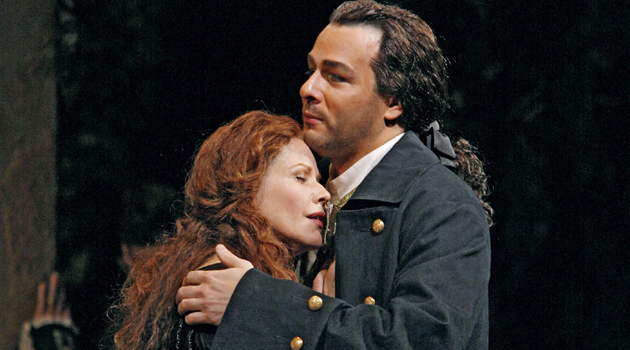
Marital bliss: Rodelinda (Renée Fleming, left) is embraced by Bertarido (Andreas Scholl.)
Photo by Ken Howard © 2011 The Metropolitan Opera.
The Met's revival of Rodelinda is the company's latest effort on behalf of soprano Renée Fleming. In presenting this comparatively obscure Handel opera, the presumed goal is to preserve the superstar's interpretation of the title role, into the ongoing Met Live in HD series. But in catering to the diva, the company has revived a dull entertainment.


Rodelinda is Handel's 19th opera. The title character is based on a real person, a 6th century Lombard queen. At the opera's opening (this is one of those plots where you need to know what happened before the curtain rises, like Die Walküre or Il Trovatore, Rodelinda's husband has been usurped and presumed killed. Of course, he's not really dead, but we'll get to that in a moment.


At the Monday night opener, Ms. Fleming's biggest assets were her good-natured manner and a majestic presence. This quality was evident even in the opening scene, which found the singer chained to a bed in a bizarre echo of Rosenkavalier. (Octavian was not present.) In the later acts, Ms. Fleming's voice developed a slight, but audible flutter in the coloratura passages. A hard edge emerged when her instrument was put under pressure and brought above the stave. Most problematic, an Act III aria, with high notes that repeatedly sharp.


Far more impressive: mezzo Stephanie Blythe as Eduige, the courtier whose jealousy helps drive the opera's complex plot. Ms. Blythe is an old-school diva with a sturdy instrument and stage presence. She dominated the scenes she was in, especially the lengthy aria that opens Act II. With roles like this and Fricka in the new Ring Cycle, the robust mezzo is now a house favorite.

Handel creates some unusual ensembles for Rodelinda, with a cast that includes two countertenors. Andreas Scholl was strong as Rodelinda's husband Bertarido, although his voice slipped into its normal register at one point, he recovered. But why does Bertarido have to sing his final aria running from room to room as the sets slide across the stage? Countertenor Iestyn Davies made his Met debut in the smaller role of Unulfo. Mr. Davies sang with great agility and the promise of bigger roles to come.

Tenor Joseph Kaiser was a convincing bad guy as Grimoaldo. Out to to seize the throne of Lombardy and marry Rodelinda, Mr. Kaiser was passionate, dastardly and ultimately forgiven (by Ms. Blythe)He was undermined by a clumsy, almost laughable sword-fight with Mr. Scholl in Act III. Baritone Shenyang was a convincing heavy, with a smooth delivery and a pleasing, dark instrument. In the half-empty pit, Harry Bickett conducted the small orchestra with flair, playing the continuo parts himself from the harpsichord.

Stephen Wadsworth's production is an anomaly in Peter Gelb's Met, an example of the hyper-realistic style that characterized the previous administration. These huge sets might be recycled (perhaps incorporated Simon Boccanegra.) Scenery slides in and out, like subway trains arriving in a station. Unnecessary effects are common, like a gardener who spends all his time planting impatiens onstage, and a gratuitous use of the house mega-elevator for the prison scene.

Trending on Superconductor

Translate

Share My Blog!

Share |

Critical Thinking in the Cheap Seats