Support independent arts journalism by joining our Patreon! Currently $5/month.

About Superconductor

Our motto: "Critical thinking in the cheap seats." Unbiased, honest classical music and opera opinions, occasional obituaries and classical news reporting, since 2007. All written content © 2019 by Paul J. Pelkonen. For more about Superconductor, visit this link. For advertising rates, click this link. Follow us on Facebook.
Showing posts with label Piotr Ilyich Tchaikovsky. Show all posts

Monday, February 26, 2018

Concert Review: These Go to Eleven

The Vienna Philharmonic plays Ives and Tchaikovsky.
by Paul J. Pelkonen
Gustavo Dudamel. Photo by Sébastien Grébille.
For the last 176 years, the Vienna Philharmonic has staked its reputation on the Austro-Germanic symphonic tradition, bringing the music of composers like Schubert, Strauss and Suppe before the public with style and skill. However, Sunday's matinee concert, the third of three this weekend at Carnegie Hall, the great orchestra eschewed the Mozart and Beethoven for a refreshing focus elsewhere. For this concert, the orchestra and current guest conductor Gustavo Dudamel agreed to play symphonies by Charles Ives and Piotr Ilyich Tchaikovsky, whose only common thread was the unconventional and innovative nature of their work.

Saturday, January 13, 2018

Concert Review: The Woman Who Played With the Sea

Susanna Mälkki returns to the New York Philharmonic.
by Paul J. Pelkonen
The conductor Susanna Mälkki returned to the New York Philharmonic this week.
Photo by Sakari Viika © 2017 Helsinki Philharmonic Orchestra.
Just a couple of years ago, a number of names were tossed around as candidates for who should become the New York Philharmonic's next music director. One of the leading candidates was Susanna Mälkki, the Finnish conductor who is best known to New Yorkers for leading the 2016 New York premiere of her compatriot Kaija Saariaho's opera L'amour de Loin. Ms. Mälkki did not get the job, but she returned to the Philharmonic this week.

Monday, January 23, 2017

Festival Preview: Beloved Friend: Tchaikovsky and his World

The New York Philharmonic goes all-in on the Russian romantic.
by Paul J. Pelkonen
Semyon Bychkov and friend. Original promotional photograph © 2016 Decca Classics. 
Piotr Ilyich Tchaikovsky died in 1893, but earned immortality, remaining far and away the most popular Russian composer of the 19th century. Starting this Thursday, his life and legacy are the subject of a new festival at the New York Philharmonic, Beloved Friend: Tchaikovsky and his World. The festival continues for three weeks, bringing the warmth and passion of his music to the stage of David Geffen Hall and other venues. Tickets and information are available here.

Wednesday, November 12, 2014

Concert Review: It's a Kind of Magic

The Orchestra of St. Luke's opens its 2014 at Carnegie Hall.
by Paul J. Pelkonen
Pablo Heras-Casado. Photo by Josep Molina © 2014 Harmonia Mundi.

The Orchestra of St. Luke's marks four decades this year. They remain one of this city's most versatile ensembles, at home in everything from Mozart to Metallica. For their 2014 season opener at Carnegie Hall, principal conductor Pablo Heras-Casado designed a program that illustrated his ensemble's flexibility, featuring four different pieces in a jarring juxtaposition of styles. In the end, this program's combination of Purcell, Tchaikovsky, Dallapiccola and Mendelssohn, four different composers from different historical periods, proved unique and ultimately, satisfying.

Sunday, July 13, 2014

Concert Review: A Bittersweet Symphony

The New York Philharmonic takes Central Park.
by Paul J. Pelkonen
Alan Gilbert leads the New York Philharmonic.
This photo is from 2009 because it does not have the ugly new apartment
towersthat are ruining the Central Park South skyline on W. 57th St.
Photo by Chris Lee © 2009 The New York Philharmonic.
The New York Philharmonic Concerts in the Parks are a celebrated event on this city's summer calendar, as well as a splendid marketing opportunity for Gotham's oldest orchestra. On Thursday night, New Yorkers filled the Great Lawn of Central Park for the first of two performances scheduled for that verdant venue, with press and friends of the orchestra (including yours truly) set forward on folding chairs near the stage and the masses sprawled on picnic blankets to hear the orchestra through a sophisticated audio system.

Sunday, January 5, 2014

Concert Review: A Blizzard of Sound

The New York Philharmonic plays Rouse, Lindberg and the Tchaikovsky Fifth.
by Paul J. Pelkonen
Yefim Bronfman (at piano) and Alan Gilbert (with baton) at the New York Philharmonic.
Photo by Chris Lee © 2013 The New York Philharmonic.
Despite the lashing snow and battering winds that briefly turned Lincoln Center into a winter playground on Thursday night, the New York Philharmonic's subscription concert under the baton of Alan Gilbert (the first of the new year) was solidly attended. The performance, featuring two works by modern composers and a crowd-pleasing symphony followed the current theory of pairing so-called "new" music with a sturdy war-horse that can drive the point home to even the most stubborn listener.

Tuesday, July 16, 2013

Concert Review: The Sweltering Sky

The New York Philharmonic plays Central Park.
by Paul J. Pelkonen
Fireworks over Central Park. From nyphil.tumblr.com.
The annual New York Philharmonic Concerts in the Park series is one of the orchestra's best marketing tools, a chance for New Yorkers to hear the city's oldest orchestra in a very public setting. This year, Alan Gilbert led the band in five such concerts, spreading the gospel of serious music to each of the five boroughs.

On Monday night, the Great Lawn of Central Park was covered with blankets, although this reporter was allowed in the up-close seats and experience the music directly from the stage. This program featured Dvorak's Cello Concerto with Philharmonic principal cellist Carter Brey and Tchaikovsky's muscular Fifth Symphony, an audience favorite. The weather was sweltering heat, an oppressive muggy pall that made water bottles and flapping programs a necessary evil for the assembled crowd. Mr. Gilbert conducted in shirt sleeves.

Thursday, October 13, 2011

Concert Review: The Kid Goes Wild

Daniil Trifonov joins the Mariinsky Orchestra at Carnegie Hall. 
Daniil Trifonov displays fearless technique.
Photo by Dmitri Lovetsky © International Tchaikovsky Competition.
To celebrate the 120th anniversary of Carnegie Hall, Valery Gergiev and the Mariinsky Orchestra played a five-night stand at the famous venue, focusing on the music of Piotr Ilyich Tchaikovsky, who conducted the first Carnegie Hall concert in 1891.

Tuesday's fifth and final concert featured the evergreen First Piano Concerto, led with gusto by Mr. Gergiev. Daniil Trifonov, a fast-blooming 20-year old virtuoso and winner of the 2011 Tchaikovsky Competition, brought fire and skill to the solo piano part. This pianist has technique to burn, an played here at astonishing speed. This was not Mr. Trifonov's Carnegie debut, but judging from the thunderous reception, it may have been the young pianist's coming-out party.

The first thing you notice about Mr. Trifonov's playing is his hands, long, with delicately formed fingers. He opened the concerto with a fierce attack, hunched over the piano as if hacking into a difficult corporate mainframe. For the loping opening theme, the pianist drove the notes hard, playing from his shoulders and driving the work forward. He then raced into the first cadenza, and jaws dropped.

Through three movements, Mr. Trifonov tempered his attack with delicate playing that shimmered through the second movement. The finale, taken at a break-neck speed by Mr. Gergiev, tested the young pianist, putting the artist through his paces and letting audiences hear the potential in this young man. It was not the most technically perfect performance, but the passion and meaning of Tchaikovsky came through in both soloist and orchestra.

Mr. Trifonov's performance met with approval, and he obliged with two encores. The first: a quicksilver performance of Chopin's Grand Valse brillante emphasizing his liquid tone and light touch in the delicate passage-work. The second was a death-defying La Campanella, the treacherous, transcendental etude constructed by Franz Liszt from a work by Paganini. Mr. Trifonov thrilled the audience as he trilled up the keyboard, playing the highest keys (and shortest strings) with ease and speed in a region of the instrument where most pianists fear to tread.

The rest of the program gave Mr. Gergiev plenty of opportunity to show off the abilities of his Russian orchestra, choosing repertory that played to their strengths. The concert opened with three excerpts from Prokofiev's Romeo and Juliet ballet, climaxing in a lurching rendition of "Montagues and Capulets" that made the boards of the Hall shake with the powerful brass and dark-colored cellos and basses.

The concert ended with Shostakovich's muscular First Symphony, which lets the listener hear the sardonic young composer before censorship and despair came to dominate his life. The "D-S-C-H" musical signature ( crucial in his later, coded compositions) is heard, along with piano, celesta and a nose-thumbing timpani solo before the last coda. The short symphony allowed the Mariinskys to end their Carnegie Hall stand with two showpieces. First, Liadov's tone poem Babi Yar. Then, more Tchaikovsky: the beloved Polonaise from the opera Eugene Onegin.

Tuesday, October 11, 2011

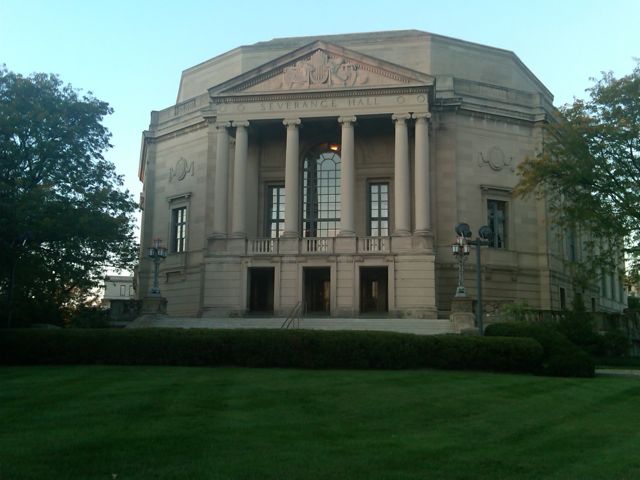
Field Trip: The Severance Package

A visit to the home of the Cleveland Orchestra.
Severance Hall at dusk, from the corner of Euclid Avenue and East Blvd, Cleveland OH.
Photo by the author.
In the interest of expanding my horizons and hearing some really good music this weekend, I took the Greyhound out to Cleveland, OH. The purpose: to attend two concerts at Severance Hall, the legendary home of the Cleveland Orchestra and hear this great band on its home turf.

Severance Hall on Sunday afternoon, set up for a choral performance.
Photo by the author.
When talking about great American orchestras, those unfamiliar with the reputation of this extraordinary ensemble are surprised to hear this Midwest city's orchestra ranked alongside the New York Philharmonic, Boston Symphony Orchestra, even the legendary Philharmonics of Vienna and Berlin. The Cleveland players are a first-class organization, and their home, Severance Hall is one of the finest music venues in North America, if not the world.
Egyptian moifs and red marble dominate the main lobby of Severance Hall,
which is available for weddings. Photo by the author.
Built in 1929 and opened in 1931, Severance (named after the deceased wife of John Severance, who put up the initial multi-million dollar stake for the venue) replaced the Masonic Hall downtown as the main venue of the Cleveland Orchestra.

The building has been renovated, but remains a miracle of Depression-era engineering, a sturdy temple of music picked out in Egyptian motifs. It sits on the western edge of the Case Western Reserve university campus. This relatively isolated location (five miles east of downtown Cleveland) emphasizes the vibe: like a performance at a nobleman's house or a European festival. Wagner would have loved it.
The Szell Shell (above the organ) modifies and brightens the acoustics.
Note the aluminum trim. Photo by the author.
The concert hall itself is picked out in beige, dark wood and aluminum, a new-fangled material in those days. The aluminum filigree on the ceiling and the walls lends a soft, burnished glow as the Orchestra plays. A second venue: Rheinberger Hall is tucked underneath, and is used for chamber music and recording sessions

The organ (left) the timpani, with the ornamental pipes.
They look cool, though. Photo by the author.
In the Hall, organ pipes lend a touch of solemnity to the decor. However, the visible pipes are ornamental, closed off by the special acoustic concert shell added to the venue under music director George Szell. The stage also expands via an old-school elevator system for performances of large-scale works. The elevator can also be lowered to form an orchestra pit, allowing opera to be performed.
Aluminum trim, beige paint, blue seats.
Severance Hall from down in the orchestra seats.
Photo by the author.
Comfortable, blue velour seats and polished, red marble lobby give a feeling of Old World elegance. But the real draw here is the acoustic, crisp, yet warm, capturing the roar of brass or the plaintive tone of bassoons. 

Read the reviews of this weekend's concerts under music director Franz Welser-Möst: 

And then consider a trip out to Cleveland for the real hall of fame where music lives: the amazing Severance Hall.

Sunday, October 9, 2011

Concert Review: Agon and Ecstasy

Stravinsky meets Tchaikovsky at Severance Hall.
Franz Welser-Möst leads the Cleveland Orchestra at Severance Hall.
Photo by Roger Mastroianni © 2010 The Cleveland Orchestra.
The Cleveland Orchestra's Saturday evening subscription concert explored the divide between reason and passion. Two cerebral pieces by  Igor Stravinsky were followed by Tchaikovsky's Fourth Symphony. Music Director Franz Welser-Möst made this program a cogent argument for pairing these very different Russian composers.

The program opened with Stravinsky's Concerto in D, written solely for strings.  This is a concerto in the baroque style, with entire sections offering commentary instead of pitting a soloist against the whole orchestra. It is in the composer's neo-classical  style. Stravinsky creates dialogue between the five sub-sections of the strings. Each principal  player held forth independently, creating a conversation among the strings that made for fascinating listening. Mr. Welser-Möst led the work in his customary, efficient manner.

The Concerto was followed by Agon, the thorniest of Stravinsky's ballet scores. This is an example of Stravinsky's serial style, where music is built from predetermined tone-rows instead of the typical scale. However, Agon is melodic, and its sardonic wit is unmistakeable Stravinsky. The twelve-part work uses the entire orchestra as its palette, calling for solo parts from all four sections and emphasizing some unusual instruments.

Mr. Welser-Möst brought maximum clarity to this work, which had not been heard at Severance Hall in nearly four decades. The orchestra responded brilliantly, as the knotty musical lines untangled themselves and the work coalesced. The brass, asked to make difficult contributions in this work, responded admirably, as did the superb woodwind section.


The Tchaikovsky Fourth finds the composer setting aside naturalism and nationalism for an unyielding exploration of his own psyche. Mr. Welser-Möst tackled the opening movement head-on, opting for a bold, aggressive approach in this famous movement. The blast of brass that opens the work became a strident expression of rage at this fast speed, clashing with the folk-like second theme.

The second movement features a sad oboe theme against the strings that builds to a quiet chorale in the brass. Mr. Welser-Möst slowed the tempo accordingly for this more contemplative music, which featured fine playing from the principal oboe and the English horn. Pizzicato strings led off the Scherzo as the grim mood started to lift in anticipation of the finale.

The last movement brings the struggle to a head, as the violent brass theme from the first movement attempted a comeback. This was ultimately rejected in favor of a more optimistic rising theme, that brought the symphony to a flowing finish. Again, fast tempos were taken, emphasizing the war inside Tchaikovsky's head, one ultimately won by the forces of light.

The enthusiastic reception of this bold Fourth led to a magnificent encore: the slow Prelude to Act III of Die Meistersinger. Reflective playing from the cellos gave way to a hushed choir of horns, creating tones that might have been created on Severance Hall's pipe organ. The Wagner piece ended with a simple, added cadence. This was either a teaser for a future Cleveland Meistersinger, or a measure to prevent playing the full two-hour act.

Trending on Superconductor

Translate

Share My Blog!

Share |

Critical Thinking in the Cheap Seats