Support independent arts journalism by joining our Patreon! Currently $5/month.

About Superconductor

Our motto: "Critical thinking in the cheap seats." Unbiased, honest classical music and opera opinions, occasional obituaries and classical news reporting, since 2007. All written content © 2019 by Paul J. Pelkonen. For more about Superconductor, visit this link. For advertising rates, click this link. Follow us on Facebook.

Thursday, June 20, 2019

Memorial for Paul J. Pelkonen

by Jessie Tannenbaum

"A statue has never been erected in honor of a critic." —Jean Sibelius

A memorial service for Paul J. Pelkonen will be held on Sunday, June 30, at 12:00pm at the Daniel J. Schaefer Funeral Home, 4123 Fourth Ave, Brooklyn, NY 11232. All who loved Paul are welcome. Please, no flowers.

Paul loved small, local opera companies, in particular the Regina Opera Company, based in his neighborhood of Sunset Park. We encourage you to honor Paul's commitment to "critical thinking in the cheap seats" with a donation to Regina Opera Company. Please donate via Paypal (please put "In memory of Paul J. Pelkonen" in the special instructions field) or by check to Regina Opera Company, PO Box 150253, Brooklyn, NY 11215 (please put "In memory of Paul J. Pelkonen" in the memo line). You can visit the Regina Opera Company website for more information about donating.

Thank you to all who have sent kind words and condolences to Emily and to Paul's family and friends. While we have not been able to respond to every message, card, email, and social media comment, your words are deeply appreciated and have brought comfort in this difficult time.

Thursday, June 13, 2019

In Memoriam: Paul J. Pelkonen

by Jessie Tannenbaum

Paul J. Pelkonen
April 12, 1973 – June 12, 2019

It is with great sadness that we announce that Paul Pelkonen died suddenly yesterday of cardiopulmonary arrest, at his home in Brooklyn. Paul lived a life full of joy, and dedicated his life to sharing with others the joy he found in music. We hope that Superconductor brought joy to everyone who reads this.  

Paul and Emily at the Kennedy Center in Washington, DC, Dec. 23, 2018

A lifelong Brooklynite, Paul was a proud alumnus of Stuyvesant High School, Fordham University, and the journalism school at Boston University. The only things he loved more than music were his partner of 14 years, Emily Ravich; their niece Lilo and nephew Bobby; his chosen family and extended family; and his beloved borough of Brooklyn and city of New York. Paul was loved by many and will be deeply missed.

Memorial information will be forthcoming.

Sunday, June 9, 2019

Opera Review: No Escape, No Parole

The Philharmonic unlocks David Lang's prisoner of the state.
by Paul J. Pelkonen
The climactic confrontation of David Lang's prisoner of the state.
Photo by Chris Lee © 2019 The New York Philharmonic,
The New York Philharmonic ended its Lincoln Center season this week with prisoner of the state, a new opera from the pen of contemporary composer David Lang. Mr. Lang, whose unconventional list of stage works include battle hymns (set deep within the bowels of the U.S.S. Intrepid and an opera created entirely from whispers, seemed like an ideal choice for this endeavor. This new opera, co-commissioned with ensembles in five other cities, is an ambitious re-telling of Beethoven's Fidelio. However, unlike many of Mr. Lang's stage works, this production, mounted on a specially built stage in David Geffen Hall, proved itself a serious misfire.

It should have worked. prisoner (the lower case is a Lang trademark) follows the plot of Beethoven's lone opera, a work that composer revised many times until achieving its final form. The story is simple: a wife with a husband in the hoosegow shears off her hair, dresses as a man and helps rescue him from certain death. This new libretto strips out Beethoven's awkward attempts at domestic opera-comedy. It also relieves the characters of their names. Finally Mr. Lang chose a dark "twist" ending worthy of middle-season Game of Thrones. (We'll get to that in the last paragraph.)

Mr. Lang is a fearless, ground-breaking composer, but his choices offer little relief to the listener over 70 minutes, especially if Beethoven's opera is familiar to the listener. This new score is percussive and repetitive, with blasts of bass drum and stark minimalist harmonies. The choral writing is skilled and the male members of the Concert Chorale of New York were on point. These fellas were confined to the acoustically dodgy back line of this house crowded together on a high walkway above the stage. Even in their singing, the optimism of Beethoven has been replaced with something much more astringent.

At Saturday night's performance (the final one of this short run) the strong cast did their best with this stuff. Coloratura soprano Julie Mathevet was a feisty and welcome presence as the Assistant, this opera's light-voiced substitute for Beethoven's dramatic heroine. She sings with alacrity and energy but was not allowed in the tight time frame to develop much as an interesting character. Eric Owens was in excellent voice Saturday night, and his dark heavy portrayal of the Jailer reminded viewers that people who work in corrections are locked up along with their charges every day. He was flanked by a chorus of four menacing guards, stacking the odds.

As the Prisoner himself, baritone Jarrett Ott had to sing his first lines, Salome like from a specially built well beneath the acting surface. He did a decent job of appearing tired and emaciated but his warm tone and burly presence were at clear odds with the character's plight. As The Governor, the opera's villain, tenor Alan Oke gleefully chewed scenery and sang with piercing force into an obvious head mic. He was draped in a purple greatcoat uniform that made him look as if the Joker had gotten a job as a hotel doorman.

The show looked great (the design is by Matt Saunders)  aside from the lighting designer's (Theatermachine) occasional decision to shine high-powered theater pieces right into the eyes of the audience. The orchestra was divided in two, to make a lane for the actors. The chorus, in chrome shackles and sodium-yellow jumpsuits (they looked like the "Kiln" prison outfits in Guardians of the Galaxy) looked appropriately oppressed. Their population was swollen with black and white film of more prisoners, suggesting a vast correctional facility with a large and seething population, ready to burst into riot at any moment.

At the climax of the work, the Assistant reveals herself and draws a gun just as the Governor is going to murder her husband. The trumpets sound offstage. The inspectors have arrived. And then the bad guy calmly takes the Assistant's gun away, delicately slipping it into the pocket of his purple greatcoat. All the characters, the now-uncuffed Prisoner included, sing at the audience about how all of us in the world are in shackles, it's just that some of them are more visible than others. This ending, (or lack of one) may reflect the problems of a world that uses private incarceration, torture and hidden "black prisons" to make its population feel safe and secure. In this "Shawshank," there was no redemption for anyone.

Become a Patron!
Superconductor is free for everyone to read but it does cost money to produce. If you enjoyed this article, it's time to click over to Superconductor's Patreon page, and help support the cost of independent music journalism in New York City. Our Patreon program starts at the low cost of just $5 per month, less than a fancy cup of coffee in this town.

Saturday, June 8, 2019

Concert Review: The Follies of Youth

The Philadelphia Orchestra at Carnegie Hall.
by Paul J. Pelkonen
Beatrice Rana onstage at Carnegie Hall with members of the Philadelphia Orchestra in the background.
Photo by Paul Vincent. 
Yannick Nézet-Séguin and the Philadelphia Orchestra returned to Carnegie Hall on Friday night for the last of their appearances this season. For this program, Mr. Nézet-Séguin chose a pair of mostly forgotten and badly neglected early works by prominent Russian composers Igor Stravinsky and Sergei Rachmaninoff. These Russian rarities flanked the more familiar Third Piano Concerto by Serge Prokofiev with soloist Beatrice Rana.

Friday, June 7, 2019

Concert Review: Take Me to Church

Bernard Labadie unveils his visionary OSL Bach Festival.
by Paul J. Pelkonen
Bernard Labadie (right) leads the new Orchestra of St. Luke's Bach Festival.
Photo by Dario Acosta.
"Tonight, we are in church." These words were spoken by Orchestra of St. Luke's president James Roe as he introduced Thursday night's program, Music of the Spirit, at Zankel Hall, the subterranean mid-sized venue that is part of the Carnegie Hall building. Bach was a man of deep religious conviction but the bulk of his church music, (aside from the major choral works like the Passions and the Mass in B minor) remains unknown to the casual listener. With this concert, the first night of a new month-long Bach festival by the Orchestra, the goal is to correct that oversight.

Pitchforked

The Met tones down La Damnation de Faust.
by Paul J. Pelkonen
Susan Graham (left) and Marcello Giordani (right) in a tender moment from
the Met's 2008 staging of La Damnation de Faust. Photo by Ken Howard © 2008 The Metropolitan Opera.
If you were planning  on seeing the Metropolitan Opera's unique and visually mind-blowing production of Berlioz' La Damnation de Faust next season, you are out of luck. In an e-mail sent to subscribers (and obtained by Superconductor) the Met has announced that the company's presentations of the hybrid opera-oratorio will not be seen in its staging as originally envisioned by director Robert Lepage. The remainder will be mounted as concert performances in the vast opera house. Also, there will be just four shows, as three of the performances are cancelled.

Wednesday, June 5, 2019

Opera Review: The Queen of Underland

Dido and Aeneas are laid in earth.
by Paul J. Pelkonen
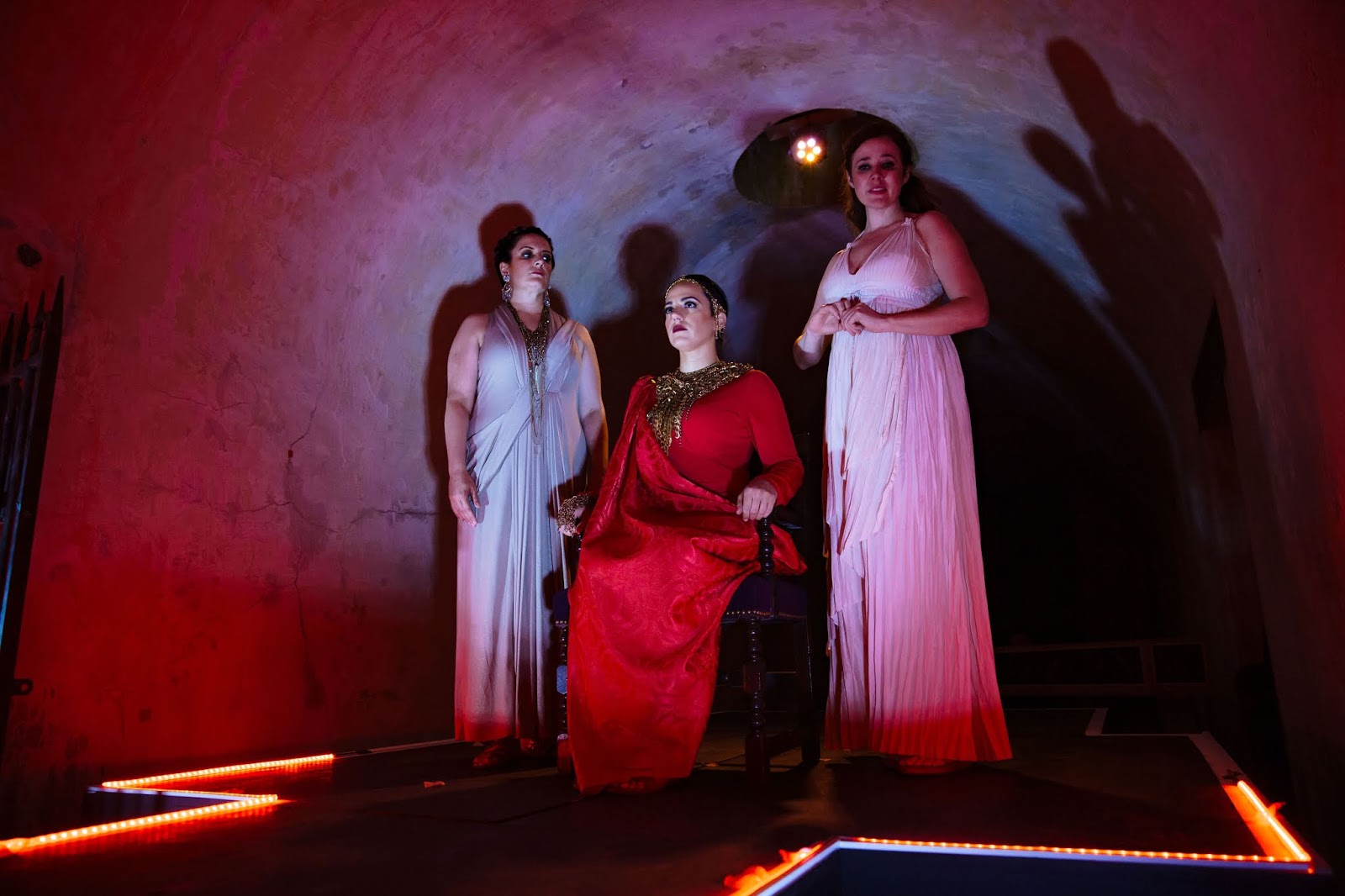
The nocturnal court of Carthage: Dido (Danela Mack) flanked by her handmaidens.
Photo by Kevin Condon for The Death of Classical.
When it comes to performing operas in innovative locations, it is hard to beat the catacombs deep within Brooklyn's Green-Wood Cemetery. Last night, before a packed house, The Angels' Share offered the premiere of its season-opening staging of Dido and Aeneas. Written by Henry Purcell in 1688, this is the oldest English-language opera to have a place in the repertory.

Tuesday, June 4, 2019

Concert Review: The Ignition Sequence

Yannick Nézet-Séguin leads the MET Orchestra at Carnegie Hall.
by Paul J. Pelkonen

There comes a time in the career of an opera singer where, through either good fortune or exceptional skill, they rise from the ranks of the roster and ignite as a genuine operatic star. For the  Isabel Leonard, 2018-19 at the Metropolitan Opera was that year, where the mezzo-soprano rose to the occasion in three major roles: Marnie, Melisande and Sister Blanche in Dialogues des Carmelites. On Monday night, Ms. Leonard capped a season which featured performances as Marnie, Melisande and Sister Blanche with a performance at Carnegie Hall, accompanied by the MET Orchestra under music director Yannick Nézet-Séguin.

Monday, June 3, 2019

Opera Review: They Could Be Royals

Amore Opera throws Verdi's Masked Ball.
by Paul J. Pelkonen

A throne of games: Tenor José Heredia (center, prone) dies at the end of Un ballo in Maschera/
hoto by Ashley Becker © 2019 Amore Opera.
The Amore Opera ended its tenth season on Sunday afternoon with a performance of Un Ballo in Maschera. Of Verdi's mature operas, Ballo is unique. It is closer to French comic opera in style than anything else the composer wrote, even if it follows the musical conventions of Italian opera with only a sprinkling of French flavor in its score. The text is in Italian, and the musical style is late Verdi, with an almost-Wagnerian use of repeated themes attached to its characters. Although it has a tragic ending, there is am airy lightness to the music and the stage action, which frames a simple love triangle against a wrenching political assassination.

Sunday, June 2, 2019

Concert Review: The Harrowing

The New York Philharmonic revives John Corigliano's Symphony No. 1.
by Paul J. Pelkonen
Composer John Cortigiano: his Symphony No. 1 was played at the New York Philharmonic
for the first time in 27 years. Photo © Sony Classical.
The New York Philharmonic is in the middle round of “Music of Conscience,” a season-ending three-week festival celebrating works written with the purpose of correcting great social injustices. This week featured the very necessary return of John Corigliano’s Symphony No. 1, subtitled Of Rage and Remembrance. Commissioned by the Chicago Symphony Orchestra and last heard at the Philharmonic in 1992, this is a a powerful three-movement cenotaph in sound, dedicated to the memory of the thousands of Americans cut down by the AIDS crisis and the government’s cruel indifference.

Saturday, June 1, 2019

Recordings Review: The World's Strongest Man

Marek Janowski's second take on Siegfried.
by Paul J. Pelkonen
What mutters most: Stephen Gould in Siegfried.
Photo by Michael Pöhl © Vienna State Opera.
Starting in 1958, the Decca engineer John Culshaw and his team of technicians took six years to record all four parts of Wagner's Ring cycle in a converted ball room in Vienna. By contrast the conductor Marek Janowski and the Berlin Radio Symphony Orchestra moved on to Siegfried, the third part of the cycle with astonishing speed. This recording was made in March of 2013, just five months after the same forces made their Die Walküre. Its release as the penultimate chapter in both the Ring and the conductor's survey of the ten Wagner operas is a marvel of efficiency, as is the label's decision to lower costs by squeezing the opera onto three discs. As before, Mr. Janowski made a live recording (on March 1, 2013) in the Berlin Philharmonie, the storied and pentagonal hall that is home to the Berlin Philharmonic.

Friday, May 31, 2019

Recordings Review: Dark Wings, Dark Words

Marek Janowski's Berlin Die Walküre.
by Paul J. Pelkonen

Fraternization: Melanie Diener and Robert Dean Smith in Die Walküre.
Photo © PentaTone Recordings, courtesy Naxos Classics.


This Die Walküre was recorded in one day (November 24, 2012) at the Berlin Philharmonie. The second part of Marek Janowski's second complete Ring Cycle, it is a searing, exciting performance that has all the benefits of a live recording, within controlled conditions that are similar to the studio environment. The sound is sweeping and crystal clear, swooping through the stereo sound-picture like a host of warrior maidens on flying horseback.

Thursday, May 30, 2019

Recordings Review: Meet the New Gods

Marek Janowski records his second Das Rheingold.
by Paul J. Pelkonen
Second time around: Marek Janowski conducted his second recording of the Ring 
in Berlin. Photo by Felix Bored for PentaTone.
(Note: This is an updated version of a 2013 Superconductor review, republished in advance of coming reviews of the rest of the cycle in the next week.)

Any recording of Das Rheingold, the "preliminary evening" to Wagner's mighty tetralogy Der Ring des Nibelungen must, in the course of review be compared to the classic Decca recording made in 1958 with Georg Solti and the Vienna Philharmonic. So let's do that first. No, this new recording from Marek Janowski and the Berlin Radio Symphony Orchestra  (released in 2013 on the PentaTone label) doesn't have much similarity to the Solti. Nor is it the "new standard", "the best" or even the "best-sounding" recording of this four-scene prelude to the main action of the Ring. However, as a document capturing some interesting young artists and a snapshot of the current state of international Wagner singing, it certainly has value.

Wednesday, May 29, 2019

Concert Review: Music of (Easy) Conscience

The New York Philharmonic opens a three-week festival to end its season.
by Paul J. Pelkonen
Conductor Jaap van Zweden leading the New York Philharmonic.
Photo by Chris Lee © 2019 The New York Philharmonic.
The New York Philharmonic is in the endgame of its spring 2019 season, the orchestra's first with Jaap van Zweden as its music director. That endgame is a three week festival dedicated to "music of conscience". This loose aggregation covers symphonies and a new opera by David Lang in the coming weeks, with the connection between works being the creation of music at times of great social and political storm and stress. On Tuesday night, Mr. van Zweden led the last concert of the first program of the festival pairing pieces by Beethoven and Shostakovich. Though these two men lived in very different times and political climates, each work had the benefit of being readily familiar to even the most conservative members of the audience.

Monday, May 27, 2019

Charred Meat, Pot Stills and (oh yeah) Classical Music

Burgers, Bourbon and Beethoven opens the summer festival season.
by Paul J. Pelkonen
Outdoor hors d'oeuvre: a string trio plays Mozart in Green-Wood Cemetery.
The summer classical music season got off to its official start this weekend in the most unlikely of locations. On Saturday night, The Death of Classical, an organization dedicated to performing great music works in the realms of the dead, launched the second season of its Angel's Share series in Green-Wood Cemetery. That sprawling Brooklyn necropolis was the site for Burgers, Bourbon and Beethoven: part cookout, part whisky tasting and part concert. The event was the three-headed brainchild of Andrew Ousley, concert promoter, music publicist and man about town. (He also founded The Death of Classical which puts on The Crypt Sessions in Harlem as well as The Angel's Share.)

Thursday, May 23, 2019

Concert Review: Two Tickets, No Paradise

Gianandrea Noseda conducts at Carnegie Hall.
by Paul J. Pelkonen
Gianandrea Noseda. Photo © 2017 Fondazione Teatro Regio di Torino.
The Carnegie Hall calendar is released every year in the final week of January, but not everything on that august and immense document comes to fruition. The concert originally planned for this Sunday would have featured Gianandrea Noseda conducting Verdi’s grand opera  I Vespri Siciliani in its five-act entirety with the Teatro Regio di Torino. Its substitute: a two part choral concert with Mr. Noseda leading the National Symphony Orchestra, who are based in Washington D.C. at the Kennedy Center.

Tuesday, May 21, 2019

Concert Review: Slip-Slidin' Away

Valery Gergiev and Daniil Trifonov return to Carnegie Hall.
by Paul J. Pelkonen
And carry a small stick: Valery Gergiev.
Photo © 2017 Munich Philharmonic Orchestra.
Six years and some months ago, the pianist Daniil Trifonov made his debut at Carnegie Hall. On Saturday night, Mr. Trifonov re-teamed with Valery Gergiev, now at the helm of the MET Orchestra. Mr. Gergiev spent many years as a principal guest conductor at the Metropolitan Opera, and one assumes that the players remain familiar with his eccentric conducting style. This was the first of three scheduled spring concerts by New York's greatest opera orchestra, an annual tradition at this venue following the end of the opera season.

Sunday, May 19, 2019

Opera Review: Her Dark Materials

On Site Opera presents Murasaki's Moon.
by Paul J. Pelkonen
Another bad creation Genji (Martin Bakari) and his maker, the Lady Murasaki (Kristen Choi.)
Photo by Stephanie Berger for On Side Opera © The Metropolitan Museum of Art.
On Site Opera, Eric Einhorn's company that mounts interesting operas in extraordinary places. This week, the company presented the world premiere of Murasaki's Moon, commissioned by the Metropolitan Museum of Art and mounted in that august institution's Astor Court, a Chinese-themed meditative space hidden in the northeast corner of the second floor of the museum's main building. (If you want to visit, it's Galleries 217 and 218.) This writer attended the first of two performances on Saturday, the third of a six show run that wrapped Sunday afternoon.

Friday, May 17, 2019

Concert Review: The Messiah Complex

Evgeny Kissin returns to Carnegie Hall.
by Paul J. Pelkonen
The chosen one, at the controls. Evgeny Kissing at Carnegie Hall.
Photo by Steve J. Sherman.
"Oh my God," the woman said. "He's amazing! He's like the Chosen One!"

Everybody loves a good salvation story, which might be why the above was said about Evgeny Kissin at intermission (right next to my seat) at last night's Carnegie Hall concert.. The storied Russian pianist made his yearly visit to the historic venue with an intelligently constructed program, dovetailing neatly between the development of music for his instrument in the 19th and 20th centuries. As the recital was sold out, Carnegie Hall added seating on the Perelman Stage, both behind and to the left of the artist as he played.

Thursday, May 16, 2019

Opera Review: Burn This

Regina Opera roars back with Il Trovatore.
by Paul J. Pelkonen
Manrico, the troubador,  Christopher Trapani (above) finds Leonora (Alexis Cregger, below) who has taken poison rather than marry the Count DiLuna. Photo by Stephen Pisano for Regina Opera.
When putting on Verdi's Il Trovatore, it is very difficult to get the balance right.  On Saturday afternoon at the first of four performances, Brooklyn's Regina Opera company struck the correct balance between dramatic energy and vocal heroics, in a performance that proves that young voices do indeed grow in the heart of Brooklyn. This was the final production of the current Regina season (their 48th) in a detailed staging by Linda Lehr that pleased traditionalists while sacrificing none of the opera's dramatic edge.

Trending on Superconductor

Translate

Share My Blog!

Share |

Critical Thinking in the Cheap Seats