

 |
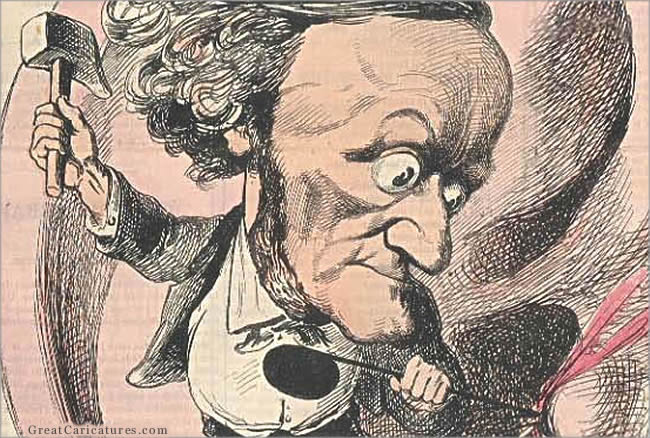
| Richard Wagner, doing what he did best. Drawing by Andre Gill from the cover of L'Eclipse © 1868. Image from GreatCaracitures.com |
In the decades before the Internet took over our lives, there were more books written about Wagner than about any other composer. Hell, the only two people who have more room in the Dewey Decimal System are Jesus Christ and Adolf Hitler.
Sorting out the good Wagner books from the bad is a daunting task. Here's a quick guide to five good books about the Meister of Bayreuth, from easy and entertaining to advanced and geeky.
Note: Wagner's many volumes
 of self-serving, bloated
 prose writing
 is not on the list. In fact it might be the WORST place you could possibly start. Don't say I didn't warn you....
Wagner Without Fear by William Berger
Mr. Berger's first book delves right into the nuts and bolts for the novice Wagnerian. He includes biographical details from Wagner's eventful life, breaks down the complex plots of the operas, and makes the music an engaging, living force. And it's a fun, entertaining read that never condescends to the novice Wagner geek.
You do not have to read music to understand this level of harmonic analysis, but this book is also a good place to start learning about the complex leitmotif system employed by Wagner. More on that in a bit.
Ring Resounding
 by John Culshaw
The late John Culshaw produced the sessions that led to the first studio recording of The Ring, under the
baton of Georg Solti. Setting his story in Vienna from 1958 to 1964, Mr. Culshaw goes into some detail about the sessions that birthed the Ring, which remains the best-selling classical box set of all time.
Ring Resounding is stuffed with dry, funny prose about the complexities of renting anvils, building thunder machines, and making sure the Vienna Philharmonic horns "played like Gods." (Hint: beer was involved.) A great opera book if you're trying to understand why people like opera recordings so much and why the Solti Ring is everyone's first choice.
Bayreuth: A History of the Wagner Festival by Frederic Spotts
An honest, by-the-numbers account of the history of the Bayreuth Festival, the annual celebration of Wagner at the German opera house designed and built by the man himself. Mr. Spotts' book goes into some detail about the various productions at the Festspielhaus.
He tells the Bayreuth story up until the mid-1990s, before family squabbles about the successor to Wolfgang Wagner resulted in a lot of press and a lot more books on Bayreuth. This was the first in English, and remains the best. I think my favorite thing about it is the use of quotes from the operas for the chapter titles. For example, the section on the Nazis is called "Thus evil enters this house."
The Wagner Operas by Ernest Newman
A big, thick book, this is an essential guide to learning the leitmotiv system that Wagner used to weave the score of his operas, including the Ring. Newman was an important British music critic, and his archaic, early 20th century prose style includes unfortunate use of the word "ejaculation" to describe brass playing. His musical analysis is sound, and his guide to the motivs is reliable, even though he slaps weird names on them as you get deep into Siegfried.
I Saw the World End by Deryck Cooke
The "unfinished symphony" of Wagner books. Deryck Cooke died before he could write the second half of this monumental analysis with a very cool title. The book only covers Das Rheingold and Die Walküre. But the wealth of mythological explanation and exhaustive detail make Cooke an essential read for the dedicated Wagnerite.
Cooke goes back to the beginning and examines each of the seven major sources that went into the forging of the Ring and how Wagner transmuted the myths to create the four librettos. Ever wonder why Mime the dwarf shows up in Rheingold and then becomes Siegfried's foster-father in the opera of the same title? This is the book to answer questions like that.
....and one more....
Rhinegold by Stephan Grundy
Yes, this is a fantasy novel in the vein of J.R.R. Tolkien or Marion Zimmer Bradley's The Mists of Avalon. Rhinegold was written by Dr. Grundy, an expert in German mythology, who decided to explore the source material used by Wagner in the Ring. He re-tells the stories of the old sagas in a hyper-violent comic-book style, pulling no punches when it comes to blood, gore, and Valkyries.
All that said, it's cool to read a book where Sigifrith, Brunnhilde, and Hagen are the main characters. Even better, the book goes beyond Siegfried's death and explores what happens later on in the Nibelunglied
 and more importantly, who winds up with the treasure....


 by J. Merrill Knapp
 ;
;  ;
;  by William Berger
 by Alex Ross


