Support independent arts journalism by joining our Patreon! Currently $5/month.

About Superconductor

Our motto: "Critical thinking in the cheap seats." Unbiased, honest classical music and opera opinions, occasional obituaries and classical news reporting, since 2007. All written content © 2019 by Paul J. Pelkonen. For more about Superconductor, visit this link. For advertising rates, click this link. Follow us on Facebook.
Showing posts with label Salonen. Show all posts

Sunday, April 1, 2012

Concert Review: Surfing on Modern Waves

Esa-Pekka Salonen conducts the Philadelphia Orchestra.
by Paul Pelkonen
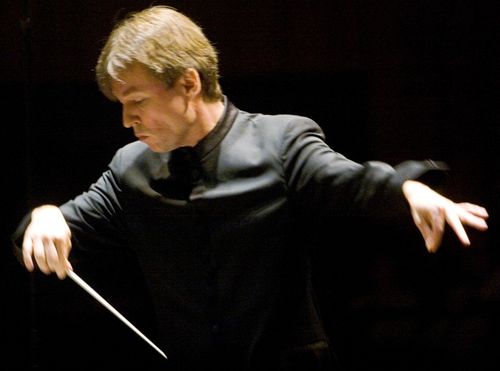
Conductor and composer Esa-Pekka Salonen in flight.
In a music industry where pianists and violinists find themselves leading symphony orchestras, the Finnish composer-conductor Esa-Pekka Salonen is an anomaly. A successful composer, he picked up the baton and started leading concerts in order to get his own music performed.

Mr. Salonen led the Philadelphia Orchestra at the Kimmel Center this weekend, in a program that featured the first Philadelphia performances of his own Violin Concerto with soloist Leila Josefowicz. This work was flanked by familiar works by Bartók and Debussy. The entire program had a spare, European elegance that matched its leader perfectly.

The concert opened with Bartók's Music for Strings, Percussion and Celesta. Conducting the twin string sections, playing them off against each other antiphonally, Mr. Salonen relied on minute gestures of the stick and encouragement from his left hand. The first movement was grim and weighted, developing from a slow fugue that recalls the late writing of Beethoven.

The Philadelphians played this complex opening with a deep, serious tone, before the percussion and piano joined the ensemble in the energetic dances of the second movement. A lengthy xylophone solo, carefully cued by Mr. Salonen, led off the dusky third. That instrument discoursed throughout this slow movement. The fourth moved lightly through Bartók's folk-song inspired dances, lifting to a bold, stirring climax.

Mr. Salonen's own violin concerto was written for Ms. Josefowicz in 2008. This is a narrative work, with the violinist as an athletic, constantly moving protagonist against a pulsing orchestra that alternates between singing and swinging. The opening bars pit the solo instrument against a texture of ancient Chinese gongs, ghostly and hollow. Mr. Salonen's expanded orchestra provided a silky texture in the second movement. 

The third stands in contrast, a vision of hot jazz and urban nightlife with heavy lifting for the soloist. At one point, Ms. Josefowicz duelled with a full drum set, scragging multiple horse-hairs from her bow as she played the fast string figurations. The finale is slow and reflective, rising to deep, emotive perorations before resolving the work in an unusual final chord.

Mr. Salonen took an unusually fast tempo for the opening movement of La Mer, the set of three "symphonic sketches" that stands as one of Claude Debussy's most impressive orchestral achievements. This was a sea rough and ready in its play, with the big climax seeming to float out of the horns, supported by the lapping strings and darting oboe and clarinet. 

The quicksilver tempos continued in the next two movements. Mr. Salonen and the experienced orchestra were perfectly matched, delivering a playful, but not bombastic performance of a work which is in this ensemble's musical DNA. The second movement flowed with dappled light and the spray of salt, conducted with brisk, efficient precision.

The conductor brought the the final dialogue of wind and waves to its final climactic surge, drawing a thunderous sound out of the rich brass and strings. As the house applauded and he walked offstage, Mr. Salonen's hands were still moving, riding the waves of sound that he helped create.  

Monday, November 7, 2011

Concert Review: Taking on the Titans

The Atlanta Symphony Orchestra at Carnegie Hall
Mr. Congenial: Garrick Ohlsson returned to Carnegie Hall
as soloist with the Atlanta Symphony Orchestra.
Robert Spano brought the Atlanta Symphony Orchestra to Carnegie Hall on Saturday night with a challenging program featuring new music from composer/conductor Esa-Pekka Salonen, followed by two works by Scriabin and Rachmaninoff. These late Russian Romantics, while very different musically, were classmates at the same conservatory.

The concert opened with the New York premiere of Nyx a large-scale orchestral work. Mr. Salonen wove a complex, yet clear fabric from gleaming melodic threads. The clarinet and horns tossed the main theme back and forth over a roil of sound. The music became menacing and monolithic, with bold brass writing and innovative percussion making a rich sonic experience. Predictably, it was met with polite applause. 

Although Scriabin's Poem of Ecstasy premiered in New York in 1908, it remains an obscure example of late Russian romanticism. Scriabin used an unusual harmonic language in this late piece. By choosing to substitute the dissonant interval of a harmonic fourth for the usual, more tonal fifth, he created a dissonant sound-world, very much his own.

This challenging score was presented with playing of the highest caliber. Concertmaster David Coucheron unleashed the shimmering first theme, answered by a clarion call in the expanded brass section. The eight horns formed a phalanx in the orchestra, leading the charge up the score's dizzying heights. Robert Spano drove the work home, bringing in the tuba and organ to anchor an orgiastic swirl of sound. The meaning of the work may have died with Scriabin, but its impact was deeply felt.

The audience seemed happier about the second half of the program: Rachmaninoff's familiar, though fearsomely difficult Piano Concerto No. 3, featuring soloist Garrick Ohlsson. Its three movements are like that old Atari game "Pitfall!"--one wrong move and the soloist will never be heard from again.
Pitfall Harry (on rope, right) may well have understood the dangers of playing Rachmaninoff.
Image from the video game Pitfall! © 1982 Activision.
It's true that Rachmaninoff wrote the concerto for himself to play on tour and was possessed with freakishly big hands that (legend has it) could stretch a twelfth (that's an octave and a half) on the keyboard. But what makes this concerto so difficult is the interwoven nature of its writing. The conductor does more than just accompany a pretty melody--he and the orchestra get into a complicated dialogue with the soloist that sometimes verges on argument. It also calls for fearsome precision among all those trills, keyboard runs and hand-crossings, pointillist playing at full forte.

Mr. Ohlsson and Mr. Spano made a congenial team, solving the concerto's problems as they unfolded its secrets. The first movement's complicated cadenzas (where the pianist takes on the role of both orchestra and soloist, an idea first developed by the composer Alkan) held the audience breathless. The slow Intermezzo sang a sad Russian song. And the pell-mell finale, calling for the greatest degree of virtuosity from the pianist proved a thrilling experience.

After a tumultuous reception from the audience, Mr. Ohlsson returned to the keyboard. Turning to the house, he announced: "This is too famous for an introduction." Then he played a slow, loving Clair de Lune from Debussy's Suite Bergamesque. It was the perfect contrast to the Rachmaninoff, and an ideal way to end the evening.

Trending on Superconductor

Translate

Share My Blog!

Share |

Critical Thinking in the Cheap Seats