Support independent arts journalism by joining our Patreon! Currently $5/month.

About Superconductor

Our motto: "Critical thinking in the cheap seats." Unbiased, honest classical music and opera opinions, occasional obituaries and classical news reporting, since 2007. All written content © 2019 by Paul J. Pelkonen. For more about Superconductor, visit this link. For advertising rates, click this link. Follow us on Facebook.
Showing posts with label anne-sophie mutter. Show all posts

Wednesday, April 29, 2015

Concert Review: To Seek a Newer World

The New World Symphony plays Carnegie Hall.
by Paul J. Pelkonen
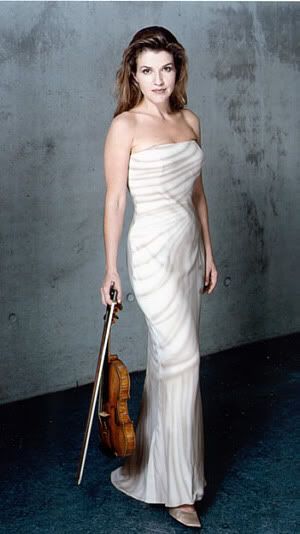
Anne-Sophie Mutter.
Photo by Lillian Birnbaum for DG/UMG
Tuesday night at Carnegie Hall featured a rare New York appearance by the New World Symphony, the Miami-based training orchestra that has given that Florida city fresh musical life. Led by founder and artistic director Michael Tilson Thomas, the NWO played an eclectic program centered around solo violinist Anne-Sophie Mutter. The German violinist, celebrating 35 years as an international touring virtuoso is one of this season's Perspectives artists at Carnegie.

Thursday, February 12, 2015

Concert Review: The Ghost of Conductors Past

The Danish National Symphony Orchestra plays Carnegie Hall.
by Paul J. Pelkonen
The conductor Cristian Măcelaru made his Carnegie Hall debut Wednesday night.
Photo by David Swanson for Primo Artists Management.
Wednesday night's concert by the Danish National Symphony Orchestra was more than just a opportunity to hear this fine Copenhagen-based ensemble play the music of Carl Nielsen and Jean Sibelius. It became a tribute to the orchestra's late music director Rafael Frühbeck de Burgos, who died last summer. His substitute was Romanian conductor Cristian Măcelaru, an enthusiastic member of the new generation of maestros making his Carnegie Hall debut.

Thursday, October 2, 2014

Concert Review: The End is the Beginning

Anne-Sophie Mutter and the Berlin Philharmonic open Carnegie Hall.
by Paul J. Pelkonen
Anne-Sophie Mutter, 2014-15 Carnegie Hall Perspectives Artist
played at opening night. Photo by Harald Hoffmann for Deutsche Grammophon.
© 2014 Universal Classics/UMG
The opening of Carnegie Hall is always a festive occasion, with red carpet laid down under the famous portico on W. 57th St., a black-tie crowd and this year, a gala dinner on the Hall's new grassy roof deck. However, the main attraction this year was that the season was opening with the Berlin Philharmonic, in town for a week of concerts, a residency that will launch not only this year's Carnegie season but Lincoln Center's own White Light Festival next week.

Friday, June 3, 2011

Concert Review: Back For the Future

NY Philharmonic Returns, with New Music and rare Bruckner.

Woman in White: Anne-Sophie Mutter and friend.
The New York Philharmonic has returned from its European tour to kick off four weeks of concerts at its home base of Avery Fisher Hall. On Friday afternoon, the orchestra offered an unusual program featuring Time Machines, a new piece by Sebastian Currier, commissioned by artist-in-residence Anne-Sophie Mutter. The new work was flanked by a rare Beethoven trifle, and a Bruckner symphony that the orchestra hadn't performed live in 40 years.

Written in 2007 but shelved until this week, Time Machines is not a memorable piece. It is another installment of Ms. Mutter's ongoing (and commendable) quest, as she seeks to expand the repertory of her instrument. Over seven movements, Mr. Currier establishes a call-and-response between the soloist and orchestra, exploring different rhythmic approaches and concepts of time. Ms. Mutter opened the first movement with growled, staccato chords, a repeated ostinato which was answered by the orchestra strings.

The major themes of the opening were expanded upon and repeated in the movements that followed, giving listeners a sensation of traveling backwards in time, with room to move for Ms. Mutter's instrument against a shifting curtain of strings, wind, and odd percussion. There were slow, soothing minimalist passages (entropic time) alternating with frantic fast sections (compressed time.) The most impressive section: backwards time, with inversions and retrogrades of the original thematic material, adding to the sensation of time running backward.

The concert opened with Beethoven's first Romance for Violin and Orchestra, featuring the talents of Philharmonic artist-in-residence Anne-Sophie Mutter. Clad in a spectacular scarlet sheath and wielding her bow with authority, Ms. Mutter captured the lovely lyricism that one associated with Beethoven's work, illustrating how this admittedly minor piece points the way to the heights of the composer's lone violin concerto.

The Philharmonic waited four decades to bring back Anton Bruckner's underrated Second Symphony, a taut, powerful work that excels and surprises, precisely because it lacks the sheer orchestral overkill associated with this Austrian composer. On the podium, music director Alan Gilbert made Bruckner's characteristic rhythms (one-two, one-two-THREE) snap, showing the crisp architecture and tight structures present in the music of a composer who remains misunderstood today.

The Second falls into Bruckner's early period, and (through some complicated numbering issues) is actually his fourth, possibly fifth effort in the genre that he made his life's work. It stands as a bridge between the symphonies of Beethoven and Schubert and the giant structures of sound that the composer worked on at the end of his life. Known (for lack of a better nickname) as the "Symphony of Pauses," the work frequently stops for a full rest, and then picks up the theme from its beginning, restating it in what is essentially a hybrid between a theme-and-variations and traditional sonata form.

The performance featured some beautiful playing from four of the Philharmonic horns, led by principal Philip Myers. The English horn made an important contribution in the slow movement. The trio of the rousing Scherzo (based on the Ländler, a curious Austrian peasant dance that was a Bruckner favorite) featured a gorgeous solo from violist Cynthia Phelps. And the mighty final movement was the sum total of Mr. Gilbert's abilities at keeping a large structure of music intact, making the work rise consistently to its thrilling, thundering climax.

Saturday, March 1, 2008

Twelve Is the Magic Number

Self-portrait in blue by Arnold Schoenberg
© The Arnold Schoenberg Foundation
Arnold Schoenberg and the Birth of Serialism.
by Paul Pelkonen.
One hundred years ago, Arnold Schoenberg took the "rule book" of music, and blew it to smithereens. Schoenberg started out as a late example of the post-Romantic sound, writing gorgeous tone poems (among them, Verklaerte Nacht) for huge orchestral forces. His biggest work, the choral cycle Gurrelieder requires a small army of musicians. But, faced with a musical dead end, Schoenberg struck a different path and changed music forever.


With the premiere of the song cycle Pierrot Lunaire, Schoenberg created a new system that inspired composers in the 20th century to push the envelope and change the way music sounded. He fused the chromaticism of Richard Wagner with the post-classical complexities of Johannes Brahms, Schoenberg wrote music that was atonal (without tonality or a fixed key). Eventually, Schoenberg developed the twelve-tone system.Schoenberg, and his two famous students (Anton Webern and Alban Berg) are referred to as the Second Viennese School.

Here's how it works. Take a 12-note scale starting with C:


C-C#-D-E♭-E-F-F#-G-A♭-A-B♭-B

Now, instead of that "normal" order, the composer takes the twelve tones and rearranges them to create a note row in any order he wishes. Sometimes, the note rows are based on strict mathematics. Sometimes, they are just the composer's own arrangement. Here's an example.


F-C-B♭-D-A-E♭-B-G-F#-A♭-E-C#

(This is not an actual note-row, just a hypothetical) This new tone row can then be played retrograde (backward), inverted) upside-down or in other permutations. The composer can also organize or "serialize" the rests between the notes, the intervals, or any other aspect of the composition that can be thought of. All these techniques together are known as serialism.

The idea of "atonal" or "serial" music can intimidate the first-time listener. Once the ears adjust to the fact that this music is not following the "traditional" mold, new sonic possibilities open up. Schoenberg, and his two famous students Alban Berg and Anton Webern are among the most important composers in the repertory.

To start exploring, check out these recordings:

Schoenberg: Piano Works, Maurizio Pollini, Piano
Verklaerte Nacht, Pelleas et Melisande, Philharmonia Orchestra, cond. Giuseppe Sinopoli (Deutsche Grammophon)

The Pollini disc is an essential one-disc survey of Schoenberg's complex, spidery piano works. It was recently reissued as part of DG's Maurizio Pollini Edition. Top-notch playing, and crystalline sound. Next, check out Schoenberg's early, post-romantic period, try the excellent Philharmonia Orchestra recordings of the composer's two major tone poems. The late Giuseppe Sinopoli conducts.

Berg: Violin Concerto, Anne-Sophie Mutter, Violin, Chicago Symphony Orchestra, cond. James Levine (Deutsche Grammophon)
Berg's concerto, written in 1935 and dedicated "To the Memory of an Angel" is one of the composer's most emotional, yet accessible works. Of the many fine recordings in the catalogue, this one leads the pack. The disc also includes Time Chant by contemporary German composer Wolfgang Rihm. The Mutter recording of the Concerto is also available on the 8-disc "Alban Berg Collection" box set, which includes most of the composer's major compositions, including the operas Lulu and Wozzeck.

Boulez Conducts Webern, Vols. 1-3 Various singers and ensembles, cond. Pierre Boulez (Deutsche Grammophon)
One of the most important composers of the 20th century in his own right, Pierre Boulez recorded the complete works of Webern twice, once for Sony and later for Deutsche Grammophon. The DG recordings are preferable. Instead of getting the three individual Volumes, you can pick up the six-disc Complete Webern box set which gives you the Emerson String Quartet's recordings of Webern's chamber music.


Contact the author: E-mail Superconductor editor Paul Pelkonen.

Trending on Superconductor

Translate

Share My Blog!

Share |

Critical Thinking in the Cheap Seats