Support independent arts journalism by joining our Patreon! Currently $5/month.

About Superconductor

Our motto: "Critical thinking in the cheap seats." Unbiased, honest classical music and opera opinions, occasional obituaries and classical news reporting, since 2007. All written content © 2019 by Paul J. Pelkonen. For more about Superconductor, visit this link. For advertising rates, click this link. Follow us on Facebook.
Showing posts with label anna bolena. Show all posts

Wednesday, January 20, 2016

Metropolitan Opera Preview: Maria Stuarda

Sondra Radvanovsky goes back to the chopping block.
by Paul J. Pelkonen
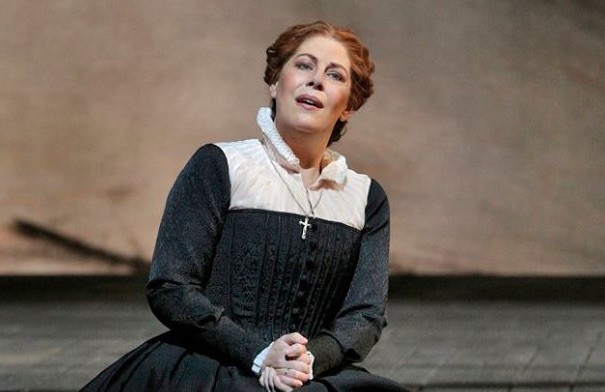
Waiting for axeman: Sondra Radvanovsky as Mary, Queen of Scots in Maria Stuarda.
Photo by Ken Howard  © 2016 The Metropolitan Opera.
All New York opera lovers hail the queen as Sondra Radvanovsky sings the title role of Mary, Queen of Scots in Maria Stuarda, the second of Donizetti's three operas depicting the stormy history of England under Henry VIII and his daughter Elizabeth I.

Tuesday, January 5, 2016

Opera Review: The Tower of Terror

Sondra Radvanovsky takes on Donizetti's Anna Bolena
by Paul J. Pelkonen
Sondra Radvanovsky (center, in white) faces madness and her own fate in the last
scene of Donizetti's opera Anna Bolena.
Photo by  Ken Howard © 2015 The Metropolitan Opera.
(Note: The Met opens a short second run of Anna Bolena this week. We're re-publishing this review from October of 2015.)

The Metropolitan Opera has slated five five Donizetti operas for this season, with the featured presenation being Sondra Radvanovsky's traversal of the "three queens", operas that depict the tumultuous Tudor dynasty in British history. The first of these is Anna Bolena, with Ms. Radvanovsky as the ill-fated second wife of Henry VIII. The production, seen Monday night at the Met, will be followed later this year by Maria Stuarda and Roberto Devereux, also starring the American soprano.

Monday, August 10, 2015

Metropolitan Opera Preview: Anna Bolena

Sondra Radvanovsky puts her head on the block.
By Paul J. Pelkonen
Sondra Radvanovsky as Anne Boleyn in the Washington National Opera production of Anna Bolena. 
Photo by Scott Suchman for the Kennedy Center.

The big spectacular event of the 2015-2016 Metropolitan Opera schedule is not a Wagnerian extravaganza but a triptych of three operas by Gaetano Donizetti, informally referred to as the “three Queens." This year, soprano Sondra Radvanovsky looks to become the first diva to sing the leading roles in Anna Bolena, Maria Stuarda and Roberto Devereux on the Met stage. First up is the revival of Anna Bolena, which opened the Met season in 2011.

Saturday, September 22, 2012

Opera Review: Head of the Class

Anna Bolena at the Washington National Opera.
Royal rumble: Anna Bolena (Sondra Radvanovsky) confronts Jane Seymour (Sonia Ganassi) in
the Washington National Opera production of Anna Bolena. Photo by Scott Suchman for the Kennedy Center
The 2012-2013 opera season is still in its first month, but it's already had its first great diva turn: Sondra Radvanovsky's portrayal of Donizetti's Anna Bolena at the Washington National Opera.

These performances mark the American singer's first turn as Henry VIII's second queen in the bel canto gem, an opera that has rapidly come back into fashion thanks to the meaty title role and her dramatic confrontations with her double-dealing husband (played here by Oren Gradus) and Giovanna (Jane) Seymour (Sonia Ganassi) her lady-in-waiting turned successor.

First of all, Ms. Radvanovsky has the pipes to sing the demanding title role, gliding easily through the role's tessitura and finding a glittering edge to her voice that allowed her to surmount everyone else on stage in the Act I finale, the moment when Anna discovers she has lost her seat on the throne. This same strength and dominating presence is there in the big Act II duet with Ms. Ganassi, where Anne discovers that "her Seymour" is in fact taking her place.

Friday, October 21, 2011

The Queen's Throat

Anna Netrebko Cancels Carnegie Hall Recital.
Fabulous, glamorous, cancelled. Anna Netrebko
Russian soprano Anna Netrebko, whose appearances as Anna Bolena have provided a thrilling start to the Metropolitan Opera's 2011 fall season has bowed out of her Carnegie Hall debut. She was scheduled to perform a program of Russian songs by Tchaikovsky and Rimsky-Korsakov, accompanied by pianist Elena Bashikirova.

A press release issued this morning by Carnegie Hall, revealed that Ms. Netrebko has been ordered to go on ten days of rest by her doctor.  No replacement artist is scheduled. Ticket-holders can receive a full refund through CarnegieCharge.

In the statement, Ms. Netrebko said: "I love this program of music from my home country, and no one is more disappointed and frustrated than me that I won't be able to perform for New York audiences next week."

This is the second time Ms. Netrebko has disappointed Carnegie Hall audiences. She nixed a recital in 2006, saying at the time that she did not feel "artistically ready" for the performance.

Ms. Netrebko sang the title role in seven performances of the taxing Donizetti opera this fall, starting with opening night on Sept. 26. She is the first singer to play Anne Boleyn at the Met. Ms. Netrebko also appeared before an international audience in the Met Live in HD broadcast of the opera on Oct. 15.

Angela Meade is scheduled to sing the next three performances of Anna Bolena at the Met this month. Ms. Netrebko returning for a three-opera encore in February.

Anna Bolena is just one role that Ms. Netrebko is singing this year at the Met. On March 29, she goes on the boards as Manon in a new co-production (with the Royal Opera House of Covent Garden) of the Massenet opera. Ms. Netrebko sang in this same production during its run at Covent Garden last year.

Tuesday, October 11, 2011

Opera Review: God Save the Queen

Anna Netrebko's Anna Bolena at the Met.
Royal rivals: Anna Bolena (Anna Netrebko, left) and
Giovanna Seymour (Ekatrina Gubenova) square off in
the Met's new production of Anna Bolena.
Photo by Ken Howard © 2011 The Metropolitan Opera.
The Metropolitan Opera's Anna Bolena, starring Russian super-soprano Anna Netrebko in the Met's first-ever production of the 1830 Donizetti classic, combines the best of all worlds: a strong cast, singing brilliant music, in a striking production by David McVicar. This is the first of three Donizetti "Queen" operas to be directed at the Met by Mr. McVicar: Maria Stuarda and Roberto Devereux will follow in future seasons. 

In singing bel canto opera, it is easy to fall into the trap of focusing too much on the singers, with the technical demands posed by a composer's ornamentation often out-weighing the plot. Mr. McVicar's production avoids these mistakes. He chose simple sets, lush costumes and an approach that lets the singing come first but incorporates the history, and tragedy of Anne Boleyn. 

Ms. Netrebko is currently a jewel among international opera stars: she is a woman of great pulchritude, and no mean singer. But what impressed in Anna was how the soprano brought dramatic weight to the small, seemingly insignificant lines of dialogue that drive the plot forward. Her attention to detail helped elevate Anna from bel canto pot-boiler to the realm of music drama.

Ildar Abdrazakov is unsubtle, swaggering and brash: just right for Enrico (Henry VIII.) He made Enrico a willful, unjust jerk whose love duets with Giovanna dripped with insincerity. The bass' dark-hued instrument matched the simple oak-and-walnut sets, exploding through the texture of the rich Hunting Quintet and the Sextet that ends the first act.

Despite fighting a cold (and asking the audience for its indulgence) Ekaterina Gubenova presented a strong performance as Giovanna (Jane) Seymour, the rival to Anna's Anna. The two singers locked horns in the Act II duet, generating fiery chemistry as Anna discovered that she was being framed--and replaced by her lady-in-waiting. The duet was just the first highlight of a strong second act.

As Percy, American tenor Stephen Costello had a solid evening. His hair-raising "Vivi tu" (almost cut before this production's premiere) was sung with passion and infused with meaning. Tamara Mumford excelled in travesti, as the treacherous, doomed court musician Mark Smeaton. She was especially moving in the second half, beaten and brutalized after confessing to Henry's thugs. Bass Keith Miller provided strong and support as Rochefort.

To ring down the curtain on his heroine's sad, short life, Donizetti gave Anna three back-to-back arias: the opera's famous mad scene. Ms. Netrebko brought sweet, supple tone to the first two sections, singing of her desperate situation and of past happiness with Percy. The chorus provided able support here, commenting with the orchestra on her wrought emotional state.

Ms. Netrebko turned on the jets for "Coppia iniquita," the famous cabaletta where the about-to-be-axed Anna unleashed her venom on Henry and Jane Seymour. Ms. Netrebko sang this powerful aria as an indictment, of her wayward, homicidal husband, unleashing her contempt on the entire audience. As the soprano stood on the lip of the Met stage, soaring with majestic fioratura technique, this was more than just a vocal showpiece. It was a fitting end to one of the best new Met productions of this century.

Wednesday, October 5, 2011

The Cobbler's Hammer

Another take on singers breaking character.

Bernd Weikl as Hans Sachs at Bayreuth.
Image © Unitel/Bayreuth Festspielhaus
When Anna Netrebko made her Metropolitan Opera debut in the company's new production of Anna Bolena, critics erupted in a furore over her grin at the end of the aria "Al dolce guidami."

In a recent post on The New York Observer, Zachary Woolfe offers a fascinating denfese of Ms. Netrebko's smile, arguing that singrs have a long history of breaking character onstage and should not be picked apart for doing so.

This reminded me of my first performance of Die Meistersinger at the Met, back in 1995 with an all-star cast led by Bernd Weikl as Hans Sachs. To give you an idea of the fire-power onstage, that night in Olde Nuremberg featured:
  • Hermann Prey (in his only Met appearances as Sixtus Beckmesser.)
  • Ben Heppner as Walther von Stolzing.
  • Karita Mattila as Eva Pogner
  • Two promising young basses (Alan Held and René Pape) as Fritz Kothner and the Night Watchman, respectively.
Back in those innocent (grad school) days, my mom had subscription seats in the fourth row of the orchestra on the left side of the house. This put us close enough to hear James Levine scat-singing along with the orchestra during the prelude.

It also put me directly across from Mr. Weikl's cobbler's last in the second act. If you're not familiar with this scene, it opens with Sachs singing poetically of the beauty of the night and the linden-tree overhead. It ends in comic chaos, as Beckmesser comes out in his nightshirt to sing the love-song he has planned for the next day's song-contest and unwittingly touches off a massive Straßenkampf.

Now this was my first live Meistersinger. But, budding Wagner geek that I was, I'd studied the opera in dept and learned it back-to-front from the first Solti recording. As Sachs banged his hammer on the cobbler's last, critiquing (or "marking") Beckmesser's performance, I felt myself caught up in the show. I started bobbing my head at each "bang."


Suddenly, I felt Bernd Weikl's eyes on me from across the orchestra pit. He wasn't angry. In fact, he looked amused that I was the kid knew where the hammer-strikes were in the score. He held up the cobbler's hammer, nd gave me a  questioning look. I grinned. I nodded vigorously and whack! Beckmesser had another mark against him. We never made eye contact again, and it was a great performance.

The point is that, moments like this are among the opera-goer's most cherished. If a singer does
"break character", it can leave the audience with the reminder: "Hey! They're human beings! Let's go back and see if they do something like that again."

Opera lovers, (and fellow critics): treasure those smiles, those glances, those cobbler's blows. They don't happen often.

Monday, September 26, 2011

Off With Her Head: Live-casting the Anna Bolena Premiere

Anna Netrebko as Anna Bolena. 
Photo by Brigitte Lacombe © 2011 The Metropolitan Opera.
PRE-GAME SHOW: 
6:09 pm:
Hi folks and welcome to the live blog of tonight's Anna Bolena at the Metropolitan Opera House. I'll be doing the same thing as last season, following the live broadcast and updating throughout the evening. Hope you all enjoy Anna Bolena which you can listen to here.
6:11pm:
Deborah Voigt interviewing Fabio Luisi on the red carpet in the pre-game show. Asking about the Don Giovanni and welcoming him to the Met family.
6:16pm:
Margaret Juntwait and William Berger talking about the new start times: 7:30pm Eastern Time is the new early start time. Got to get the audience home to Long Island and Westchester. So get to the theater on time or you'll watch the opera in List Hall. Now onto the three Russians singing the leads in the new Anna Bolena. Now WB is running down the season of HD broadcasts. Hope he read my preview.
6:18pm: 
Deborah Voigt interviewing Tyne Daly (Maria Callas in the revival of Master Class on Broadway).
6:23pm
DV talks to Enchanted Island designer Julian Crouch. Frighteningly good cast and hope it's better than it sounds. Plot is A Midsummer Night's Dream's lovers walking into the island of The Tempest. Would be better if it were Zerbinetta and Arlecchino added to the show to get it done before the fireworks go off.
6:26pm 
Pre-recorded featurette with Anna Bolena costume designer.
6:30pm 
Summing up the plot of Act I it's getting ready for game time. I've got £10 on the mezzo. Orchestra warming up.
6:35pm:
Plot analysis as they wait for the show to start.
6:40 pm:
Marco Armiliato to conduct the Star-Spangled Banner before the opera actually starts. Oh what heights we'll hit--but they really should play God Save the Queen.
6:44pm:
"and the hoooooome of the braaaaaave!" PLAY BALL!

ACT I: 6:46pm:
Marco Armiliato takes the podium. Anddddd.....
Dark chivvying figures in the cellos answered by woodwinds and horns. Establishing grim atmosphere of what is to come with that short bass solo, almost a recitative. Can hear how this points the way to Verdi's Don Carlo. Second half brighter, a Rossini-like crescendo as heard in a lot of bel canto. 
Last time I heard this it was played by 13 musicians--different with a full band!
6:55pm:
Curtain is up and dark castle atmosphere established by the Met Orch.--who sound really great tonight. Ditto the chorus. Guess having a new contract helps!
6:57pm:
Mezzo Ekaterina Gubanova makes her entrance as Giovanna (Jane) Seymour, Anna's lady-in-waiting and soon to be the next Queen of England. Gubanova was an 11th-hour replacement for a pregnant Elina Garanca.
6:59pm:
Audience applauds suddenly--La Netrebko enters. They trade recitatives.
7:01pm: 
Tamara Mumford as Smeton, with whom Anna may (or may not) be smitten. Nice mezzo cavatina.
7:04pm
Great theatrical device: the Queen interrupts Smeton (Smeaton?) for her own first aria, "Come, innocente giovine," Netrebko's instrument sounding fit and flexable with a strong center tonal column. Now to the upper register and you can hear the breaths being held. Bella.
7:08pm: 
Netrebko hitting those high intervals like a skier doing a sweeping slalom. Now for the fioratura and that first thrilling Family-Circle reaching high note--and a second, third and fourth. Damn she's floating 'em. Applause.
7:10pm: 
Next scene: Giovanna and Enrico's duet. Ildar Abdrazakov sounding impressive, now that he's not wearing a plumed light-up Prada helmet. Maybe he is. I only have audio.
7:24pm: 
Long, impressive duet between King Hank and Queen Jane ends with the feed punking out for 15 seconds. Curse you, Internet technology. E maleditto!
7:28pm:
Enter the tenor: Stephen Costello as Percy who is happy not to have any of his big scenes cut. Now, "Da quel dì che, lei perduta" gives him his first chance to strut his stuff. Nicely pushed high note with a little sforzando.
7:36pm: 
Tension rising and everyone in place for that big kick-ass quintet with chorus. Netrebko launches it with some gorgeous if breathy singing. Abdrazakov solid and deep a black-toned voice.
7:48pm: 
Mumford returns as Smeton for a big three-verse aria. (checks libretto) Queen will not interrupt him this time....I think.
7:51pm: Everyone behind the arras! "Dead, for a ducat! Dead!" Hmmm. Wrong opera. Plot thickening up 'til the king's entrance and the last ensemble that ends the act.
8pm: Netrebko injecting real emotion and heart-melting tone into "Per pietà del mio spovento." That's why the lady's face is all over town. Costello's pretty good too here with some rich delivery and just a hint of vibrato but not unsteady.
8:03pm: Heard a page turn. The prompter?
8:08pm: King Enrico VIII is now onstage for the final chorus from "How to Murder Your Wife." Make that the Act I finale where he accuses Anna of infidelity and has her escorted off to the Tower.
Action shot from the end of Act I. Those sets are really oppressive looking.
That's Netrebko in the red dress, Costello next to prompter's box. 
Re-posted from @MetOpera Twitter on Yfrog. © 2011 Metropolitan Opera.
8:15pm: And that's the curtain on Act I to a roar of approval from the house. Get the axe.


INTERMISSION:
8:16pm: Deborah Voigt interviewing Gubenova (Jane Seymour) and Abdrezakov (Enrico VIII, the ocho) "How do you embody the King of England?" "I have little bit of blood of Genghis Khan."
Say what?

8:33pm: Nice interview feature with Ira Siff, and now pre-recorded interview with Netrebko on the technical side of singing Anna. Character is "not a poor innocent victim. Let's not forget what she was, ambitious."
8:40pm: Apropos of nothing, Mariusz Kwiecien with a plug for Don Giovanni.
8:44pm: "And I love Manon." "And I love Manon." Orchestra is warming up....

ACT II: 
8:54pm: Conductor to the pit and off we go with Act II.
8:58pm: Long expository chorus of the Queen's retainers and ladies--this is kinda like Don Carlo.
9:01pm: Nice horn playing from the Met pit. Enter Gubenova. Here's the big duet: "Dio che mi vedi in core". Queen Anna vs. Queen Giovanna for all the (metaphorical) operatic nachos.
9:09pm: This duet is kicking so much butt right now I'm not sure what to be live-blogging about it. Um it's awesome and these ladies are burning up the stage? Yeah. That'll do.
9:16pm: And the crowd goes wild.
9:17pm: Back to the opera.
9:25pm: Fire-breathing confrontation between Enrico, Percy and Anna. Netrebko is exceptional here getting better as the opera goes on. Stephen Costello very strong here and Ildar getting a lot out of playing the King as a complete tool.
9:35pm: Trio ends with Netrebko tossing up some pretty awe-inspiring high notes matched by Costello.
9:38pm: Giovanna and Enrico where she learns she's being promoted and is probably not too happy about it. Abdrazakov rich and resonant in this rep, a dark, resonant quality that is not the prettiest sound but satisfying for this role--voice like a Guinness Stout.
9:41pm: Gubenova laying claim to this role and tossing off some inpressive legato singing pushing herself up for all that she's worth, fading soft, going deep and then heading back to the heights in this impressive duet. I don't think this third marriage will work out.
9:46pm: One of those tough Donizetti cabalettas that is like a rapidly rising staircase as she pleads with the King to be merciful to Anna. Really impressive singing here.
9:48pm: The Tower Scene and Stephen Costello's big aria. Hard to believe this important sequence was almost cut from the run of the show. Here we go: "Vivi tu." Go get 'em.
9:52pm: Impressive, if a little restrained. Here's the b section with some skyscraper notes. Up. Up, and...he took the Par 5. Still pretty good singing but not brain-melting. Still, good job.
9:55pm: La Netrebko back on stage for the tripartite Mad Scene. But first a chorus that goes on for five minutes.
10:01pm: Here we go. Some parallels with Lucia esp. the flute solo.
10:05pm: Feed punked for a second. She's out of the slow section and moving up on the steep rise and drop of the first climax. Sounded like she collapsed to the stage. Gorgeous, sultry tone laced with pain and heartbreak.
10:07pm: Conductor leading her very slowly and she's starting to produce these trills and tremolos. Not a wobble (she's doing this on purpose) and the effect is thrilling, almost hypnotic. Delicate, pointillist singing from an artist in total control of her instrument and at the top of her game.
10:10pm: Top deck for the a capella trope. Down the stairs, THERE's the big high note up at the top and and out of the aria. BRAVA!
10:11pm: The house being brought down. That was pretty + awesome = pretty awesome.
10:12pm: OK. Last scene.
10:22pm: My Internet ganked. Just went down completely. Got to catch the last bits of the final scene but not really the very last aria. Caught the last minute with some impressive, fiery singing from La Netrebko but not enough musical information to really make a judgment on her performance in the last part of that aria. Sigh.

Well, that's the peril of live-casting an opera folks. You can have two computers, everything set up to go and then Time Warner croaks on you and decides you don't get to hear the very last 10 minutes of the opera. Hope you've enjoyed the performance, of both this writer and of the live broadcast, which was really great until I couldn't hear it anymore.

Stay tuned to this blog for a review of tomorrow night's Nabucco where I'll actually be in the theater and not at the behest of the Internet. This was a great way to start the season and I hope you had as much fun reading it as I had doing it--until the last ten minutes, anyway.

Opening Night: Some Heads Are Gonna Roll

The axe used to execute Anne Boleyn in 1536.
Tonight's Anna Bolena opens the 2011-2012 Met Season.

Conductors have been booked, singers have been confirmed, and after a dramatic off-season filled with cancellations, heavy union negotiations, and a whirlwind of drama surrounding music director James Levine, the Metropolitan Opera opens its doors tonight.

The 2011-2012 season starts with the 6pm gala premiere of Donizetti's Anna Bolena. (Curtain time is 6:30.) Anna Netrebko puts her head on the block in the title role. The supporting cast includes Ildar Abdrazakov as Henry VIII and Stephen Costello as Percy.

The opera will be transmitted as a live broadcast in Lincoln Center Plaza (for an audience of 1,000 people) and to Times Square. 2,000 seats are available, first-come, first- served.

But fear not opera lovers, the Met will also carry this opening Anna as a live-stream telecast on the Met's Listen Live site.

Starting tomorrow, the Met season rolls forward with an exciting slate of 26 operas. Five of these are new productions. Here they are:
  • Don Giovanni (The new staging of Mozart's dramma giacoso) Oct 14.)
  • Siegfried (Oct. 27, part III of The Ring).
  • Faust (Nov. 29, with Jonas Kaufmann)
  • The Enchanted Island (Dec. 31. The Met's first pastiche, starring David Daniels and Joyce DiDonato)
  • Götterdämmerung (Jan. 27, 2012, the conclusion of the new Ring Cycle)
  • Manon (March 29, 2012) starring (once again) Anna Netrebko).

The slate of revivals for this year includes Das Rheingold and Die Walküre, and three full cycles of the new Robert Lepage staging of Wagner's Ring.

For non-Wagnerians, the schedule includes:

  • Nabucco (opens Sept. 27 with Zdneko Lucic in the title role.)
  • Il Barbiere di Siviglia, (Bart Sher's madcap staging.)
  • Satyagraha (Philip Glass' version of the life of Gandhi, sung in Sanskrit)
  • Rodelinda (A Handel opera, starring Renée Fleming.)
  • La bohéme (The Zeffirelli classic,still packing 'em in.)
  • Madama Butterfly (Anthony Minghella's striking production.) 
  • La Fille du régiment (Donizetti's bel canto comic confection.)
  • Hansel and Gretel (featuring Robert Brubaker as the Witch.) 
  • Tosca (Luc Bondy's much-reviled, much-revised 2009 staging.) 
  • Ernani (starring Marcelo Giordani as Verdi's bandit chief.)
  • Aida (Verdi's Egyptian business, a testament to '80s excess.)  
  • Khovanshchina (Mussorgsky's political opera for these troubled times.)
  • L'Elisir d'amore (reuniting Juan Diego Flórez with Diana Damrau.) 
  • Macbeth (Verdi's take on the Scottish play starring Thomas Hampson.)
  • La Traviata (Natalie Dessay dons the little red dress.) 
  • The Makropoulos Case (Karita Mattila makes a bid for immortality.)
  • Billy Budd (with Nathan Gunn manning the topsail.)

(Whew!)

Consult the Superconductor Metropolitan Opera Season Preview, your guide to what's on, who's singing, and which recordings to pick up if you're building a collection. Each opera has its own page, so just click on the titles or search the site for the opera you're planning on attending.

Going to the Met for the first time? Then our Metropolitan Opera User's Guide is the article for you--some basic tips and tricks on dress code, opera etiquette and getting to the house on time.

Trending on Superconductor

Translate

Share My Blog!

Share |

Critical Thinking in the Cheap Seats