Support independent arts journalism by joining our Patreon! Currently $5/month.

About Superconductor

Our motto: "Critical thinking in the cheap seats." Unbiased, honest classical music and opera opinions, occasional obituaries and classical news reporting, since 2007. All written content © 2019 by Paul J. Pelkonen. For more about Superconductor, visit this link. For advertising rates, click this link. Follow us on Facebook.
Showing posts with label american symphony orchestra. Show all posts

Saturday, December 9, 2017

Concert Review: The Undiscovered Countries

Leon Botstein and the ASO explore music of the Eastern bloc.
by Paul J. Pelkonen
The violinist Alena Baeva played the Concerto No. 7 by Grazyna Bacewicz at Alice Tully Hall
with the American Symphony Orchestra. Photo by International Classical Artists. 
One of the biggest problems facing the classical music world in the 21st century is repetition. There are only so many times you can hear the Fifth Symphonies of Beethoven, Tchaikovsky, and Mahler before interest dries up and ticket sales dwindle. Luckily for New Yorkers, the compulsively curious academic Dr. Leon Botstein and the American Symphony Orchestra have forged an artistic legacy exploring music that is off the beaten path. Their efforts often lead to neglected works being heard, and sometimes even programmed elsewhere.

Thursday, October 12, 2017

Concert Review: The Bleeding Hearts and Artists

The American Symphony Orchestra stands up for what's right.
Leonard Bernstein and Aaron Copland back in the day.
Photo from the estate of Leonard Bernstein.

A peculiar sense of existential dread hung over Wednesday night’s concert at Carnegie Hall, the first of the young season featuring the American Symphony Orchestra under the baton of its long time music director Dr. Leon Botstein. For this concert, titled “The Sounds of Democracy”,Dr. Botstein chose 20th century music by Leonard Bernstein, Roger Sessions and Aaron Copland, leading lights of American music in the last century but now largely ignored by the fast-food reality-television culture of the 21st.

Monday, June 19, 2017

Summer Festival Preview: Bard SummerScape

False Tsars and Polish piano mastery mark this year's festival.
by Paul J. Pelkonen
The Murder of the False Dmitry by Konstantin Makovsky
gives some idea of the mayhem to come at this summer's Bard Festival.
Image from Wikimedia Commons.
The rolling greens of Bard College, located just off the Hudson River in the quaint but practical little town of Annandale-on-Hudson, welcome music lovers once more. The attraction: Bard SummerScape, offering six weeks of classical music, academic programming and as always, a unique opera that you probably won't hear anywhere else anytime soon.

Tuesday, July 26, 2016

Opera Review: Her Daddy Said: "A Whore"


Bard SummerScape plucks Mascagni's rare Iris.
by Paul J. Pelkonen
Pimp daddy: Kyoto (Douglas Williams) menaces Iris (Talise Trevigne) in Mascagni's opera.
Photo by Cory Weaver © 2016 Bard SummerScape.
Composer Pietro Mascagni once famously said that of all his operas he regretted writing Cavalleria Rusticana first. This month, his Iris is the centerpiece of the annual Bard SummerScape festival,  held at the shiny Frank Gehry-designed Fisher Center (on the verdant grounds of Bard College in Annandale-on-Hudson New York.) At Sunday's matinee performance, conductor, artistic director and Bard president Leon Botstein made a forceful case for Iris as a lost Mascagni masterwork.

Saturday, March 19, 2016

Concert Review: When Dinosaurs Attack

The American Symphony Orchestra plays Max Reger.
by Paul J. Pelkonen

Please keep your arms and legs inside the blog at all times.
Photo alteration by the author, a parody of Jurassic Park © 1994 Amblin Entertainment.
Max Reger belongs to a shadowy period at the turn of the 20th century, a sort of missing link between the Romantic harmonic complexity of Brahms and the atonal revolution led by Arnold Schoenberg and the Second Viennese School. Yet his major works stand largely ignored, dismissed as difficult dinosaurs that are ignored by most pianists and orchestras. They're long. They're complicated. And they translate 18th century ideas of polyphony and counterpoint to the modern orchestra, offering solid musicianship that, in the wrong hands can be sober and heavy-handed.

Sunday, December 20, 2015

Concert Review: No Country for Forgotten Men

The ASO explores Russia's lost Jewish composers.
by Paul J. Pelkonen
Big stick: the composer Anton Rubinstein on the podium. His work was played
Thursday night by the American Symphony Orchestra.
Painting by Ilya Repin.
The concert hall music of Russia has a shorter history than most, as no major composers emerged in that land until the 19th century. And yet, there are as many forgotten and neglected composers from Russia as there are trees in its vast taiga forests. On Thursday night, Leon Botstein chose four Jewish composers from Russia as the focus of a Carnegie Hall concert by the American Symphony Orchestra: Aleksandr Krein, Anton Rubinstein, Mikhail Gnesin and Maximillian Steinberg.

Monday, July 27, 2015

Opera Review: Love on the Rocks

Ethyl Smyth's The Wreckers rises from the vasty deep.
by Paul J. Pelkonen
(This article is presented in collaboration with our friends at OperaPulse.)
Wrecking crew: (L-r) Katharine Goeldner, Sky Ingram, Michael Mayes, Neal Cooper and Kendra Broom 
in rehearsal for Dame Ethel Smyth’s The Wreckers.
Photo by Stephanie Berger © 2015 Bard SummerScape.
Each summer, it is the business of the Bard SummerScape Festival to present an opera that for whatever reason has fallen far from the fringes of the standard repertory. On Friday night, artistic director and Bard College president) Leon Botstein led the first fully staged performance of The Wreckers the 1907 opera by Dame Ethyl Smyth. (The work was first performed in the U.S. by the American Symphony Orchestra under Dr. Botstein at Carnegie Hall in 2007.) This was the first of five scheduled performances this month at the Fisher Center, the Frank Gehry-designed concert hall on the Bard campus that is SummerScape's headquarters.

Monday, March 30, 2015

Concert Review: Beginning at the Beginning

The American Symphony Orchestra plays early works by major Romantics.
by Paul J. Pelkonen
Conductor and college president Leon Botstein.
Photo © American Symphony Orchestra/Bard College.
The annual concert series by the American Symphony Orchestra at Carnegie Hall continued last Thursday with Opus Posthumous, a concert curated by music director (and Bard College president) Leon Botstein and featuring rarities unearthed from the early catalogues of Schubert, Bruckner and Dvořák. Although the works on this program (particularly the Symphony No. 00 by Bruckner and the Symphony No. 1 by Dvořák) have been recorded and are part of each composer's catalogue of work, performances of these pieces are a rare occasion indeed.

Saturday, February 21, 2015

Opera Review: The Da Vinci Coda

The American Symphony Orchestra presents Max von Schillings' Mona Lisa.
by Paul J. Pelkonen
American Symphony Orchestra music director Leon Botstein visits the Louvre.
With apologies to Leonoardo Da Vinci. Original photo by Ric Kelleher.
Photo alteration by the author.
Leonardo Da Vinci's Mona Lisa is one of the most famous paintings in history, featuring in bad suspense novels, Hollywood adaptations of same, and countless Internet memes. On Friday night at Carnegie Hall, the American Symphony Orchestra under the baton of conductor and scholar Leon Botstein, unearthed the 1915 opera of the same name by the long-forgotten composer Max von Schillings. This was the first New York performance of Mona Lisa since 1923, when it was mounted at the Metropolitan Opera.

Thursday, October 16, 2014

Concert Review: The Easy Life in Garmisch

Leon Botstein explores the home life of Richard Strauss.
by Paul J. Pelkonen
Symphonia Domestica: the Strauss family (Richard, Pauline, Franz) in the year 1910.
Photo © 1910 the Estate of Richard Strauss.
The American Symphony Orchestra's yearly Vanguard series is an opportunity for music director Leon Botstein to shine a flashlight into the dark corners of the repertory, unearthing rare (or in some cases, unheard) treasures for the pleasure of its Carnegie Hall audience. Wednesday night was Dr. Botstein's yearly excursion into the lesser-known repertory of Richard Strauss, the composer of tone poems and operas whose 150th birthday was celebrated earlier this year.

Sunday, June 1, 2014

Concert Review: Slaughter-House Four

The American Symphony Orchestra offers Forged in Fire.
by Paul J. Pelkonen
The trenches of France in World War I.
The First World War (known as the "Great War" in the years between its ending and World War II) was one of the key events of the 20th century. Starting on June 28, 1914, this five-year conflagration destroyed much of France, severely damaged Germany and cost the lives of an entire generation of young men, slaughtered in the battlefield trenches by the mechanized weaponry of the early 20th century. However, observance of this tragic event has been largely muted, even as the centennial of the war approaches this year.

Friday, March 28, 2014

Concert Review: He Supposes, Erroneously

The American Symphony Orchestra exhumes Max Bruch's Moses.
by Paul J. Pelkonen
Sssh: American Symphony Orchestra music director Leon Botstein
Photo by Jito Lee © 2011 The Melos Ethos Festival.
Since assuming the directorship of the American Symphony Orchestra in 1991, Dr. Leon Botstein has made it his mission to expose audiences to long-forgotten works of the 19th and 20th centuries. His latest discovery is Moses, a two-hour oratorio by Max Bruch, written in 1895 when the Romantic tradition was breathing its last. On Thursday night, Dr. Botstein led the ASO in this work, joined by the Collegiate Chorale and a trio of up-and-coming opera singers at Carnegie Hall.

Monday, December 16, 2013

Opera Review: Re-light My Fire

The American Symphony Orchestra presents Feuersnot.
by Paul J. Pelkonen
It's either a virgin...or this as Feuersnot by Richard Strauss gets a rare hearing.
The early operas of Richard Strauss (that is, the two he wrote before the whirlwind success de scandale of Salome) are incorrectly dismissed as juvenalia. Take Feuersnot the one-act comedy that the composer wrote (right after Ein Heldenleben) as a riposte to his home city of Munich and its notably conservative musical establishment. On Sunday afternoon, New Yorkers were able to judge Feuersnot for themselves, as the opera received a much-neeeded airing from Leon Botstein and the American Symphony Orchestra.

Friday, October 4, 2013

Concert Review: The Thunder of Invention

The American Symphony Orchestra returns to Carnegie Hall.
by Paul J. Pelkonen
American Symphony Orchestra music director Leon Botstein.
Image from Orchestra in Exile © 2013 Aronson Film Associates.
A Carnegie Hall concert by Leon Botstein and the American Symphony Orchestra demands commitment. The ASO's yearly Vanguard Series offers works from dark corners of the orchestral repertory, often presented in an unyielding marathon of music that packs as many as five compositions into a single musical evening.

On Thursday night, the ASO's first Carnegie concert of the season (and, due to an Oct. 2 strike by Carnegie Hall stagehands, that venue's de facto opening night) featured five musical behemoths, enormous works for orchestra from the 20th century. The common thread: all of these works were by American composers (the last, Edgard Varèse, lived here for 50 years) and all broke new ground in terms of changing how audiences listen to music. A program note (by Dr.  Botstein) tied all five pieces to the Armory Show, a seminal art exhibition from 1913 that introduced new concepts (like cubism) to American eyes.

Saturday, July 27, 2013

Opera Review: This House Aches

Bard SummerScape presents Taneyev's Oresteia.
by Paul J. Pelkonen
Detail from The Remorse of Orestes by William-Adolphe Bouguereau (1862.)
Image from Project Gutenberg, used under license through Wikimedia Commons.
A summer visit to the Fisher Center, that Frank Gehry-designed theater plunked down in the rolling greens of Bard College means that the average opera-lover is going to hear something that they've never heard before. On Friday night, Bard President (and Bard SummerScape music director) Leon Botstein offered up the United States stage premiere of Oresteia, by forgotten Russian composer Sergei Taneyev. Dr. Botstein conducted the American Symphony Orchestra, who played this sumptuous music at their usual high standard of execution.

Friday, May 3, 2013

Concert Review: The Shame of a Nation

The American Symphony Orchestra presents Hungary Torn
by Paul J. Pelkonen
The damage done to Hungary by the right-wing "Arrow Cross" movement and the Nazis
has forever scarred the country's cultural heritage. Photoshop by the author.
The horrors inflicted on Europe by the rise of fascism in the 1930s were not confined to Germany and Italy. On Thursday night, Leon Botstein and the American Symphony Orchestra used the work of five relatively obscure composers to explore the detriment of that political movement and the following Second World War on the development of music and arts in Hungary. Their goal: to shed much-needed light on these brilliant voices, silenced all too early.

Monday, February 11, 2013

Concert Review: Death by Chocolate

The ASO presents an apocalypse of...whipped cream?
by Paul J. Pelkonen
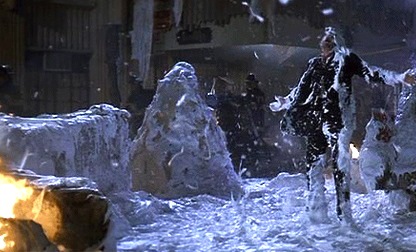
What a dessert apocalypse might look like. Image of actor William Atherton as "Walter Peck"
in the last reel of Ghostbusters. Film still © 1984 Columbia Pictures/Sony Entertainment.
On Sunday afternoon at Carnegie Hall, the always adventurous Dr. Leon Botstein led the American Symphony Orchestra in a concert marketed as Truth or Truffles. The program juxtaposed two works that stood at absolute polar opposites on the wide spectrum of 20th century musical achievement. The featured composers were Germans: Karl Amadeus Hartmann, a symphonist who defied the Nazis only to sink into obscurity, and Richard Strauss, whose two years as president of Hitler's Reichsmusikkammer remains an indelible blight on his legacy.

The program opened with the United States premiere of the 1961 composition Gesangsszene, the last (and unfinished) work by Hartmann. This is a setting for baritone and orchestra of the Jean Girodoux poem Sodom and Gomorrah, which recreates the fall of those two Biblical cities through the filter of World War II and the age of atomic anxiety.

Hartmann wrote a grim final testament. Jagged stabs of woodwind and violin filled the space between slab-like brass chords. Hartmann, who wrote eight (mostly) forgotten symphonies, was a conservative modernist, following in the orchestral tradition of Mahler and Berg. His music recalls the heavier passages of Shostakovich without the Russian composer's wit.

Friday, December 14, 2012

Concert Review: The Last Party Hats

The American Symphony Orchestra fétes John Cage.
by Paul J. Pelkonen
John Cage turned 100 this year. We celebrate with this photo of him in a hat.
Image © The Estate of John Cage.
In New York City, the year 2012 will be remembered for natural disasters, pseudo-Mayan hysteria and the cheerful mayhem caused in the city's concert and recital halls by due to the observance of the 100th birthday of John Cage.

On Friday night, Leon Botstein and the American Symphony Orchestra acknowledged the centennial of that iconoclastic American composer with The Cage Concert at Carnegie Hall. The performance, which is (as far as we know) the last major concert of the year to feature Cage's music, included the New York premieres of two late works.

Unlike some concerts which rely on this composer's vast output to stand by itself, Dr. Botstein chose to place John Cage in a context of important musical directions of the 20th century. In encyclopedic fashion, the set list covered minimalism, indeterminacy, 12-tone serial organization and a healthy sense of the absurd, before culminating in the performance of three Cage compositions.

The performance opened with the most conventional music of the night: Anton Webern's Symphony. An example of Webern's intricate 12-tone style, this two-movement ten-minute work creates spidery, delicate textures, a brush of bassoon, a short series of notes on the strings, and (most importantly) a breath of empty space between the notes, the rests themselves forming part of the work's integral fabric.

Friday, April 20, 2012

Concert Review: Celestial Mechanics

The American Symphony Orchestra plays George Crumb.
An appearance by composer George Crumb...
on a t-shirt. Image © Zazzle.com.

The American Symphony Orchestra specializes in "deep cuts": unusual pieces from outside the repertory. Occasionally, though, music director Leon Botstein focuses on contemporary American masters. At Carnegie Hall on Thursday night, Dr. Botstein presented the major orchestral works of George Crumb. The composer was in attendance.

This is unusual music, and Dr. Botstein had his players seated in an unusual configuration on the Carnegie Hall stage. Woodwinds formed a line across the front, with French horns on extreme stage left opposite a complicated percussion station. The double basses were in the back, changing the balance of sound considerably.

Dr. Crumb is best known for his quirky works for solo piano and chamber ensemble. The concert opened with his Variazioni, a work that served as the young composer's doctoral thesis at the University of Michigan. It starts with a simple, Bach-like theme that forms a tone-row, a serialist technique where notes are arranged in a manner ignoring the conventional system of scales and keys. 

This plaintive, moving theme served as a digression point for the rest of the work. At one point, the brass play a stately toccata. Strings intertwine with unusual percussion instruments, creating unearthly soundscapes. The piece ended where it began, with a reprise of the original theme. Dr. Botstein spoke briefly to the audience, and reprised the Toccata one more time.

Echoes of Time and the River shows the maturing composer experimentingfurther wih percussion. Gongs are crucial to this work, stationed on either side of the stage and carried about by musicians in a strange series of processions, either through the house or across the stage. These little parade maneuvers were announced with the ring of antique cymbals, echoed by gongs and the shake of a sistrum-like Chinese bell-tree. 

Echoes is part tone poem and part performance art, with interspersed sprechstimme texts. The brass joined the parade, forming a line across stage left, aiming the bells of their instruments squarely at the listeners, and then breathing through them, a hollow, ghostly sound familiar to anyone who has learned trombone. A little procession of wind players appeared too, gathering around a piano and playing short melodic lines as if to entertain the musician manning the keyboard. 

The orchestra was re-arranged again for Star-Child an apocalyptic oratorio-like piece that depicts a Biblical end to the world in terms familiar to listeners who know the Mahler Resurrection and the Berlioz Requiem. A rarity because of its staging challenges, this piece was originally commissioned by the New York Philharmonic during Pierre Boulez' fearlessly experimental administration.


This massive work features, in addition to a large orchestra,  small ensembles and soloists scattered about Carnegie Hall, seven trumpets (some using disposable aluminum pie plates as mutes) soprano soloist Audrey Luna, and two choral groups: the Brooklyn Youth Chorus and the men of the Collegiate Chorale.

This enormous piece begins with Music of the Spheres, a celestial drone on the strings and wind that permeates the entire 30-minute work. A dialogue began, with Ms. Luna pleading for divine mercy. She was  answered (in a manner recalling the old Peanuts® cartoons) by a trombonist using a metal mute to make his instrument sound voice-like.

The crushing second section (Musica Apocalyptica) featured the actual apocalypse in Mahlerian terms, with batteries of percussion, skittering strings and the seven spatially arranged trumpets who remained strangely silent during the Tuba Mirum. At this point, the still-silent Brooklyn Youth Chorus looked genuinely scared at the unfamiliar sonorities whirling forth from the orchestra.


The children finally sang in the last movement, another series of hymn-like calls and responses. They answered in clear, angelic voice, responding to the Latin text sung by Ms. Luna. She hit the dizzy heights required by the score, as the work swelled to a series of massive, celestial climaxes. Eventually, the drone faded into silence, and the composer rose from his box seat to receive the roar of approval from the audience.

Monday, March 19, 2012

Opera Review: Half Made-Up

The American Symphony Orchestra present Franz Schmidt's Notre Dame.
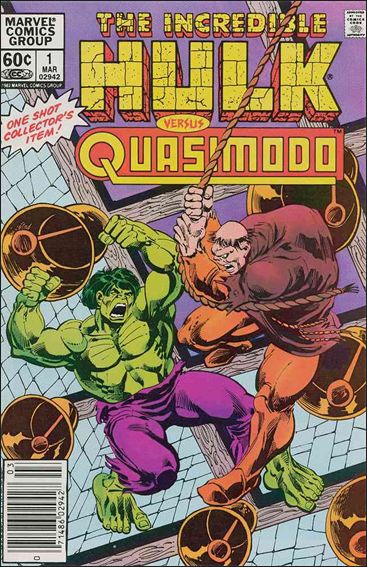
Another unlikely adaptation: The Incredible Hulk
vs. Quasimodo
. 
Art by Sal Buscema and
Steve Mitchell.© 1983 Marvel Comics Group.

In its long history, Victor Hugo's novel Notre-Dame de Paris (a.k.a. The Hunchback of Notre Dame) has been subject to many adaptations. On Sunday afternoon, Leon Botstein and the American Symphony Orchestra presented a rarely heard one: Franz Schmidt's 1914 opera Notre Dame

Schmidt (1874-1939) was an Austrian composer, the author of four powerful symphonies that are favorites with brass players. He faded into obscurity after World War II, although he has his champions: including Dr. Botstein and Austrian conductor Franz Welser-Möst. A post-Wagnerian (who played cello in the Vienna Philharmonic under the direction of Gustav Mahler) Schmidt's musical idiom falls between the brassy religiosity of Bruckner and the Viennese wit of Richard Strauss. 

The music uses leitmotifs, a series of short themes depicting Hugo's colorful characters. Traces of tambourine and minor-key Hungarian violins depict Esmerelda. Powerful brass themes  reference the bell-ringer and his master, the Archdeacon. The two acts feature three scenes each, separated by long symphonic intermezzos to cover the complex stagecraft needed for a full performance of this opera. An organ lends weight to the scene in front of the cathedral. The great bells of Notre Dame are depicted by crashing gongs at the opera's close. 

Leon Botstein managed the big forces of this opera with skill, drawing some beautiful lyric lines in the Intermezzo, the only part of this work performed with any regularity. There were some dynamic problems in the second act, with the soloists being drowned out by the waves of sound, but the last bars crashed home with stunning power. 

The opera moves the focus of Hugo's story away from Quasimodo, the hunchback, and onto Esmerelda, the innocent Gypsy girl. Here, she was played by soprano Lori Gulbeau, who has a pleasing soprano with spinto power and some flexibility. Ms. Gulbeau projected Esmerelda's deadly cocktail of sexuality and innocence, creating a moving portrayal of this compassionate character. Like a less ruthless version of Carmen, she is a force of nature, causing the downfall of all four male leads by simply existing.

The most significant of these four would-be paramours is the Arch-Deacon of Notre Dame. (Claude Frollo in the novel.) He is the very picture of religious rectitude and sexual frustration. Stephen Powell walked a fine line between piety and desparation, using his potent baritone in the prison scene to convincingly portray the deacon's capricious, ambivalent attitude toward Esmerelda. He repents at the last moment, crying for her to live as she is executed, but falls off the cathedral.

The most difficult casting requirement is a pair of heroic tenors. They're required to play Grigoire (Esmerelda's unloved Gypsy husband) and Phoebus, the young knight she falls for. requires two heldentenors for the roles of Phoebus and Gringoire. Robert Chafin moved between heroic voice and characterful, whispered singing as Grigoire. Corey Bix displayed impressive, ringing tone as Phoebus, with the right hint of metal in his voice. 

Turkish bass Burak Bilgili sang Quasimodo with a harsh,  guttural delivery, growling out the bell-ringer's part with power and authority. One sensed the hunchback's despair following the execution of Esmerelda and his subsequent murder of the Archdeacon. In this final scene, Schmidt's opera rose to the tragic heights of Victor Hugo's novel.

Trending on Superconductor

Translate

Share My Blog!

Share |

Critical Thinking in the Cheap Seats