

The ASO presents an apocalypse of...whipped cream?
by Paul J. Pelkonen
On Sunday afternoon at Carnegie Hall, the always adventurous Dr. Leon Botstein led the American Symphony Orchestra in a concert marketed as Truth or Truffles. The program juxtaposed two works that stood at absolute polar opposites on the wide spectrum of 20th century musical achievement. The featured composers were Germans: Karl Amadeus Hartmann, a symphonist who defied the Nazis only to sink into obscurity, and Richard Strauss, whose two years as president of Hitler's Reichsmusikkammer remains an indelible blight on his legacy.
The program opened with the United States premiere of the 1961 composition Gesangsszene, the last (and unfinished) work by Hartmann. This is a setting for baritone and orchestra of the Jean Girodoux poem Sodom and Gomorrah, which recreates the fall of those two Biblical cities through the filter of World War II and the age of atomic anxiety.
Hartmann wrote a grim final testament. Jagged stabs of woodwind and violin filled the space between slab-like brass chords. Hartmann, who wrote eight (mostly) forgotten symphonies, was a conservative modernist, following in the orchestral tradition of Mahler and Berg. His music recalls the heavier passages of Shostakovich without the Russian composer's wit.
by Paul J. Pelkonen
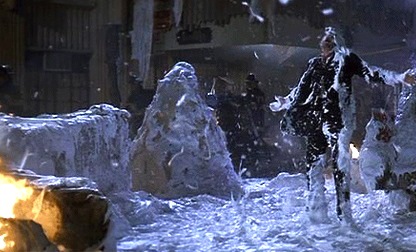 |
| What a dessert apocalypse might look like. Image of actor William Atherton as "Walter Peck" in the last reel of Ghostbusters. Film still © 1984 Columbia Pictures/Sony Entertainment. |
The program opened with the United States premiere of the 1961 composition Gesangsszene, the last (and unfinished) work by Hartmann. This is a setting for baritone and orchestra of the Jean Girodoux poem Sodom and Gomorrah, which recreates the fall of those two Biblical cities through the filter of World War II and the age of atomic anxiety.
Hartmann wrote a grim final testament. Jagged stabs of woodwind and violin filled the space between slab-like brass chords. Hartmann, who wrote eight (mostly) forgotten symphonies, was a conservative modernist, following in the orchestral tradition of Mahler and Berg. His music recalls the heavier passages of Shostakovich without the Russian composer's wit.


